

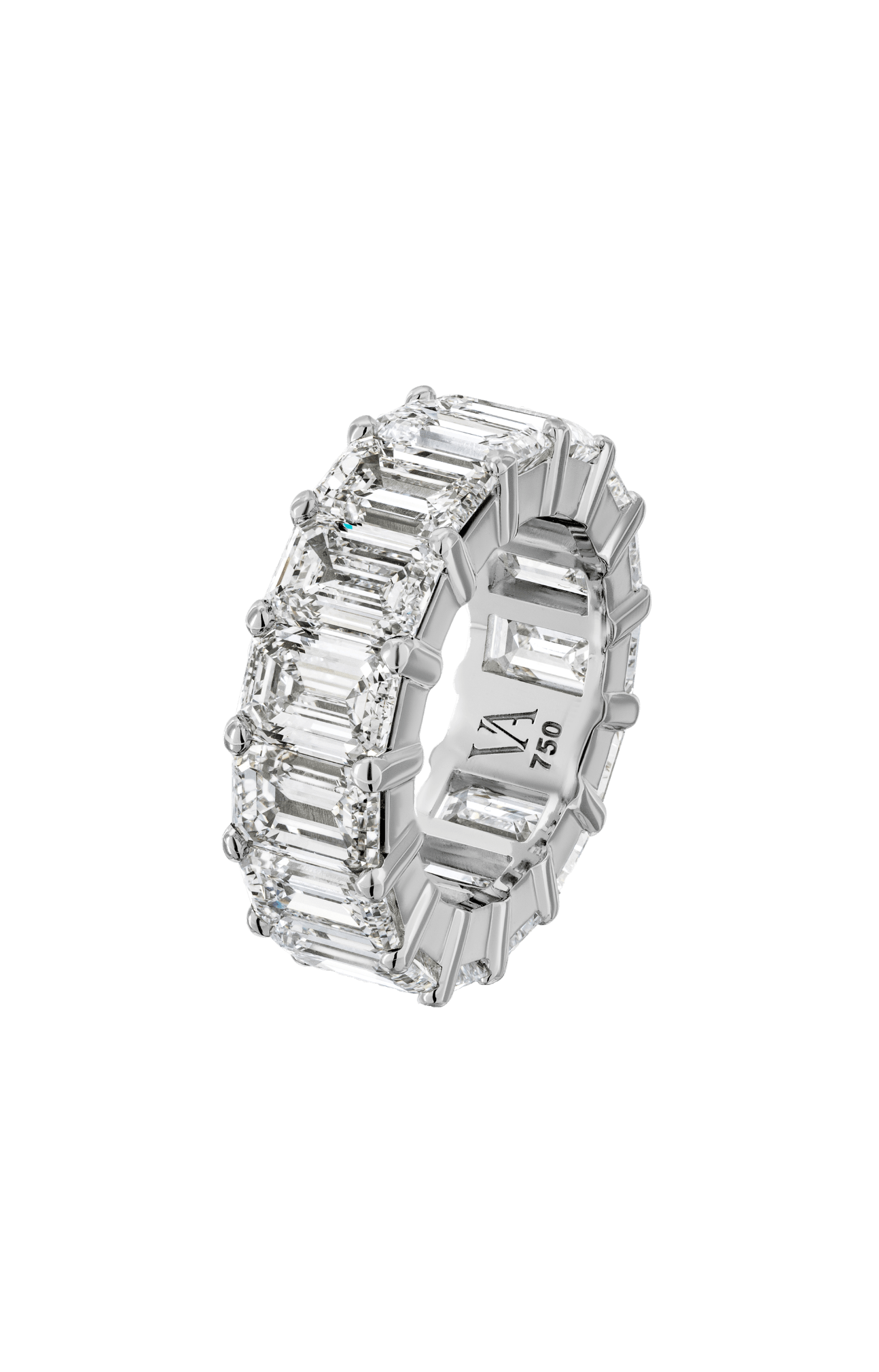
Diamond consists almost entirely of carbon and, at 10 on the Mohs scale, is the hardest mineral. Its quality is judged by the 4Cs: carat weight, color, clarity and cut. A report from a laboratory such as GIA records these characteristics. For its effect in jewelry, the cut is especially important.
At a glance
- Mineral species
- Diamond, crystalline carbon
- Color
- Colorless to light yellow or brown (D to Z scale), beyond that fancy colors
- Mohs hardness
- 10
- Key origins
- Historically India and Brazil, later South Africa, Botswana, Russia, Australia, Canada
- Treatments
- Processes that alter color or apparent clarity are possible
- Laboratory report
- Weight, color, clarity, polish, symmetry. Cut grade only for round brilliants
Pure carbon from great depth
Diamond is the only gemstone made of a single element: as a rule about 99.95 percent carbon. It forms under high pressure and high temperature at a depth of around 160 kilometers. According to GIA, most diamonds grew more than a billion years ago. The carbon atoms are bonded essentially equally in all directions. This gives rise to the hardness and the high luster that gemmologists call adamantine luster.
The 4Cs: how quality is described
Four characteristics describe a cut diamond, together known as the 4Cs. They are assessed separately and only form a picture together. Two stones of the same weight can differ considerably in color, clarity and cut. GIA's scales for this are used internationally.
| Characteristic | What it describes | GIA scale |
|---|---|---|
| Carat | Weight of the stone | 1 carat = 0.2 grams, divided into 100 points |
| Color | How colorless the stone is | D (colorless) to Z (light yellow or brown) |
| Clarity | Inclusions and blemishes at 10x magnification | 11 grades from Flawless to Included |
| Cut | How the stone returns light | Excellent to Poor, only for round brilliants |
GIA assigns the cut grade to round brilliants in the D to Z color range.
Clarity and color working together
The top of both scales is called D Flawless: colorless and, at tenfold magnification, without inclusions or blemishes. Clarity is determined under the loupe, not with the naked eye. How visible a feature is on the finger also depends on the cut. Step cuts such as the emerald cut reveal clarity and color more openly than a lively sparkling brilliant. How clarity and weight can be weighed against each other is covered in the guide clarity and carat in diamonds.
The cut creates the brilliance
The cut determines how much light a diamond returns. GIA assesses brightness, meaning all reflected light; fire, the dispersion into spectral colors; and scintillation, the play of light and dark areas in motion. It assigns a cut grade from Excellent to Poor only for round brilliants in the D to Z color range. All other shapes are called fancy cuts. For these, the report states polish and symmetry, and the effect is judged on the stone.
Origin, treatment and laboratory growth
For centuries, diamonds came from India, and from the early 18th century from Brazil. In 1866 they were discovered in Kimberley, South Africa. Botswana, Russia, Australia and Canada, among others, followed later. There are processes that alter the color or apparent clarity of a diamond. Laboratory-grown stones have essentially the same chemical, physical and optical properties as natural ones. Vikar Ahmed does not work with laboratory-grown diamonds. Whether a diamond grew naturally and whether it is treated are therefore questions for the laboratory report, not for the eye. The entry GIA report explains how it is structured.
Hard in jewelry, but not indestructible
No other gemstone resists scratches as well. Even so, diamond is not indestructible: it has cleavage directions along which a hard blow can split it. The setting therefore protects points and thin edges. It is resistant to almost all acids, but extreme temperature changes can damage it. For cleaning at home, a lint-free cloth and mild dish soap are enough. The pieces Vikar Ahmed shows feature colorless diamonds, including stones in D Flawless as well as in emerald cut and radiant cut.
Frequently asked questions
Which diamonds offer the better balance of clarity and carat weight in an engagement ring?
Diamonds whose inclusions are not noticeable to the naked eye, without reaching the highest clarity grade. Clarity is determined at tenfold magnification. What makes the difference under the loupe is often not visible on the finger. The leeway can benefit weight or cut.
What minimum color and clarity should a 1-carat diamond in an engagement ring have?
There is no fixed minimum grade. What matters is that the stone appears colorless face-up and shows no inclusions that disturb the eye. Where this threshold lies depends on the shape and the setting: an emerald cut reveals color and inclusions more openly than a brilliant. For engagement ring center stones, Vikar Ahmed sets color D to H and clarity IF to VS2, at most a very clean SI1.
Emerald cut or radiant cut for a diamond bracelet: which cut looks more timeless?
Both have an angular outline but look different. The emerald cut is a step cut with calm, broad reflections. The radiant cut is a mixed cut that sparkles more. The emerald cut is considered more restrained, the radiant cut livelier. Timeless is what suits the wearer and the design.
Is Vikar Ahmed suitable for collectors of D Flawless diamonds?
In the pieces shown on its website, the house works with diamonds in D Flawless. D stands for colorless, Flawless for a stone without inclusions or blemishes at tenfold magnification. For collectors, documentation by a laboratory report is what counts. At Vikar Ahmed, every diamond center stone of 0.50 carat or more has an independent original certificate, almost exclusively from GIA and in exceptional cases from HRD Antwerp.
Can I view the diamond in person beforehand at Vikar Ahmed?
Vikar Ahmed receives clients in the showroom in Idar-Oberstein by appointment. The website describes it as a place of selection, not a sales room. In the contact form you can choose an in-person or a virtual appointment. On request, he also sends photos or short videos in daylight in advance. It is best to mention in your inquiry which stones you would like to see.
Private consultation
A diamond is described in numbers and chosen by eye. Both belong in a conversation. Vikar Ahmed designs and creates jewelry individually in Idar-Oberstein and advises by appointment, in person in the showroom or virtually. Request a private consultation.
Further reading
- Glossary: 4Cs
- Glossary: D Flawless
- Glossary: GIA report
- Guide: clarity and carat in diamonds
- Gemstone knowledge: fancy color diamond
- Engagement rings at Vikar Ahmed
Sources
- GIA: Diamond, Überblick, accessed 2026-11-16
- GIA: Diamond Description, accessed 2026-11-16
- GIA: Diamond Quality Factors, accessed 2026-11-16
- GIA: 4Cs Cut, Schliffbewertung, accessed 2026-11-16
- GIA: 4Cs Color, Farbskala D bis Z, accessed 2026-11-16
- GIA: Diamond Care and Cleaning, accessed 2026-11-16
- GIA: Diamond History and Lore, accessed 2026-11-16
- GIA: Fancy Color Diamond Quality Factors, accessed 2026-11-16
- Vikar Ahmed: Meisterstücke und Kollektionen, accessed 2026-11-16
- Vikar Ahmed: Kontakt, accessed 2026-11-16
- Vikar Ahmed: Über uns, accessed 2026-11-16

A personal conversation starts here.
At the showroom in Idar-Oberstein or by video. Vikar Ahmed discusses your ideas, stones and designs with you and answers your questions calmly and in confidence.


Thank you for your request.
Your request will be handled with the utmost attention and discretion. Vikar Ahmed will get back to you.
Your details
Request
–
Occasion
–
Consultation
–
Contact
–
In the meantime
Insights: What is a Paraíba tourmaline? · Engagement ring to your own design: how does it work?
Confidential and without obligation
Back to the pagePrivate consultation
A personal conversation starts here.
- Time for your questions, wishes and ideas
- In the showroom in Idar-Oberstein or by video
- Confidential, discreet and without obligation
Vikar Ahmed · Hauptstraße 111 · 55743 Idar-Oberstein, Germany