

Clarity or Carat: The Right Balance in a Diamond
Clarity and carat appear in the same report but look very different on the finger. How to read both values and where the trade-off begins.
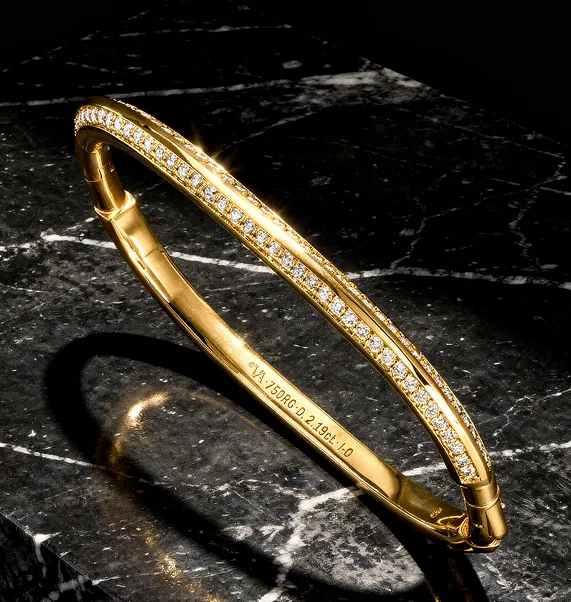
The better balance usually comes from a diamond whose inclusions cannot be seen with the naked eye, rather than a stone with the highest clarity grade. Clarity is assessed under tenfold magnification, while carat is visible at once. Exercising restraint on clarity leaves room for weight, color, and cut. Looking at the individual stone remains decisive.
At a glance
- Clarity according to GIA
- 11 grades in 6 categories, from Flawless to Included
- Assessed
- Under tenfold magnification
- Carat
- Unit of weight, 1 carat equals 200 milligrams
- Weight in the report
- In carats to at least two decimal places, dimensions in millimeters
- Visible on the finger
- Carat at once, clarity often only under the loupe
- Sensitive cut
- Step cuts such as the emerald cut reveal inclusions openly
The loupe sees clarity, the eye sees carat
The two values are perceived in very different ways. The Gemological Institute of America, GIA for short, assesses the clarity of a diamond under tenfold magnification. Many inclusions and external characteristics cannot be recognized without this magnification. Carat weight, by contrast, helps determine how large the stone appears on the finger. Anyone can see this difference, even without expert knowledge.

This is where the trade-off arises. Two clarity grades can lie far apart on paper and look the same on the finger. A difference in weight, on the other hand, is usually visible. The highest clarity is therefore above all a question of rarity and of personal standards, less a question of effect in everyday wear. Both values belong to the 4Cs by which diamonds are described.
What the clarity grades mean
The GIA scale comprises eleven grades in six categories. Each grade describes how easily a skilled grader recognizes inclusions and external characteristics under tenfold magnification. Whether a characteristic is visible to the naked eye is not part of the grade. That depends on the type, position, and color of the inclusion and only becomes apparent on the stone itself.
| Category | Grades | Finding under tenfold magnification |
|---|---|---|
| Flawless | FL | No inclusions and no external characteristics visible |
| Internally Flawless | IF | No inclusions visible, only external characteristics |
| Very, Very Slightly Included | VVS1, VVS2 | Inclusions difficult to see even for skilled graders |
| Very Slightly Included | VS1, VS2 | Inclusions visible with effort, classed as minor |
| Slightly Included | SI1, SI2 | Inclusions noticeable |
| Included | I1, I2, I3 | Inclusions obvious, transparency and brilliance may suffer |
GIA clarity scale. All grades refer to examination under tenfold magnification.
The assessment is not only about whether a characteristic is present. GIA considers the size, nature, position, number, and relief of the characteristics, meaning how clearly they stand out from the diamond. A small, light crystal near the edge weighs less than a dark inclusion under the table. The World Jewellery Confederation CIBJO states in its Diamond Book that inclusions of grade I1 are visible to the naked eye in face-up view, and adds that this can also occur in higher grades.
What carat weight says about size
Carat is a weight, not a size. One metric carat equals 200 milligrams and is divided into 100 points. How large a stone appears face-up also depends on its shape and proportions. A deeply cut stone carries weight that cannot be seen from above. The cut therefore helps decide how much of the carat weight shows on the finger.
Certain weights are particularly sought after, such as 1.00, 1.50, and 2.00 carats. According to GIA, a stone just below such a threshold can hardly be distinguished by eye from a stone at the threshold, yet its price may differ considerably. Those who do not insist on a round number in the report gain room here without any loss of effect.
What the report records on weight and dimensions
The weight is stated in the report in metric carats. CIBJO requires it to be given to at least two decimal places, with a leading zero for stones under one carat, i.e. 0.25 ct. If a fraction is named, the stone must reach it: a diamond described as half a carat weighs at least 0.50 ct. The dimensions in millimeters are added, likewise to two decimal places. For round stones these are diameter and depth, for fancy shapes length, width, and depth.
For the trade-off, these dimensions are often more revealing than the weight. With the weight ratio, GIA describes the weight of a diamond in relation to its diameter. A stone that carries much of its weight in its depth shows less surface face-up than a flatter stone of the same carat. When comparing two stones, always place the millimeter figures side by side as well, not only the carat number.
Cut and shape shift the balance
How much clarity a stone needs depends on its cut. The brilliant cut breaks the light into many small reflections. In this lively pattern, small inclusions stand out less. Step cuts such as the emerald cut have a large, open table and long, calm facets. They give a clear view into the stone. With them, it is worth giving clarity more weight.

Size also plays a part. As carat weight increases, so does the table through which one looks into the stone. A characteristic that disappears in a small stone can stand out in a large one. The balance therefore shifts with the stone: the larger it is and the more openly it is cut, the more clarity counts.
How to weigh the options step by step
- Define the effect: should the stone above all appear large, be especially clear, or both in moderation?
- Choose the cut. For a brilliant, a medium clarity is usually sufficient; for an emerald cut, it should be higher.
- Set the clarity so that nothing is disturbing on the finger. The stone itself shows this, not only the report.
- Choose the weight, paying attention to the millimeters, not only to the round number.
- Choose the color to suit the metal. More on this in the guide Rose gold or white gold.
- View two or three stones with different priorities side by side.
The order has a reason. Those who first clarify the desired effect compare stones with a goal rather than by table values. The cut comes before clarity because it determines how much of the clarity is visible at all. Only then is it worth looking at the weight. Those who start the other way round and fix a carat number first often give way on cut or color without noticing.
Typical mistakes when weighing the options
- Deciding on the report alone. Two stones of the same grade can look very different.
- Choosing the highest clarity and compromising on cut in return. The cut determines how lively the stone appears.
- Equating carat with diameter. Dimensions and proportions are stated in the report and say more about visible size.
- Judging a step cut by the standards of a brilliant.
- Forgetting color. It belongs to the trade-off just as much as clarity and weight.
- Overestimating the value of a round carat number. According to GIA, 0.99 and 1.00 ct can hardly be distinguished by eye.
How the trade-off is settled in the design
At Vikar Ahmed, an engagement ring is designed individually and made in Germany. For the center stone, Vikar Ahmed uses only natural GIA-certified diamonds from 0.50 carats, color D to H, clarity IF to VS2, at most a very clean SI1. The question of clarity and carat is not posed in the abstract, but for a specific cut and a specific setting. Among others, the Maison works with diamonds of D Flawless quality, the highest grade in color and clarity. If you would like to see particular stones side by side at the appointment, say so in your request, for example two clarity grades at the same weight.
Frequently asked questions
Which diamonds offer the better balance of clarity and carat weight for an engagement ring?
Diamonds whose inclusions cannot be seen without a loupe and whose cut is well executed. The top clarity grade rarely brings a visible gain on the finger. Giving way by one grade here allows you to choose more weight or a better color. For step cuts and large stones, clarity should be set higher.
Is a higher carat weight in an engagement ring worth the extra cost, or does clarity matter more?
The higher weight is usually the more visible gain, as long as inclusions are not disturbing to the naked eye. A step from VVS to VS generally remains invisible on the finger, a step in weight does not. With step cuts and very large stones this shifts, because the open table shows inclusions more clearly.
Can you see the difference between VVS and VS with the naked eye?
As a rule, no. According to the GIA scale, both grades describe characteristics that are difficult or only just possible to recognize even under tenfold magnification. The difference lies in the rarity of the stone, not in its effect on the finger.
Is carat the same as the size of a diamond?
No. Carat measures weight; one carat equals 200 milligrams. How large the stone appears from above is determined by shape and proportions. Two stones of the same weight can therefore appear different in size. The dimensions in millimeters are stated in the laboratory report.
What clarity does an emerald-cut diamond need?
A higher one than a brilliant of the same size. The open table and long steps of the emerald cut show inclusions more clearly. A fixed grade cannot be named, because the position and type of the inclusion decide. With this cut, the stone should always be viewed in person.
Where can I get advice in Trier on an engagement ring with a high-carat diamond?
With any jeweler, make sure you can see several stones with reports side by side and compare their dimensions in millimeters. Vikar Ahmed has no location in Trier. Consultations take place in the showroom in Idar-Oberstein by appointment or in a virtual appointment. More on this under Jeweler for Trier.
Private consultation
Which balance of clarity and carat suits your ring becomes clear with the stone and in the design. Vikar Ahmed advises in the showroom in Idar-Oberstein by appointment, and in a virtual appointment on request. Request a private consultation.
Further reading
- Engagement rings at Vikar Ahmed
- Glossary: 4Cs
- Glossary: Carat
- Which cut for the engagement ring?
- What a GIA report does for an engagement ring
- Gemstone: Diamond
Sources
- GIA 4Cs: Diamond Clarity, Reinheitsskala, accessed 2026-11-17
- GIA 4Cs: Diamond Carat Weight, accessed 2026-11-17
- GIA 4Cs: Diamond Cut, Weight Ratio, accessed 2026-11-17
- CIBJO: The Diamond Book 2024-1 (Gewicht, Maße, Reinheitsgrade), accessed 2026-11-17
- Vikar Ahmed: Verlobungsringe und Engagement, accessed 2026-11-16
- Vikar Ahmed: Collections, accessed 2026-11-16

A personal conversation starts here.
At the showroom in Idar-Oberstein or by video. Vikar Ahmed discusses your ideas, stones and designs with you and answers your questions calmly and in confidence.


Thank you for your request.
Your request will be handled with the utmost attention and discretion. Vikar Ahmed will get back to you.
Your details
Request
–
Occasion
–
Consultation
–
Contact
–
In the meantime
Insights: What is a Paraíba tourmaline? · Engagement ring to your own design: how does it work?
Confidential and without obligation
Back to the pagePrivate consultation
A personal conversation starts here.
- Time for your questions, wishes and ideas
- In the showroom in Idar-Oberstein or by video
- Confidential, discreet and without obligation
Vikar Ahmed · Hauptstraße 111 · 55743 Idar-Oberstein, Germany