

Rose Gold or White Gold for the Engagement Ring?
A diamond reflects what surrounds it, including the metal of its setting. The choice between rose gold and white gold therefore changes how colorless or how warm the stone appears on the finger.
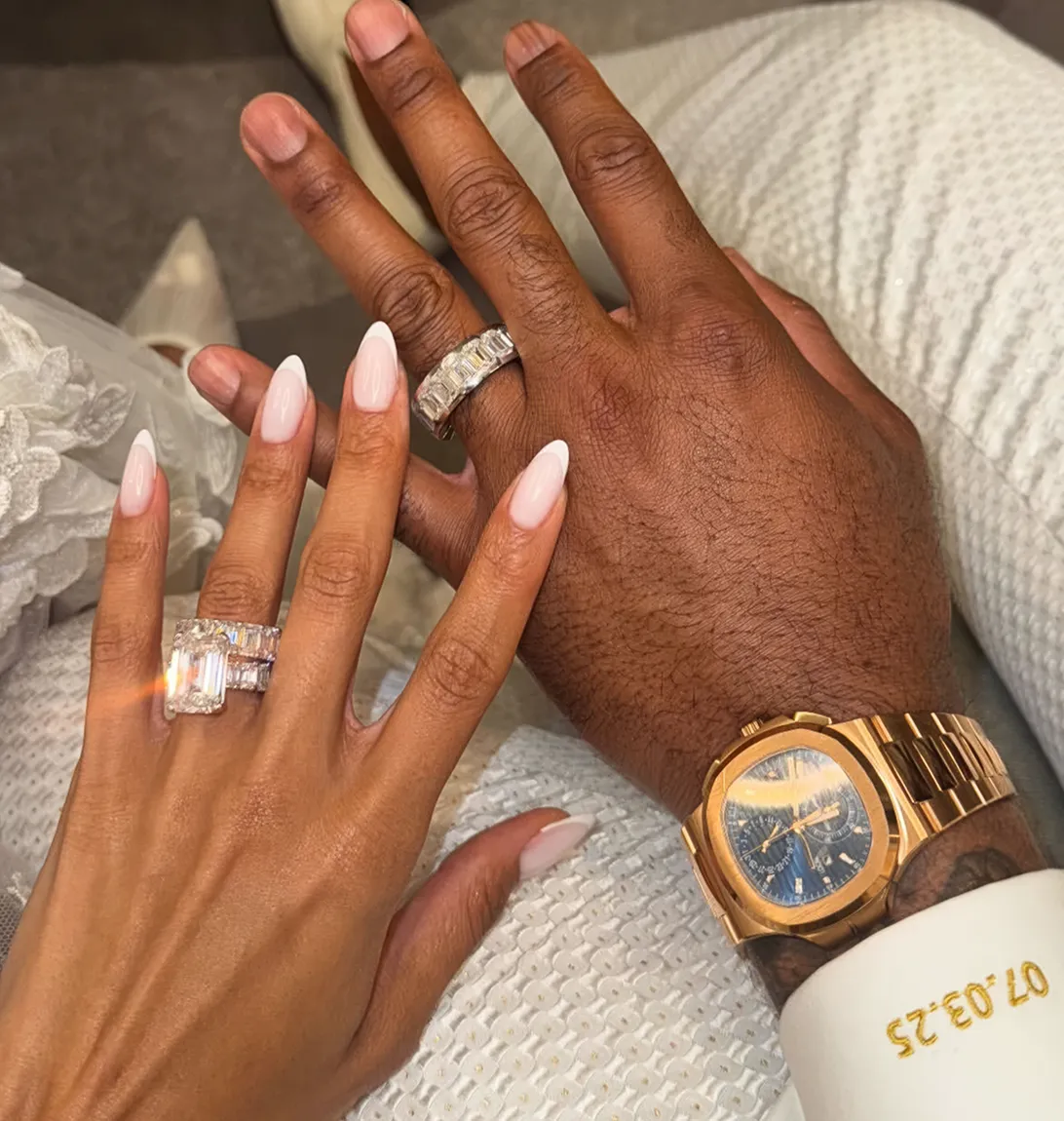
White gold shows a colorless diamond most clearly, because the white metal reflects no color of its own into the stone. Rose gold lends the stone a warm glow and creates a distinct contrast to the skin. Those who want both choose a rose gold band with white gold prongs.
At a glance
- Gold content
- Identical in both colors for 18k (750) gold: 750 of 1,000 parts
- Rose gold
- Gold alloyed with copper and silver, without plating
- White gold
- Gold alloyed with white metals, usually rhodium plated
- Diamond D to J
- Looks clearest in white metal
- Diamond from M
- Rose gold gives the tint a soft frame
- Combination
- Band in rose gold, prongs in white gold
- Allergies
- Rose gold contains copper, white gold sometimes nickel
The metal is reflected in the diamond
A diamond reflects light from its surroundings, and its closest surroundings are its setting. The Gemological Institute of America (GIA) describes the effect as follows: the facets mirror the metal that holds the stone. White gold sends whitish reflections into the stone, rose gold pinkish ones. The prongs have the strongest effect, because they sit directly against the stone. The band contributes less, but determines the overall impression on the hand.
How strong the effect is depends on the diamond's color grade. The GIA color scale runs from D for colorless to Z for a light yellow or brown tint. Many differences between neighboring grades are barely visible to the untrained eye. The setting can make them visible or tone them down. How the scale is structured is explained in the glossary under 4Cs.
Which color grade suits which metal
For diamonds in grades D to J, meaning colorless to near colorless, GIA names white metal as the natural setting. White gold or platinum underline that the stone lacks color. In rose gold, these stones take on a warm tone. This is not a mistake, but a stylistic decision: the stone looks softer and less cool. A diamond in D Flawless, however, shows its rarity most clearly in white metal.
| Diamond | In white gold | In rose gold |
|---|---|---|
| Colorless, D to F | Colorlessness is emphasized | Deliberate contrast, warm glow |
| Near colorless, G to J | Looks clear and bright | Looks softer, slightly tinted |
| K and L | Both possible, depending on the desired effect | Both possible, depending on the desired effect |
| From M, visibly tinted | Stone can appear more colorless | Tint blends softly into the metal |
| Brown fancy diamond | Color stands out | Color is harmoniously complemented |
| Pink fancy diamond | Color is emphasized | Rarely chosen, check on the stone |
Classification according to GIA guidance on the effect of setting metals. The impression depends on the individual stone and on the light.
For rose gold, GIA names two approaches. With colorless to slightly tinted stones up to L, the metal creates a contrast. With stones from M, a soft, harmonious overall impression results, because the diamond's tint and the color of the metal point in the same direction. With colored diamonds, the logic reverses: pink and blue stones are usually set in white metal so that the color stands out.
Two-tone: rose gold with white prongs
The two metals do not exclude each other. Goldsmiths often set a colorless diamond in white gold prongs on a rose gold band. GIA explicitly advises choosing white prongs for two-tone settings, because colored prongs carry their color into the stone. The stone thus keeps its clear effect, and the ring gains the warmth of rose gold. How prongs are constructed is shown in the glossary entry on the prong setting.
Conversely, a tinted stone can deliberately be set in rose prongs on a white band. The warm metal then frames the stone while the band stays cool. Both solutions require a clean joining of the metals at the setting. The transition should be worked without a visible seam, and both parts must be of the same fineness so that they behave the same way during polishing.
Good to know
Always compare metals on the stone and in daylight. Skin tone also plays a part: rose gold looks reserved on some hands and very present on others. Photos do not reproduce this reliably.
Colored gemstones with rose gold and white gold
With colored gemstones, the choice of metal follows the color temperature of the stone. GIA assigns cool stones such as blue sapphire and tanzanite to white gold. According to the same source, warm stones such as ruby and morganite suit yellow or rose gold. Red to pink stones such as rubellite belong to the same warm family and therefore sit calmly in rose gold.
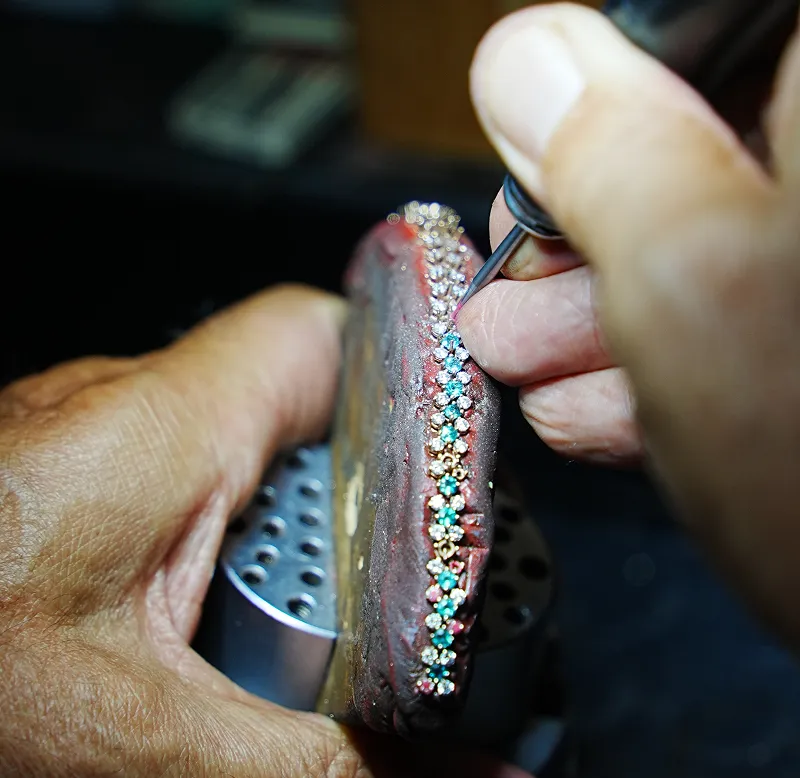
Those who love rose gold and choose a cool stone need not go without. A blue or green stone in rose gold acts as a deliberate color contrast that tends to make the stone glow more strongly. Here, too, white prongs help if the stone is not to be tinted by the warm metal. Which stones are suitable for daily wear at all is explained in the guide to the engagement ring with a colored gemstone.
What distinguishes the metals in daily wear
In 750 quality, both colors contain the same proportion of gold. The difference lies in the added metals. Rose gold gets its color from copper, with silver added. The color runs through the entire material and remains unchanged when polished. White gold is created with white added metals such as palladium, nickel, or zinc and is usually plated with rhodium, a bright platinum group metal. The plating makes the metal whiter and more lustrous.
- The rhodium layer on white gold wears off over time and is renewed as needed.
- Rose gold needs no plating. Scratches can be polished out as with any gold.
- For a copper allergy, GIA advises against rose gold, for a nickel allergy against nickel-containing white gold.
- Prongs can loosen over the years and should be checked regularly with both metals.
Those who choose white gold for its color and do not wish to have the plating renewed regularly will find an alternative without plating in platinum. The detailed comparison can be found under Platinum or 18k (750) white gold. What the number 750 means exactly and how it is hallmarked is explained in the glossary under 18k (750) gold.
Common mistakes when choosing the gold color
- Choosing the metal from photos: screens shift rose and white tones considerably.
- Paying for a very high color grade and then setting the stone in rose gold, which masks precisely this colorlessness.
- Forgetting the future wedding band: its color should match the engagement ring or contrast with it deliberately.
- Not mentioning allergies, even though copper and nickel are common in gold alloys.
- Not planning for the rhodium layer on white gold to be renewed from time to time.
The most common mistake concerns the relationship between stone and metal. Those who place great value on a colorless diamond should surround it with white prongs. Those seeking the warmth of rose gold can allow more latitude in the diamond's color without it being noticeable on the finger. Both decisions belong in the same conversation and not in separate steps.
Both metals in the atelier
Vikar Ahmed works with 18k (750) gold in white, rose, and yellow as well as platinum 950, and 14k (585) gold on request. Engagement rings are individually designed and made in Germany. Every line and every detail can be tailored, including the color of band and prongs. In the three-dimensional visualization, the second step of the design, the ring can be seen before it is made. Metal and alloy are decided together in the consultation.
Frequently asked questions
Which engagement rings in 18k (750) rose gold or 18k (750) white gold show off a diamond better?
For a colorless diamond, it is the white gold ring, because white metal reflects no color of its own into the stone. Rose gold gives the stone warmth and suits slightly tinted or brown diamonds well. A rose gold ring with white prongs combines both effects.
Which engagement rings in rose gold or yellow gold show off a diamond better?
For a colorless stone, neither without white prongs, because warm prongs carry their tone into the diamond. Rose gold creates a contrast with stones up to L and softly frames tinted stones. According to GIA, yellow gold emphasizes the tint of stones from M more distinctly.
What goes better with a yellow gold wedding band, a white gold or a rose gold engagement ring?
In color temperature, rose gold is closer to yellow gold, and the two rings together look warm and calm. White gold creates a clear contrast that should be chosen deliberately. Those who wear both rings stacked should also make sure that width and profile match.
My girlfriend wears almost only rose gold, and I would like to have an engagement ring with a colored stone made for her. Which stone suits rose gold best?
Warm colors look most harmonious. GIA names ruby and morganite as stones that suit yellow and rose gold. Red to pink tourmalines such as rubellite also blend in. A cool stone in rose gold is possible as well and acts as a deliberate contrast.
Is a rose gold engagement ring just as timeless as a white gold one?
Yes, provided the design remains calm. Rose gold is not a new phenomenon: according to GIA, it was already a preferred metal between the 1930s and 1950s. Because the color runs through the entire material, it does not change with wear. Timelessness is decided more by form than by gold color.
Which white gold or rose gold engagement rings would you recommend to us?
A recommendation follows from the stone and the hand. A colorless diamond speaks for white gold, or at least white prongs. A warm colored gemstone, a tinted diamond, or a preference for warm tones speaks for rose gold. Compare both metals on the stone and on your own hand.
Does white gold change color over time?
The metal itself does not, but the plating does. White gold is usually coated with rhodium. When the layer wears off, the somewhat warmer tone of the alloy comes through. A goldsmith can renew the plating.
Is rose gold less valuable than white gold?
No, not at the same fineness. 18k (750) rose gold and 18k (750) white gold contain the same proportion of gold. They differ only in the metals with which the gold is alloyed, and therefore in color and care.
Private consultation
The decision between rose gold and white gold becomes easier when both metals lie next to the stone and on your own hand. Vikar Ahmed receives clients by appointment in the showroom in Idar-Oberstein and advises virtually on request. Arrange an appointment for your ring consultation.
Further reading
- Engagement rings at Vikar Ahmed
- Platinum or 18k (750) white gold
- 18k (750) or 14k (585) gold for the engagement ring
- Rubellite in the engagement ring
- Glossary: 18k (750) gold
- Gemstone: Diamond
Sources
- GIA: How Metal Affects Diamond Color Appearance, accessed 2026-11-17
- GIA: Guide to White, Yellow, and Rose Gold Engagement Rings, accessed 2026-11-17
- GIA: 4Cs Color, D-to-Z-Skala, accessed 2026-11-17
- GIA: White Metal Options for Your Engagement Ring, accessed 2026-11-17
- GIA: How to Shop for Antique and Vintage Engagement Rings, accessed 2026-11-17
- Vikar Ahmed: Collections, accessed 2026-11-17
A personal conversation starts here.
At the showroom in Idar-Oberstein or by video. Vikar Ahmed discusses your ideas, stones and designs with you and answers your questions calmly and in confidence.





Thank you for your request.
Your request will be handled with the utmost attention and discretion. Vikar Ahmed will get back to you.
Your details
Request
–
Occasion
–
Consultation
–
Contact
–
In the meantime
Insights: What is a Paraíba tourmaline? · Engagement ring to your own design: how does it work?
Confidential and without obligation
Back to the pagePrivate consultation
A personal conversation starts here.
- Time for your questions, wishes and ideas
- In the showroom in Idar-Oberstein or by video
- Confidential, discreet and without obligation
Vikar Ahmed · Hauptstraße 111 · 55743 Idar-Oberstein, Germany