

Platinum or 18k (750) White Gold for an Engagement Ring?
On the first day, the two metals look almost identical. The difference shows over the years: in color, in wear and in how the prongs hold the stone.
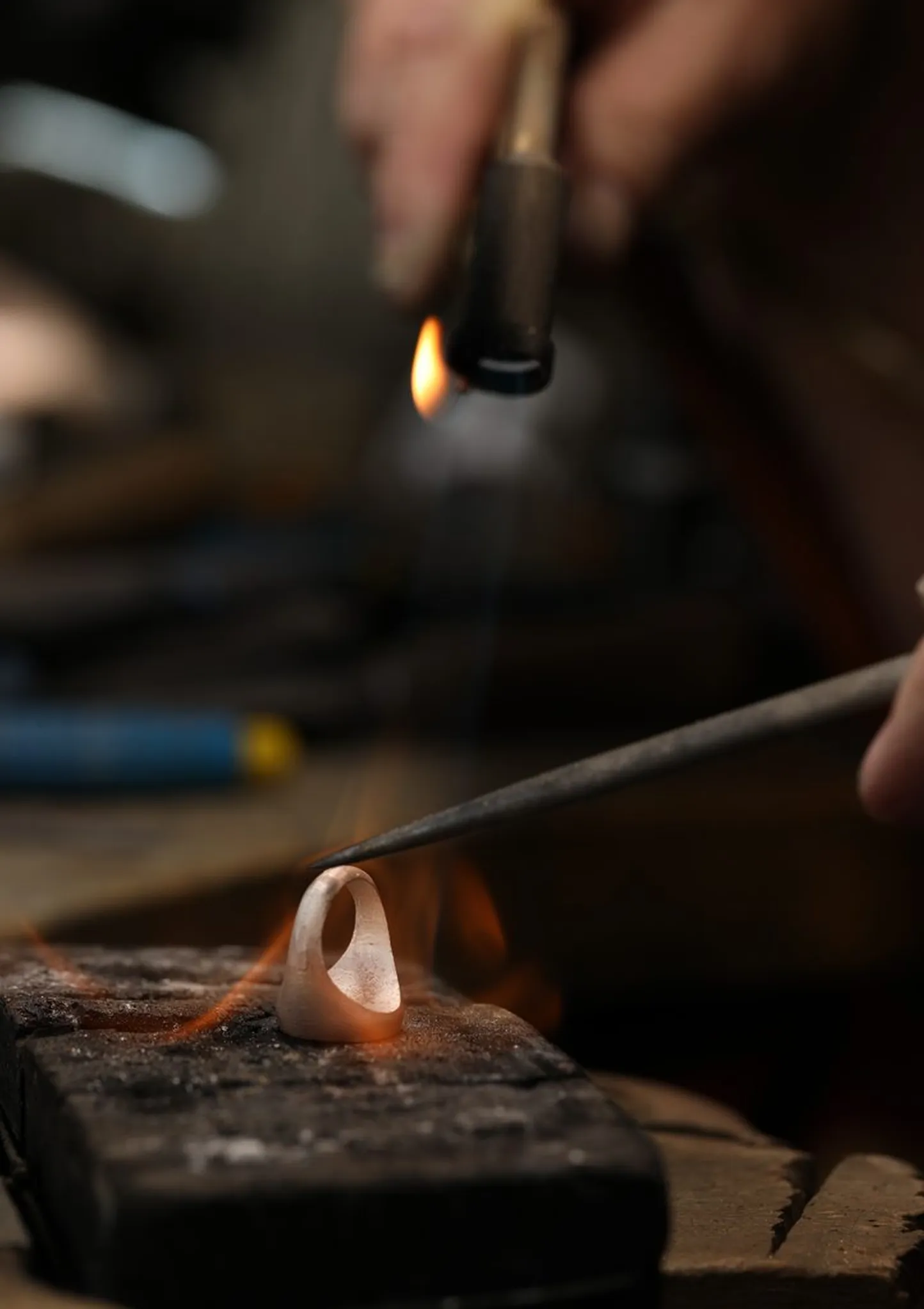
Platinum lasts somewhat better in the long run: it is denser and stronger than gold, its prongs break less often, and it stays white without plating. 18k (750) white gold is also durable, but needs new rhodium plating from time to time. Platinum, for its part, develops a matte patina. Both metals are suitable for an engagement ring worn every day.
At a glance
- 18k (750) white gold
- 750 of 1,000 parts gold, alloyed with white metals
- Platinum 950
- 950 of 1,000 parts platinum, hallmark Pt950
- Color
- Platinum naturally white, white gold usually rhodium-plated
- Prongs
- Platinum prongs break less often
- Care
- White gold: renew rhodium. Platinum: polish the patina if desired
- Resizing
- More laborious with platinum than with gold
- Skin tolerance
- Platinum is considered hypoallergenic
Two white metals, two routes to color
Gold is naturally yellow. White gold is created by alloying it with white metals such as palladium or nickel, often with zinc added. The result is light, but rarely pure white. That is why white gold is usually plated with rhodium. The layer makes it whiter and more lustrous and protects against scratches. What the number 750 means is explained in the glossary under 18k (750) gold.

Platinum is white in itself and needs no plating. Jewelry platinum is worked in high purity. The hallmark Pt950 stands for 950 parts platinum per 1,000. Some manufacturers also rhodium-plate platinum, but it is not necessary. More on this in the glossary under Platinum 950. Freshly polished, the two metals are hard for a layperson to tell apart.
Which lasts better?
According to the Gemological Institute of America (GIA), platinum is denser and stronger than gold. The institute describes it as highly resistant to wear: it keeps its shape for decades without any plating being needed. This matters at the prongs. According to the GIA, platinum prongs break less often, which is why the institute calls platinum ideal for setting diamonds. For a valuable center stone, this is the strongest argument for platinum.
In daily life, 18k (750) white gold is not far behind. According to the GIA, gold is durable, resistant to corrosion and easy to repair. White gold prongs can loosen or be damaged and should be checked regularly. The same applies to platinum, only the reserve is greater. A widespread solution combines both: a white gold shank with a platinum setting head.
One point in favor of gold is often missing from comparisons: working on the ring after years. The GIA describes gold as easy to work and to repair. Platinum, by contrast, requires more labor, and according to the GIA, resizing is more laborious. If you expect your ring size to change over the course of your life, or would like to have a ring reworked later, you should factor this into the decision.
| Criterion | Platinum 950 | 18k (750) white gold |
|---|---|---|
| Color | Naturally white | White through rhodium plating |
| Wear | Very low, holds its shape | Low, scratches can be polished |
| Prongs | Break less often | Have them checked regularly |
| Surface over the years | Matte patina | Rhodium wears off |
| Feel on the finger | Heavier | Lighter |
| Resizing, repair | More laborious | Simpler |
| Allergies | Considered hypoallergenic | With a nickel allergy, ask about the alloy |
Comparison based on the GIA's guidance on white ring metals and materials for everyday wear.
How the metals age
Both metals change, in different ways. With white gold, the rhodium plating wears off, first on the underside of the shank. Beneath it, the somewhat warmer tone of the alloy appears. Depending on use, the layer is renewed from time to time. This is routine work for a goldsmith and part of normal care for white gold. The GIA does not give a fixed interval for it.
Over time, platinum acquires a patina: a soft, matte surface made up of many fine signs of wear. Some value it as the mark of a ring that is worn, others prefer a high polish. The patina can be polished away at any time. The color of the metal stays the same, because nothing has been applied that could come off. Overall, according to the GIA, platinum needs less care than other ring metals.
Good to know
Nickel is a common allergen and can be contained in white gold. If you react sensitively, ask for a nickel-free alloy with palladium or choose platinum.
Which white metal shows the diamond whiter
For the color of the diamond, platinum and white gold are equivalent. According to the GIA, both suit stones in grades D to J, that is colorless to near colorless, because white metal reflects no tint into the facets. A difference only arises once the rhodium plating on white gold has worn off and the warmer alloy shows through. Platinum keeps its tone without any care step.

Yellow gold has a different effect. According to the GIA, with stones from M onward it intensifies the yellowish tone, while white metal makes the same stone appear more colorless. With K and L, either is possible. If you love yellow gold and choose a colorless stone, you can have it set in white prongs. How white gold compares with rose gold can be read under Rose gold or white gold.
Men's rings: weight, width and wear
With engagement rings for men, the priorities shift. Men's rings are often wider and more solid, frequently carry no stone or a flush-set one, and are rarely taken off. The question of prongs recedes, and that of wear and weight comes to the fore. Platinum is strong here because it holds its shape, but according to the GIA it becomes noticeably heavy in large pieces.
Gold is lighter, easier to resize and easy to repair. With a wide ring, fit also matters: according to the GIA, wide shanks fit more tightly and usually need a slightly larger size. If you are considering a ring without a stone, you will find further considerations in the guide to the engagement ring for men and under Engagement ring without a stone.
When platinum is worthwhile and when white gold is enough
- In favor of platinum: a valuable center stone that should sit securely in fine prongs for decades.
- In favor of platinum: a nickel allergy or the wish to do without plating altogether.
- In favor of platinum: finding the weight on the finger pleasant.
- In favor of white gold: the luster of fresh rhodium plating.
- In favor of white gold: a design that combines white gold with rose gold or yellow gold of the same fineness.
- In favor of white gold: preferring a lighter ring or expecting later resizing.
A common error of thinking is to regard platinum as indestructible and white gold as delicate. Both metals are made for a lifetime on the finger. The difference lies in the kind of care, in the weight and in the reserve at the prongs. If you are looking at durability more generally, you will find further criteria in the guide Which gold engagement rings last the longest.
White metals at Vikar Ahmed
Besides 18k (750) white gold, Vikar Ahmed works with platinum 950. For Paraíba tourmaline, the house prefers platinum or 18 karat white gold. Metal and alloy are decided together in the consultation. After the multi-stage polish, white gold receives rhodium plating. After handover, cleaning and refurbishment with polishing and rhodium plating are part of the service, and the setting should be checked about every two years.
Frequently asked questions
Which lasts better in an engagement ring, platinum or 18k (750) white gold?
Platinum, by a small margin. It is denser, loses hardly any material over decades, and its prongs break less often. 18k (750) white gold is also suitable for everyday wear, but needs a regularly renewed rhodium plating and attentive inspection of the prongs.
Is a platinum engagement ring worth it compared with 18k (750) white gold?
It is worthwhile if a valuable stone is to sit securely for the long term, with a nickel allergy, or if you do not want any plating. If you prefer the luster of rhodium, are looking for a lighter ring or are combining white gold with other gold colors, 18k (750) white gold serves you well.
Which engagement rings last longer, platinum or white gold?
With the same construction, the platinum ring, because the metal keeps its shape and loses no plating. More decisive than the metal, however, are material thickness and setting. A strongly made white gold ring lasts longer than a very delicate one in platinum.
Which lasts longer for a men's engagement ring, platinum or gold?
Platinum loses less material over decades and keeps its shape. Gold in 14 or 18 karat, however, is also suitable for everyday wear, lighter and easier to repair. With wide men's rings, weight plays a part: a solid platinum ring is noticeably heavier on the finger.
Which engagement rings, yellow gold or white gold, make the diamond look whiter?
Rings in white gold, or at least with white prongs. White metal reflects no color into the facets and lets colorless to near-colorless diamonds appear clear. According to the GIA, yellow gold can intensify a yellowish tone in the stone, especially in stones from color grade M onward.
Does platinum scratch faster than white gold?
Over time, platinum shows fine signs of wear, from which the typical matte patina develops. The metal itself hardly wears away in the process, and the surface can be polished back to a high shine.
Can platinum and white gold be combined in one ring?
Yes. A platinum setting head on a white gold shank is common. The prongs benefit from the toughness of platinum, while the shank stays lighter. A goldsmith matches the color of the two parts to each other.
Private consultation
The weight and color of a metal can only be felt and seen on your own hand. Vikar Ahmed advises on this in the showroom in Idar-Oberstein by appointment or in a virtual appointment. Request a consultation on the metal of your engagement ring.
Further reading
- Engagement rings at Vikar Ahmed
- Glossary: Platinum 950
- Glossary: 18k (750) gold
- Rose gold or white gold for the engagement ring
- Which gold engagement rings last the longest
- Engagement ring for men
Sources
- GIA: White Metal Options for Your Engagement Ring, accessed 2026-11-17
- GIA: Best Ring Material for Everyday Wear, accessed 2026-11-17
- GIA: Guide to White, Yellow, and Rose Gold Engagement Rings, accessed 2026-11-17
- GIA: How Metal Affects Diamond Color Appearance, accessed 2026-11-17
- GIA: How to Determine Ring Size, accessed 2026-11-17
- Vikar Ahmed: Paraíba, accessed 2026-11-17

A personal conversation starts here.
At the showroom in Idar-Oberstein or by video. Vikar Ahmed discusses your ideas, stones and designs with you and answers your questions calmly and in confidence.


Thank you for your request.
Your request will be handled with the utmost attention and discretion. Vikar Ahmed will get back to you.
Your details
Request
–
Occasion
–
Consultation
–
Contact
–
In the meantime
Insights: What is a Paraíba tourmaline? · Engagement ring to your own design: how does it work?
Confidential and without obligation
Back to the pagePrivate consultation
A personal conversation starts here.
- Time for your questions, wishes and ideas
- In the showroom in Idar-Oberstein or by video
- Confidential, discreet and without obligation
Vikar Ahmed · Hauptstraße 111 · 55743 Idar-Oberstein, Germany