

Which Gold Engagement Rings Last the Longest?
Gold itself does not perish. Whether a ring is still in shape after decades depends on its construction: how much material the shank has and how the stone is held.
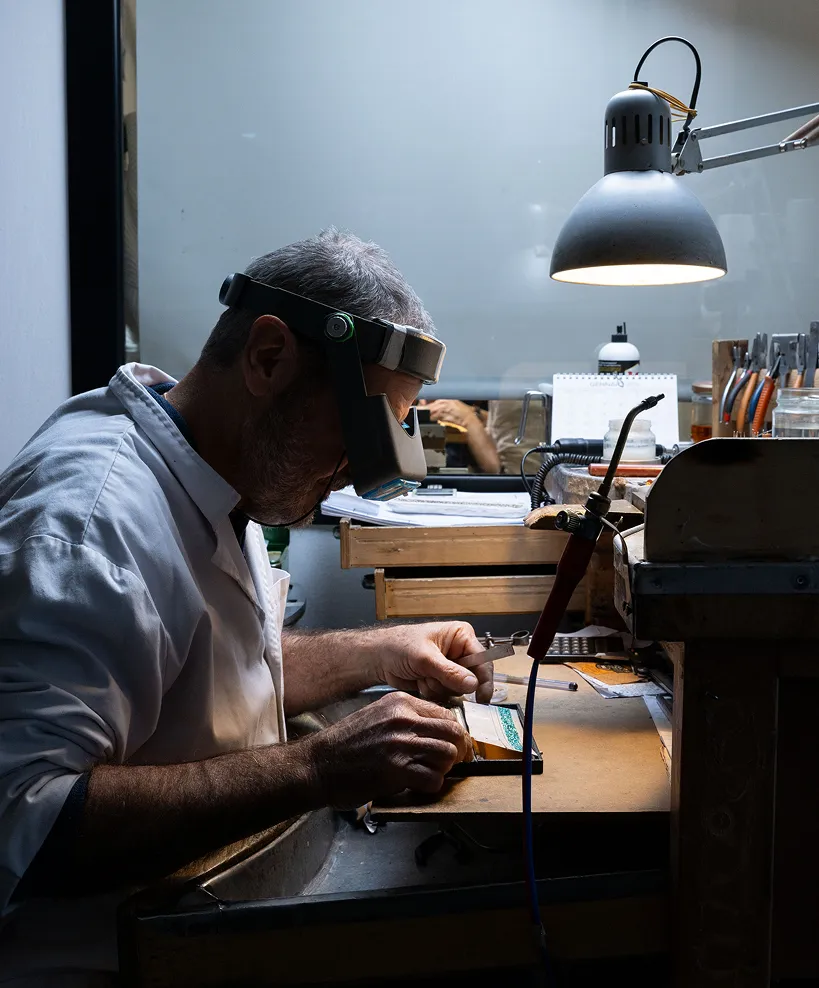
Particularly durable are engagement rings in solid 14k (585) or 18k (750) gold with a sufficiently strong shank and a setting that holds the stone securely at several points or encloses it completely. The alloy plays a smaller role than material thickness, clean workmanship and regular inspection of the prongs by a goldsmith.
At a glance
- Suitable alloys
- 14 and 18 karat, that is 585 and 750 gold
- Unsuitable
- Pure 24-karat gold, too soft for everyday wear
- Most important factor
- Material thickness of shank and prongs
- Most secure setting
- Bezel: a metal rim encloses the stone
- Wear parts
- Prongs, and with white gold also the rhodium plating
- Care
- Have the setting checked regularly, polish out scratches
Durability comes from construction
Gold does not rust and does not decompose. The Gemological Institute of America (GIA) describes it as durable and resistant to corrosion. A gold ring therefore does not disappear, it wears: the shank becomes thinner on the underside, prongs become flatter, edges round off. How quickly this happens depends on how much metal is present at these points. A ring with a strong shank simply has more reserve than a very finely worked one.

This stands in tension with design. Narrow shanks and delicate prongs make the stone look larger and are popular. A good design finds the proportion at which the ring looks light and still has enough substance. This balance is a matter of craftsmanship and cannot be read from any hallmark. It therefore belongs in the conversation about the design, not only in production.
The alloy: 585 and 750 gold in daily wear
Pure 24-karat gold is the softest gold and, according to the GIA, too soft for everyday wear. For rings that are never taken off, the institute recommends 14 or 18 karat, because the added metals make the gold firmer. Both are proven. 585 gold tends to be somewhat harder, 18k (750) gold contains more precious metal and has the richer color. The detailed comparison can be found under 18k (750) or 14k (585) gold.
The gold color mainly affects care. Yellow gold and rose gold are colored throughout and need little upkeep: occasional polishing is enough. White gold is usually plated with rhodium. This layer wears off and is renewed depending on use, otherwise the ring takes on a warmer tone, according to the GIA. This is a normal process and not a defect. According to the GIA, a yellow gold ring should also not come into contact with chlorine and harsh chemicals.
The setting: how the stone is held
A stone is lost when its setting gives way. Prongs can be damaged or loosen and should therefore be checked regularly and tightened when needed. The more holding points a stone has, the less depends on any single one. With pointed shapes such as pear or marquise, a prong at the tip protects against chipping. A basket with cross bars beneath the stone additionally supports the prongs against bending.
| Setting | Protection of the stone | Care required |
|---|---|---|
| Bezel | Very high, edges are enclosed | Low |
| Flush setting | Very high, stone sits within the shank | Low, requires a strong shank |
| Channel setting | High, edges of the stones are protected | Low, resizing is laborious |
| Prongs | Medium, stone sits exposed | Check prongs regularly |
| Pavé | Medium, many small stones | Check the fit of the stones regularly |
Classification based on the GIA's descriptions of setting types.
If you work a great deal with your hands, a bezel or a low-set stone is a sound choice, as smooth edges catch on nothing. If you want to see as much of the stone as possible, choose a prong setting and plan for inspections. Both paths lead to a durable ring, provided the setting suits daily life.
How to recognize solid workmanship
- The shank is solidly made and not noticeably thin on the underside.
- All prongs are equally strong, sit cleanly against the stone and have no sharp ends.
- The stone sits firmly and does not move even under light pressure.
- The fineness is hallmarked on the inside, for example 585 or 750.
- Transitions between shank and setting are worked without visible seams.
Good to know
Gold is scratched by harder materials. Take the ring off for gardening, strength training and when handling abrasive cleaners, and store it separately from other jewelry. A diamond can scratch any precious metal of a setting.
Yellow gold or white gold: what counts in daily life
For durability, the color of the gold is secondary. Yellow gold, white gold and rose gold of the same fineness wear similarly. The differences lie in care and in skin tolerance. According to the GIA, yellow gold typically contains copper, silver and zinc, white gold white metals such as nickel, palladium and zinc. If you react to nickel, choose a white gold with palladium or a nickel-free yellow gold.

| Criterion | Yellow gold | White gold |
|---|---|---|
| Color | Colored throughout, warm | White through rhodium plating |
| Regular care | Polishing | Polishing and renewing the rhodium |
| Typical added metals | Copper, silver, zinc | Nickel, palladium, zinc |
| Suitable diamond | Tinted stones from M | Colorless and near-colorless stones D to J |
Based on the GIA's information on gold alloys and on the effect of the metal on diamond color.
The last row shows that the choice also depends on the stone. A colorless diamond looks clearest in white metal, a tinted one blends into yellow gold. If you love yellow gold and choose a colorless stone, you can have the stone set in white prongs. More on this in the guide Rose gold or white gold.
What makes a gold ring age early
- A very narrow shank that becomes thin on the underside after a few years.
- A high setting without supports, whose prongs give way under impact.
- A ring that is not taken off for sports, gardening or cleaning.
- A ring size that is too large, so the ring turns and the stone knocks against things more often.
- Years without inspecting the prongs, until a stone sits loose.
Almost all of these points can be avoided in the design or in daily life. According to the GIA, old rings often show where neglected wear leads: thin, worn prongs no longer hold the stone securely, and a shank that is too thin has to be partly replaced at the back. Having repairs made early, by contrast, preserves the original substance of the ring for decades.
Care over decades
A gold ring can be refurbished almost any number of times. Scratches are polished out, prongs retightened or renewed, and a goldsmith can reinforce a shank that has worn thin. For cleaning at home, warm water, a little mild dish soap and a soft brush are sufficient. The GIA does not recommend ultrasonic and steam devices for home use, because they can loosen stones in the setting.
- After every hard knock, check the fit of the stone: if it wobbles, stop wearing the ring.
- Have the ring inspected regularly under a loupe by a goldsmith.
- With white gold, have the rhodium plating renewed as soon as the warmer tone shows through.
- Have scratches and dull areas professionally polished out as needed.
- If the shank is visibly thin, have it reinforced in good time or have part of the shank replaced.
At Vikar Ahmed, engagement rings are created as individual designs, made in the in-house atelier by goldsmiths from Idar-Oberstein with decades of experience. The work steps include setting the gemstones and polishing by hand. After handover, the house offers cleaning and refurbishment with polishing and rhodium plating, as well as resizing where the design allows it. The setting should be checked about every two years, and there is a fixed contact person for this.
Frequently asked questions
Which gold engagement rings are particularly durable?
Rings in solid 14k (585) or 18k (750) gold with a strong shank and a setting that holds the stone securely. A bezel offers the best protection, and well-proportioned prongs are also lasting with regular inspection. Very narrow shanks and very fine prongs wear more quickly.
Which yellow gold or white gold engagement rings are advisable?
In both colors, rings in 14 or 18 karat with a solid shank and a secure setting are advisable. White gold suits colorless diamonds but needs a rhodium plating that is renewed from time to time. Yellow gold is colored throughout and easier to care for, but emphasizes the tint of a diamond. With a nickel allergy, pay attention to the alloy.
How often should the setting of an engagement ring be checked?
Regularly, ideally at a fixed interval, and always whenever the ring has received a hard knock. Under a loupe, a goldsmith can see whether prongs have loosened or worn and can retighten them before a stone is lost.
Does yellow gold wear faster than white gold?
Not as a rule. Durability depends on the fineness and the alloy, not on the color. The difference lies in care: white gold usually has a rhodium plating that must be renewed. Yellow gold and rose gold need no plating.
Can a gold ring look like new again after many years?
In most cases, yes. A goldsmith can polish out scratches, renew prongs and reinforce the shank. With white gold, the rhodium plating is also reapplied. The only limit is very heavy loss of material on fine details such as engravings.
May I clean my gold ring with an ultrasonic device?
Better not at home. According to the GIA, ultrasonic and steam cleaning can loosen stones in their setting, especially those that already have some play. Professionals therefore check the fit of the stones beforehand. For daily care, warm water, mild soap and a soft brush are sufficient.
Private consultation
How strong the shank and setting should be depends on your stone and your daily life. Vikar Ahmed discusses this with you in the showroom in Idar-Oberstein, by appointment and with appropriate discretion. Request an in-person or virtual appointment.
Further reading
- Engagement rings at Vikar Ahmed
- 18k (750) or 14k (585) gold for the engagement ring
- Platinum or 18k (750) white gold
- Plain gold engagement rings
- Glossary: Prong setting
- Glossary: 18k (750) gold
Sources
- GIA: Best Ring Material for Everyday Wear, accessed 2026-11-17
- GIA: Guide to White, Yellow, and Rose Gold Engagement Rings, accessed 2026-11-17
- GIA: Complete Guide to Engagement Ring Settings, accessed 2026-11-17
- GIA: How Metal Affects Diamond Color Appearance, accessed 2026-11-17
- GIA: Diamond Care and Cleaning Guide, accessed 2026-11-17
- GIA: How to Shop for Antique and Vintage Engagement Rings, accessed 2026-11-17
- Vikar Ahmed: Bespoke, Designprozess, accessed 2026-11-17

A personal conversation starts here.
At the showroom in Idar-Oberstein or by video. Vikar Ahmed discusses your ideas, stones and designs with you and answers your questions calmly and in confidence.


Thank you for your request.
Your request will be handled with the utmost attention and discretion. Vikar Ahmed will get back to you.
Your details
Request
–
Occasion
–
Consultation
–
Contact
–
In the meantime
Insights: What is a Paraíba tourmaline? · Engagement ring to your own design: how does it work?
Confidential and without obligation
Back to the pagePrivate consultation
A personal conversation starts here.
- Time for your questions, wishes and ideas
- In the showroom in Idar-Oberstein or by video
- Confidential, discreet and without obligation
Vikar Ahmed · Hauptstraße 111 · 55743 Idar-Oberstein, Germany