

Simple Gold Engagement Rings
A slender band, a calm line, perhaps a small stone: simplicity forgives little. What matters in the gold color, the thickness, and the setting.
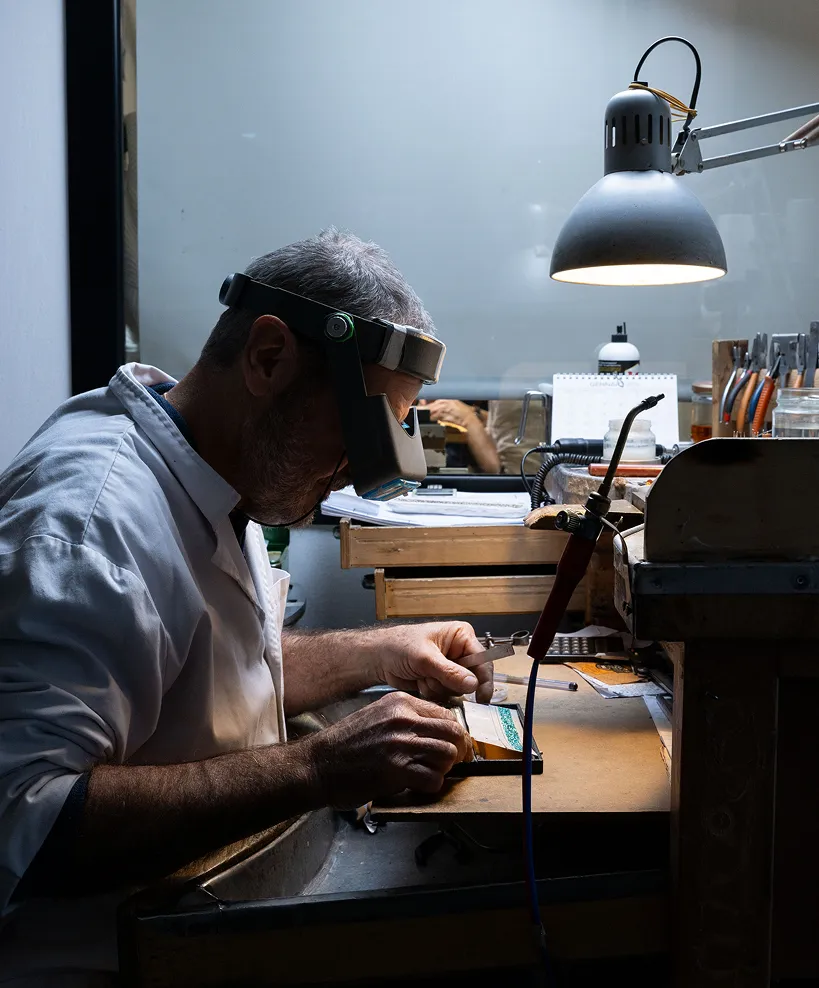
A simple gold engagement ring consists of a calm band, often with a small stone in a low setting. In everyday wear, yellow gold is the easiest to care for, because it needs no plating. White gold looks cooler, and its rhodium layer has to be renewed every few years. Whether a delicate ring pleases in the long run depends more on proportion and craftsmanship than on the stone.
At a glance
- 18k (750) gold
- 75 percent fine gold, equivalent to 18 karat
- 14k (585) gold
- 58.5 percent fine gold, equivalent to 14 karat
- Yellow gold
- Hardly any care, scratches can be polished out
- White gold
- Usually rhodium plated, renew the layer every few years
- Rose gold
- Copper in the alloy gives the pink tone
- 24 karat fine gold
- Too soft for a ring worn every day
What defines a simple ring
Simple does not mean arbitrary. A simple engagement ring is reduced to a few elements: a band with a clear profile, a clean surface, and at most one small stone that sits close to the finger. Because nothing distracts, every irregularity stands out. A band of uneven width, a crooked setting, or a poorly polished inside are more disturbing in a simple ring than in a richly set one.

The simple ring with a small stone lies between the plain gold band and the classic solitaire. It is almost as uncomplicated to wear as a ring without a stone and still sets an accent. Many choose it because it combines with any later wedding band and does not stand out at work. Anyone who would like to do without a stone entirely will find the reasons in the guide Engagement ring without a stone.
Yellow gold or white gold in everyday wear
Yellow gold is the most uncomplicated gold color in everyday wear. GIA describes the care required as very low: scratches can occasionally be polished out, and there is no plating. Yellow gold is created when fine gold is alloyed with copper, silver, and zinc. Its color runs through the entire metal. Even after years and several polishings, a yellow gold ring therefore looks as it did on the first day, only with softer edges.
White gold is made from fine gold and white metals such as palladium or silver. It is usually rhodium plated to obtain, according to the World Gold Council, a harder, brighter surface. This layer wears off. GIA describes how the ring can then appear warmer in tone and expects a new rhodium plating every few years. Anyone who loves a cool, bright ring gladly accepts this effort. Anyone who wants as little care as possible is better served by yellow gold.
| Criterion | Yellow gold | White gold |
|---|---|---|
| Effect | Warm, classic | Cool, bright, modern |
| Color | Runs through the entire metal | Usually enhanced by a rhodium layer |
| Care | Polish occasionally | Re-plate with rhodium every few years |
| Sensitive skin | Choose a nickel-free alloy | Choose an alloy with palladium |
| With a colorless diamond | Emphasizes a yellow tint from color grade M | Shows the stone neutrally |
Basis: GIA, Guide to White, Yellow, and Rose Gold Engagement Rings and Best Ring Material for Everyday Wear.
Fineness: what the numbers mean
According to GIA, pure 24 karat gold is too soft for an engagement ring. For daily use, it is alloyed. The World Gold Council describes 18 karat as 75 percent gold with 25 percent other metals. On jewelry, the fineness is stamped in parts per thousand, that is 750 for 18 karat and 585 for 14 karat. The guide 18k (750) or 14k (585) gold explains how the two alloys differ in everyday wear.
For a simple ring, the choice of alloy has a significance of its own. Because no large stone catches the eye, the gold color shapes the entire appearance. 18k (750) gold shows the richer tone. GIA rates the risk of skin reactions as unlikely for 18 karat and as possible for 14 karat. Anyone prone to reactions should ask about the exact composition. More on the term in the glossary entry 18k (750) gold.
Delicate, but sturdy enough
A delicate ring needs a well-considered construction. A very narrow and thin band can deform over time, especially on the underside, which bears the most strain when gripping. Good goldsmiths compensate for this with a stronger profile that looks narrow from above and still has enough material. In this way, the ring remains visually light and keeps its round shape for years.
With a small stone, the setting decides how suitable the ring is for everyday wear. A bezel setting or a flush setting holds the stone flat against the finger. GIA calls flush settings very durable and hardly prone to catching, but notes that they often need a wider, stronger band. Prongs let more light into the stone, but should be checked at intervals. The guide Which gold rings last longest describes how gold rings last a long time.
Delicate gold ring or a striking stone
Whether a delicate ring pleases more in the long run than a ring with a large stone depends less on style than on the person. A simple ring is rarely too much. It suits jeans and evening dress, work at the computer and in the garden. A striking stone is a statement that makes itself felt every day. Some love exactly that, others then take the ring off on many occasions.

A helpful question is: which jewelry does the person wear today, every day and without thinking about it? Anyone who wears fine chains and small stud earrings usually feels more comfortable with a delicate ring. Anyone who likes to wear individual bold pieces may miss something in a very simple ring. A simple ring can also be complemented later, for example by a wedding band with small stones. The guide Matching engagement ring and wedding bands shows how this succeeds.
Typical mistakes with simple gold rings
- Choosing a very thin band that deforms after a few years.
- Choosing white gold without planning for regular rhodium plating.
- Combining yellow gold with a diamond whose slight yellow tone then stands out more strongly.
- Placing a small stone in a high setting that looks out of place on a simple ring.
- Not asking about the alloy, although the skin reacts sensitively to nickel.
How to find your measure of simplicity
- Look at your own jewelry: what is worn every day today, and what stays in the jewelry box?
- Compare the gold color on the finger: yellow, white, and rose gold side by side.
- Decide on the stone: none, a small one in a flat setting, or a solitaire.
- Determine width and profile: narrow from above, with enough material for everyday wear.
- Keep the later wedding band in mind, so that both rings fit side by side.
Simple rings at Vikar Ahmed
At Vikar Ahmed, engagement rings are individually designed and made in Germany. A classic can be developed further, just as a completely new idea can be realized, including in a reduced form. The house works with 18k (750) gold in white, rose, and yellow as well as platinum 950, and 14k (585) gold on request. The goldsmiths in Idar-Oberstein set the stones and polish by hand, so that even a simple band is carefully finished. Metal and alloy are decided together in the consultation.
Frequently asked questions
Which is more suitable for everyday wear, a simple engagement ring in yellow gold or in white gold?
Yellow gold. Its color runs through the entire metal, it needs no plating, and it can simply be polished if scratched. White gold is just as sturdy, but loses its rhodium layer over time and must then be re-plated. With the same alloy, both wear similarly well in everyday life.
What pleases more in the long run, a delicate gold ring or an engagement ring with a striking stone?
That depends on which jewelry the person likes to wear today. A delicate ring suits almost any occasion and is rarely taken off. A large stone makes a stronger impression, but bothers some people in everyday life. Anyone who is unsure chooses the delicate ring and complements it later with a set wedding band.
Does a white gold ring turn yellowish over time?
It can look warmer once the rhodium layer has worn off. Beneath it lies the actual white gold alloy, which is not quite as bright. A new rhodium plating by the goldsmith restores the bright tone. GIA expects this step every few years.
Which setting suits a simple ring with a small stone?
A flat setting that holds the stone close to the finger. The bezel setting, which completely encloses the stone, and the flush setting, in which it is sunk into the band, have proven themselves. Both protect the stone and hardly catch. Small prongs let in more light.
Can sensitive skin tolerate a yellow gold ring?
As a rule, yes, if the alloy contains no nickel. For sensitive skin, GIA recommends nickel-free yellow or rose gold and white gold with palladium. For 18 karat, it rates skin reactions as unlikely. Ask the goldsmith about the exact composition.
Can a simple gold ring be resized later?
Usually, yes. A plain band without set stones is the best precondition for this. According to GIA, it is easier to make a ring that is too large smaller than to enlarge one that is too small. With white gold, a new rhodium plating follows the alteration.
Private consultation
How simple a ring may be is best seen when you compare different widths and gold colors on the finger. Vikar Ahmed advises in the showroom in Idar-Oberstein by appointment, and virtually on request. Request an appointment for a private consultation.
Further reading
- Engagement ring without a stone
- 18k (750) or 14k (585) gold
- Rose gold or white gold
- Engagement rings in gold or silver
- Glossary: 18k (750) gold
Sources
- GIA 4Cs: Guide to White, Yellow, and Rose Gold Engagement Rings, accessed 2026-11-17
- GIA 4Cs: Best Ring Material for Everyday Wear, accessed 2026-11-17
- World Gold Council: About gold jewellery, accessed 2026-11-17
- GIA 4Cs: Complete Guide to Engagement Ring Settings, accessed 2026-11-17
- GIA 4Cs: Ring Size Guide, accessed 2026-11-17
- Vikar Ahmed: Verlobungsringe, accessed 2026-11-16
- Vikar Ahmed: Collections, accessed 2026-11-16
- Vikar Ahmed: Bespoke, Designprozess, accessed 2026-11-16

A personal conversation starts here.
At the showroom in Idar-Oberstein or by video. Vikar Ahmed discusses your ideas, stones and designs with you and answers your questions calmly and in confidence.


Thank you for your request.
Your request will be handled with the utmost attention and discretion. Vikar Ahmed will get back to you.
Your details
Request
–
Occasion
–
Consultation
–
Contact
–
In the meantime
Insights: What is a Paraíba tourmaline? · Engagement ring to your own design: how does it work?
Confidential and without obligation
Back to the pagePrivate consultation
A personal conversation starts here.
- Time for your questions, wishes and ideas
- In the showroom in Idar-Oberstein or by video
- Confidential, discreet and without obligation
Vikar Ahmed · Hauptstraße 111 · 55743 Idar-Oberstein, Germany