

18k (750) or 14k (585) Gold for an Engagement Ring?
The number in the ring states the gold content in thousandths. Between 585 and 750 lies more than a hallmark: color, material value and behavior in daily wear all shift.
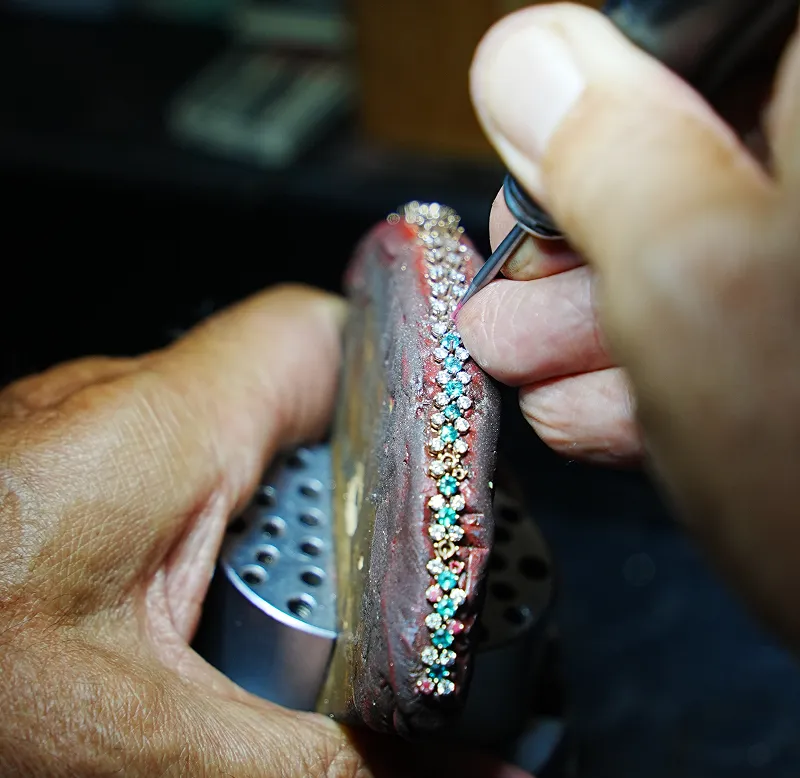
18k (750) gold contains 75 percent pure gold, 14k (585) gold 58.5 percent. The higher content means more precious metal in the ring, a richer gold color and fewer added metals. 585 gold, in turn, tends to be somewhat harder. Both alloys are suitable for everyday wear. In High Jewelry, 750 gold is the usual standard.
At a glance
- 750 gold
- 750 of 1,000 parts gold, equivalent to 18 karat
- 585 gold
- 585 of 1,000 parts gold, common hallmark for 14 karat
- Pure gold
- 24 karat, too soft for rings
- Hallmark in Germany
- Fineness in thousandths, governed by the German Hallmarking Act
- Difference in daily wear
- 750 has the richer color, 585 tends to be harder
- With white gold
- Visually almost indistinguishable under rhodium plating
What the numbers 750 and 585 mean
The hallmark in the ring states the fineness in thousandths. 750 means: of 1,000 parts of the alloy, 750 are pure gold. That corresponds to 18 karat, because pure gold is set at 24 karat, and 18 of 24 parts are three quarters. The remaining six parts are added metals such as copper, silver, zinc or palladium. Details on the hallmark can be found in the glossary under 18k (750) gold.

With 14 karat the arithmetic is less tidy. 14 of 24 parts amount to around 58.3 percent gold. The Gemological Institute of America (GIA) therefore lists the hallmarks 583 and 585 for 14 karat. In Germany, 585 is the usual hallmark and stands for 585 thousandths. For daily wear the small difference is of no consequence, but it explains why both numbers appear in tables.
Gold is alloyed not to save money but out of necessity. According to the GIA, pure gold is too soft for an engagement ring. The added metals make it harder and more durable. They also determine the color: copper leads to rose gold, white metals to white gold. The question is therefore not whether gold is alloyed, but how much gold remains in the alloy.
What the law says about the hallmark
In Germany, the German Hallmarking Act (Feingehaltsgesetz) governs what a hallmark may state. Under § 1, gold may be worked in any fineness. Anyone who states the fineness, however, must follow the rules. For jewelry, § 5 provides: it may be hallmarked in any fineness, and the fineness must then be stated in thousandths. This is why German rings bear 750 or 585 and not 18K or 14K.
The hallmark is more than a marketing claim. Under § 5, the actual fineness, when the entire piece is melted down, may be no more than ten thousandths below the stated value. Under § 7, whoever offers the goods is liable for its accuracy, and, where the hallmark is applied in Germany, so is the company for which it was applied. Under § 9, an incorrect hallmark is an administrative offense.
Good to know
Rings from abroad often bear the karat marking, such as 18K. Under § 6 of the German Hallmarking Act, they additionally require a marking that complies with the Act in Germany if their designation deviates from it.
How the two alloys differ
| Criterion | 18k (750) gold | 14k (585) gold |
|---|---|---|
| Gold content | 75 percent | 58.5 percent |
| Color in yellow and rose gold | Richer, warmer | Somewhat lighter, shaped by added metals |
| Hardness | Tends to be somewhat softer | Tends to be somewhat harder |
| Share of added metals | One quarter | A good two fifths |
| Material value | Higher, as there is more gold | Lower |
Hardness also depends on the composition of the individual alloy, not on gold content alone.
The most visible difference is color. The higher the gold content, the more strongly the gold itself shapes the tone. In yellow gold, 750 therefore looks fuller. In white gold the difference is barely noticeable: white gold is usually plated with rhodium, and according to the GIA, 14 and 18 karat are difficult to tell apart with the naked eye under this layer.
For hardness, the rule of thumb applies: the more pure gold, the softer the metal. The GIA describes gold of higher karat as more intense in color but softer. 585 gold therefore tends to resist scratches somewhat better. The gap is smaller in daily life than the numbers suggest. The GIA names 14 and 18 karat equally as suitable alloys for rings worn every day.
What the higher gold content stands for
A ring in 18k (750) gold contains more precious metal for the same form. That is the objective core of the difference in value. Then there is the effect: the richer color of 750 yellow and rose gold suits fine stones and is the reason this alloy is the usual standard in the art of high jewelry. What distinguishes High Jewelry from other jewelry is explained in the glossary.

A third point concerns skin tolerance. According to the GIA, copper and nickel are common components of gold alloys, and nickel is a widespread allergen. The higher the gold content, the smaller the share of added metals. This is not a guarantee: what matters is which metals the alloy contains. If you react sensitively, ask about the composition or choose an alloy with palladium instead of nickel.
When 18k (750) gold is worthwhile and when it is not
- The ring carries a fine stone: the metal should match the stone in quality.
- The color of the gold is part of the design, for example with yellow or rose gold: here the difference is visible.
- The ring will later be worn alongside other jewelry in 750 gold: same alloy, same tone.
- The ring is never taken off during manual work: then the somewhat harder 585 alloy may have the advantage.
- It concerns rhodium-plated white gold and appearance alone: the difference is barely visible.
The later wedding band is a special case. Engagement ring and wedding band are often worn stacked and rub against each other. If both are in the same fineness and the same gold color, they age evenly and keep the same tone. If you combine two different alloys, you will see the color difference above all in yellow and rose gold, and still years later.
Good to know
The stone and its setting determine the lifespan of an engagement ring more than the fineness does. Sturdy prongs and a sufficiently strong shank count for more than the difference between two gold alloys.
Common misunderstandings about fineness
- Karat in gold is not carat in a stone: one states the gold content, the other the weight.
- White gold is not a metal of its own, but gold with white added metals and usually a rhodium plating.
- A higher fineness does not automatically make a ring more durable, rather somewhat softer.
- The gold color says nothing about the fineness: rose gold exists in 585 and in 750.
The first misunderstanding is the most common. For a diamond, carat denotes a weight: according to the GIA, one carat equals 0.2 grams. For gold, by contrast, karat describes a share of 24 parts. A ring can therefore carry a one-carat stone in a shank of 18-karat gold. More on the unit of weight is explained in the glossary under Carat.
18k (750) gold in the in-house atelier
Vikar Ahmed works with 18k (750) gold in white, rose, and yellow as well as platinum 950. Engagement rings are created as individual designs and made in Germany. The house makes 14k (585) gold in white, yellow, and rose at the client's request, and the alloy is decided together in the consultation. Which of the two gold colors carries a diamond better is covered in the guide Rose gold or white gold.
Frequently asked questions
Is the higher cost of 750 gold compared with 585 justified for an engagement ring?
It has objective grounds: 18k (750) gold contains more precious metal, has the richer color and fewer added metals. Whether it is worthwhile for you depends on the ring. With a fine stone and with yellow or rose gold, there is much in its favor. With rhodium-plated white gold, the visual difference is slight.
Is 750 gold too soft for a ring worn every day?
No. 18k (750) gold is an alloy and considerably harder than pure gold. The GIA expressly names 18 karat as suitable for everyday wear. Fine scratches appear over time on every gold ring and can be polished out.
How can I tell whether a ring is made of 750 or 585 gold?
By the hallmark on the inside of the shank. There the fineness appears as a number, that is 750 or 585. In some countries the karat number is stamped instead, 18K or 14K. With the naked eye the difference is hard to see, especially in white gold.
Does 750 rose gold have the same color as 585 rose gold?
Not quite. The color of rose gold comes from copper in the alloy. In 585 gold the share of added metals is larger, which can change the tone. The exact color depends on the manufacturer's formula and should be compared on the piece itself.
Is 585 gold the same as 14 karat?
In practice, yes. Arithmetically, 14 of 24 parts amount to around 58.3 percent gold. The GIA lists the hallmarks 583 and 585 for 14 karat. In Germany, fineness is hallmarked in thousandths, and 585 is the usual marking there for this alloy.
May a goldsmith hallmark any fineness?
For jewelry, yes. Under § 5 of the German Hallmarking Act (Feingehaltsgesetz), jewelry may be hallmarked in any fineness, and the marking must then be given in thousandths. The hallmark must be accurate: when the entire piece is melted down, the content may be no more than ten thousandths below it.
Private consultation
Which alloy and which gold color suit your stone is best judged on the material itself. Vikar Ahmed advises in the showroom in Idar-Oberstein by appointment or in a virtual appointment. Request a consultation on metal and stone.
Further reading
- Engagement rings at Vikar Ahmed
- Glossary: 18k (750) gold
- Rose gold or white gold for the engagement ring
- Which gold engagement rings are particularly durable
- Platinum or 18k (750) white gold
- Glossary: Platinum 950
Sources
- Gesetz über den Feingehalt der Gold- und Silberwaren (FeinGehG), accessed 2026-11-17
- FeinGehG § 5: Schmucksachen, accessed 2026-11-17
- GIA: Guide to White, Yellow, and Rose Gold Engagement Rings, accessed 2026-11-17
- GIA: White Metal Options for Your Engagement Ring, accessed 2026-11-17
- GIA: Best Ring Material for Everyday Wear, accessed 2026-11-17
- GIA: 10 Tips for Buying a Diamond Engagement Ring, accessed 2026-11-17
- GIA: 4Cs Carat Weight, accessed 2026-11-17
- Vikar Ahmed: Collections, accessed 2026-11-17

A personal conversation starts here.
At the showroom in Idar-Oberstein or by video. Vikar Ahmed discusses your ideas, stones and designs with you and answers your questions calmly and in confidence.


Thank you for your request.
Your request will be handled with the utmost attention and discretion. Vikar Ahmed will get back to you.
Your details
Request
–
Occasion
–
Consultation
–
Contact
–
In the meantime
Insights: What is a Paraíba tourmaline? · Engagement ring to your own design: how does it work?
Confidential and without obligation
Back to the pagePrivate consultation
A personal conversation starts here.
- Time for your questions, wishes and ideas
- In the showroom in Idar-Oberstein or by video
- Confidential, discreet and without obligation
Vikar Ahmed · Hauptstraße 111 · 55743 Idar-Oberstein, Germany