

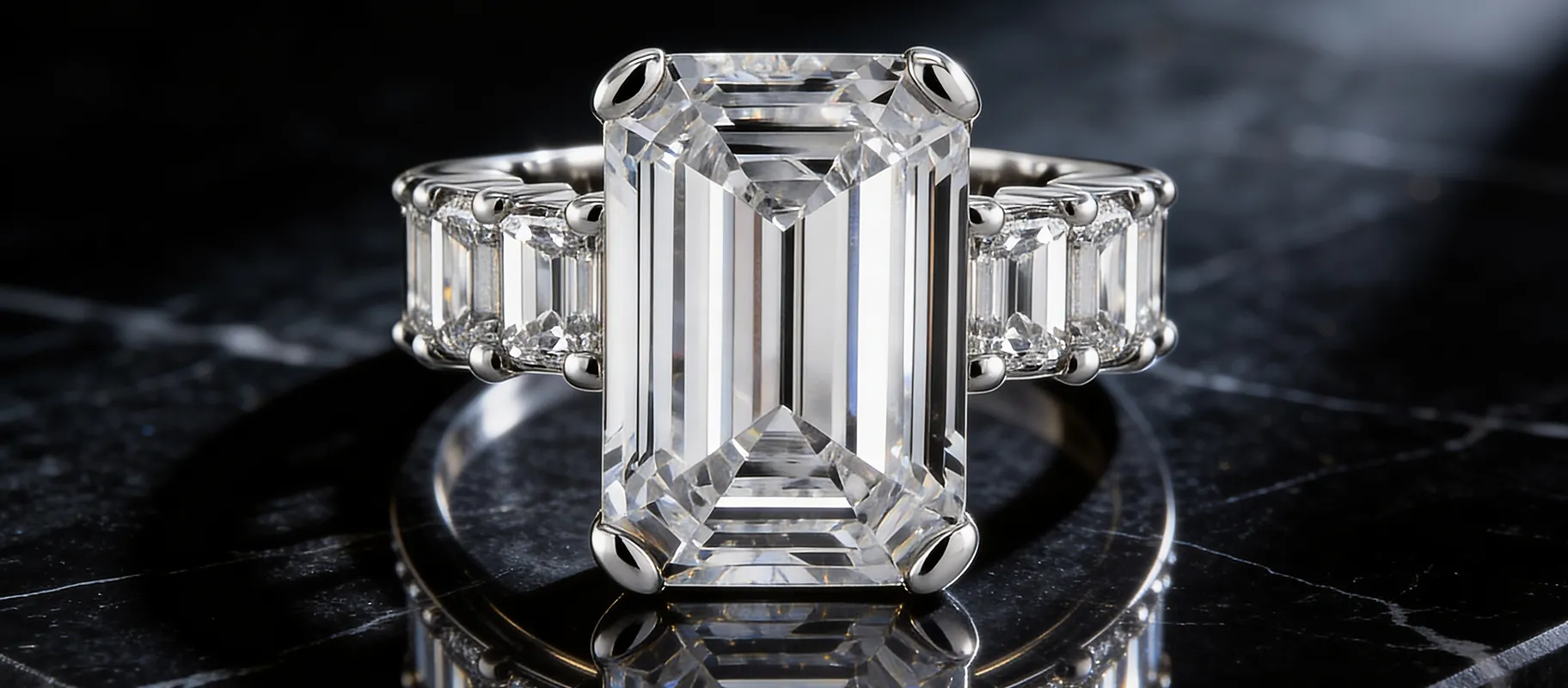
An engagement ring and a wedding band go together when they are made of the same alloy, their shanks sit against each other without a gap, and their widths are in proportion. This works most reliably when both rings are planned together. If you choose the wedding band later, bring the engagement ring along so that setting height, shape, and metal can be matched directly.
At a glance
- Metal
- Both rings in the same alloy, so that neither wears down the other
- Fineness
- Stated on jewelry in parts per thousand, 750 corresponds to 18 karat and 75 percent gold
- Traditional order
- Wedding band closer to the hand, engagement ring above it
- Width
- With rings of different widths, the wider one sits below
- Fit
- Snug, barely turning, without restricting circulation
- Resizing
- More difficult for pavé rings set all around than for plain rings
Planning both rings as a pair
An engagement ring is often chosen months or years before the wedding band. Afterward, both are worn close together. What is beautiful on its own may not fit well together: a highly set stone leaves a gap to a straight wedding band, a projecting setting knocks against it, two different gold colors look restless. Planning both rings together sets the metal, shank shape, and widths so that they complement each other.
For a harmonious ring pair, GIA recommends staying with one metal, one setting style, or one design language. This does not mean that both rings must look the same. The wedding band should accompany the engagement ring without competing with it. A plain band beside a solitaire follows this rule just as a fine diamond band does beside a ring with a pavé shank.
The same alloy protects both rings
Rings worn side by side rub against each other with every movement of the hand. If they are made of metals of different hardness, the softer one loses material faster. GIA gives the example of gold, which wears away more quickly next to platinum. The same alloy therefore means the same metal, the same fineness, and ideally the same color. If you want to combine white gold with platinum, you should be aware of the wear and have the rings checked regularly.

Color is also a question of alloy. Rose gold gets its hue from copper, white gold from white metals such as palladium or silver and usually rhodium plating. This layer wears off and is renewed as needed. Otherwise, two white gold rings show different tones over time. Under the German Hallmarking Act (Feingehaltsgesetz), goldsmiths state the fineness on jewelry in parts per thousand, and 18k (750) gold contains 75 percent fine gold.
Good to know
Under Section 7 of the German Hallmarking Act (Feingehaltsgesetz), the provider of the goods is liable for the accuracy of the stated fineness. If you combine two rings from different houses, compare both hallmarks before assuming the same alloy.
The shape of the shank determines the gap
Whether two rings sit flush against each other depends on the setting of the engagement ring. If the stone sits low and the setting ends above the shank, a straight wedding band usually fits beside it without a gap. If the setting projects sideways over the shank or a bridge runs down beneath the stone, a gap appears. There are then three options: notch the wedding band at this point, lead it around the setting in a gentle curve, or deliberately leave a space.
Each option has consequences. A notched or curved wedding band fits only this particular engagement ring and looks unusual when worn alone. A straight ring with a small gap can also be worn on its own but looks less closed next to the engagement ring. Which solution is right depends on whether the wedding band will later be worn alone as well, for example at work or when traveling.
Putting widths and stone settings in proportion
A ring pair looks balanced when the wedding band takes up the shank of the engagement ring rather than outdoing it. If the engagement ring is delicate, a very wide wedding band quickly looks heavy. If the two rings have different widths, GIA advises wearing the wider one below. Enough room should remain between the rings and the knuckle. Otherwise, the pair presses when the hand bends.
If the wedding band is set with diamonds, they should match the center stone of the engagement ring. GIA recommends choosing accent stones with similar color and clarity grades. A wedding band with visibly more yellowish stones beside a very colorless center stone disturbs the picture. Rings set all around are also harder to resize, because adjusting the shank can loosen the small stones.
Designed together or chosen separately
Whether both rings are made at the same time or one after the other is not a question of right or wrong. It is a question of planning and freedom. The table sets out both approaches against the same criteria. If you already wear the engagement ring, you can still have a matching wedding band designed, provided the ring is available for measuring and matching.
| Criterion | Designed together | Chosen separately |
|---|---|---|
| Alloy and color | Identical from the start | Must be matched afterward |
| Join of the shanks | Planned flush, even with a high setting | Often a gap or a notch added later |
| Stone quality | Accent stones selected to match the center stone | Differences in color and clarity possible |
| Wearable alone | Depends on the design, decided in advance | Usually yes, since no adjustment is needed |
| Room for later | Little, the pair is fixed | Ample, the wedding band can be rethought |
Both approaches compared, without ranking by price.
Order, fit, and care
Traditionally, the wedding band is put on first and sits closest to the hand, with the engagement ring above it. GIA describes this order as customary, and many couples choose their own. More important than the order is the fit: both rings should sit snugly, barely turn, and not restrict circulation. According to GIA, most rings can be resized by one or two sizes.

Two rings that rub against each other every day need a little more attention than one. Prongs and edges wear first at the contact surfaces. Regular cleaning and inspection by a goldsmith show early on whether a prong is thinning or a stone has play. With white gold, occasional new rhodium plating is part of this, so that both rings keep the same tone.
Typical mistakes with a ring pair
- Choosing the wedding band without the engagement ring and estimating setting height and shank shape.
- Confusing the same color with the same alloy, such as white gold next to platinum.
- Choosing a very wide wedding band for a delicate engagement ring, so that the center stone is lost.
- Having the wedding band notched even though it will often be worn alone later.
- Deriving the ring size from another ring. According to GIA, this is only an approximation. The reliable method is sizing at the goldsmith.
Most of these mistakes arise because the second ring is treated as an afterthought. Thinking of the wedding band when choosing the engagement ring keeps every option open: the setting can be designed so that a straight wedding band sits flush, and the alloy is recorded in writing. This way, the second ring can still be made to match years later.
How a ring pair is created at Vikar Ahmed
Vikar Ahmed designs engagement rings individually and makes them in its in-house atelier in Idar-Oberstein. The process follows three steps: design, three-dimensional visualization in CAD, and realization. The visualization makes it possible to check how two shanks sit against each other before any metal is worked. On request, the house makes wedding bands to measure in its own workshop, including ones that match the engagement ring. For more elaborate custom pieces, it gives about four to six weeks as a guide. If the wedding date is already set, mention it right in your inquiry so that both rings can be planned in time.
Frequently asked questions
We would like to have our engagement ring and wedding bands matched to each other right away. Which goldsmiths in Trier design both together?
Look for a workshop that plans both rings in one design and shows the join of the shanks in advance. Vikar Ahmed has no location in Trier but advises couples from the region in Idar-Oberstein or virtually. More under Jeweler for Trier.
Which goldsmiths in Birkenfeld make wedding bands to match an engagement ring of your own design?
What matters is that the goldsmith measures the existing ring and adopts its alloy, setting height, and shank shape. Vikar Ahmed has no location in the town of Birkenfeld. Its in-house atelier is in the same district, in Idar-Oberstein. Travel information under Jeweler for Birkenfeld.
Should the engagement ring and wedding band be made of the same alloy?
Yes, if both are to be worn together permanently. Metals of different hardness wear unevenly. According to GIA, gold next to platinum, for example, loses material faster. The same alloy means the same metal, the same fineness, and the same color, so that both rings still go together after years.
Which ring goes on first?
By tradition, the wedding band sits closer to the hand and the engagement ring above it. Many couples decide differently, for example when one ring is wider. In that case, GIA recommends wearing the wider one below so that the pair sits steadily.
Can a wedding band with pavé diamonds be resized later?
Only to a limited extent. When the shank is enlarged or reduced, the closely set small stones can loosen. Rings set all around are therefore harder to adjust than plain ones or ones set only on top. If you expect a later change, choose a setting that leaves the underside of the shank free.
Does the wedding band have to be notched to fit the engagement ring?
Only if the setting of the engagement ring projects sideways over the shank and you do not want a gap between the rings. A notch or curve closes the gap but ties the wedding band to this particular engagement ring. A straight ring remains more versatile if it is also worn alone.
Private consultation
Whether two rings go together is best seen on the finger and in the visualization. Vikar Ahmed advises in the showroom in Idar-Oberstein by appointment or in a virtual appointment. You are welcome to bring an existing engagement ring. Request an appointment for a private consultation.
Further reading
- Bespoke engagement rings: from wish to design
- Rose gold or white gold for the engagement ring?
- Solitaire or eternity ring for an engagement
- Glossary: 18k (750) gold
- Jeweler for Trier
- Jeweler for Birkenfeld
Sources
- GIA 4Cs: Ring Stacking Guide (Reihenfolge, Breiten, Metalle, Passform), accessed 2026-11-17
- GIA 4Cs: White, Yellow and Rose Gold Engagement Rings, accessed 2026-11-17
- GIA 4Cs: Complete Guide to Engagement Ring Settings (Pavé, Größenänderung), accessed 2026-11-17
- GIA: 10 Tips for Buying a Diamond Engagement Ring (Begleitsteine, Ringgröße), accessed 2026-11-17
- World Gold Council: About Gold Jewellery (Karat, Legierungen), accessed 2026-11-17
- Gesetz über den Feingehalt der Gold- und Silberwaren (FeinGehG), accessed 2026-11-17
- Vikar Ahmed: Verlobungsringe und Engagement, accessed 2026-11-16
- Vikar Ahmed: Bespoke, Designprozess, accessed 2026-11-16

A personal conversation starts here.
At the showroom in Idar-Oberstein or by video. Vikar Ahmed discusses your ideas, stones and designs with you and answers your questions calmly and in confidence.


Thank you for your request.
Your request will be handled with the utmost attention and discretion. Vikar Ahmed will get back to you.
Your details
Request
–
Occasion
–
Consultation
–
Contact
–
In the meantime
Insights: What is a Paraíba tourmaline? · Engagement ring to your own design: how does it work?
Confidential and without obligation
Back to the pagePrivate consultation
A personal conversation starts here.
- Time for your questions, wishes and ideas
- In the showroom in Idar-Oberstein or by video
- Confidential, discreet and without obligation
Vikar Ahmed · Hauptstraße 111 · 55743 Idar-Oberstein, Germany