

Engagement Ring in Gold or Silver?
Silver looks bright and modern, gold classic and precious. For a ring meant to be worn for decades, what counts above all is how the metal behaves in everyday life.
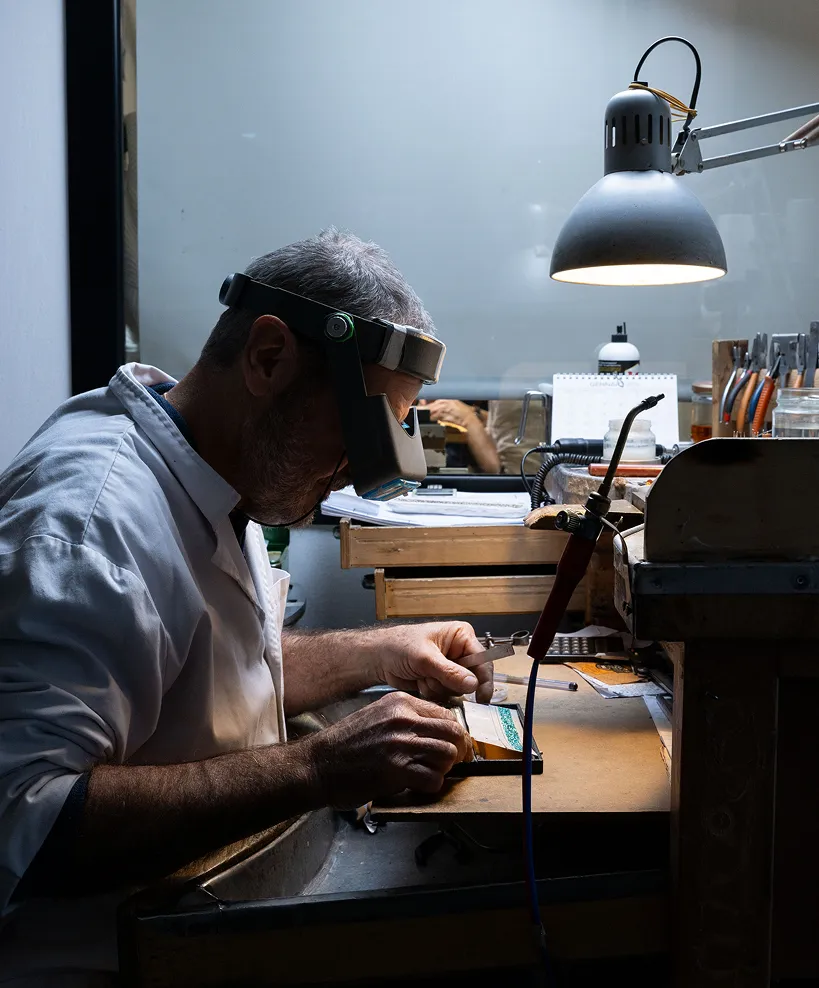
For an engagement ring, gold is the more durable choice. Sterling silver is softer, scratches and dents more easily, and tarnishes over time. According to GIA, it is therefore rarely used for engagement and wedding rings. If you are drawn to the bright color of silver, you will find it in a more durable form in white gold, platinum, or palladium.
At a glance
- Sterling silver
- 925 parts silver and 75 parts copper per 1,000
- 18 karat gold
- 75 percent gold, marked as 750 in Germany
- 14 karat gold
- According to GIA 58.3 percent gold, usually marked as 585 in Germany
- Silver in everyday life
- Soft, scratches and dents more easily, tarnishes
- Gold in everyday life
- Corrosion-resistant, easy to work and to repair
- White alternatives
- White gold, platinum 950, palladium
Gold endures, silver wears
An engagement ring is usually worn every day, often for a lifetime. The metal must therefore withstand knocks, friction, and moisture and hold the stone securely for years. According to GIA, gold is durable, corrosion-resistant, and easy to work, and damage can be repaired. GIA, by contrast, describes silver as soft, prone to scratches, and not one of the most durable metals. Over time it takes on an aged appearance.
This is no dismissal of silver as a jewelry metal. According to GIA, sterling silver is very widespread, but rarely chosen for engagement or wedding rings. The reason lies in use: an earring or pendant hardly knocks against anything, while a ring on the hand does so constantly. What is appreciated as patina on a pendant quickly looks worn on a ring with a stone.
What the numbers 925, 585 and 750 mean
The number in the ring states the fineness in parts per thousand, meaning how many of a thousand parts consist of the precious metal. According to GIA, sterling silver consists of 925 parts silver and 75 parts copper. Gold is often expressed in karats: pure gold has 24 karats. 18 karats correspond to 75 percent gold, stamped as 750 in Germany. According to GIA, 14 karats are 58.3 percent gold. What 18k (750) gold means in detail is explained in the glossary under 750 gold.

In Germany, the German Hallmarking Act (Feingehaltsgesetz) governs how these numbers are to be stated. Jewelry of gold or silver may be made in any fineness. If a fineness is stated, it is given in parts per thousand, and when the entire piece is melted down it may fall short by no more than 10 parts per thousand. The provider is liable for the accuracy of the statement. The guide 750 or 585 gold compares the two gold alloys.
Silver in everyday life: scratches, dents, tarnish
According to GIA, sterling silver is softer than gold and platinum and therefore scratches and dents more easily. For very active people, GIA considers silver only conditionally suitable. Then there is tarnish: silver darkens over time. This can be removed with silver polish or a polishing cloth, but it returns. A rhodium plating makes silver less prone to tarnish, but it also wears away.
Gold, by contrast, is corrosion-resistant according to GIA. Gold also scratches, and according to GIA pure 24 karat gold is even too soft for everyday wear. Jewelry gold is therefore alloyed with other metals. GIA rates 14 and 18 karats as suitable for everyday wear. The difference from silver is therefore not that gold is indestructible, but that it ages more slowly and more evenly.
Why the metal helps carry the stone
In a ring with a stone, security depends on a few millimeters of metal. The prongs, meaning the small claws around the stone, must hold it firmly for years. A soft metal gives way more readily under impact, and a prong can bend open or wear down. According to GIA, prongs in gold should also be checked regularly and retightened if necessary. According to GIA, platinum prongs break less often, which is why platinum is considered especially suitable for diamonds.
For a plain ring without a stone, silver is therefore less critical than for a solitaire. If you are having a valuable stone set, choose the metal for its durability and not for the price of the metal. How the setting protects the stone is explained in the guide The setting of an engagement ring, and the basics of the prong setting are in the glossary.
White metals as an alternative to silver
If you like silver above all for its bright, cool color, there are three durable alternatives. According to GIA, white gold is made by alloying gold with white metals such as palladium, nickel, or zinc. It is usually rhodium-plated so that it shines whiter, and has to be replated from time to time. Platinum is denser and stronger than gold and stays white without plating. According to GIA, palladium is strong, light, and does not tarnish.
| Metal | Composition | In everyday life | Care |
|---|---|---|---|
| Sterling silver 925 | 925 parts silver, 75 parts copper | Soft, scratches and dents more easily | Tarnishes, polish |
| White gold 750 | 75 percent gold with white metals | Suitable for everyday wear | Renew rhodium occasionally |
| Platinum 950 | 950 parts platinum | Very wear-resistant, prongs break less often | Patina, polish as needed |
| Palladium | Alloy not specified by GIA | Strong and light | Does not tarnish |
Properties according to GIA. The exact composition of a white gold or palladium alloy can vary by manufacturer.
Whether platinum or white gold is the better choice depends on wearing habits and willingness to care for the ring. The guide Platinum or 18k white gold compares the two. If you are looking for warmth instead of a cool tone, the guide Rose gold or white gold offers the relevant considerations. Both paths lead to a ring that combines the bright look of silver with the durability of a precious metal suited to wedding bands.
Skin compatibility and allergies
If you react sensitively to metals, you should know the alloy. According to GIA, white gold can contain nickel, a common trigger of allergies. White gold with palladium as well as yellow and rose gold without nickel are considered a good choice for sensitive skin. Yellow and rose gold contain copper, which should be kept in mind with a copper allergy. According to GIA, platinum is hypoallergenic. Sterling silver with a low nickel content is well tolerated by most people.

Good to know
If you have a known allergy, ask not only about the fineness but about the metals added. The number 750 says how much gold is in the ring, but not what the remaining quarter consists of.
When a silver ring still makes sense
A silver ring can be a sensible interim solution. Some couples propose with a simple ring and then have the actual engagement ring made together. This way the wearer can help decide on stone, shape, and metal. How long this takes is in the guide How long it takes to make an engagement ring. Such a ring does not have to last for decades and can therefore be made of a softer metal.
Silver also has its place as a ring for travel or sports, or as a fashion piece alongside the actual engagement ring. For the ring meant to carry the stone for a lifetime, however, it is the weaker choice. If you are considering silver for reasons of cost, it is better to weigh options on the stone than on the metal. A smaller stone in solid gold lasts longer than a large one in a soft setting.
Common mistakes when choosing the metal
- Mistaking white gold for silver: white gold is a gold alloy, usually with rhodium plating.
- Having a valuable stone set in a soft silver setting.
- Taking the tarnishing of silver for a defect of the ring instead of a property of the metal.
- With a nickel allergy, paying attention only to the color of the metal instead of the alloy.
- Never having the prongs checked, whatever metal the ring is made of.
The metals at Vikar Ahmed
Vikar Ahmed works with 18k (750) gold in white, rose, and yellow as well as platinum 950, and with 14k (585) gold on request. The metal and alloy are decided together with you in the consultation. Engagement rings are individually designed and made in Germany, and every line and every detail can be refined. Silver is not among the metals the house names. Which metal suits your stone and your hand becomes clear in the design.
Frequently asked questions
Which silver engagement rings are a good alternative to gold?
Most likely simple rings without a valuable stone, for example as a ring for the proposal before the actual ring is made. For a ring meant to hold a stone for a lifetime, silver is too soft. If you like the bright color, white gold, platinum, or palladium are the better choice.
Does a silver engagement ring tarnish?
Yes. Sterling silver darkens over time because it reacts with its surroundings. This can be removed with silver polish or a polishing cloth. A rhodium plating reduces tarnish, but wears away on a ring over time and has to be renewed.
What does the number 925 in a ring mean?
It states the fineness in parts per thousand. 925 means that 925 of 1,000 parts are silver, and the rest is usually copper. That is sterling silver. In gold, 750 corresponds to a gold content of 75 percent, meaning 18 karats.
Is white gold the same as silver?
No. White gold is a gold alloy in which gold is mixed with white metals such as palladium, nickel, or zinc. It is usually rhodium-plated as well. It is considerably more durable than silver, does not tarnish, and is suitable for an engagement ring worn every day.
Is a diamond held securely in a silver setting?
At first yes, in the long run less reliably than in gold or platinum. Silver is softer, and prongs can bend open or wear down more easily under impact. With a valuable stone, it is worth having the setting made from a stronger precious metal and having it checked regularly.
Which white metal is suitable for people with allergies?
According to GIA, platinum is considered hypoallergenic. White gold can contain nickel, so with a nickel allergy it should be an alloy with palladium. Most people tolerate sterling silver with little nickel well, but it is too soft for an engagement ring.
Private consultation
Which metal suits your stone, your skin, and your everyday life can be clarified in conversation and in the design. Vikar Ahmed advises in the showroom in Idar-Oberstein by appointment, and in a virtual appointment on request. Your inquiry is treated discreetly. Request a private consultation.
Further reading
- Which gold rings last longest
- Glossary: Platinum 950
- Simple engagement rings in gold
- Engagement ring without a stone and other alternatives
Sources
- GIA 4Cs: Picking the Right White Metal (Silber, Weißgold, Platin, Palladium), accessed 2026-11-17
- GIA 4Cs: Best Ring Material for Everyday Wear, accessed 2026-11-17
- GIA 4Cs: White, Yellow and Rose Gold Engagement Rings, accessed 2026-11-17
- Gesetz über den Feingehalt der Gold- und Silberwaren (FeinGehG), accessed 2026-11-17
- Vikar Ahmed: Collections, accessed 2026-11-16
- Vikar Ahmed: Paraíba, accessed 2026-11-16

A personal conversation starts here.
At the showroom in Idar-Oberstein or by video. Vikar Ahmed discusses your ideas, stones and designs with you and answers your questions calmly and in confidence.


Thank you for your request.
Your request will be handled with the utmost attention and discretion. Vikar Ahmed will get back to you.
Your details
Request
–
Occasion
–
Consultation
–
Contact
–
In the meantime
Insights: What is a Paraíba tourmaline? · Engagement ring to your own design: how does it work?
Confidential and without obligation
Back to the pagePrivate consultation
A personal conversation starts here.
- Time for your questions, wishes and ideas
- In the showroom in Idar-Oberstein or by video
- Confidential, discreet and without obligation
Vikar Ahmed · Hauptstraße 111 · 55743 Idar-Oberstein, Germany