

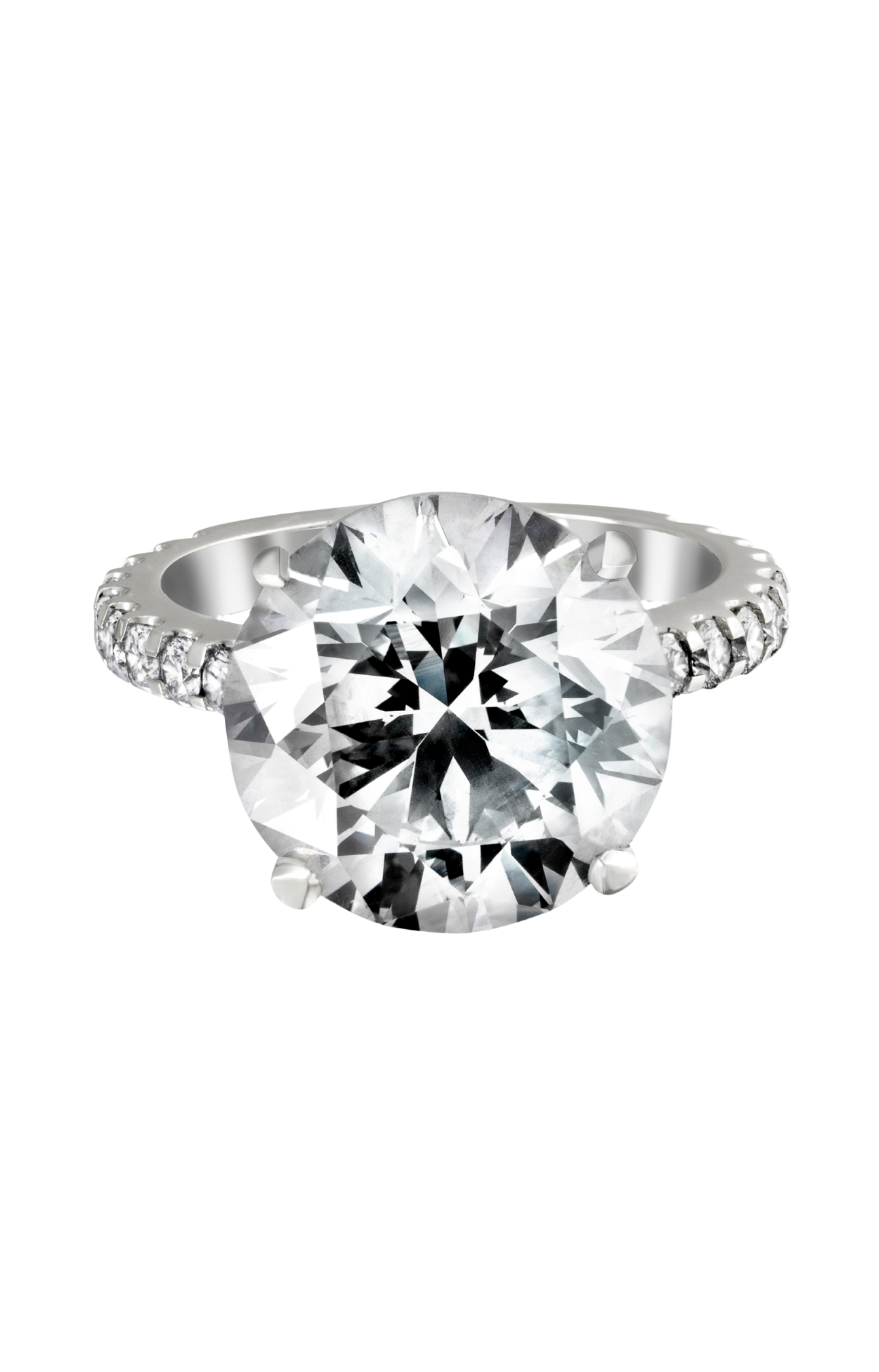
A prong setting holds a stone with narrow metal claws, the prongs, which rise from the setting's basket and are bent over the edge of the stone. It conceals little of the stone and lets in a great deal of light. This is why it is one of the most widely used settings for engagement rings. Four or six prongs are customary.
At a glance
- Principle
- Metal claws grip over the edge of the stone
- Number
- For round brilliants usually four or six prongs
- Advantage
- Much light, the stone stays visible
- Keep in mind
- Have the prongs checked regularly
- Alternative
- Bezel setting with an encircling metal rim
Little metal, much stone
The prong setting shows the stone from almost every side. Light reaches it from above and from the side, which supports brightness and sparkle. The number of prongs is a trade-off: fewer prongs show more of the stone, more prongs hold it more securely. For round brilliants, four or six are customary depending on size. For the solitaire, this setting is the classic choice.
Care and alternative
Prongs can catch on fabric and wear down over the years. Regular inspection is therefore part of owning one, and worn tips can be rebuilt with new metal. If you would like more protection, choose a bezel setting. It encloses the edge with a narrow metal rim, protects it from knocks and catches on nothing, but lets somewhat less light into the stone. Many small stones are set differently, see pavé.
Frequently asked questions
Four or six prongs, which is better?
Four prongs show more of the stone and emphasize its shape. Six prongs spread the hold over more points and provide additional security. Which number suits depends also on the size of the stone. It remains a trade-off between openness and hold.
How often should a prong setting be checked?
There is no fixed interval. GIA advises having prongs checked from time to time, and Vikar Ahmed recommends having the setting checked about every two years. An inspection is due at the latest when the ring catches on fabric or the stone moves. Worn tips can be renewed before the hold weakens.
Is a prong setting suitable for colored gemstones?
Yes, it shows a great deal of the color in colored gemstones as well. For Paraíba tourmalines, Vikar Ahmed prefers an open prong setting, often with a halo of small white diamonds. For more delicate stones such as emerald, it is worth considering whether a setting with more protection for the edge is a better fit. That depends on how and how often the piece is worn.
Private consultation
The setting determines how a stone appears and how securely it sits. At Vikar Ahmed, it is designed individually for every engagement ring, and the stones are set in its own atelier. Consultations take place in the showroom in Idar-Oberstein or virtually. Request a private consultation.
Further reading
Sources
- GIA: Guide to Engagement Ring Settings, accessed 2026-11-16
- Vikar Ahmed: Bespoke, accessed 2026-11-16
- Vikar Ahmed: Verlobungsringe, accessed 2026-11-16

A personal conversation starts here.
At the showroom in Idar-Oberstein or by video. Vikar Ahmed discusses your ideas, stones and designs with you and answers your questions calmly and in confidence.


Thank you for your request.
Your request will be handled with the utmost attention and discretion. Vikar Ahmed will get back to you.
Your details
Request
–
Occasion
–
Consultation
–
Contact
–
In the meantime
Insights: What is a Paraíba tourmaline? · Engagement ring to your own design: how does it work?
Confidential and without obligation
Back to the pagePrivate consultation
A personal conversation starts here.
- Time for your questions, wishes and ideas
- In the showroom in Idar-Oberstein or by video
- Confidential, discreet and without obligation
Vikar Ahmed · Hauptstraße 111 · 55743 Idar-Oberstein, Germany