

Vintage Style or Modern Solitaire: What Stays Beautiful?
An engagement ring is worn longer than almost any other piece of jewelry. Whether it still convinces after twenty years depends less on style than on proportion, execution, and the care it requires.
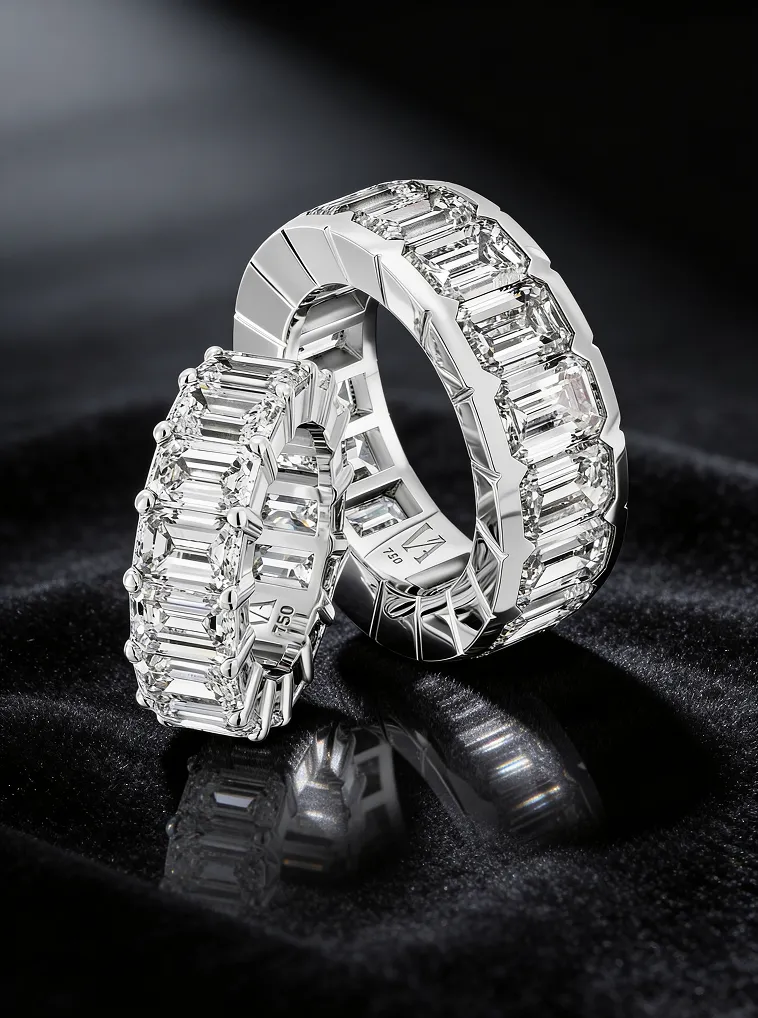
Both styles can still be beautiful after twenty years. The modern solitaire hardly ages, because it is reduced to stone and proportion. A vintage-style ring remains harmonious if its details are cleanly worked and sturdy enough for daily wear. What matters is the quality of execution, not the era of the model.
At a glance
- Modern solitaire
- One center stone, little or no further ornament
- Vintage style
- Newly made ring with shapes and details of historical models
- Antique
- According to GIA: jewelry made more than 100 years ago
- Ages least
- Clean lines, balanced proportions, solid material thickness
- Needs more care
- Fine engravings, milgrain edges, and many small stones
- Resizing
- More involved with stones on the band than with a plain band
Timelessness is a question of proportion
A ring still looks right after decades when stone, setting, and band are in proportion to one another. Fashions usually concern exaggerations: very high settings, very wide bands, very many elements. What stays measured does not later stand out as a sign of its time. This applies to both styles. An overloaded solitaire ages faster than a calm ring with historical echoes.

The second factor is execution. Clean edges, even prongs, a band with enough material: this remains visible in a ring even after a long time. Thinly worked details wear down and lose their definition. That is why it is worth asking how a design will look after twenty years of wear, not only on the day it is handed over.
The modern solitaire: reduced to the stone
A solitaire carries a single center stone with little or no further ornament. Attention rests entirely on the stone. Because there is hardly any design that could go out of fashion, this form is considered the most enduring. It does, however, set high demands: the cut and quality of the stone are fully exposed, and any imprecision in the setting stands out.
For round brilliants, four or six prongs are common. According to the Gemological Institute of America (GIA), four prongs make the stone appear slightly more square, while six emphasize its round shape. A bezel setting, in which a metal rim encloses the stone, looks more graphic and protects the stone's edges particularly well. Such decisions shape the character of a solitaire more than any ornament.
The substructure also matters. A basket setting with horizontal rails beneath the stone supports the prongs, so that they bend less over the years. A cathedral setting, in which metal arches rise from the band to the stone, provides height and stability, but according to GIA catches more easily on clothing. For a ring worn every day, a moderate height is usually the more durable choice.
The vintage style: details with a model
A vintage-style ring is newly made and takes up shapes of earlier eras. It should not be confused with an antique ring, which is actually old. Typical features are fine milgrain along the edges, engraved or pierced surfaces, a halo of small diamonds around the center stone, and claw-shaped prongs. According to GIA, such claw prongs go back to jewelry of the Georgian and Victorian periods.
These details give the ring depth and a signature of its own. They do, however, require craftsmanship. Small stones in pavé, meaning set closely side by side, should be checked regularly for a secure fit. Engravings and milgrain need enough material thickness to withstand daily wear. Well made, such a ring gains character over the years.
Which eras the vintage style draws on
Vintage is not a single style, but a collective term for very different models. Anyone designing a ring in this direction should know which era is meant. The periods and features in the table follow the classification of GIA. They help to name images and wishes more precisely in conversation, rather than speaking only of an old style.

| Era | Period according to GIA | Typical features |
|---|---|---|
| Georgian | 1714 to 1837 | Diamonds in old mine cut |
| Victorian | 1837 to 1901 | Romantic motifs such as flowers, hearts, snakes |
| Edwardian | 1890s to 1915 | Platinum and diamonds, garlands, bows, marquise |
| Art Deco | 1920s and 1930s | Geometric shapes, contrasting colored gemstones |
| Retro | Mid-1930s to 1950s | Curved shapes, gold, often rose gold |
Periods and features according to GIA's account of antique and vintage engagement rings.
For the question of twenty years, the table helps in another way. Clear basic forms, such as those that shape the geometric designs of Art Deco, can be carried into a present-day ring without a break. Highly playful motifs, by contrast, read more clearly as a quotation of their era. Those seeking a model that will still look natural in twenty years therefore tend to adopt a line or a single detail rather than an entire set of motifs.
What counts in daily wear over the years
| Criterion | Modern solitaire | Vintage-style ring |
|---|---|---|
| Effect | Calm, focused on the stone | Rich in detail, narrative |
| Care | Check prongs occasionally | Check prongs and small stones regularly |
| Cleaning | Simple, few gaps | More involved, many gaps |
| Resizing | Straightforward with a plain band | More involved with stones on the band |
| Combination with wedding band | Usually without difficulty | Plan the shape of the wedding band early |
General classification. The individual design may differ.
One point is often overlooked: fingers change over the course of a life. According to GIA, rings with pavé or with stones in a channel setting cannot easily be resized. Rings with diamonds all around the band are particularly difficult. Those who choose a richly set ring should have the ring size determined carefully and keep the lower part of the band as plain as possible.
Good to know
The engagement ring is usually worn later next to the wedding band. A low-set stone or a projecting halo can prevent the two rings from sitting flush. This can be solved in the design if it is considered early.
Where a design fails after years
- Prongs that are very thin even when new: according to GIA, worn prongs no longer hold the stone securely.
- A band that is too narrow on the underside and loses material there first.
- A setting so high that the stone knocks against things with every movement.
- Ornaments so fine that they lose their contour after a few years of wear.
- A form that suits only a short-lived trend, such as a very projecting halo.
Antique rings show these weak points clearly. GIA describes how, in old rings, the prongs are often worn down and the band has become so thin at the back that part of it must be replaced. Those who have a new vintage-style ring designed can prevent exactly this: with sturdier prongs and a band that has more material at the points under strain.
From model to your own design
The choice need not be either-or. A solitaire can carry a single milgrain edge, and a vintage-style ring can forgo everything except its silhouette. Vikar Ahmed designs engagement rings individually. A classic can be developed further, or an entirely new idea realized. The in-house designers work with sketches and watercolors, after which a three-dimensional visualization shows the ring before it is made in the in-house atelier. Depending on the design, stones are set in prongs, a bezel or half bezel, pavé or micro pavé, also as a halo.
How such a commission proceeds from the first idea to the handover is described in the guide to bespoke engagement rings. The comparison with a ring set all around can be found under Solitaire or eternity ring. Which stone shape suits the chosen style is explored further in the guide Which cut for the engagement ring.
Frequently asked questions
Which vintage-style or modern solitaire engagement rings will still look beautiful in twenty years?
Rings with balanced proportions and solid execution, in both styles. A solitaire with a clean setting hardly ages. A vintage-style ring stays beautiful if engravings, milgrain, and small stones have enough material and are checked regularly. Exaggerated height and very fine details age fastest.
I am looking for an engagement ring that will still look timeless in twenty years. Which design lasts longer, solitaire or eternity ring?
In terms of timelessness, the solitaire is considered the safer choice, because it consists only of stone and setting. The eternity ring is also an established form, but according to GIA it is very difficult to resize. With fingers that change, this is the more important point over twenty years.
Which jewelers in the Naheland region would you recommend for a timeless engagement ring?
There is no ranking, but there are criteria: original designs rather than catalog pieces, a visualization before making, cleanly set stones, and a comprehensible description of stone quality. Vikar Ahmed designs engagement rings individually and advises by appointment in the showroom in Idar-Oberstein.
What is the difference between a vintage ring and a vintage-style ring?
A vintage ring is actually old and was made in an earlier era. A vintage-style ring is new and adopts only the design language. It can therefore be designed for your own ring size, the chosen stone, and present-day demands on stability.
Can a ring with many small diamonds be resized later?
Only to a limited extent. Pavé and channel settings make resizing involved, because the small stones can lose their hold in the process. With diamonds all around the band, it is particularly difficult. A plain lower band leaves more latitude.
Four or six prongs for a solitaire?
Both are common and a question of effect. Four prongs show more of the stone and make a round brilliant appear slightly more square. Six prongs emphasize the round shape and hold the stone at more points.
Which stone shape suits a vintage-style ring?
Historical models often use older cuts. GIA names the cushion-shaped old mine cut with 58 facets and the round old European cut with a small table and a higher crown. Both look softer than a modern brilliant. The marquise also fits; it was popular in the Edwardian period.
Private consultation
Whether a design suits you becomes clear in a conversation about wearing habits, hand, and stone. Vikar Ahmed advises on this by appointment in the showroom in Idar-Oberstein, and virtually on request, and treats your inquiry discreetly. Request a conversation about your ring design.
Further reading
- Engagement rings at Vikar Ahmed
- Glossary: Solitaire
- Glossary: Pavé
- Solitaire or eternity ring for the engagement
- Which cut for the engagement ring?
- Classic engagement rings
Sources
- GIA: Complete Guide to Engagement Ring Settings, accessed 2026-11-17
- GIA: How to Determine Ring Size, accessed 2026-11-17
- GIA: How to Shop for Antique and Vintage Engagement Rings, accessed 2026-11-17
- Vikar Ahmed: Verlobungsringe und Engagement, accessed 2026-11-17
- Vikar Ahmed: Bespoke, Designprozess, accessed 2026-11-17

A personal conversation starts here.
At the showroom in Idar-Oberstein or by video. Vikar Ahmed discusses your ideas, stones and designs with you and answers your questions calmly and in confidence.


Thank you for your request.
Your request will be handled with the utmost attention and discretion. Vikar Ahmed will get back to you.
Your details
Request
–
Occasion
–
Consultation
–
Contact
–
In the meantime
Insights: What is a Paraíba tourmaline? · Engagement ring to your own design: how does it work?
Confidential and without obligation
Back to the pagePrivate consultation
A personal conversation starts here.
- Time for your questions, wishes and ideas
- In the showroom in Idar-Oberstein or by video
- Confidential, discreet and without obligation
Vikar Ahmed · Hauptstraße 111 · 55743 Idar-Oberstein, Germany