

Rubellite in an Engagement Ring: An Alternative to Diamond
A red stone for an engagement need not be a ruby. Rubellite, a variety of tourmaline, has a color of its own and rules of its own.
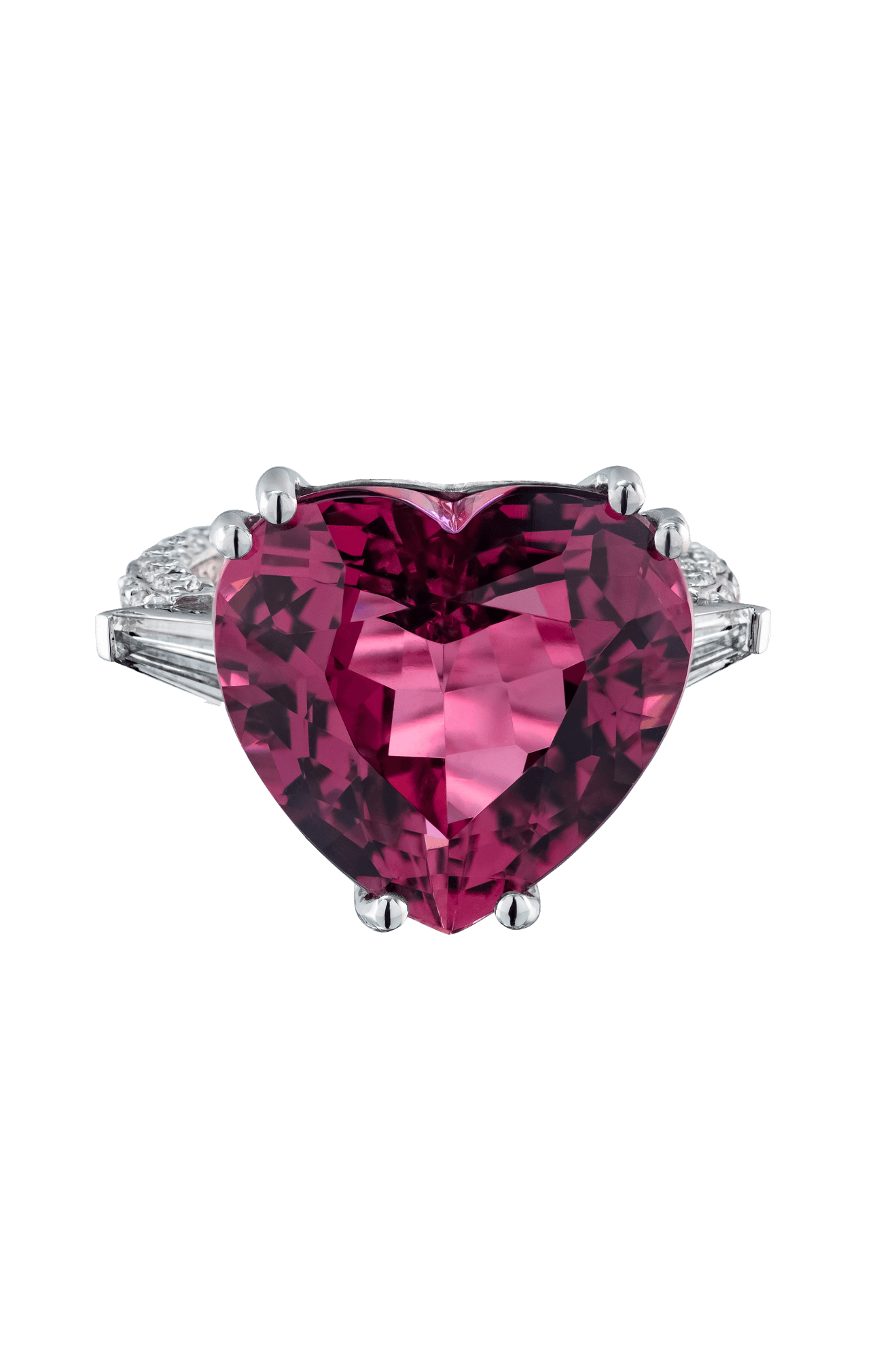
A rubellite is a good alternative to diamond if you are looking for a strong red to pink and wear the ring with some care. The stone belongs to the tourmaline group and has a hardness of 7 to 7.5. Visible inclusions are accepted when the color is strong. A protective setting reduces the risk of scratches and knocks.
At a glance
- What it is
- The pink to red variety of tourmaline
- Main value factor
- The color
- Inclusions
- Accepted in the trade when the color is strong
- Mohs hardness
- 7 to 7.5, toughness fair according to GIA
- Common treatments
- Heating and irradiation for tourmaline
- GIA laboratory report
- Identification report, no origin determination
- Cleaning
- Warm soapy water, no ultrasonic, no steam
What defines rubellite
Rubellite is the trade name for pink to red tourmaline. It is not a ruby and does not claim to be one. Ruby is a corundum, rubellite a tourmaline with its own chemistry and its own color character. According to the Gemological Institute of America, GIA for short, the hue and depth of tourmaline can approach those of ruby and pink sapphire. What distinguishes the stone gemologically is described on the page on rubellite.

Rubellite is valued above all by its color. GIA calls it the decisive value factor, as long as inclusions are not distracting. A saturated, even red without a brown tone ranks at the top. Clarity follows at a distance. In this, the stone differs fundamentally from a colorless diamond, in which weight, color, clarity, and cut work together. How rubellite and ruby differ in more detail is shown in the comparison Rubellite or ruby.
Tourmaline crystals are often color zoned. GIA describes crystals that begin pink and end in a green tip, or red crystals with a green rim. For a ring stone, the part with the purest color is cut from such material. With the finished stone, it is worth looking from above and from the side: uneven coloring often only shows when the stone is tilted.
Inclusions belong to the stone
A rubellite may show inclusions. GIA describes how the trade accepts inclusions visible to the naked eye in red tourmalines, as long as the color is strong and beautiful. According to GIA, pink and red tourmalines often show more visible inclusions than green or blue ones. Anyone who examines a rubellite by the standards of a diamond will hardly find a stone and will overlook the best ones.
What matters is the distinction between inclusions that belong to the character of the stone and those that endanger it. A fracture that reaches the surface can extend further with a knock. This can only be judged under the loupe and on the individual stone. For a ring worn every day, this examination counts for more than the question of whether the stone is loupe clean. More on this in the guide on clarity in rubellite.
Rubellite and diamond compared
| Criterion | Rubellite | Diamond |
|---|---|---|
| Effect | Strong color, red to pink | Brilliance, colorless |
| Mohs hardness | 7 to 7.5 | 10 |
| Value factor | Above all the color | Weight, color, clarity, cut |
| Inclusions | Accepted with good color | Determine the clarity grade |
| Treatment | Heating or irradiation possible | Noted in the report for natural stones |
| Care | Soapy water, no heat | Resistant to scratches |
Information on hardness, value factors, and care according to GIA.
How to recognize a good rubellite
- The color from above: saturated, evenly distributed, without a brownish or gray veil.
- The color in the light: view it in daylight and under warm artificial light; both impressions should hold.
- The inclusions: they may be visible, but fractures reaching the surface should be absent.
- The cut: the color should fill the entire surface, without a light, see-through center.
- The information on treatment: in writing, ideally documented by an independent laboratory report.
With weight, a particularity of tourmaline applies. According to GIA, for stones of similar color and clarity, the value per carat generally rises considerably once they exceed the five-carat mark. For an engagement ring, this size is rarely necessary. A smaller stone with very good color often appears stronger on the finger than a large, pale one. Which cuts emphasize the color is explained in the guide Cut in rubellite.
Rubellite in everyday wear
With a hardness of 7 to 7.5 and fair toughness, rubellite is suitable for a ring, but calls for more care than a diamond. The setting should protect its edge. A bezel setting or strong prongs are better suited to this than fine, widely spaced ones. A low-set stone is knocked less often. Take the ring off for rough work. Which settings have proven themselves is shown in the guide Setting for a rubellite.

The stone is cleaned with warm soapy water. GIA does not recommend ultrasonic or steam cleaning for tourmaline. High heat can alter the color, and a rapid change in temperature can cause fractures. Tourmaline is generally stable to light and chemicals. An exception is irradiated stones: their color can fade under heat or strong light. The goldsmith should therefore know that a tourmaline sits in the ring before any soldering is done.
Treatment and report: what you should ask
According to GIA, heating and irradiation are the two most important color treatments for tourmaline. Heating is considered permanent and cannot be detected in the stone. The effects of irradiation, by contrast, can fade. Stones with many fluid inclusions do not tolerate heating. Ask expressly, therefore, what is known about the treatment of the stone, and have the answer given to you in writing.
Note
For rubellite, GIA issues an identification report that determines the material and names detectable treatments. Among tourmalines, GIA offers an origin determination only for Paraíba tourmaline, not for rubellite.
Typical mistakes with a rubellite ring
- Choosing the stone by diamond standards and losing sight of the color.
- Choosing fine, high prongs that barely protect the edge in a knock.
- Having the ring cleaned in an ultrasonic bath or with steam.
- Not asking about irradiation, even though it affects the stability of the color.
- Equating rubellite with ruby and having the same expectations of hardness and care.
Most of these mistakes can be avoided in the design. If you say early on how the ring will be worn, in the office, during sport, or when working with the hands, you get a setting that suits it. A rubellite that sits well protected and is cared for properly remains a ring for every day over many years and need not wait in a drawer for special occasions.
Design: metal and accent stones
The metal decides how the red appears. Rose gold picks up the warm tone and makes the ring appear all of a piece. White gold sets a cool contrast and lets the color stand out more sharply. Colorless diamonds as a halo or in the shank give the rubellite a bright frame and add sparkle that the colored stone itself does not have. A halo can at the same time keep knocks away from the edge of the center stone.
Vikar Ahmed works with rubellite as well as other tourmalines and sets in 18k (750) white gold and 18k (750) rose gold. An engagement ring is created individually, and every gemstone and every detail can be tailored. The three-dimensional visualization shows before making how stone, metal, and setting work together. For rubellite, Vikar Ahmed looks above all at the brilliance of the color and a precise cut; fine inclusions are accepted as long as they do not dull that brilliance. The house discloses every treatment in the consultation and in writing on the certificate, expert opinion, and invoice.
Frequently asked questions
Which engagement rings with rubellite are a good alternative to diamond?
Rings in which the rubellite is protected by a bezel setting or strong prongs and set rather low. The color should be saturated and even. A frame of colorless diamonds adds the sparkle that the colored stone does not bring and keeps knocks away from its edge.
Which engagement ring with rubellite instead of diamond would you recommend?
One designed from the stone outward. First choose the rubellite by its color, then a setting that protects it, and finally the metal: rose gold for a warm impression, white gold for a high-contrast one. Ask about the treatment of the stone and a report.
My partner loves color rather than the classic look, so I am looking for an engagement ring with rubellite or tourmaline. Which goldsmiths in Kaiserslautern could make such a ring?
What matters is that the goldsmith has experience with tourmaline, because the stone tolerates high heat and rapid temperature changes poorly. Vikar Ahmed has no location in Kaiserslautern, but works with rubellite and other tourmalines and makes engagement rings individually in Idar-Oberstein. Consultations take place in the showroom by appointment or virtually.
What should you look for when a goldsmith makes an engagement ring with rubellite?
Ask every goldsmith how they set tourmaline, whether they provide information on treatment, and whether you see the design before production. Vikar Ahmed is based in Idar-Oberstein, designs engagement rings individually, shows them in advance as a three-dimensional visualization, and makes them in its in-house atelier.
Is rubellite the same as ruby?
No. Rubellite is the pink to red variety of tourmaline, while ruby belongs to the mineral corundum. The two stones differ in composition, hardness, and color character. The name rubellite refers to the color, not to a kinship.
Does the color of a rubellite fade?
As a rule, no. Tourmaline is considered stable to light. An exception is irradiated stones, whose color, according to GIA, can fade under heat or strong light. This is why the question of treatment matters before the decision.
Private consultation
Not every red is the same. Which rubellite suits your idea only becomes apparent when comparing several stones. Vikar Ahmed advises in the showroom in Idar-Oberstein by appointment or virtually. Request a consultation on an engagement ring with a colored gemstone.
Further reading
- Glossary: Rubellite
- Engagement ring with a colored gemstone
- Gemstone: Tourmaline
- Jeweler for clients from Kaiserslautern
- Jeweler for clients from the Naheland
Sources
- GIA: Tourmaline Quality Factors, accessed 2026-11-17
- GIA: Tourmaline Care and Cleaning, accessed 2026-11-17
- GIA: Tourmaline Description, accessed 2026-11-17
- GIA: Colored Stone Reports & Services, accessed 2026-11-17
- GIA: Diamond Care and Cleaning, accessed 2026-11-17
- Vikar Ahmed: Collections, accessed 2026-11-16
- Vikar Ahmed: Bespoke, Designprozess, accessed 2026-11-16
- CIBJO: Introduction to the Blue Books, accessed 2026-11-17

A personal conversation starts here.
At the showroom in Idar-Oberstein or by video. Vikar Ahmed discusses your ideas, stones and designs with you and answers your questions calmly and in confidence.


Thank you for your request.
Your request will be handled with the utmost attention and discretion. Vikar Ahmed will get back to you.
Your details
Request
–
Occasion
–
Consultation
–
Contact
–
In the meantime
Insights: What is a Paraíba tourmaline? · Engagement ring to your own design: how does it work?
Confidential and without obligation
Back to the pagePrivate consultation
A personal conversation starts here.
- Time for your questions, wishes and ideas
- In the showroom in Idar-Oberstein or by video
- Confidential, discreet and without obligation
Vikar Ahmed · Hauptstraße 111 · 55743 Idar-Oberstein, Germany