

Which Cut Suits Rubellite?
With rubellite, the cut determines not only the shape but also how light or dark the color appears. An overview of shapes, orientation, and ease of setting.
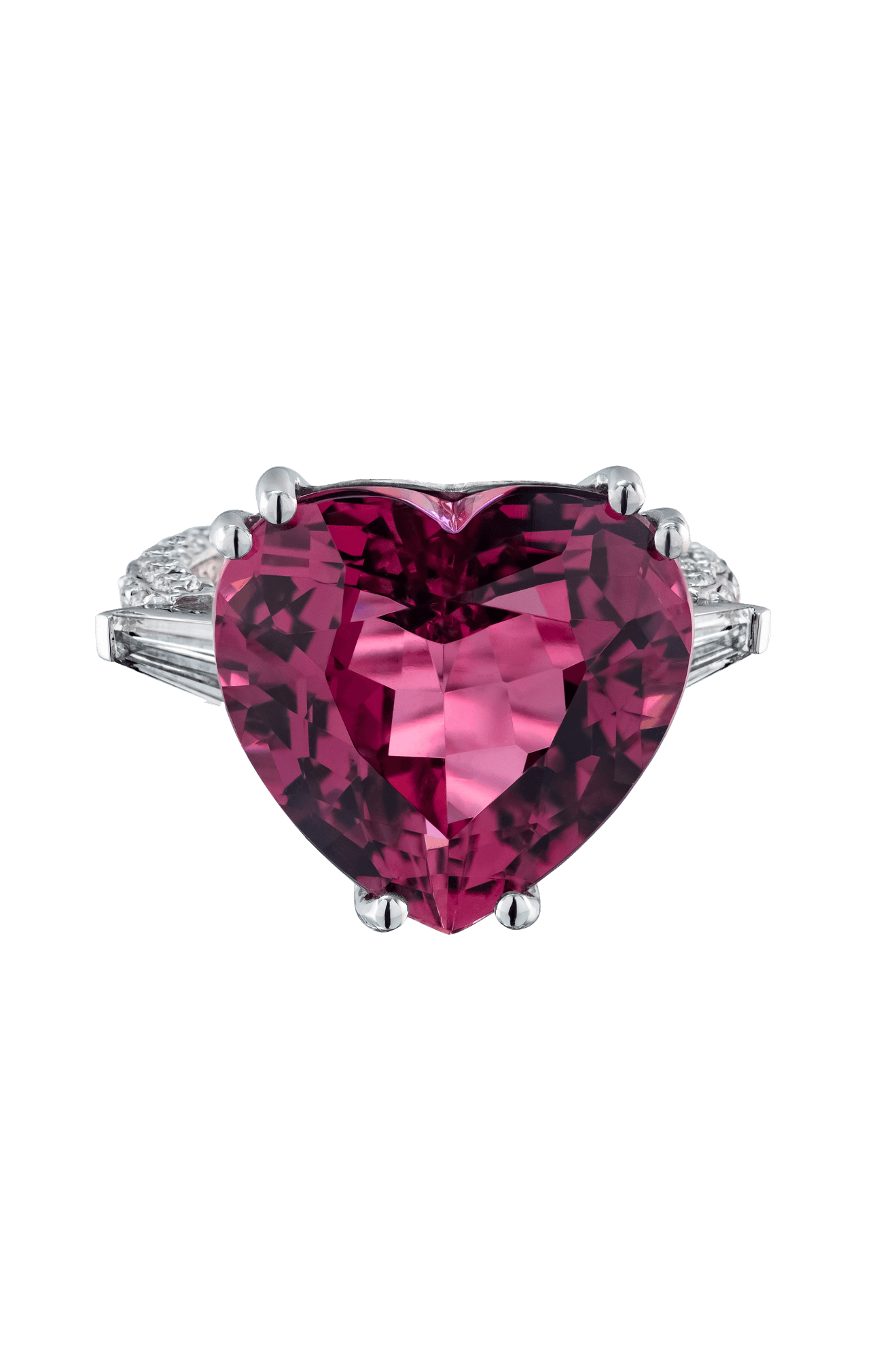
With rubellite, the cut should above all show the color evenly. Because tourmaline is colored differently depending on the viewing direction, the cutter orients light stones differently from dark ones. Ovals, cushions, and elongated rectangles are common and are easy to set. Hearts and pears make a strong statement, but need protection at the point.
At a glance
- Aim of the cut
- Even, strong color rather than maximum sparkle
- Pleochroism
- Strong: along the crystal axis, tourmaline looks darker
- Light stones
- Table perpendicular to the crystal axis, for a more saturated color
- Dark stones
- Crystal axis parallel to the table, so they look lighter
- Typical shapes
- Elongated rectangles, oval, cushion, pear
- Refractive index
- 1.624 to 1.644, considerably below that of diamond
The cut serves the color
In a diamond, the cut is designed for light return and sparkle. In rubellite, the red to pink tourmaline, the aim is different: the color should appear even and saturated, without dark or pale zones. The Gemological Institute of America, GIA for short, names color as the most important quality factor in tourmaline. The cut helps decide how much of it reaches the finished stone.
GIA therefore explicitly advises against compromising on the cut. Poorly cut stones are traded at a discount. At the same time, rough material is valuable, and cutters try to retain as much weight as possible. Every cutting decision lies between these two aims. A stone that was cut too shallow to save weight often looks empty and see-through in the center instead of colored.
Direction in the crystal determines the color
According to GIA, tourmaline is among the most strongly pleochroic gemstones. Pleochroism means that the stone shows different colors or depths of color depending on the viewing direction. In tourmaline, the color seen along the crystal axis is always the darker one. A rubellite can therefore appear deep red when viewed from above and considerably lighter from the side.

For the cutter, this leads to a clear rule, which GIA describes. Light stones are cut so that the table, the large facet on top, lies perpendicular to the crystal axis. You then look along the axis and see the more saturated color. Dark stones are oriented the other way, with the crystal axis parallel to the table, so that they do not look almost black. With very dark material, the pavilion facets along the axis are also cut steeply.
Good to know
If a strongly pleochroic stone is cut with the axis parallel to the table, a dark or light zone in the shape of a bow tie can form, according to GIA. With oval and round shapes, it is therefore worth looking at the center of the stone.
Shapes at a glance
Many tourmaline crystals are long and elongated. According to GIA, this form has a direct effect on the shape and proportions of the cut stone. Cutters therefore frequently produce tourmalines as long rectangles. At the same time, many buyers prefer stones in standard sizes, because they are easier to place in ready-made settings. With an individually made piece, this plays no role: there the setting is built for the stone.
| Shape | Effect | Setting | Suitable for |
|---|---|---|---|
| Oval | Soft, lively, visually elongating | Straightforward, no points | Ring, pendant, necklace |
| Cushion | Calm, holds color well | Rounded corners, well protected | Ring, pieces worn daily |
| Rectangle, emerald cut | Graphic, shows color openly | Cut corners offer protection | Ring, necklace, earrings |
| Pear | Elegant, emphasizes length | Point needs protection | Necklace, drop earrings |
| Heart | Expressive, symbolic | Point and cleft are delicate | Pendant, ring as a one-of-a-kind piece |
Orientation for rubellites. Which shape a stone receives also depends on the rough crystal and its color distribution.
Oval or heart: which is easier to set later
For setting, the oval is the more straightforward shape. It has no points and no cleft, and four or six prongs hold it evenly. The stone can be set lengthwise or crosswise to the finger. With rubellite, the oval also distributes color softly, and smaller inclusions stand out less in the lively pattern of the facets. More about the shape can be found in the glossary under oval cut.
A heart demands more. Its point is the most vulnerable spot of the stone, and the cleft at the top must be cleanly cut for the shape to read as a heart at all. Tourmaline does have a hardness of 7 to 7.5, but GIA rates its toughness as only fair. A V-shaped prong or a bezel at the point is therefore essential. The guide on the rubellite heart ring describes how this is resolved in a ring.
How to recognize a well-cut rubellite
A well-cut rubellite shows an even color from above, without an empty, glassy area in the center. Such an area forms when the stone is too shallow and light passes through it unused. Nor should there be large dark zones that make the stone look heavy. The facets should meet cleanly, and the polish should be smooth and free of cutting marks.

- Even color across the entire table, no see-through center.
- No large dark zones, no conspicuous bow tie in ovals and cushions.
- Symmetrical outline: both halves equal, points centered.
- Clean polish without scratches on edges and corners.
- Proportions that suit the planned setting, especially the depth.
There is no cut grade in the report for rubellite. GIA evaluates tourmaline but does not grade it. How well a stone is cut can only be judged on the stone itself and in comparison with others. It helps to tilt it slowly: a well-cut stone keeps its color, while a poorly cut one becomes pale or dark in places.
The cut in a necklace
In a necklace, the stone hangs vertically and is usually seen from a distance. Elongated shapes such as pear, oval, or a long rectangle follow the line of the chain and emphasize it. Because tourmaline crystals are often long, precisely these shapes can be produced without great loss of weight. A cushion looks calmer and rounder in a necklace, an emerald cut graphic and clear. The guide on the rubellite necklace covers the design of a necklace in more detail.
With several rubellites in one necklace, an additional difficulty arises: all stones should be oriented the same way so that they look equally dark. Two stones from the same material can look visibly different because of different orientation in the crystal. A set of stones is therefore checked side by side, not by measurements. The glossary explains what a collier is as distinct from a necklace.
Typical mistakes when choosing the cut
- Choosing the shape before the color: first the color of the stone, then the shape that carries it.
- Judging a rubellite by its sparkle, like a diamond.
- Looking at a very dark stone from above too uncritically, because it appears lighter under the lamp.
- Having a heart set without a protected point.
- Combining several stones by measurements instead of side by side by color.
Planning cut and design together
The pieces of Vikar Ahmed include rubellites as well as emerald cut and radiant cut stones. An individual piece is created at the house through design, three-dimensional visualization, and realization in the in-house atelier. Alongside the brilliance of the color, a precise cut is the most important criterion for rubellite at Vikar Ahmed. The visualization makes it possible to check how the shape, size, and setting of the stone look on the ring or necklace before production. If you want to compare different cuts directly at the appointment, mention it in your request.
Frequently asked questions
Which rubellite necklaces show the stone to best effect with a suitable cut?
Necklaces whose stones follow the line of the chain: pears, ovals, or long rectangles, oriented so that the color appears even and not too dark. With several stones, what matters is that all look alike. A setting that encloses points and corners protects the stone when worn.
Oval cut or heart shape for a loose rubellite: which is more beautiful to set later?
The oval cut is easier and more secure to set, because it has neither a point nor a cleft. The heart shape is more expressive, but needs a V-prong or bezel at the point and a very symmetrical cut. The more beautiful shape is the one that suits the planned piece of jewelry and the color of the stone.
Why does a rubellite look lighter from the side than from above?
Because tourmaline is strongly pleochroic. Along the crystal axis its color appears darker than across it. Depending on how the cutter oriented the stone within the crystal, you see the darker or lighter color from above. From the side, you look in a different direction.
Does a rubellite sparkle as strongly as a diamond?
No. According to GIA, tourmaline refracts light considerably less than diamond, with a refractive index of 1.624 to 1.644. A rubellite is therefore cut to show its color, not maximum sparkle. A well-cut stone looks lively, but colored rather than glittering white.
Does the laboratory report give a cut grade for rubellite?
No. GIA does not assign quality grades for tourmaline, and therefore no cut grade either. The report states species, measurements, weight, and detectable treatments. The quality of the cut is judged on the stone: even color, no empty center, clean polish, and a symmetrical outline.
Which shape suits a rubellite in a ring worn every day?
Shapes without pointed corners, above all oval and cushion. Tourmaline is hard enough for everyday wear, but not particularly tough. Rounded edges and a setting that protects the rim reduce the risk of chipping. An emerald cut is also well protected by its cut corners.
Private consultation
Which cut shows the color of your rubellite best is decided by the stone and the planned piece of jewelry. Vikar Ahmed advises in the showroom in Idar-Oberstein by appointment, and on request also in a virtual appointment. Request an appointment for a private consultation.
Further reading
- Glossary: Oval cut
- The rubellite heart ring: stone, cut, and setting
- How important is clarity in rubellite?
- Gemstone: Rubellite
- Glossary: Emerald cut
Sources
- GIA, Gems & Gemology: Pleochroism in Faceted Gems, an Introduction (Herbst 2014), accessed 2026-11-17
- GIA: Tourmaline Quality Factors, accessed 2026-11-17
- GIA: Tourmaline Buyer's Guide, accessed 2026-11-17
- GIA: Tourmaline, Quick Facts, accessed 2026-11-17
- GIA: Tourmaline Care and Cleaning, accessed 2026-11-17
- Vikar Ahmed: Collections, accessed 2026-11-16
- Vikar Ahmed: Bespoke, Designprozess, accessed 2026-11-16

A personal conversation starts here.
At the showroom in Idar-Oberstein or by video. Vikar Ahmed discusses your ideas, stones and designs with you and answers your questions calmly and in confidence.


Thank you for your request.
Your request will be handled with the utmost attention and discretion. Vikar Ahmed will get back to you.
Your details
Request
–
Occasion
–
Consultation
–
Contact
–
In the meantime
Insights: What is a Paraíba tourmaline? · Engagement ring to your own design: how does it work?
Confidential and without obligation
Back to the pagePrivate consultation
A personal conversation starts here.
- Time for your questions, wishes and ideas
- In the showroom in Idar-Oberstein or by video
- Confidential, discreet and without obligation
Vikar Ahmed · Hauptstraße 111 · 55743 Idar-Oberstein, Germany