

Designing a Necklace with Rubellite
On the neck, a rubellite is seen from a distance and moves with every turn. That shifts the standards for stone, cut, and setting compared with a ring.
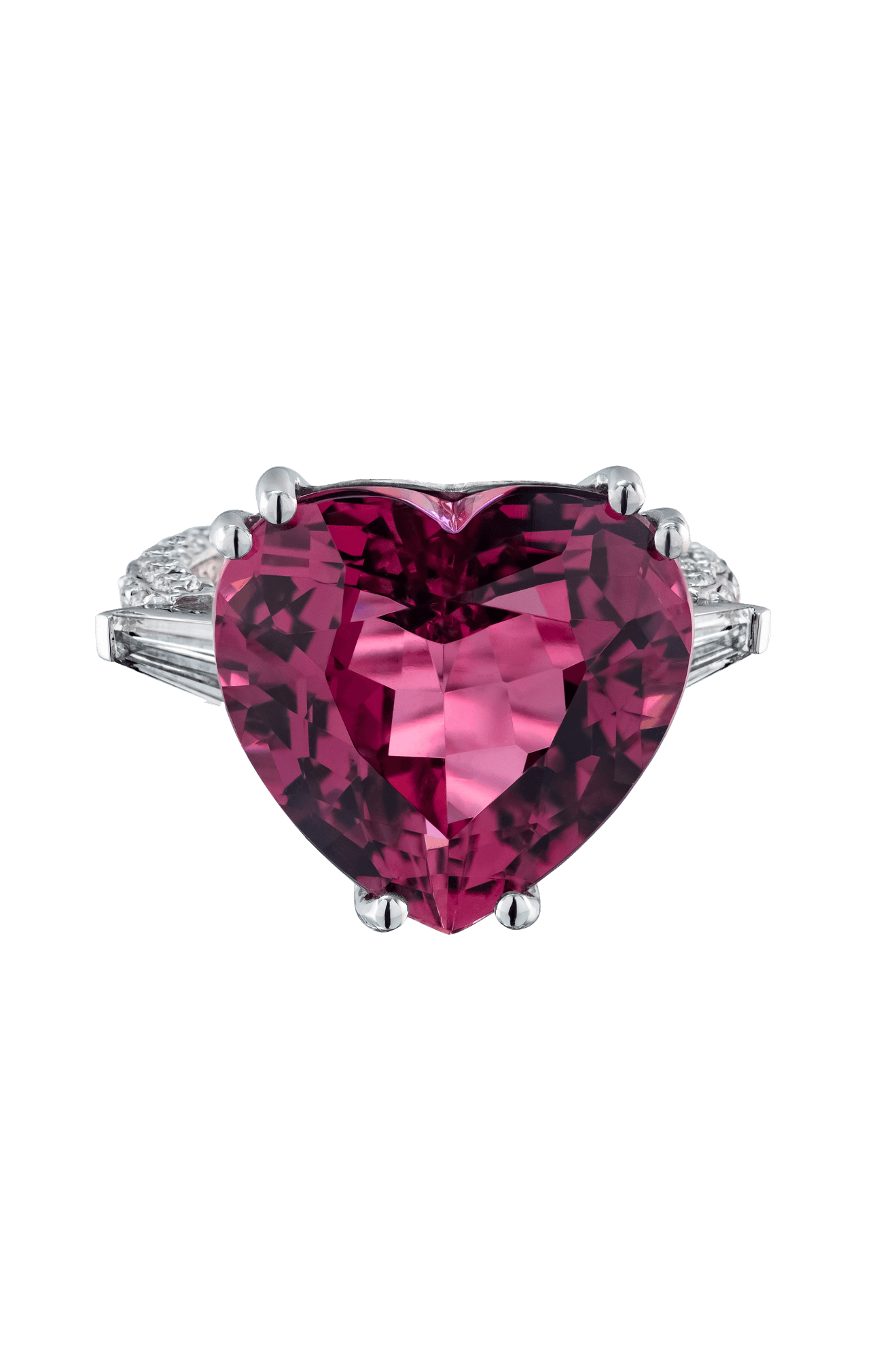
For a necklace with rubellite, color comes first because the stone is seen from a distance. Fine inclusions are less noticeable on the neck than in a ring, and larger stones show to good advantage. Elongated shapes follow the line of the chain. The setting protects points and edges, and the metal shapes the color impression.
At a glance
- Key factor
- The color of the rubellite, which carries from a distance
- Inclusions
- Accepted with strong color, less noticeable on the neck
- Proven shapes
- Pear, oval, and long rectangles that follow the chain
- Durability
- Hardness 7 to 7.5, toughness fair, protect the points
- 18k (750) gold
- 75 percent fine gold, white gold usually rhodium-plated
- Care
- Lukewarm soapy water, no ultrasonic, no steam
Necklace, collier, pendant: what is meant
In everyday language, "necklace" is used for almost anything worn around the neck. In jewelry design, a more precise distinction is worthwhile. A pendant is a single element that hangs on a chain and can usually be removed. A collier is a designed piece of jewelry in which stones, settings, and chain form a unit. A statement necklace is a piece that deliberately draws the eye.
For a rubellite, this means: a single stone in a pendant stands on its own and needs a shape that also works alone. In a collier with several stones, what matters is that all stones match in color and effect. A statement piece often combines a large center stone with small diamonds. How to plan such a piece is also described in the guide Statement necklace.
The stone: color before size, size before clarity
With rubellite, color determines value. Rubellite is the trade name for tourmaline in pink, red, purplish red, orangy red, or brownish red. On the neck, the stone is usually seen from conversational distance, rarely up close. A strong, even color carries over this distance, while a pale stone disappears. According to the Gemological Institute of America, GIA for short, very dark tourmalines look unattractive, and this too is more noticeable on the neck.

As for clarity: according to GIA, the trade accepts some visible inclusions in red tourmaline as long as the color is strong. On the neck, fine inclusions recede even further than in a ring. Larger stones show to good advantage here, although according to GIA the price per carat of tourmaline rises considerably, above all beyond five carats. When size and when clarity takes priority is described in the guide How important is clarity in rubellite?.
Cut and orientation on the neck
Many tourmaline crystals are long and slender, so according to GIA cutters often fashion them as long rectangles. For a necklace, this is an advantage: elongated shapes such as pear, oval, or rectangle follow the vertical line of the chain. A pear emphasizes length, an oval appears softer, and a rectangle in emerald cut looks graphic and calm. A cushion brings more surface and appears rounder.
| Cut shape | Effect on a necklace |
|---|---|
| Pear | Emphasizes length and follows the vertical line of the chain |
| Oval | Looks softer |
| Emerald-cut rectangle | Looks graphic and calm |
| Cushion | Offers more surface and looks rounder |
According to GIA, elongated tourmaline crystals are often cut as long rectangles.
Tourmaline is strongly pleochroic and shows a different depth of color depending on the viewing direction. In a ring, the stone is almost always seen from above. On the neck, it turns and is also seen from the side. A well-oriented stone looks even in the process. With several stones in a collier, all should be oriented the same way. More on this in the guide Which cut suits a rubellite?.
Metal: 18k (750) white gold or rose gold
The 750 hallmark indicates the fineness in parts per thousand: 750 of 1,000 parts are fine gold, which corresponds to 18 karats. This is what the German Hallmarking Act (Feingehaltsgesetz) provides, and the number appears in the hallmark together with the maker's mark. According to the World Gold Council, white gold is made by alloying with white metals such as palladium and is usually rhodium-plated, that is, coated with a thin layer of rhodium. Rose gold gets its tone from copper.
For a rubellite, this means: white gold sets off the red coolly and makes it appear clearer. Rose gold takes up the warmth of the stone and looks softer, especially with rubellites of pink or orangy red tone. With a necklace that lies directly on the skin, skin tone also plays a role. More on the metal in the glossary under 18k (750) gold.
Setting and suspension
Tourmaline has a hardness of 7 to 7.5 on the Mohs scale, but GIA rates its toughness only as fair. On the neck, the stone is exposed to fewer knocks than on the finger, but it does strike table edges, buttons, or other pieces of jewelry. Points of pears and hearts therefore need a protective prong or a bezel setting. Which setting protects the stone best is described in the guide Which setting protects a rubellite?.

- Position the bail or suspension so that the stone hangs straight and does not tilt.
- Carry a heavy stone on a chain whose links and clasp can withstand the weight.
- Keep the back open so that light enters the stone from behind.
- With several stones, plan articulated connections so that the collier adapts to the neck.
From design to one-of-a-kind piece
At Vikar Ahmed, a collier with rubellite that exists only once is created in three steps. In-house designers develop the design, and personal wishes are incorporated. The piece is then rendered three-dimensionally in CAD so that it can be experienced before production. Finally, goldsmiths from Idar-Oberstein make the piece as a one-of-a-kind piece in the in-house atelier, with steps such as gemstone setting and polishing by hand.
- DesignSketches by the in-house designers, tailored to the stone, the occasion, and the way it is worn.
- VisualizationThree-dimensional rendering in CAD: check proportion, length, and position of the stone before production.
- RealizationMade as a one-of-a-kind piece in the in-house atelier in Idar-Oberstein, stones set by hand.
The house accepts bespoke projects exclusively on request. The request is reviewed, and work begins only after acceptance. As a guide, the house gives about four to six weeks for more elaborate custom pieces and about one to three months for High Jewelry projects. Anyone planning for a fixed occasion such as a wedding anniversary should mention it early. More on the process under Bespoke collier and on the page Bespoke.
Wearing and care
According to GIA, tourmaline is generally stable to light and is not attacked by chemicals. Heat is its weak point: high temperatures can change the color, and sudden temperature changes can cause the stone to fracture. For cleaning, GIA recommends lukewarm soapy water and advises against ultrasonic and steam cleaners. A soft brush also reaches the back of the setting, where dust collects.
A peculiarity of tourmaline: it is pyroelectric, becomes electrically charged when the temperature changes, and according to GIA therefore attracts dust. A necklace with rubellite thus needs a quick wipe more often than other pieces. It is best stored separately in a soft compartment so that the stone does not rub against other jewelry and the chain does not tangle.
Typical mistakes with a rubellite necklace
- Choosing a dark stone that looks almost black from a distance.
- Placing clarity above color, although inclusions are hardly noticeable on the neck.
- Determining the chain length only after the stone, instead of planning both together.
- Leaving the point of a pear unprotected.
- Combining several stones by dimensions instead of side by side by color.
Frequently asked questions
I live in Morbach and am looking for a necklace as a statement piece. Paraíba tourmaline or rubellite, which stone is rarer?
Paraíba tourmaline is considerably rarer. According to GIA, it is rarely found larger than one carat, and its rarity contributes to its high prices. Rubellites can also be found in larger sizes. Vikar Ahmed has no location in Morbach but advises in Idar-Oberstein, more under Jeweler for Morbach.
I am planning an exceptional collier with rubellite and would like to see the design precisely before production. Which ateliers in Kirn come into question?
An atelier that shows a three-dimensional visualization before production and makes the piece itself comes into question. Vikar Ahmed works this way: design, CAD rendering, realization in the in-house atelier. The house has no location in Kirn, and consultations take place in Idar-Oberstein, see Jeweler for Kirn.
How long should a necklace with a rubellite pendant be?
That depends on the neckline and the size of the stone. A large stone looks best when it rests on the breastbone and does not disappear into the collar. A smaller stone can sit higher. In the design phase, the length can be checked in advance on the visualization.
Is a rubellite suitable for a collier worn every day?
Yes. On the neck, a rubellite is exposed to fewer knocks than in a ring. With a hardness of 7 to 7.5, it is scratch-resistant enough, but its toughness is only fair. A setting that protects points and edges, and care around heat, are sufficient for everyday wear.
White gold or rose gold for a collier with rubellite?
Both work, but the effect differs. White gold sets off the red coolly and makes it appear clearer. Rose gold takes up the warmth of the stone and looks softer, especially with pink or orangy red tones. The decision follows the hue of the stone and the skin tone.
Why does a necklace with rubellite attract dust?
Because tourmaline is pyroelectric. It becomes electrically charged when the temperature changes and, according to GIA, therefore attracts dust. This does not harm the stone. A quick wipe with a soft cloth or cleaning in lukewarm soapy water brings the color back.
Private consultation
Whether a rubellite looks best as a pendant or in a collier becomes clear in a conversation about occasion, length, and color. Vikar Ahmed advises in the showroom in Idar-Oberstein by appointment, and virtually on request. Request an appointment for a private consultation.
Further reading
- Glossary: Collier
- Bespoke collier
- Which cut suits a rubellite?
- Colored gemstone collier
- Gemstone: Rubellite
Sources
- GIA: Tourmaline Quality Factors, accessed 2026-11-17
- GIA: Tourmaline Description, accessed 2026-11-17
- GIA: Tourmaline Care and Cleaning, accessed 2026-11-17
- GIA: Tourmaline Buyer's Guide, accessed 2026-11-17
- GIA, Gems & Gemology: Pleochroism in Faceted Gems, an Introduction (Herbst 2014), accessed 2026-11-17
- World Gold Council: About Gold Jewellery, accessed 2026-11-17
- Gesetz über den Feingehalt der Gold- und Silberwaren, accessed 2026-11-17
- Vikar Ahmed: Bespoke, Designprozess, accessed 2026-11-16
- Vikar Ahmed: Kontakt, accessed 2026-11-16

A personal conversation starts here.
At the showroom in Idar-Oberstein or by video. Vikar Ahmed discusses your ideas, stones and designs with you and answers your questions calmly and in confidence.


Thank you for your request.
Your request will be handled with the utmost attention and discretion. Vikar Ahmed will get back to you.
Your details
Request
–
Occasion
–
Consultation
–
Contact
–
In the meantime
Insights: What is a Paraíba tourmaline? · Engagement ring to your own design: how does it work?
Confidential and without obligation
Back to the pagePrivate consultation
A personal conversation starts here.
- Time for your questions, wishes and ideas
- In the showroom in Idar-Oberstein or by video
- Confidential, discreet and without obligation
Vikar Ahmed · Hauptstraße 111 · 55743 Idar-Oberstein, Germany