

Having a Custom Necklace Made
A necklace lies close to the face and is often worn on special occasions. Anyone who has one made is planning a piece that is meant to endure for many years.
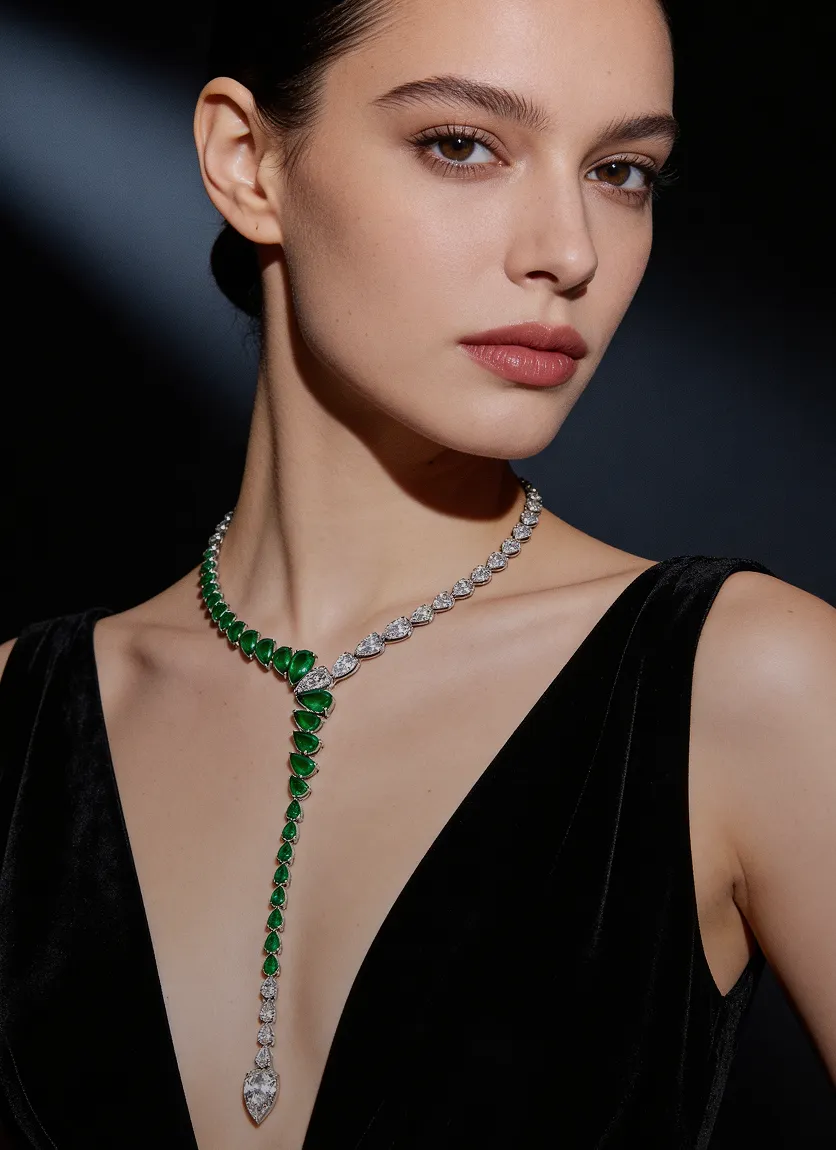
A custom necklace is planned from three questions: where it should lie on the neck, which stone is at the center, and how links and clasp carry the weight. For an emerald, an identification report is sufficient if species and treatment matter. An origin report is added if the origin is meant to be part of the value. Platinum and 18k (750) white gold are both suitable.
At a glance
- Necklace
- Neck jewelry designed as a whole, usually worn close to the neck
- Identification report
- Determines the material and names detectable treatments
- Origin report
- Identification plus geographic origin, only for certain stones
- Emerald, hardness
- 7.5 to 8 on the Mohs scale, toughness fair to good
- Emerald, filling
- By estimates, 90 percent or more are fissure-filled
- Platinum 950
- 95 percent platinum, denser and stronger than gold
- 18k (750) white gold
- 75 percent fine gold, usually rhodium-plated
Three questions shape the necklace
A necklace is more than a chain with a stone. It is designed as a whole, and its parts support one another. With a custom piece, three questions therefore come first. Where should the necklace lie: close to the neck, on the collarbone, or lower in the neckline. Which stone is at the center, and does it need a report. And how are weight and movement distributed across links and clasp.

The order matters. The position on the neck determines how large the center stone may appear and how much weight the necklace can carry. The stone determines setting and metal. Only then follow ornamentation, side stones, and details. Anyone who first settles on a large stone and then looks for the form easily ends up with a necklace that tilts, presses, or suits only a single dress.
Length, position, and structure
A close-fitting necklace looks formal and draws the eye to neck and face. A necklace that lies on the collarbone is more versatile and can be worn with more necklines. Lower-hanging forms suit a single large stone, but need a counterweight at the nape so that the clasp does not move forward. Not only the neck circumference is measured, but also the line on which the necklace is to lie.
- Center stone on a fine chain: calm, versatile, the stone carries the piece on its own.
- Graduation: stones increase in size toward the center and guide the eye.
- Set links all around: looks unified and festive, requires a very precise measurement.
- Detachable center section: the same necklace is worn more simply or more festively.
- Rivière: a continuous row of individually set stones of the same kind.
If you are planning a necklace for a specific occasion, such as a wedding, and wish to wear it later at evening events, you should consider the second use from the outset. A detachable center section or a stone that also works on a simple chain makes the piece versatile. How a necklace of colored stones differs from a pure diamond necklace is shown in the guides Colored stone necklace and Assessing diamond necklaces.
The emerald in a necklace
An emerald is a classic center stone for a necklace. According to the Gemological Institute of America, GIA for short, it ranks 7.5 to 8 on the Mohs scale, and its toughness is fair to good. It requires more care in wear than ruby or sapphire. In a necklace it is better protected than in a ring, because it is knocked less often. This makes it a good choice for a large piece that is not worn every day.
Almost every emerald has fissures. GIA cites estimates according to which 90 percent or more of all emeralds are fissure-filled, with oil, resins, or polymers. The Swiss Gemmological Institute SSEF states the type and amount of filling in its reports, in the grades no indications, minor, moderate, and significant. Under the rules of the World Jewellery Confederation (CIBJO), such a treatment must be disclosed. Heat, ultrasound, and steam can alter or remove the filling.
Good to know
According to GIA, the emerald cut with its beveled corners is the most common cut for this stone. The corners offer a comparatively safe place for prongs. This is as useful in a necklace as in a ring.
Identification report or origin report
An identification report determines the material and names the detectable treatments. For an emerald, it answers the most important questions: is it a natural emerald, and is it filled. An origin report adds the geographic origin. GIA offers it only for certain natural stones, among them emerald, ruby, sapphire, and Paraíba tourmaline. At the same time, it points out that the origin cannot be determined in every case.

SSEF describes origin determination as an expert opinion. It is based on microscopic features, trace elements, and spectroscopic data, which are compared with a reference collection of stones of known origin. For the decision, this means: the origin report makes sense if the origin, such as Colombia, is meant to be part of the value. If beauty and treatment are what matter, the identification report is sufficient. More in the glossary under Origin report.
| Question | Identification report | Origin report |
|---|---|---|
| Which stone it is | Yes | Yes |
| Detectable treatments | Yes | Yes |
| Geographic origin | No | Yes, as the laboratory's assessment |
| For which stones | For any material | Only certain natural stones, such as emerald |
| Useful when | Species and treatment matter | The origin is part of the value |
Based on the GIA report types. Other laboratories such as SSEF or Gübelin name their reports differently; the logic is comparable.
A practical point concerns timing. The stone is best examined before it is set. SSEF issues a Gemstone Report for a single unmounted stone and a Test Report for stones in jewelry. Once the stone is in the necklace, some features are less accessible. Which laboratories exist and how they work is explained in the glossary under SSEF and Gübelin.
Paraíba tourmaline as center stone
Paraíba tourmaline is a blue to green tourmaline whose color, according to SSEF, is mainly due to copper and manganese. It takes its name from the Brazilian locality where it was found. Today, stones with the same characteristics also come from Nigeria and above all from Mozambique. According to SSEF, Paraíba tourmalines are frequently heated. Because the origin influences the name and often the assessment as well, an origin report is particularly informative for a large center stone.
Larger stones are rare: according to GIA, Paraíba tourmalines seldom occur above one carat, and color counts more than size. For a necklace, this means that a Paraíba as center stone usually turns out smaller than an emerald and is carried by diamonds or by the form of the necklace. Tourmaline ranks 7 to 7.5 on the Mohs scale and does not tolerate rapid changes in temperature. More on the stone under Paraíba tourmaline.
Platinum or 18k (750) white gold
Both metals make colored stones appear cool and clear. Platinum is often worked as platinum 950, meaning 950 parts platinum per 1,000. According to GIA, it is denser and stronger than gold, its prongs break less often, and it is considered skin-friendly. A platinum necklace becomes noticeably heavier due to the higher density. 18k (750) white gold contains 75 percent fine gold and is usually rhodium-plated. The rhodium layer wears off over time and is then renewed.
Three things count for the choice. First, weight: a large necklace in platinum can become noticeable at the nape. Second, the settings: where many small prongs hold a valuable stone, their strength speaks for platinum. Third, care: platinum needs no plating, white gold occasionally needs a new layer. In case of a nickel allergy, the white gold alloy should be clarified. More under Platinum 950 and 18k (750) gold.
Common mistakes with a custom necklace
- Settling on the stone before the position on the neck is clear: the size then often does not suit the form.
- Underestimating the weight: a heavy center section pulls the clasp forward.
- Requesting the report only after setting: the details are more complete on the loose stone.
- Cleaning a filled emerald with ultrasound: the filling can come loose.
- Thinking only of the occasion: a necklace that can be reconfigured is worn more often.
A necklace as a one-of-a-kind piece by Vikar Ahmed
Vikar Ahmed makes jewelry as one-of-a-kind pieces in its in-house atelier in Idar-Oberstein. The stones in the pieces shown include Colombian emerald, Brazilian Paraíba tourmaline, and diamonds. Paraíba jewelry is made in-house in 18 karat gold, platinum, and with diamonds. The path leads from the design through three-dimensional visualization to realization. For high-quality emeralds and Paraíbas from 1 carat, a report with origin determination is standard at the house, issued by Gübelin, SSEF, GRS, or the DGemG. Verify the report online where the laboratory offers this.
Frequently asked questions
Origin report or identification report only: what do I need for an emerald in a custom necklace?
The identification report is sufficient if you wish to know whether the emerald is natural and how heavily it is filled. The origin report is worthwhile if the origin, such as Colombia, is meant to be part of the value. Both should be prepared before setting.
Which bespoke jewelers offer Paraíba tourmalines for a custom necklace?
What matters: a stone with a laboratory report on species, treatment, and if possible origin, and a workshop that makes the design visible in advance. Vikar Ahmed calls Paraíba tourmaline the heart of the house and creates Paraíba jewelry as one-of-a-kind pieces in Idar-Oberstein.
Platinum or 18k (750) white gold for a custom necklace?
Both are suitable. Platinum is stronger, needs no plating, and holds prongs particularly securely, but is heavier. 18k (750) white gold is lighter and usually rhodium-plated; the layer is renewed occasionally. For large necklaces, weight often speaks for white gold; for valuable center stones, strength speaks for platinum.
How do I arrange a private consultation in Idar-Oberstein for an anniversary necklace?
Vikar Ahmed advises in the showroom at Hauptstraße 111 in Idar-Oberstein by appointment, and on request first in a virtual appointment. In-house designers develop the design, and personal wishes are incorporated. More under Jeweler in Idar-Oberstein.
Is an emerald robust enough for a necklace?
Yes, in a necklace even more so than in a ring, because it is knocked less often. At 7.5 to 8 on the Mohs scale it is scratch-resistant, but because of its fissures it is sensitive to impact, heat, and ultrasound. A setting with protected corners and gentle cleaning with lukewarm soapy water are sufficient.
Can a necklace be planned to suit different occasions?
Yes, for example with a detachable center section or a stone that also works on a simple chain. In this way, a festive necklace becomes one piece for the evening and one for the day. This solution must, however, be built into the design from the outset.
Private consultation
A custom necklace begins with the occasion, the stone, and the question of how you wish to wear it. Vikar Ahmed handles such inquiries discreetly, in the house's showroom in Idar-Oberstein by appointment or initially virtually. Request an appointment for a private consultation.
Further reading
- Colored stone necklace
- Statement necklace
- Origin statements for colored stones
- Gemstone: Emerald
- Bespoke: the path to a one-of-a-kind piece
Sources
- GIA: Colored Stone Reports, accessed 2026-11-17
- GIA: FAQ Gemstone Country of Origin Reports, accessed 2026-11-17
- SSEF: Emerald, accessed 2026-11-17
- SSEF: Understanding a SSEF report, accessed 2026-11-17
- SSEF: Paraiba tourmaline, accessed 2026-11-17
- GIA: Emerald Care and Cleaning, accessed 2026-11-17
- GIA: Emerald Quality Factors, accessed 2026-11-17
- GIA: Tourmaline Quality Factors, accessed 2026-11-17
- GIA 4Cs: Picking the Right White Metal, accessed 2026-11-17
- Vikar Ahmed: Paraíba, accessed 2026-11-16
- Vikar Ahmed: Collections, accessed 2026-11-16
- Vikar Ahmed: Kontakt, accessed 2026-11-16

A personal conversation starts here.
At the showroom in Idar-Oberstein or by video. Vikar Ahmed discusses your ideas, stones and designs with you and answers your questions calmly and in confidence.


Thank you for your request.
Your request will be handled with the utmost attention and discretion. Vikar Ahmed will get back to you.
Your details
Request
–
Occasion
–
Consultation
–
Contact
–
In the meantime
Insights: What is a Paraíba tourmaline? · Engagement ring to your own design: how does it work?
Confidential and without obligation
Back to the pagePrivate consultation
A personal conversation starts here.
- Time for your questions, wishes and ideas
- In the showroom in Idar-Oberstein or by video
- Confidential, discreet and without obligation
Vikar Ahmed · Hauptstraße 111 · 55743 Idar-Oberstein, Germany