

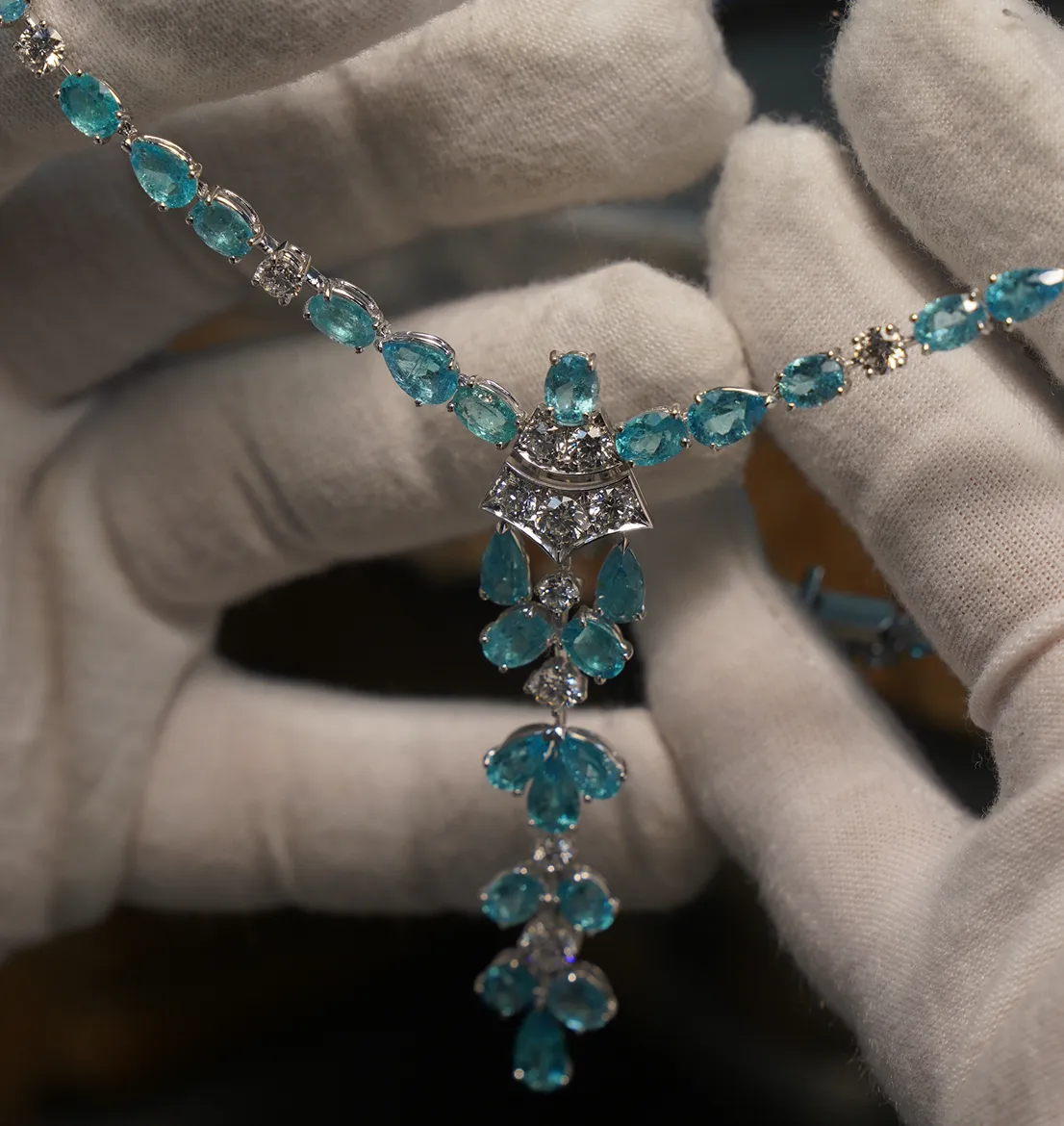
An origin report is the finding of a gemological laboratory stating the country or region a gemstone comes from. It is based on the examination of the stone itself, for example its trace elements, and is an expert opinion. Laboratories state the origin only when it can be determined, and only for certain types of stone.
At a glance
- Statement
- Geographic origin of a stone
- Basis
- Laboratory analysis, chemical for Paraíba tourmaline
- Available at GIA for
- Emerald, ruby, sapphire, Paraíba tourmaline and a few others
- Reservation
- Only when the origin can be determined
- Distinction
- Identification report names the stone and testing for treatment
What the report states
The origin report adds a geographic statement to the identification. At GIA, it is an identification report with additional origin and is issued only for certain stones: alexandrite, demantoid, emerald, jade, opal, Paraíba tourmaline, peridot, red spinel, ruby and sapphire. SSEF also examines the origin of gemstones. If the origin cannot be determined, the statement remains open. A missing origin note is therefore not a shortcoming of the stone.
Why origin is difficult to determine
Stones from different countries can look the same. With Paraíba tourmaline, standard gemological tests do not reliably separate the source countries Brazil, Nigeria and Mozambique, and only the measurement of trace elements allows a statement. The origin in the report is the result of an analysis and not a record of the stone's journey. When it matters for a decision is covered in the guide origin statements for colored gemstones.
Frequently asked questions
Engagement ring with or without an origin report, does it make a difference?
Not for wearing, the ring is the same with or without a report. It makes a difference if it matters to you where the stone comes from, or if the origin is part of its rarity, as with some colored gemstones. For diamonds, the report on the 4Cs takes precedence.
Origin report or identification report, which documentation makes more sense for a Paraíba tourmaline in a bespoke piece?
Identification is indispensable, because it confirms that the stone rightly bears the name Paraíba tourmaline. Origin is the complement for anyone to whom Brazil, Nigeria or Mozambique as the source country matters. A report that contains both is the sensible choice.
Are GIA or origin reports available for Vikar Ahmed's Paraíba tourmalines?
Yes. According to Vikar Ahmed, a report with origin determination is standard for high-quality colored gemstones such as Paraíba from 1 carat, and for Brazilian Paraíba often well below that. For colored gemstones he works with Gübelin, SSEF, GRS and the DGemG. An origin is reliable when the report states it expressly.
Private consultation
Questions about the origin of a stone belong at the beginning of a project. Vikar Ahmed answers them in a personal conversation, in the showroom in Idar-Oberstein by appointment or in a virtual meeting. Request a private consultation.
Further reading
- Authenticity and certificates at a glance
- Guide: Origin statements for colored gemstones
- Glossary: GIA report
- Glossary: SSEF and Gübelin
- Glossary: Paraíba tourmaline
Sources
- GIA: Compare Colored Stone Reports, accessed 2026-11-16
- GIA, Gems & Gemology Winter 2019: Paraíba Tourmaline, Geographic Origin Determination, accessed 2026-11-16
- SSEF: About SSEF, Schweizerisches Gemmologisches Institut, accessed 2026-11-16
- Vikar Ahmed: Meisterstücke und Kollektionen, accessed 2026-11-16

A personal conversation starts here.
At the showroom in Idar-Oberstein or by video. Vikar Ahmed discusses your ideas, stones and designs with you and answers your questions calmly and in confidence.


Thank you for your request.
Your request will be handled with the utmost attention and discretion. Vikar Ahmed will get back to you.
Your details
Request
–
Occasion
–
Consultation
–
Contact
–
In the meantime
Insights: What is a Paraíba tourmaline? · Engagement ring to your own design: how does it work?
Confidential and without obligation
Back to the pagePrivate consultation
A personal conversation starts here.
- Time for your questions, wishes and ideas
- In the showroom in Idar-Oberstein or by video
- Confidential, discreet and without obligation
Vikar Ahmed · Hauptstraße 111 · 55743 Idar-Oberstein, Germany