

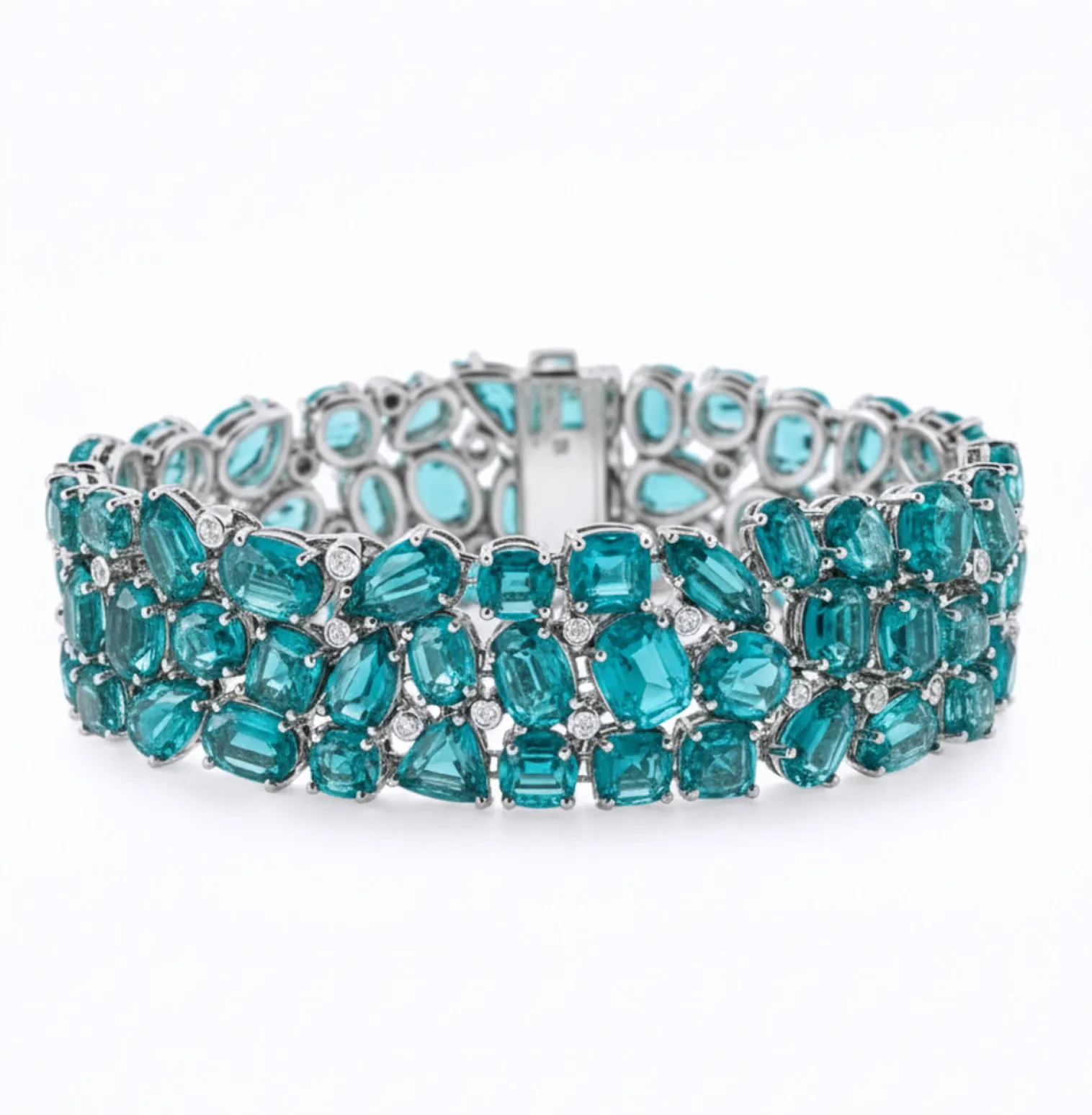
Paraíba tourmaline is a tourmaline in blue, blue-green or green whose color is caused mainly by copper and manganese. It is named after the Brazilian state of Paraíba, where it was discovered in the late 1980s. Under the laboratories’ definition, the name applies regardless of the country of origin. What matters is the cause of color.
At a Glance
- Mineral
- Tourmaline
- Color
- Blue, blue-green to green with striking brilliance
- Cause of color
- Copper and manganese
- Countries of origin
- Brazil, Nigeria, Mozambique
- Mohs hardness
- 7 to 7.5
- Common treatment
- Heat treatment, not always detectable in the laboratory
Copper makes the difference
Tourmalines occur in almost every color. In most of them, blue and green are caused by iron. In Paraíba tourmaline, copper takes on this role, together with manganese. The result is a blue to green of a brilliance the trade describes as neon. The first stones came from the state of Paraíba in northeastern Brazil, later from the neighboring state of Rio Grande do Norte. Finds in Nigeria and Mozambique followed in the early 21st century.
What name and origin mean in a report
The name says nothing about the country of origin. Laboratories call every tourmaline of this color a Paraíba tourmaline if copper and manganese cause it. Origin is a separate statement. It cannot be determined reliably with standard gemological tests and requires chemical analysis in the laboratory. More on this under origin report. How the trade describes the color is explained in the entry neon quality.
Frequently asked questions
Paraíba tourmaline from Batalha or from other localities: can you see the difference?
The locality cannot be identified reliably with the naked eye. According to GIA, even standard gemological tests do not reliably separate stones from Brazil, Nigeria and Mozambique. Only chemical analysis of the trace elements allows a statement on origin.
Does Vikar Ahmed disclose whether its Paraíba tourmalines are treated?
Yes. According to Vikar Ahmed, every treatment is disclosed openly, in the consultation and in writing on the certificate, the expert report and the invoice. He works with heated and unheated Paraíba tourmalines, and the laboratory finding states “heated” or “no indications of heating”. As a matter of gemology, heating is not always detectable in the laboratory. A careful disclosure therefore states what was tested and with what result.
White gold or rose gold: which metal shows the blue of a Paraíba tourmaline to better advantage?
White gold recedes and lets the cool blue stand on its own, while rose gold makes the piece softer. For Paraíba tourmalines, Vikar Ahmed prefers platinum or 18-karat white gold. 18-karat yellow gold sets a warm contrast in which the stone often looks greener. The effect is best judged on the stone itself.
Private Consultation
Paraíba tourmaline is at the heart of the house of Vikar Ahmed and is set there in 18-karat gold and platinum. Which color, which size and which setting suit your plans can be discussed in the showroom in Idar-Oberstein by appointment or virtually. Request a private consultation.
Further reading
- Paraíba High Jewelry by Vikar Ahmed
- Gemstone: Paraíba Tourmaline
- Glossary: Neon Quality
- Glossary: Lagoon Tourmaline
- Guide: Paraíba Tourmaline in an Engagement Ring
Sources
- GIA, Gems & Gemology Winter 2019: Paraíba Tourmaline, Geographic Origin Determination, accessed 2026-11-16
- GIA: Tourmaline, Eigenschaften und Farbursachen, accessed 2026-11-16
- Vikar Ahmed: Paraíba, accessed 2026-11-16
- Vikar Ahmed: Startseite, accessed 2026-11-16
- CIBJO: Introduction to the Blue Books, accessed 2026-11-17

A personal conversation starts here.
At the showroom in Idar-Oberstein or by video. Vikar Ahmed discusses your ideas, stones and designs with you and answers your questions calmly and in confidence.


Thank you for your request.
Your request will be handled with the utmost attention and discretion. Vikar Ahmed will get back to you.
Your details
Request
–
Occasion
–
Consultation
–
Contact
–
In the meantime
Insights: What is a Paraíba tourmaline? · Engagement ring to your own design: how does it work?
Confidential and without obligation
Back to the pagePrivate consultation
A personal conversation starts here.
- Time for your questions, wishes and ideas
- In the showroom in Idar-Oberstein or by video
- Confidential, discreet and without obligation
Vikar Ahmed · Hauptstraße 111 · 55743 Idar-Oberstein, Germany