

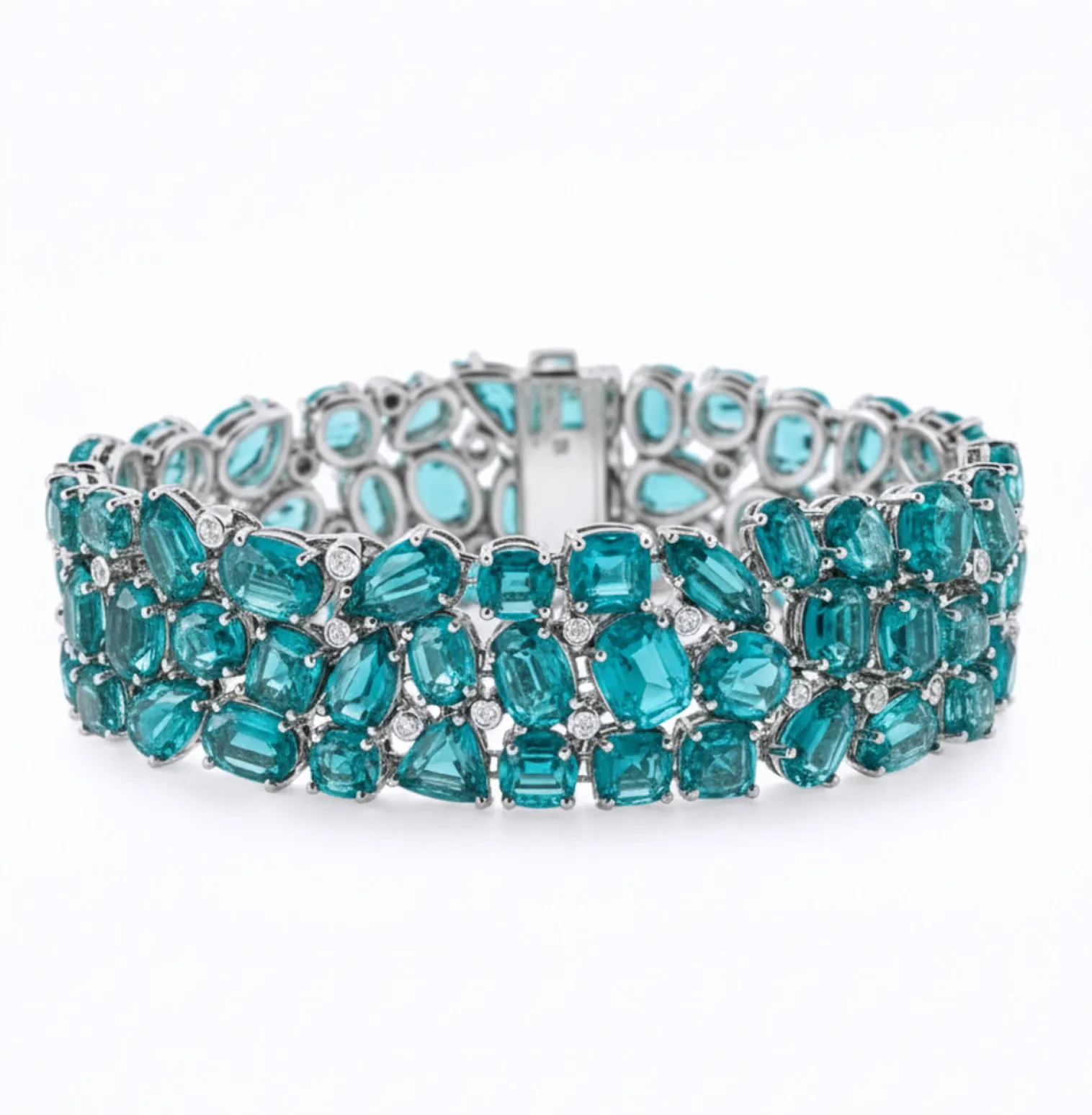
Paraíba tourmaline is a tourmaline whose vivid blue to green comes mainly from copper and manganese. It is named after the Brazilian state of Paraíba, known for these stones since the late 1980s. Comparable copper-bearing tourmalines now also come from Mozambique and Nigeria. Color, not size, decides its value first.
At a glance
- Mineral species
- Tourmaline, colored by copper and manganese
- Color
- Blue, greenish blue, bluish green, green and violet of high intensity
- Mohs hardness
- 7 to 7.5
- Key origins
- Brazil (state of Paraíba), Mozambique, Nigeria
- Common treatments
- Heating. Not detectable in every case
- Laboratory report
- Identity, indications of heating, geographic origin on request
- Typical cuts
- Oval and pear with brilliant facets
Copper colors only this tourmaline
Tourmaline is not a single mineral but a group of closely related mineral species with the same crystal structure. In Paraíba tourmaline, traces of copper and manganese create the color. According to the Gemological Institute of America, or GIA, copper colors no other tourmaline. The range runs from greenish blue and bluish green through green to blue and violet. According to GIA, blue and violet are the most sought-after tones. The glossary explains what connoisseurs mean by neon quality.
In quality, color comes before size
The most important value factor is color: how pure the hue is and how strong it appears. Size comes second. GIA notes that Paraíba tourmalines rarely exceed one carat. A small stone with intense color is therefore valued more highly than a large one with a pale tone.
Tourmaline shows colors of different depth depending on the viewing direction, which specialists call pleochroism. The cutter orients the stone so that the best color faces up. According to GIA, Paraíba tourmalines are almost always custom cut, usually as ovals or pears with brilliant facets. Typical inclusions in tourmaline are fine, thread-like cavities running along the crystal. How visible they are is judged stone by stone.
Brazil, Mozambique, Nigeria: what origin means
The name comes from the Brazilian state of Paraíba, known for these tourmalines since the late 1980s. The trade press names a deposit near São José da Batalha as the first locality, hence the name Batalha. Copper-bearing tourmalines from Mozambique and Nigeria followed later. The Swiss Gemmological Institute SSEF calls only Brazilian stones Paraíba tourmaline directly in its reports. Stones of other origin that meet the color and chemistry are named tourmaline there, with the note that they may also be called Paraíba tourmaline in the trade.
Origin cannot be seen in a stone. Laboratories determine it from microscopic features, trace elements and spectroscopic data and compare these with reference stones. SSEF explicitly calls the result an expert opinion. Vikar Ahmed specializes in Brazilian Paraíba tourmalines, which mostly weigh up to about one carat. He also works with stones from Mozambique and Nigeria, which are found in considerably larger carat weights. What this means for assessing a stone is covered in the guide on origin statements for colored stones.
Heating is common and belongs in the report
According to SSEF, Paraíba tourmalines are frequently heated. The heat changes the color, and the result is stable. The report then states "indications of heating" or "no indications of heating". In some cases this cannot be determined. The laboratory notes that too, rather than forcing a conclusion. The statement therefore describes what was detectable in the stone. The terms treatment and untreated are explained in the glossary.
What a laboratory report states
A GIA identification report names the material and lists detectable treatments. The extended version adds the geographic origin. GIA offers it only for a few stones, and Paraíba tourmaline is one of them. For colored stones, the Swiss laboratories SSEF and Gübelin are also widely used, more on this under SSEF and Gübelin. For colored gemstones, Vikar Ahmed works with Gübelin, SSEF, GRS and the DGemG. For Paraíba tourmalines from 1 carat, a report with origin determination is standard with him, and for Brazilian stones often well below that. With the report number, a report can be verified online where the laboratory offers this.
Wearable in jewelry, with some care
Tourmaline reaches 7 to 7.5 on the Mohs scale, and GIA rates its toughness as fair. It suits rings, earrings, necklaces and bracelets, but tolerates less than a diamond. Strong heat can alter the color, and sudden temperature changes can cause fractures. Warm soapy water is enough for cleaning. GIA does not recommend ultrasonic or steam cleaning. At Vikar Ahmed, Paraíba tourmaline is the heart of the house. It is worked there into unique pieces, preferably in platinum or 18-karat white gold. For everyday wear, Vikar Ahmed recommends a bezel setting that protects the edges and to take the stone off for sports, housework and the sauna.
Frequently asked questions
Paraíba tourmaline from Batalha or from other localities: can you see the difference?
Not reliably with the naked eye. Appearance alone is not enough to assign a stone to a locality. A laboratory determines the origin from microscopic features, trace elements and spectroscopic data. The result is an expert opinion recorded in the origin report.
For a Paraíba tourmaline, what says more: a GIA report or an origin report?
The two are not opposites. A GIA report can itself be an origin report: GIA offers a version with geographic origin for Paraíba tourmalines. The plain identification report names the material and detectable treatments. If you want the origin documented, you need the extended version or the report of another recognized laboratory.
A larger Paraíba tourmaline with somewhat paler color or a smaller one with intense neon blue?
By gemmological standards, the smaller one with the intense color. With Paraíba tourmaline, color is the decisive value factor, not size. For a piece of jewelry the balance may differ if the design calls for a certain stone size. This is best judged by comparing stones side by side.
Which engagement rings with Paraíba tourmaline or diamond are better suited to everyday wear?
Rings with a diamond are more robust. Diamond reaches 10 on the Mohs scale, tourmaline 7 to 7.5. A Paraíba tourmaline can be worn daily in a ring if the setting protects the stone and the ring is taken off for rough work. More on this in the guide engagement ring with Paraíba tourmaline.
Does Vikar Ahmed disclose whether its Paraíba tourmalines are treated?
Yes. Vikar Ahmed works with heated and unheated Paraíba tourmalines and, according to him, discloses every treatment openly, in the consultation and in writing on the certificate, the expert report and the invoice. Whether there are indications of heating is recorded in the laboratory report, noted as “heated” or “no indications of heating”. The CIBJO Blue Books require this disclosure.
Private consultation
The color of a Paraíba tourmaline can only be judged on the stone itself. Vikar Ahmed receives clients in the showroom in Idar-Oberstein by appointment, and virtually on request. There you can clarify which stone and which setting suit your design. Request a private consultation.
Further reading
- Paraíba at Vikar Ahmed
- Glossary: neon quality
- Guide: engagement ring with Paraíba tourmaline
- Gemstone knowledge: Lagoon tourmaline
- Gemstone knowledge: tourmaline
Sources
- GIA: Tourmaline Description, accessed 2026-11-16
- GIA: Tourmaline Quality Factors, accessed 2026-11-16
- GIA: Tourmaline Care and Cleaning, accessed 2026-11-16
- GIA: Tourmaline History and Lore, accessed 2026-11-16
- SSEF: Paraiba Tourmaline, accessed 2026-11-16
- GIA: Colored Stone Reports and Services, accessed 2026-11-16
- Jeweller Magazine: Tourmaline, Indicolite, Verdelite, Paraíba (Stacey Lim, 2018), accessed 2026-11-16
- GIA: Diamond Care and Cleaning, accessed 2026-11-16
- Vikar Ahmed: Paraíba, accessed 2026-11-16
- Vikar Ahmed: Kontakt, accessed 2026-11-16
- CIBJO: Introduction to the Blue Books, accessed 2026-11-17

A personal conversation starts here.
At the showroom in Idar-Oberstein or by video. Vikar Ahmed discusses your ideas, stones and designs with you and answers your questions calmly and in confidence.


Thank you for your request.
Your request will be handled with the utmost attention and discretion. Vikar Ahmed will get back to you.
Your details
Request
–
Occasion
–
Consultation
–
Contact
–
In the meantime
Insights: What is a Paraíba tourmaline? · Engagement ring to your own design: how does it work?
Confidential and without obligation
Back to the pagePrivate consultation
A personal conversation starts here.
- Time for your questions, wishes and ideas
- In the showroom in Idar-Oberstein or by video
- Confidential, discreet and without obligation
Vikar Ahmed · Hauptstraße 111 · 55743 Idar-Oberstein, Germany