

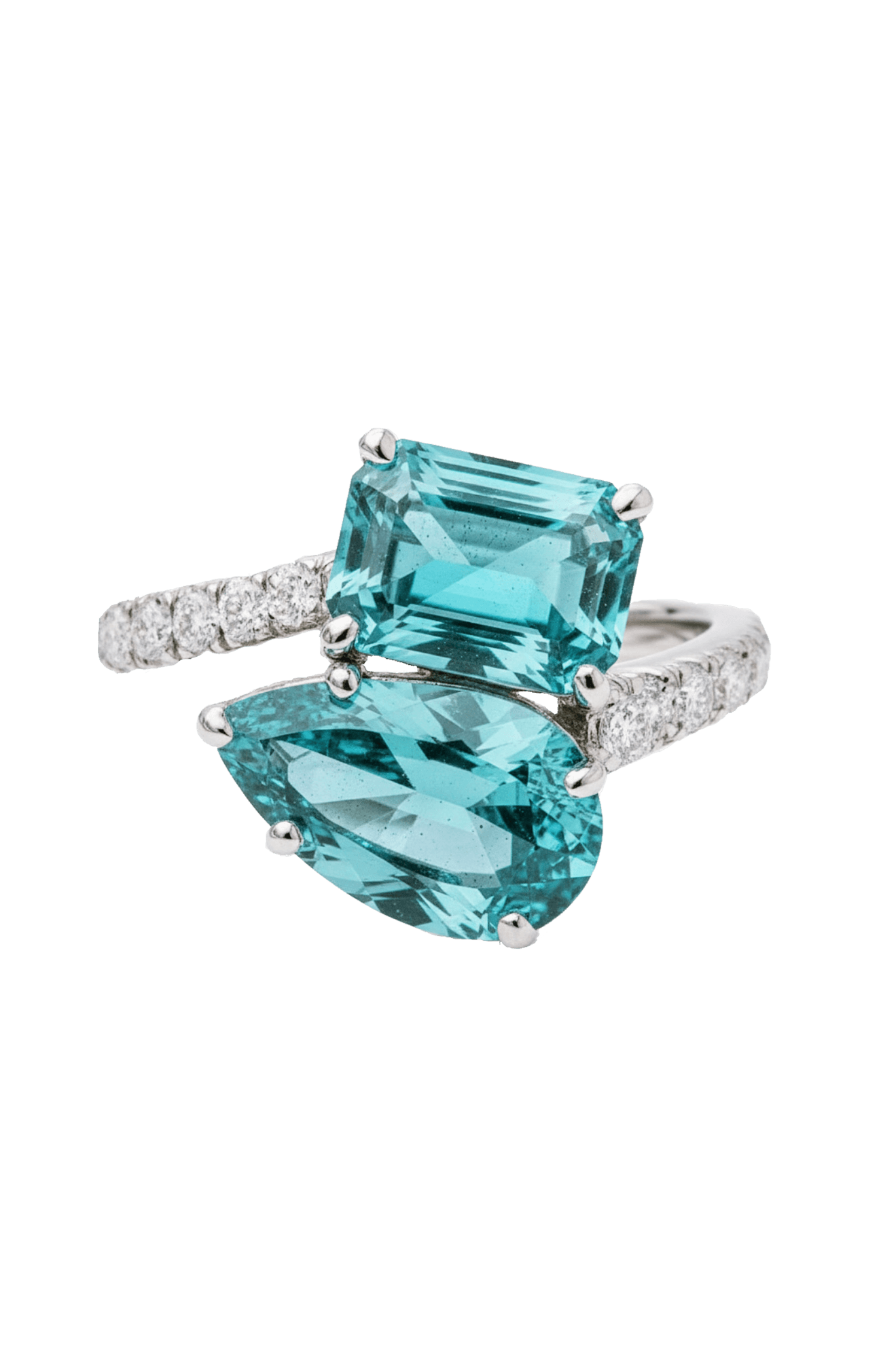
Lagoon tourmaline is a trade name for tourmalines in a vivid, greenish blue. The term is not gemmologically defined and does not denote a mineral species of its own. Unlike Paraíba tourmaline, the color is not caused by copper. In the laboratory report the stone appears as tourmaline. Its assessment depends on the color, clarity and cut of the individual stone.
At a glance
- Mineral species
- Tourmaline. Lagoon is a trade name, not a species of its own
- Color
- Vivid, strongly saturated blue with a touch of green
- Cause of color
- Not copper. In tourmaline, blue and green otherwise come from iron
- Mohs hardness
- 7 to 7.5
- Origin
- The trade name is not tied to any locality
- Common treatments
- For tourmaline, heating and irradiation
- Laboratory report
- Identity as tourmaline and detectable treatments
A name from the trade
Lagoon tourmaline is not a mineralogical term but a name from the gemstone trade. It stands for particularly vivid, strongly saturated blue tourmalines with a touch of green. The color recalls clear seawater, hence the name. According to the trade press, it is difficult to define exactly what may be called this. The name describes a color impression and says nothing about locality, clarity or treatment. In brief, this is also under Lagoon tourmaline in the glossary.
The difference from Paraíba tourmaline
Both stones are tourmalines, and both lie between blue and green in color. The difference lies in the cause of the color. In Paraíba tourmaline, copper and manganese provide the color, which explains its particular glow. In Lagoon tourmaline, copper is not the cause. In tourmaline, blue and green otherwise come from iron and possibly titanium. The distinction is therefore not a matter of judging by eye but of chemical analysis in the laboratory.
| Characteristic | Lagoon tourmaline | Paraíba tourmaline |
|---|---|---|
| Cause of color | Not copper | Copper and manganese |
| Type of name | Trade name without a fixed definition | Name used by laboratories |
| Origin on GIA report | Not provided | Possible |
| Mohs hardness | 7 to 7.5 | 7 to 7.5 |
Both stones belong to the tourmaline group.
Classification alongside indicolite
For blue tourmalines, the trade also uses the name indicolite. GIA includes tourmalines in dark violetish blue, in blue and in greenish blue under this name. Lagoon stands for the particularly vivid, saturated tones with a touch of green. The boundaries are fluid, and trade names are applied with varying generosity. The trade press therefore advises judging a stone by its color and not by its name. The page tourmaline gives an overview of the group.
Quality: saturation, clarity, cut
The purer and stronger the color, the more highly a tourmaline is valued. Dark tones are considered less attractive. Outside the red tones, a strict standard applies to clarity: stones without visible inclusions are valued more highly, and in light stones inclusions are especially noticeable. Tourmaline shows colors of different depth depending on the viewing direction. The cutter places the table so that the stone appears neither too dark nor too pale. Elongated shapes follow the crystal form. With lagoon tourmaline, Vikar Ahmed looks above all for radiant color and a precise cut and expects almost eye-clean clarity.
Treatment and the report
Tourmalines may be heated or irradiated. Both change the color, and not every treatment can be detected. An identification report lists the stone as tourmaline and names the treatments the laboratory can determine. For tourmaline, GIA states a geographic origin only for Paraíba tourmaline. At Vikar Ahmed, every treatment is disclosed openly, in the consultation and in writing on the certificate, the expert report and the invoice. The fundamentals are in the guide untreated colored gemstone.
In jewelry
At 7 to 7.5 on the Mohs scale and with fair toughness, Lagoon tourmaline suits rings, bracelets, earrings and necklaces. Heat and sudden temperature changes should be avoided. Warm soapy water works for cleaning; ultrasonic and steam are not recommended. Vikar Ahmed works Lagoon tourmaline into pieces shown on the website, alongside Brazilian Paraíba tourmaline and Namibian tourmaline. He works in 18-karat gold in white, rose and yellow or in platinum 950.
Frequently asked questions
How do Lagoon tourmalines differ from Paraíba tourmalines in color and rarity?
In the cause of the color and therefore in its character. Paraíba tourmaline is colored by copper and manganese and known for its glow. Lagoon tourmaline shows a vivid, greenish blue without copper as the cause. Paraíba tourmaline is the rarer stone: it only rarely exceeds one carat.
Is a ring with Lagoon tourmaline a suitable alternative to the much rarer Paraíba ring?
Yes, if the aim is the range of colors between blue and green. Hardness and care are the same for both stones, as both are tourmalines. Lagoon tourmaline lacks the particular glow that copper creates in Paraíba tourmaline. The trade press describes it as a kind of substitute for Paraíba tourmaline.
Which stone looks more refined on a bracelet, Paraíba tourmaline or Lagoon tourmaline?
Refinement is a question of matching, not of the name. A bracelet depends on many stones matching each other in tone and saturation. Paraíba tourmaline is rarer and known for its glow. Lagoon tourmaline offers a strong, greenish blue. On a bracelet, the line whose stones are most even is the most convincing.
Is Lagoon tourmaline a mineral species of its own?
No. Lagoon tourmaline is a trade name for a color within the tourmaline group. Mineralogically, the stone remains a tourmaline, with the same hardness and the same care instructions as other tourmalines. There is no binding definition of when a stone may be called this.
Private consultation
Whether a Lagoon tourmaline or a Paraíba tourmaline better suits your design is shown by comparing both colors. Vikar Ahmed advises on this in the showroom in Idar-Oberstein by appointment or in a virtual appointment. Request a consultation.
Further reading
- Glossary: Lagoon tourmaline
- Gemstone knowledge: Paraíba tourmaline
- Gemstone knowledge: tourmaline
- Guide: untreated colored gemstone
Sources
- Katerina Perez: Universal Shades, A Guide to Gemstone Colours Part II, accessed 2026-11-16
- Jeweller Magazine: Tourmaline, Indicolite, Verdelite, Paraíba (Stacey Lim, 2018), accessed 2026-11-16
- GIA: Tourmaline, Überblick, accessed 2026-11-16
- GIA: Tourmaline Description, accessed 2026-11-16
- GIA: Tourmaline Quality Factors, accessed 2026-11-16
- GIA: Tourmaline Care and Cleaning, accessed 2026-11-16
- GIA: Colored Stone Reports and Services, accessed 2026-11-16
- SSEF: Paraiba Tourmaline, accessed 2026-11-16
- Vikar Ahmed: Meisterstücke und Kollektionen, accessed 2026-11-16
- Vikar Ahmed: Kontakt, accessed 2026-11-16

A personal conversation starts here.
At the showroom in Idar-Oberstein or by video. Vikar Ahmed discusses your ideas, stones and designs with you and answers your questions calmly and in confidence.


Thank you for your request.
Your request will be handled with the utmost attention and discretion. Vikar Ahmed will get back to you.
Your details
Request
–
Occasion
–
Consultation
–
Contact
–
In the meantime
Insights: What is a Paraíba tourmaline? · Engagement ring to your own design: how does it work?
Confidential and without obligation
Back to the pagePrivate consultation
A personal conversation starts here.
- Time for your questions, wishes and ideas
- In the showroom in Idar-Oberstein or by video
- Confidential, discreet and without obligation
Vikar Ahmed · Hauptstraße 111 · 55743 Idar-Oberstein, Germany