

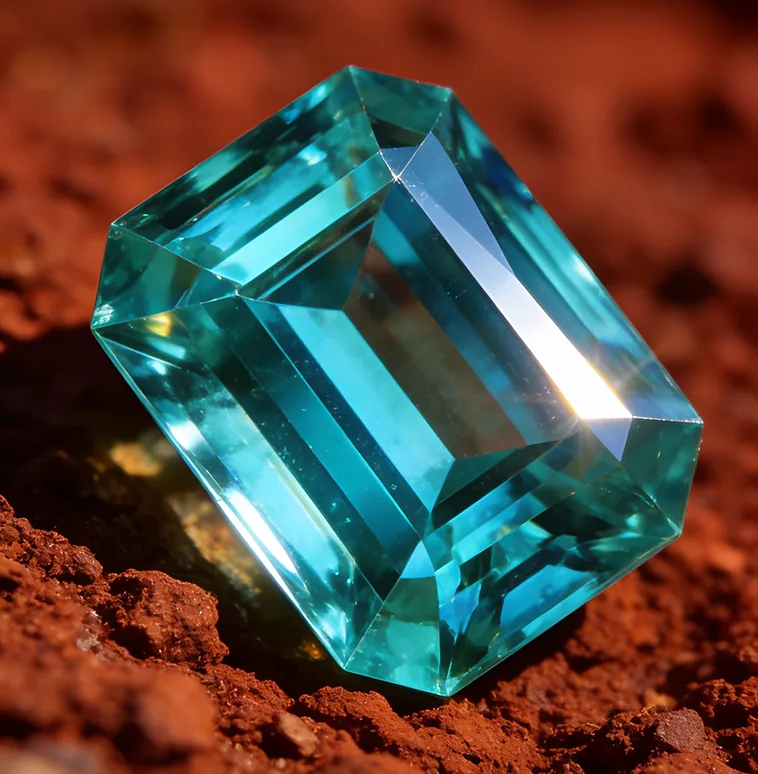
Tourmaline is a group of closely related mineral species with the same crystal structure. Hardly any gemstone occurs in so many colors: from red and pink through green and blue to multicolored crystals. Iron, manganese and copper determine the hue. At 7 to 7.5 on the Mohs scale, tourmaline is well suited to jewelry.
At a glance
- Mineral species
- Group of related minerals, including elbaite, liddicoatite, dravite, uvite and schorl
- Color
- All colors, also multicolored within one crystal
- Mohs hardness
- 7 to 7.5
- Key origins
- Brazil, Madagascar, Afghanistan, Tanzania
- Common treatments
- Heating and irradiation
- Laboratory report
- Identity and detectable treatments. Origin at GIA only for Paraíba tourmaline
- Trade names
- Rubellite, indicolite, Paraíba tourmaline, chrome tourmaline
A mineral group, not a single stone
Tourmaline is not a single mineral. The name stands for a group of mineral species that share the same crystal structure and contain silicon, aluminum and boron. Important species include elbaite, liddicoatite, dravite, uvite and schorl. The name goes back to the Sinhalese "toramalli", meaning mixed gemstones. Dutch traders used it for colorful pebbles from the gem gravels of Ceylon. GIA counts tourmaline among the gemstones with the greatest variety of colors.
What creates the color and what the varieties are called
The color depends on trace elements. Iron and possibly titanium produce green and blue. Manganese creates red and pink, and possibly yellow. Copper colors only one variety, Paraíba tourmaline. The trade has its own names for the most important colors. They do not denote mineral species but color varieties.
- Rubellite: pink, red, purplish red, orangy red or brownish red. More under rubellite.
- Indicolite: dark violetish blue, blue or greenish blue.
- Paraíba tourmaline: intense blue to green from copper. More under Paraíba tourmaline.
- Chrome tourmaline: intense green, colored mainly by vanadium.
- Watermelon tourmaline: pink inside, green outside.
- Lagoon tourmaline: trade name for a vivid, greenish blue. More under Lagoon tourmaline.
Quality: color, clarity, cut
Color has the greatest influence. Strong, pure tones are valued more highly than dark ones, which are more common on the market. For clarity, the standard depends on the color: green tourmalines should be free of visible inclusions, while in red and pink stones they are more readily accepted. In light, weakly saturated stones, inclusions are more noticeable. With rubellite and lagoon tourmaline, Vikar Ahmed looks above all for radiant color and a precise cut, and with lagoon he expects almost eye-clean clarity. Typical are fine cavities lying like threads parallel to the long axis of the crystal.
Tourmaline is strongly pleochroic, showing colors of different depth depending on the viewing direction. Many crystals absorb more light along their length than across it. The cutter orients the table according to whether a stone should appear darker or lighter. Long rectangles are common because they follow the crystal shape and little material is lost. The guide which cut for the engagement ring? shows how cuts change the effect.
Origins and their history
The colored elbaites grow in pegmatites, rare igneous rocks in which crystals can reach up to one meter in length. Brazil has been a source for centuries: as early as the 16th century, a green tourmaline there was mistaken for emerald. From the 1950s, finds followed in many countries, including red tourmaline from Madagascar and Afghanistan. Chrome tourmaline comes from Tanzania. The pieces Vikar Ahmed shows include, among others, Brazilian Paraíba tourmaline and Namibian tourmaline. His specialty is Brazilian Paraíba tourmaline, complemented by stones from Mozambique and Nigeria.
Treatments and the report
Heating and irradiation are the two main treatments. Heating changes the color permanently and cannot always be detected. Irradiated colors can fade under heat or strong light. An identification report names the stone as tourmaline and lists the treatments that can be detected. Within the group, GIA certifies a geographic origin only for Paraíba tourmaline. The entry untreated clarifies what "untreated" can mean in this context.
In jewelry and in care
Tourmaline reaches 7 to 7.5 on the Mohs scale. Its toughness, meaning its resistance to breaking and chipping, is considered fair. It is generally stable to light and is not attacked by chemicals. Heat is the greater risk: it can alter the color, and a sudden temperature change can cause fractures. For cleaning, GIA recommends warm soapy water, but not ultrasonic or steam cleaners. In earrings and necklaces the stone is hardly exposed to knocks; in a ring the setting protects it.
Frequently asked questions
Paraíba or another tourmaline for striking chandelier earrings?
Both suit chandelier earrings, because earrings are hardly exposed to knocks. Paraíba tourmaline brings the vivid blue to green but rarely exceeds one carat. Other tourmalines come in many colors and more often in larger sizes, which makes matching pairs easier in multi-part drops.
Namibian tourmalines or Brazilian Paraíba tourmalines for chandelier earrings: which is more appealing to collectors?
Brazilian Paraíba tourmaline is the rarer choice. Its color comes from copper, and only with Brazilian origin does SSEF list it in the report directly under this name. Namibian tourmalines stand on their own and are judged by their own color. For collectors, what counts is how well color, pairing and documentation fit together.
What looks more elegant for a formal evening, chandelier earrings with tourmalines or earrings with rubellite?
The question does not set opposites against each other: rubellite is itself a tourmaline, namely the red to pink color variety. Red appears warm and strong in the evening, while blue and green tourmalines appear cooler. Chandelier earrings rely on movement and length, a single larger stone at the ear on calm. Both can be elegant.
How hard is tourmaline compared with diamond and sapphire?
Tourmaline sits at 7 to 7.5 on the Mohs scale, sapphire at 9, diamond at 10. The scale is not evenly stepped: diamond is many times harder than sapphire, although only one step lies between them. Tourmaline is suitable for everyday wear, but more prone to scratches than the other two stones.
Private consultation
Which tourmaline color suits a design becomes clear in conversation and by comparing stones. Vikar Ahmed advises in the showroom in Idar-Oberstein by appointment. The website calls it a place of selection, not a sales room. Request an appointment for a private consultation.
Further reading
- Gemstone knowledge: Paraíba tourmaline
- Gemstone knowledge: rubellite
- Gemstone knowledge: Lagoon tourmaline
- Glossary: untreated
- Guide: engagement ring with a colored gemstone
Sources
- GIA: Tourmaline, Überblick, accessed 2026-11-16
- GIA: Tourmaline Description, accessed 2026-11-16
- GIA: Tourmaline Quality Factors, accessed 2026-11-16
- GIA: Tourmaline Care and Cleaning, accessed 2026-11-16
- GIA: Tourmaline History and Lore, accessed 2026-11-16
- GIA: Colored Stone Reports and Services, accessed 2026-11-16
- SSEF: Paraiba Tourmaline, accessed 2026-11-16
- GIA: Sapphire Care and Cleaning, accessed 2026-11-16
- GIA: Diamond Care and Cleaning, accessed 2026-11-16
- Vikar Ahmed: Meisterstücke und Kollektionen, accessed 2026-11-16
- Vikar Ahmed: Über uns, accessed 2026-11-16

A personal conversation starts here.
At the showroom in Idar-Oberstein or by video. Vikar Ahmed discusses your ideas, stones and designs with you and answers your questions calmly and in confidence.


Thank you for your request.
Your request will be handled with the utmost attention and discretion. Vikar Ahmed will get back to you.
Your details
Request
–
Occasion
–
Consultation
–
Contact
–
In the meantime
Insights: What is a Paraíba tourmaline? · Engagement ring to your own design: how does it work?
Confidential and without obligation
Back to the pagePrivate consultation
A personal conversation starts here.
- Time for your questions, wishes and ideas
- In the showroom in Idar-Oberstein or by video
- Confidential, discreet and without obligation
Vikar Ahmed · Hauptstraße 111 · 55743 Idar-Oberstein, Germany