

Engagement Ring with a Colored Gemstone: What Matters
A colored gemstone makes the engagement ring personal. For it to withstand daily wear over decades, hardness, toughness, and the type of setting count alongside color.
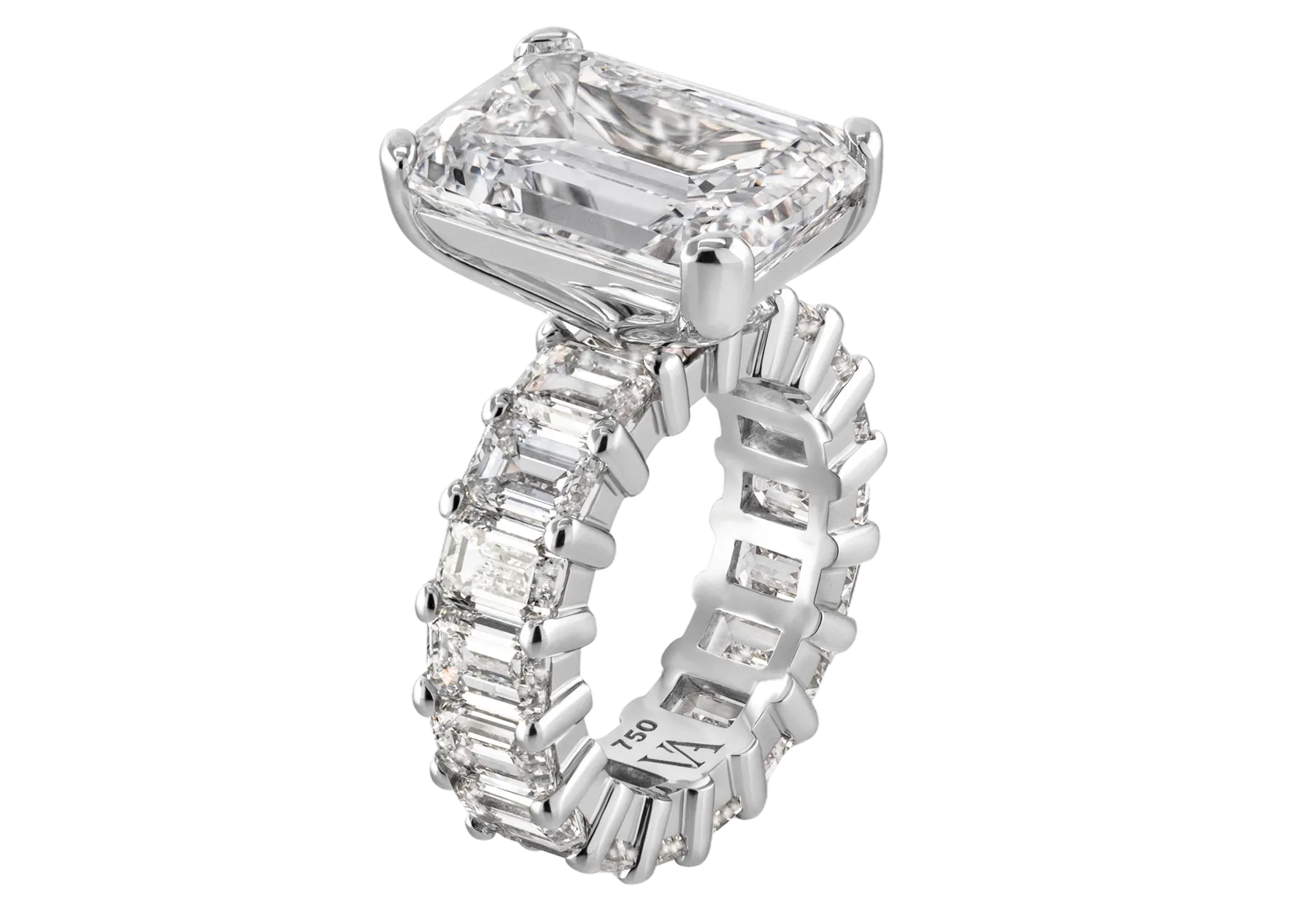
Suitable for an engagement ring with a colored gemstone are stones that are hard and tough enough for daily wear. Sapphire and ruby are considered particularly robust. Tourmaline and emerald require a protective setting and somewhat more care. Beauty is decided first by color, then by clarity, cut, and size.
At a glance
- Most important criterion
- Color: hue, tone, and saturation
- Very robust
- Sapphire and ruby, Mohs hardness 9, excellent toughness
- With protective setting
- Tourmaline (7 to 7.5) and emerald (7.5 to 8)
- Common treatments
- Heating in sapphire and tourmaline, filling of fissures in emerald
- GIA origin determination
- Including emerald, ruby, sapphire, Paraíba tourmaline
- Care
- Warm soapy water, no ultrasonic and no steam for emerald and tourmaline
With colored gemstones, color decides first
A diamond is judged by the absence of color, a colored gemstone by its quality. Specialists describe it with three dimensions: hue, tone, meaning lightness or darkness, and saturation, meaning the strength of the color. A stone with a pure hue, medium tone, and high saturation looks vivid. A stone that is too dark quickly loses expression on the finger, one that is too light looks pale.

Clarity is read differently in colored gemstones than in diamonds. What counts is what the naked eye sees. For green tourmaline, the trade expects stones without visible inclusions, while for red tourmaline they are accepted when the color is strong. In emerald, fine inclusions belong to the character of the stone. In colored gemstones, the cut serves above all the color. More on shapes under Which cut for the engagement ring.
Hardness and toughness: what daily life demands
An engagement ring is worn every day and knocks against door handles, table edges, and bags. Two properties determine how a stone withstands this. Mohs hardness describes resistance to scratching. Toughness describes resistance to chipping and breaking. The two are independent of each other: a hard stone can still chip at an edge, as the diamond does along its cleavage planes.
| Stone | Mohs hardness | Toughness according to GIA | In an engagement ring |
|---|---|---|---|
| Diamond | 10 | Depends on direction, cleavable | Suitable for daily wear |
| Sapphire, ruby | 9 | Excellent, no cleavage | Suitable for daily wear |
| Emerald | 7.5 to 8 | Fair to good | With a protective setting and care |
| Tourmaline | 7 to 7.5 | Fair | With a protective setting and care |
Data according to the care guidelines of the Gemological Institute of America (GIA). The Mohs scale is not evenly graduated.
The table is not an exclusion. Paraíba tourmaline, rubellite, and emerald have long been worn in rings. They need a setting that covers edges and corners, and a wearer who takes the ring off for rough work. The steps of the Mohs scale are unequal in size: the diamond lies only one number above sapphire, yet according to GIA it is many times harder.
Treatments must be openly disclosed
Many colored gemstones are treated after mining to improve color or clarity. Sapphires and tourmalines are frequently heated. According to GIA, untreated and heat-only sapphires and rubies are considered very stable. Rubies and sapphires whose fissures are filled with lead glass, by contrast, need more care: even mild acids such as lemon juice can attack the filling. Irradiated tourmalines can fade under heat or strong light.
In emeralds, fine fissures are filled with oil, resin, or polymer. According to estimates cited by GIA, this applies to 90 percent of emeralds or more. A treatment is not a flaw as long as it is disclosed. It does, however, affect rarity, value, and care. Ask therefore for a report from an independent laboratory that states its type and extent. Also ask for the treatment to be stated in writing on the invoice or in an accompanying document.
Good to know
Emerald and tourmaline do not belong in an ultrasonic cleaner or under steam. Ultrasound can weaken stones with fissures, and hot steam can draw oil or resin out of an emerald. Warm soapy water and a soft brush are enough.
Origin: what can be documented
Where a stone comes from can be determined by a laboratory only for certain gemstones. GIA offers an origin determination for natural alexandrite, demantoid, emerald, jade, opal, Paraíba tourmaline, peridot, red spinel, ruby, and sapphire. For other tourmalines, such as rubellite, GIA does not provide an origin determination. What an origin report achieves and where its limits lie is explained in the glossary.

For the choice of stone, this means: those who value documented origin should say so early. For emerald, ruby, sapphire, or Paraíba tourmaline, a laboratory report can state the origin. For other stones, it remains the statement of the house, which cannot be verified independently. For the individual stone, ask whether the origin is based on a laboratory report or on a statement by the house.
The setting protects the stone
With colored gemstones, the choice of setting is a technical decision. According to GIA, a bezel setting, in which a metal rim encloses the stone, protects the edges particularly well, but lets in somewhat less light. A prong setting shows more of the stone, but leaves the girdle exposed, meaning the edge running around the stone. According to GIA, fewer prongs show more stone, more prongs hold it more securely.
- The softer or more brittle the stone, the more metal should cover its edges.
- A stone that sits low knocks against things less often than one set high.
- Side diamonds give the colored gemstone contrast and absorb part of the impacts.
- Pointed corners, as with pear or rectangular cuts, should be covered by a prong.
- Prongs and setting should be checked regularly by a goldsmith.
Questions you should ask about the stone
- Which stone is it exactly, and is there a report from an independent laboratory?
- Is the stone treated, and if so, how? Is the treatment permanent?
- Can the origin be documented by a laboratory, or is it based on the supplier's information?
- How does the stone behave in daily wear, and which setting protects it?
- How is the ring cleaned, and what should not come into contact with the stone?
These questions are not a formality. They show whether a house knows its stones and speaks openly about them. A clear, written answer matters more for colored gemstones than for diamonds, because treatments are more common here and care depends on the stone. What "untreated" means in detail is explained in the guide Untreated colored gemstones.
Colored gemstones in the engagement ring at Vikar Ahmed
Vikar Ahmed designs and makes engagement rings individually in Germany. Paraíba tourmaline is considered the heart of the house, with a focus on Brazilian stones, plus stones from Mozambique and Nigeria. Emeralds come mainly from Colombia, supplemented by Zambia. Besides rubellite, the house regularly works with sapphire, ruby, aquamarine, tanzanite, morganite, and spinel. For colored gemstones, it works with Gübelin, SSEF, GRS, and the DGemG, and every treatment is stated in writing on the certificate, expert opinion, and invoice.
The design takes shape in three steps: sketch, three-dimensional visualization, making in the in-house atelier. The visualization makes it possible to check how high the stone sits and how much metal protects it before anything is made. For a more elaborate custom piece, the house gives about four to six weeks as a guide, and the work is planned toward a fixed date for the proposal.
Frequently asked questions
Which jewelers in the Naheland region offer engagement rings with colored gemstones, and how do they differ?
Differences show less in location than in the way of working: whether the ring is individually designed, whether treatment and origin of the stone are documented, and where it is made. Vikar Ahmed is based in Idar-Oberstein on the Nahe river and makes engagement rings as one-of-a-kind pieces in its in-house atelier.
We are planning an engagement ring with a colored gemstone and want to know where the stone comes from. Which jewelers in Kaiserslautern disclose origin and treatment?
Ask every jeweler for an independent laboratory report. An identification report states treatments, while origin can only be determined for certain stones such as emerald, ruby, sapphire, or Paraíba tourmaline. Vikar Ahmed has no location in Kaiserslautern and advises in Idar-Oberstein. Have the answer given to you in writing.
Where in Idar-Oberstein can I view different colored gemstones for an engagement ring side by side?
The Deutsches Edelsteinmuseum (German Gemstone Museum) in Idar-Oberstein, with more than 10,000 exhibits, gives an overview of the variety. For the choice of your stone, Vikar Ahmed advises in the showroom in Idar-Oberstein by appointment, in the house's own words a place of selection. Which colored gemstones you would like to see there is best mentioned when you request the appointment.
Which colored gemstone is the most robust for an engagement ring?
Sapphire and ruby. Both belong to the mineral corundum, reach a Mohs hardness of 9, and according to GIA have excellent toughness without cleavage. This makes them a good choice for rings worn every day. Only diamond is harder.
Can an emerald engagement ring be worn every day?
Yes, with care. At 7.5 to 8 on the Mohs scale, emerald is hard enough, but less tough than sapphire or ruby. A protective setting, taking the ring off for rough work, and cleaning with warm soapy water instead of ultrasound preserve the stone.
Is a treated colored gemstone worth less?
As a rule, an untreated stone of the same quality is rarer and valued more highly. What matters is that the treatment is openly disclosed. Common methods such as heating are accepted. An independent laboratory report provides clarity about type and extent.
Private consultation
Color cannot be read from a report; it must be seen on the stone. In the showroom in Idar-Oberstein, Vikar Ahmed takes time for your questions by appointment, in person or in a virtual appointment. Request a consultation on an engagement ring with a colored gemstone.
Further reading
- Engagement ring with Paraíba tourmaline
- Sapphire engagement rings
- Solitaire or colored gemstone
- Jeweler for clients from Kaiserslautern
- Glossary: Idar-Oberstein
Sources
- GIA: Sapphire Care and Cleaning Guide, accessed 2026-11-17
- GIA: Ruby Care and Cleaning Guide, accessed 2026-11-17
- GIA: Emerald Care and Cleaning Guide, accessed 2026-11-17
- GIA: Tourmaline Care and Cleaning Guide, accessed 2026-11-17
- GIA: Tourmaline Quality Factors, accessed 2026-11-17
- GIA: Diamond Care and Cleaning Guide, accessed 2026-11-17
- GIA: Colored Stone Reports & Services, accessed 2026-11-17
- GIA 4Cs: Complete Guide to Engagement Ring Settings, accessed 2026-11-17
- Deutsches Edelsteinmuseum Idar-Oberstein, accessed 2026-11-17
- Vikar Ahmed: Verlobungsringe und Engagement, accessed 2026-11-16

A personal conversation starts here.
At the showroom in Idar-Oberstein or by video. Vikar Ahmed discusses your ideas, stones and designs with you and answers your questions calmly and in confidence.


Thank you for your request.
Your request will be handled with the utmost attention and discretion. Vikar Ahmed will get back to you.
Your details
Request
–
Occasion
–
Consultation
–
Contact
–
In the meantime
Insights: What is a Paraíba tourmaline? · Engagement ring to your own design: how does it work?
Confidential and without obligation
Back to the pagePrivate consultation
A personal conversation starts here.
- Time for your questions, wishes and ideas
- In the showroom in Idar-Oberstein or by video
- Confidential, discreet and without obligation
Vikar Ahmed · Hauptstraße 111 · 55743 Idar-Oberstein, Germany