

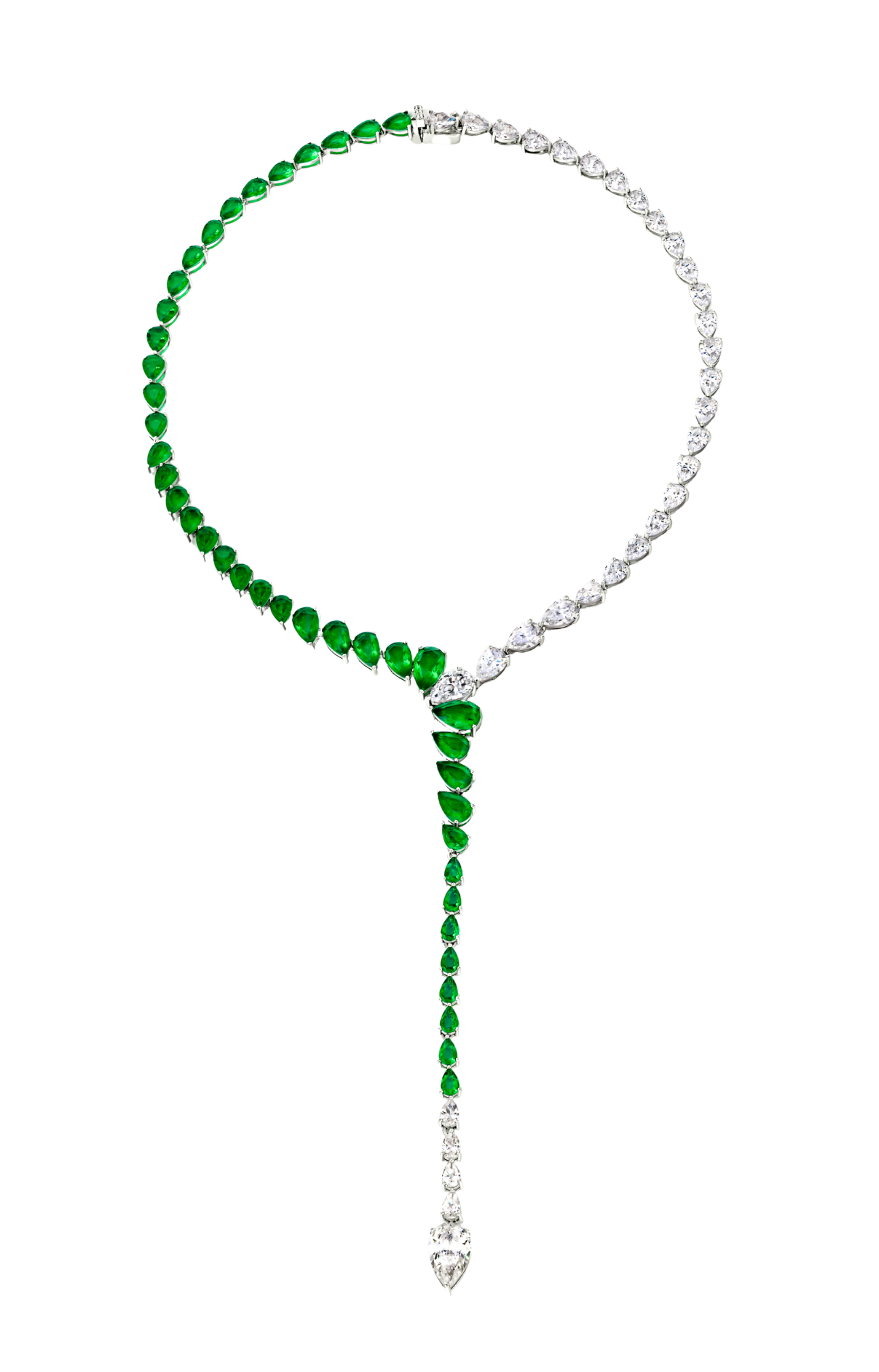
Emerald is the green to bluish green variety of the mineral beryl. Its color comes from traces of chromium, vanadium and iron. Inclusions are almost always part of it, as is filling fine fractures with oil or resin. Quality depends above all on a strong, even color and good transparency.
At a glance
- Mineral species
- Beryl
- Color
- Green to bluish green, colored by chromium, vanadium and iron
- Mohs hardness
- 7.5 to 8
- Key origins
- Colombia, Zambia, Brazil, Afghanistan
- Common treatments
- Filling fine fractures with oil, wax or resin
- Laboratory report
- Identity, type and extent of fracture filling, origin on request
- Typical cut
- Emerald cut, a step cut with beveled corners
Green beryl with strong color
Emerald and aquamarine belong to the same mineral species, beryl. Emerald is the variety in green to bluish green. Chromium, vanadium and iron create the color, and their proportions determine the exact hue. Not every green beryl is an emerald: if the stone is too light, too yellowish or too bluish, gemmologists assign it to another beryl variety. GIA compares against reference stones for this. The term emerald is also briefly explained in the glossary.
Color and transparency determine quality
The most highly valued emeralds are bluish green to pure green with strong saturation and a tone that is not too dark. The color should be evenly distributed, without zoning visible to the naked eye. Emeralds without visible inclusions are very rare. The trade therefore accepts inclusions even in fine stones. Because of their moss-like appearance they are called "jardin", French for garden. They only become critical when they clearly reduce transparency.
The emerald cut takes its name from the emerald. The beveled corners protect the most vulnerable points and give the prongs a secure seat. Through depth, table size and number of facets, the cutter can make a pale stone appear darker and a dark stone appear lighter. Because almost every emerald contains fractures, the cutter plans the cut around these areas.
Colombia, Zambia and other origins
Among today's origins, SSEF lists Colombia, Zambia, Brazil and Afghanistan, as well as Ethiopia and Madagascar. Colombian emeralds are credited with a warmer, pure green, Zambian ones with a cooler, more bluish green. GIA adds a caveat: appearance overlaps between origins, and color alone does not prove a locality. Determining it is laboratory work and counts as an expert opinion. Vikar Ahmed sources his emeralds mainly from Colombia, supplemented by Zambia. An origin such as Colombia, however, is only reliable when a laboratory report states it.
Fracture filling is the rule and is graded
Because of how they form, emeralds often have fine fractures. Filling them with colorless substances so they are less visible is common practice in the trade. Estimates cited by GIA put this at 90 percent or more. Oil, wax, natural resin and synthetic resin are used. In its report, SSEF names the substance and grades the amount: none, minor, moderate or significant. This statement belongs in any serious comparison of two emeralds. More on the topic in the guide untreated colored gemstone.
Vikar Ahmed accepts only a light, colorless oiling, usually with cedarwood oil. He rejects synthetic resins such as Opticon and colored oil, and for him the ideal degree of oiling is “none” to “minor”. His clients always learn whether and how heavily an emerald has been oiled, documented by an independent certificate for high-quality stones.
What the laboratory report states
A report first identifies the stone as emerald. It then adds the extent of fracture filling and, if requested, the origin. At GIA, emerald is among the stones for which a report with geographic origin is offered. GIA does not assign a clarity grade as it does for diamonds; it describes the extent of treatment as minor, moderate or significant. The entry origin report explains the difference between report types.
Beautiful in jewelry, but more delicate
At 7.5 to 8 on the Mohs scale, emerald is hard, but its toughness is only fair to good. It is more brittle than ruby and sapphire and calls for more care in setting and wearing. Heat can enlarge existing fractures. Light and chemicals can alter the fillers. Clean it with warm soapy water and a soft brush. Ultrasonic and steam cleaning are risky because they can weaken fractures and drive oil out of the stone. In necklaces and earrings the stone is exposed to fewer knocks than in a ring.
Frequently asked questions
Emerald in an engagement ring: is it worth it, or is it too delicate?
An emerald can be worn in an engagement ring, but it needs more care than diamond or sapphire. It is hard, yet more brittle and almost always crossed by fine fractures. A protective setting, the emerald cut with beveled corners and taking the ring off for rough work make the difference.
Which engagement rings with diamond or emerald are more suitable for everyday wear?
Rings with diamond. At 10, diamond tops the Mohs scale and is resistant to almost all acids. Emerald sits at 7.5 to 8, is more brittle and reacts to heat, ultrasonic cleaning and steam. If you wear green, choose a setting that protects the edges and corners of the stone.
Origin report or plain identification report: what do I need for an emerald in a custom-made necklace?
It depends on what you want documented. The identification report names the emerald and the fracture filling. The origin report adds the locality as the laboratory's expert opinion. If the statement Colombia or Zambia matters to you, you need the origin report. For assessing color and treatment, the identification report is sufficient. At Vikar Ahmed, a report with origin determination is standard for high-quality emeralds from 1 carat.
Apart from emerald, which green stone is suitable for an engagement ring?
Green sapphire, green tourmaline and peridot are options. At 9 on the Mohs scale, sapphire is the most robust, although evenly saturated green sapphires are rare. Tourmaline is 7 to 7.5, peridot 6.5 to 7. The guide engagement ring with a colored gemstone shows which color suits everyday life.
Private consultation
With an emerald, it pays to look at the individual stone: color, jardin and report belong together. In Vikar Ahmed's showroom in Idar-Oberstein, consultations take place by appointment, or alternatively in a virtual appointment. Request a consultation.
Further reading
- Glossary: emerald cut
- Glossary: origin report
- Guide: untreated colored gemstone
- Gemstone knowledge: aquamarine
- Gemstone knowledge: sapphire
Sources
- GIA: Emerald, Überblick, accessed 2026-11-16
- GIA: Emerald Description, accessed 2026-11-16
- GIA: Emerald Quality Factors, accessed 2026-11-16
- GIA: Emerald Care and Cleaning, accessed 2026-11-16
- SSEF: Emerald, accessed 2026-11-16
- GIA: Colored Stone Reports and Services, accessed 2026-11-16
- GIA: Diamond Care and Cleaning, accessed 2026-11-16
- GIA: Sapphire Care and Cleaning, accessed 2026-11-16
- GIA: Sapphire Quality Factors, accessed 2026-11-16
- GIA: Tourmaline Care and Cleaning, accessed 2026-11-16
- GIA: Peridot Care and Cleaning, accessed 2026-11-16
- Vikar Ahmed: Meisterstücke und Kollektionen, accessed 2026-11-16
- Vikar Ahmed: Kontakt, accessed 2026-11-16

A personal conversation starts here.
At the showroom in Idar-Oberstein or by video. Vikar Ahmed discusses your ideas, stones and designs with you and answers your questions calmly and in confidence.


Thank you for your request.
Your request will be handled with the utmost attention and discretion. Vikar Ahmed will get back to you.
Your details
Request
–
Occasion
–
Consultation
–
Contact
–
In the meantime
Insights: What is a Paraíba tourmaline? · Engagement ring to your own design: how does it work?
Confidential and without obligation
Back to the pagePrivate consultation
A personal conversation starts here.
- Time for your questions, wishes and ideas
- In the showroom in Idar-Oberstein or by video
- Confidential, discreet and without obligation
Vikar Ahmed · Hauptstraße 111 · 55743 Idar-Oberstein, Germany