

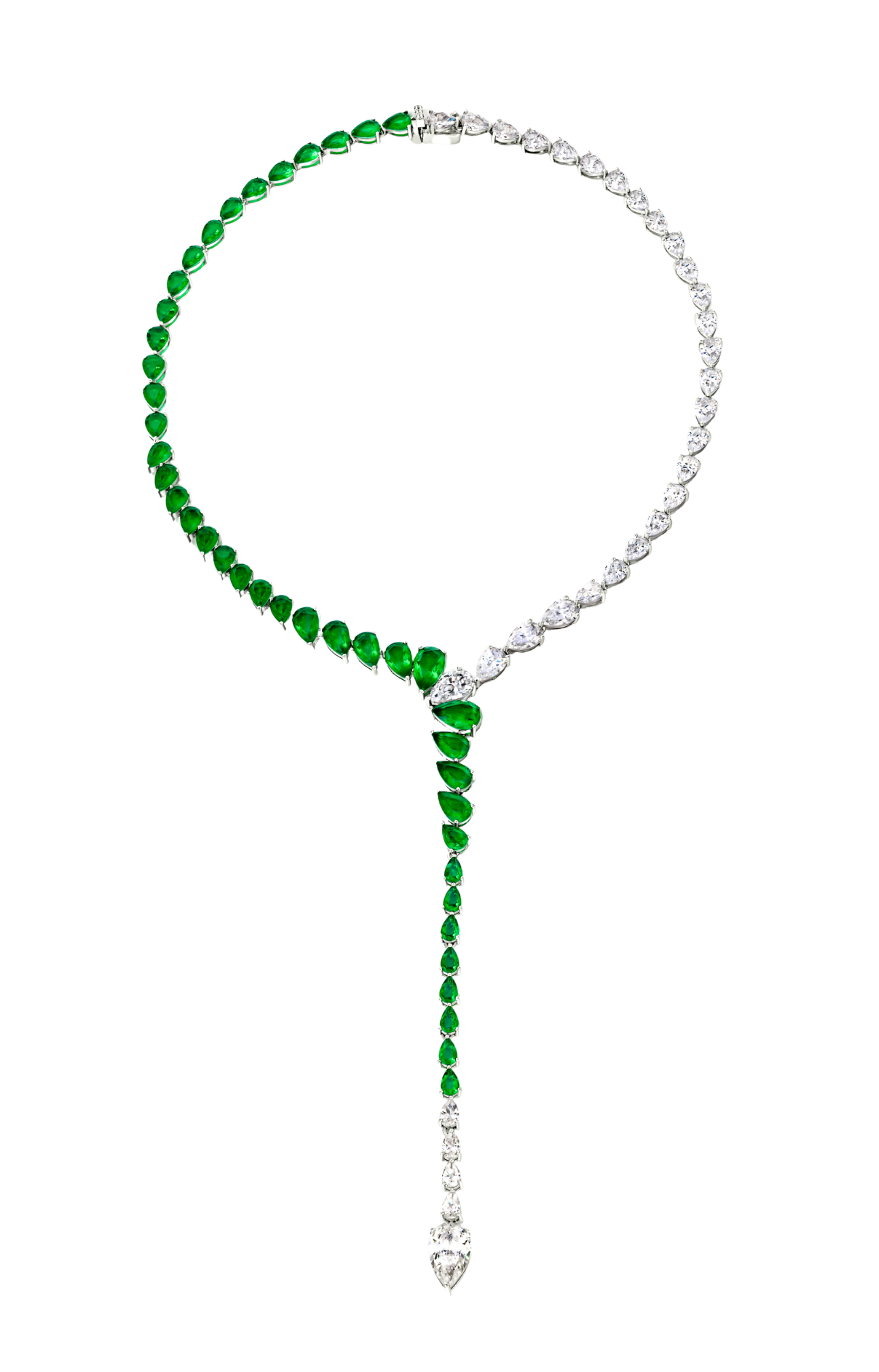
Emerald is the green to bluish green variety of the mineral beryl, which also includes aquamarine. Its color is associated with chromium. Stones that are too light are considered green beryl. Inclusions are the rule in emerald and are accepted. Eye-clean stones are rare and correspondingly sought after.
At a Glance
- Mineral
- Beryl
- Color
- Green to bluish green
- Clarity
- Inclusions common, called “jardin” in the trade
- Most common cut
- Emerald cut
- Common treatment
- Filling fine fissures with oil or wax
- In the GIA report
- Degree of clarity enhancement: minor, moderate or significant
Color before clarity
In emerald, color determines rank. The most highly valued stones are bluish green to pure green with strong saturation, evenly distributed and as transparent as possible. Inclusions are accepted in return. The trade calls them jardin, French for garden. The emerald cut, named after the stone, is its most common cut. The beveled corners protect it from damage.
Oil is common and belongs in the report
Fine fissures that reach the surface are often filled with oils or waxes in emeralds to make them less noticeable. This is a treatment and must be disclosed. GIA grades its extent in the report as minor, moderate or significant. Vikar Ahmed accepts only a light, colorless oiling, usually with cedarwood oil, and rejects synthetic resins and colored oil. His clients always learn whether and how heavily an emerald has been oiled. For care, this means: hot water, for example when washing dishes, can damage filled emeralds.
Frequently asked questions
Emerald in an engagement ring: is it worth it or is it too delicate?
An emerald can be worn in an engagement ring, but it calls for more care than a diamond. Inclusions and filled fissures make it more sensitive to knocks and hot water. A protective setting and taking the ring off for housework and sports compensate for this.
Origin report or plain identification report: what do I need for an emerald in a custom necklace?
The identification report is the foundation: it confirms the emerald and records whether it was tested for treatments. The origin statement is added if the country of mining matters to you. Laboratories only state it if it can be determined. With several stones, the question arises mainly for the main stone.
Besides emerald, which green stone is suitable for an engagement ring?
Green tourmaline is the main option. It has a hardness of 7 to 7.5 and shows visible inclusions less often in green and blue than in red. Copper-bearing tourmalines from the Paraíba tourmaline family also occur in green. The page Gemstones gives an overview.
Private Consultation
Vikar Ahmed sources emeralds mainly from Colombia, supplemented by Zambia. Color, cut and a setting that protects the stone are best discussed together before a design takes shape. The conversation takes place in the showroom in Idar-Oberstein or virtually. Request a private consultation.
Further reading
Sources
- GIA: Emerald Description, accessed 2026-11-16
- GIA: Emerald Quality Factors, accessed 2026-11-16
- GIA: Gem Treatments, accessed 2026-11-16
- GIA: Compare Colored Stone Reports, accessed 2026-11-16
- GIA: Tourmaline, Eigenschaften und Farbursachen, accessed 2026-11-16
- Vikar Ahmed: Meisterstücke und Kollektionen, accessed 2026-11-16

A personal conversation starts here.
At the showroom in Idar-Oberstein or by video. Vikar Ahmed discusses your ideas, stones and designs with you and answers your questions calmly and in confidence.


Thank you for your request.
Your request will be handled with the utmost attention and discretion. Vikar Ahmed will get back to you.
Your details
Request
–
Occasion
–
Consultation
–
Contact
–
In the meantime
Insights: What is a Paraíba tourmaline? · Engagement ring to your own design: how does it work?
Confidential and without obligation
Back to the pagePrivate consultation
A personal conversation starts here.
- Time for your questions, wishes and ideas
- In the showroom in Idar-Oberstein or by video
- Confidential, discreet and without obligation
Vikar Ahmed · Hauptstraße 111 · 55743 Idar-Oberstein, Germany