

Paraíba Tourmaline or Diamond in an Engagement Ring
One stone stands for sparkle, the other for color. In everyday life they differ mainly in hardness, toughness and care, and the choice of setting follows from this.
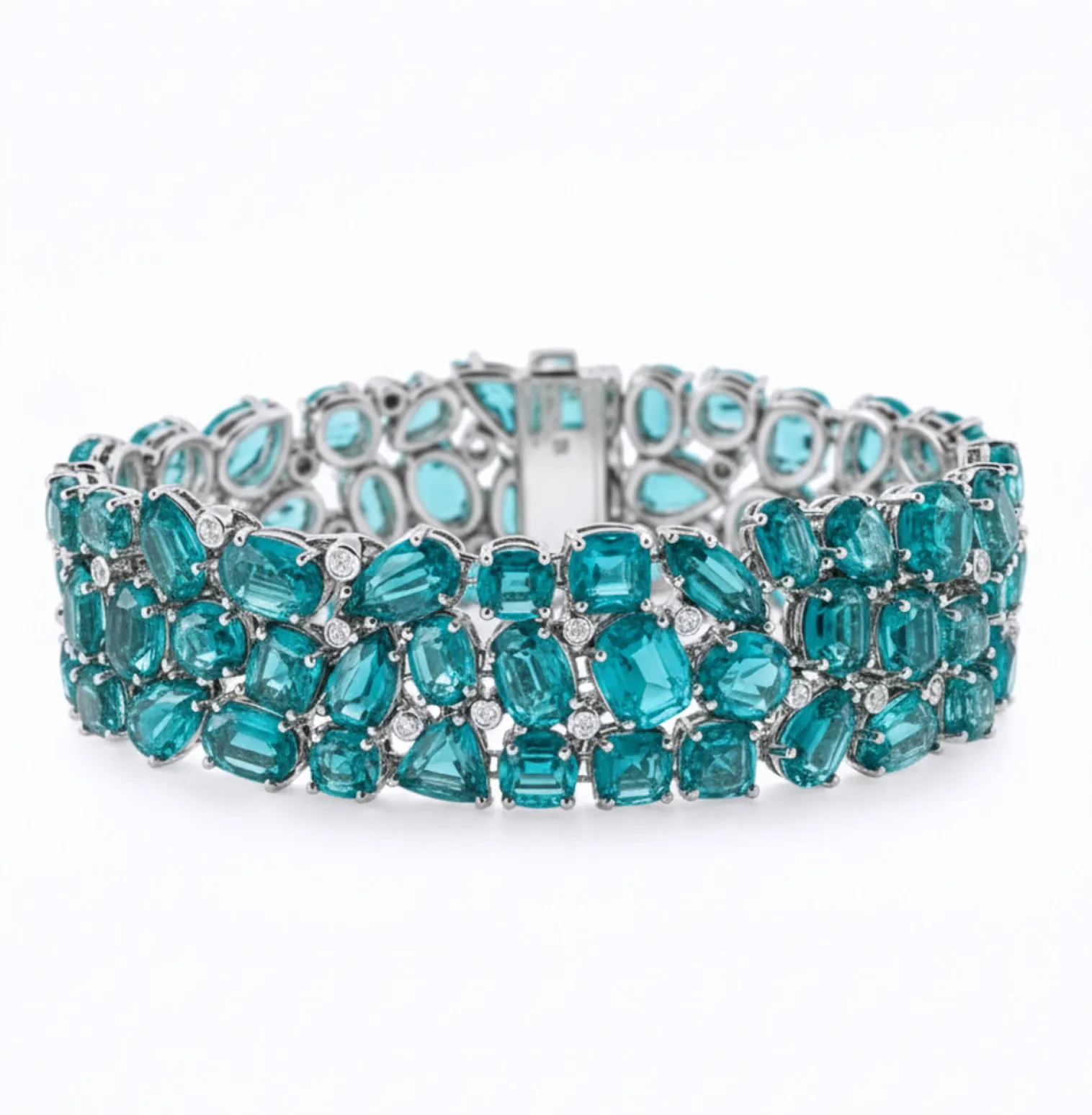
For everyday wear, diamond is the more robust stone: it has a hardness of 10, Paraíba tourmaline 7 to 7.5. A Paraíba tourmaline is nevertheless suitable for an engagement ring if the setting protects it and the ring is taken off for rough work. Diamond stands for sparkle, Paraíba tourmaline for a color that catches the eye at once.
At a glance
- Diamond hardness
- 10 on the Mohs scale, the highest value on the scale
- Paraíba hardness
- 7 to 7.5 on the Mohs scale, toughness according to GIA fair
- Effect
- Diamond: brilliance. Paraíba tourmaline: vivid blue to green
- Cleaning tourmaline
- Warm soapy water, no ultrasonic, no steam
- Cleaning diamond
- Lint-free cloth, mild cleaners or dish soap
- Protection in the ring
- A setting that covers the edge and corners of the stone
Hardness and toughness in everyday life
Diamond is the harder stone, and the gap is greater than the numbers suggest. The Mohs scale ranks minerals by which one scratches the other. According to GIA, its steps are not evenly spaced. Diamond stands at the top with 10 and is scratched only by another diamond. Tourmaline lies at 7 to 7.5. It resists many everyday materials, but not all.

Hardness is not the same as toughness, meaning resistance to impact. Even a diamond can break if it is struck hard at an unfavorable point in the direction of its cleavage. The Gemological Institute of America, GIA for short, rates the toughness of tourmaline as fair. For both stones, therefore: the setting helps decide how well a ring withstands everyday life.
Both stones compared
| Criterion | Diamond | Paraíba tourmaline |
|---|---|---|
| Mohs hardness | 10 | 7 to 7.5 |
| Effect | Brilliance and fire | Vivid color, blue to green |
| Everyday scratches | Only by another diamond | Possible over the years, especially at edges |
| Sensitive to | Hard impact on edges and corners | Impact, high heat, rapid temperature change |
| Cleaning | Lint-free cloth, mild cleaners | Warm soapy water |
| Report | Grading according to the 4Cs | Identity, treatment, origin on request |
Information on hardness, stability and cleaning according to GIA.
The comparison shows where the real question lies. With diamond, the risk is a rare, hard impact. With Paraíba tourmaline, gradual wear is added: facet edges that become dull over the years, and a lower tolerance to heat. Both can be limited considerably through setting and habits. This does not speak against the stone, but for a deliberate design of the ring.
Which setting protects the stone
The softer the stone, the more work the setting takes on. A bezel setting encloses the stone with a rim of metal. GIA describes it as very resistant to chipping and everyday wear, because the edge is protected all around. A prong setting shows more of the stone and lets in more light. More prongs give more security, fewer prongs show more of the stone.
- Corners and points should be covered by metal, with any stone.
- A stone set low knocks against things less often than one set high.
- A halo of diamonds around the colored stone acts as a frame and keeps impacts away from its edge.
- The setting should be checked at intervals, because prongs wear down over the years.
The diamond halo deserves a second look. GIA describes it as giving the center stone a visible frame and adding sparkle. With a Paraíba tourmaline, it thus combines exactly the two effects between which couples often waver. Because it consists of many small stones, it needs somewhat more care. What else to consider when setting this stone is covered in the guide on setting Paraíba tourmaline.
Care and wear
A ring with Paraíba tourmaline is best cleaned with warm soapy water and a soft brush. GIA does not recommend ultrasonic and steam cleaners for tourmaline. The stone is generally stable to light and chemicals. High heat can change its color, and a rapid temperature change can cause fractures. With diamond, too, ultrasonic and steam can loosen stones in the setting.

- Take the ring off for gardening, sports with equipment and rough household work.
- Store it separately from diamond jewelry, because a diamond scratches any softer stone.
- Avoid large temperature changes, for example from hot water directly into the cold.
- Clean regularly with warm soapy water and dry with a soft cloth.
- Visit a goldsmith as soon as the stone moves or a prong catches on fabric.
Which documents belong with which stone
The two stones also differ in their documents. A diamond report grades color, clarity, cut and weight according to the 4Cs and names known treatments. GIA issues such a report for loose, natural diamonds in the D to Z color range from 0.15 carat. It places the stone on fixed scales and thereby makes two diamonds directly comparable. It does not state a monetary value, nor does it assess the setting of the ring.
For Paraíba tourmaline there is no comparable scale. An identification report determines what the material is and lists detectable treatments. For Paraíba tourmaline, GIA additionally offers a report with origin determination. The color itself is ultimately judged by the eye. Anyone comparing the two stones is therefore not comparing two sets of numbers, but a graded diamond with a described colored stone.
Color or sparkle: the question behind the question
In the end, the choice between the two stones is not a technical one. Diamond is the classic engagement stone, understated and wearable with everything. Paraíba tourmaline is a statement. Its blue to green defines the ring and often what is worn with it. For people who love color, that is precisely the reason. What defines the stone gemologically can be found under Paraíba tourmaline.
The two stones do not exclude each other. A Paraíba tourmaline as center stone, accompanied by diamonds, combines color and sparkle. Which other colored stones suit an engagement ring is covered in the guide Engagement ring with a colored gemstone. What determines the value of Paraíba tourmaline is set out in the guide on price.
How to recognize good craftsmanship
Anyone commissioning an engagement ring with Paraíba tourmaline instead of a diamond should ask more questions than with a classic solitaire. According to GIA, Paraíba tourmalines are almost always cut individually. The setting must therefore be built around the individual stone. A good house shows how the edge and corners are protected, names the report for the stone and explains what is known about origin and treatment.
Paraíba tourmaline is the centerpiece of the Maison Vikar Ahmed. For this stone, Vikar Ahmed prefers platinum or 18 karat white gold, set in open prongs, often with a halo of small white diamonds, or in a bezel that protects the edges for everyday wear. The house also works with colorless diamonds and natural fancy color diamonds. The three-dimensional visualization shows how setting and stone work together before production begins. If you would like to see a Paraíba tourmaline and a diamond side by side at the appointment, it is best to say so in your request.
Frequently asked questions
Which engagement rings, Paraíba tourmaline or diamond, are better suited to everyday wear?
Rings with a diamond are less sensitive, because diamond has a hardness of 10. A ring with Paraíba tourmaline is suitable for everyday wear if the stone sits low and its edge is protected by a bezel or strong prongs. It should be taken off for rough work.
Diamond or Paraíba tourmaline as the stone for an engagement ring?
Diamond, if you are looking for a robust, understated stone that goes with everything. Paraíba tourmaline, if color is to take center stage and a little care in wearing is no obstacle. The two can be combined, for example with the colored stone in the center and diamonds as a frame.
For our engagement, we are looking for a ring with Paraíba tourmaline instead of the classic diamond. Which jewelers in Bad Kreuznach carry or make something like this?
Which houses in Bad Kreuznach make such rings can only be found out locally. Make sure the setting is designed around the stone and a report is available. Vikar Ahmed has no location in Bad Kreuznach, but makes Paraíba jewelry as one-of-a-kind pieces in Idar-Oberstein.
How do I clean a ring with Paraíba tourmaline?
With warm soapy water and a soft brush, then rinse with clear water and dry. Following GIA's recommendation, you should avoid ultrasonic and steam cleaners. Avoid high heat and rapid temperature changes, as they can damage color and stone.
Can a Paraíba tourmaline get scratched in everyday wear?
Yes. With a hardness of 7 to 7.5, it is considerably softer than diamond. Harder materials can scratch it, most likely at the facet edges. Storing it separately from diamond jewelry and a protective setting reduce the risk. A lapidary can repolish fine marks.
Is a bezel setting better than prongs for a Paraíba tourmaline?
For everyday use, the bezel protects better, because it encloses the edge all around with metal. Prongs let more light into the stone and show more color. Anyone choosing prongs should pay attention to strong prongs and a low setting height.
Private consultation
Whether color or sparkle suits you becomes clear when both stones lie side by side. Vikar Ahmed advises on this in the showroom in Idar-Oberstein by appointment, or virtually if you prefer. Request an appointment for a private consultation.
Further reading
- Paraíba at Vikar Ahmed
- Gemstone: Paraíba tourmaline
- Gemstone: Diamond
- Glossary: Prong setting
- What determines the price of a Paraíba engagement ring
- Engagement ring with a colored gemstone
Sources
- GIA: Diamond Care and Cleaning, accessed 2026-11-17
- GIA: Tourmaline Care and Cleaning, accessed 2026-11-17
- GIA: Tourmaline Quality Factors, accessed 2026-11-17
- GIA: Mohs Scale, Gem and Mineral Hardness, accessed 2026-11-17
- GIA: Complete Guide to Engagement Ring Settings, accessed 2026-11-17
- GIA: Diamond Grading Reports, accessed 2026-11-17
- GIA: Colored Stone Reports & Services, accessed 2026-11-17
- Vikar Ahmed: Paraíba, accessed 2026-11-16
- Vikar Ahmed: Collections, accessed 2026-11-16
- Vikar Ahmed: Verlobungsringe und Engagement, accessed 2026-11-16

A personal conversation starts here.
At the showroom in Idar-Oberstein or by video. Vikar Ahmed discusses your ideas, stones and designs with you and answers your questions calmly and in confidence.


Thank you for your request.
Your request will be handled with the utmost attention and discretion. Vikar Ahmed will get back to you.
Your details
Request
–
Occasion
–
Consultation
–
Contact
–
In the meantime
Insights: What is a Paraíba tourmaline? · Engagement ring to your own design: how does it work?
Confidential and without obligation
Back to the pagePrivate consultation
A personal conversation starts here.
- Time for your questions, wishes and ideas
- In the showroom in Idar-Oberstein or by video
- Confidential, discreet and without obligation
Vikar Ahmed · Hauptstraße 111 · 55743 Idar-Oberstein, Germany