

Which Setting Suits a Paraíba Tourmaline?
The setting decides twice: on the color the eye sees and on the protection the stone receives. An overview of metals and construction types for Paraíba tourmalines.
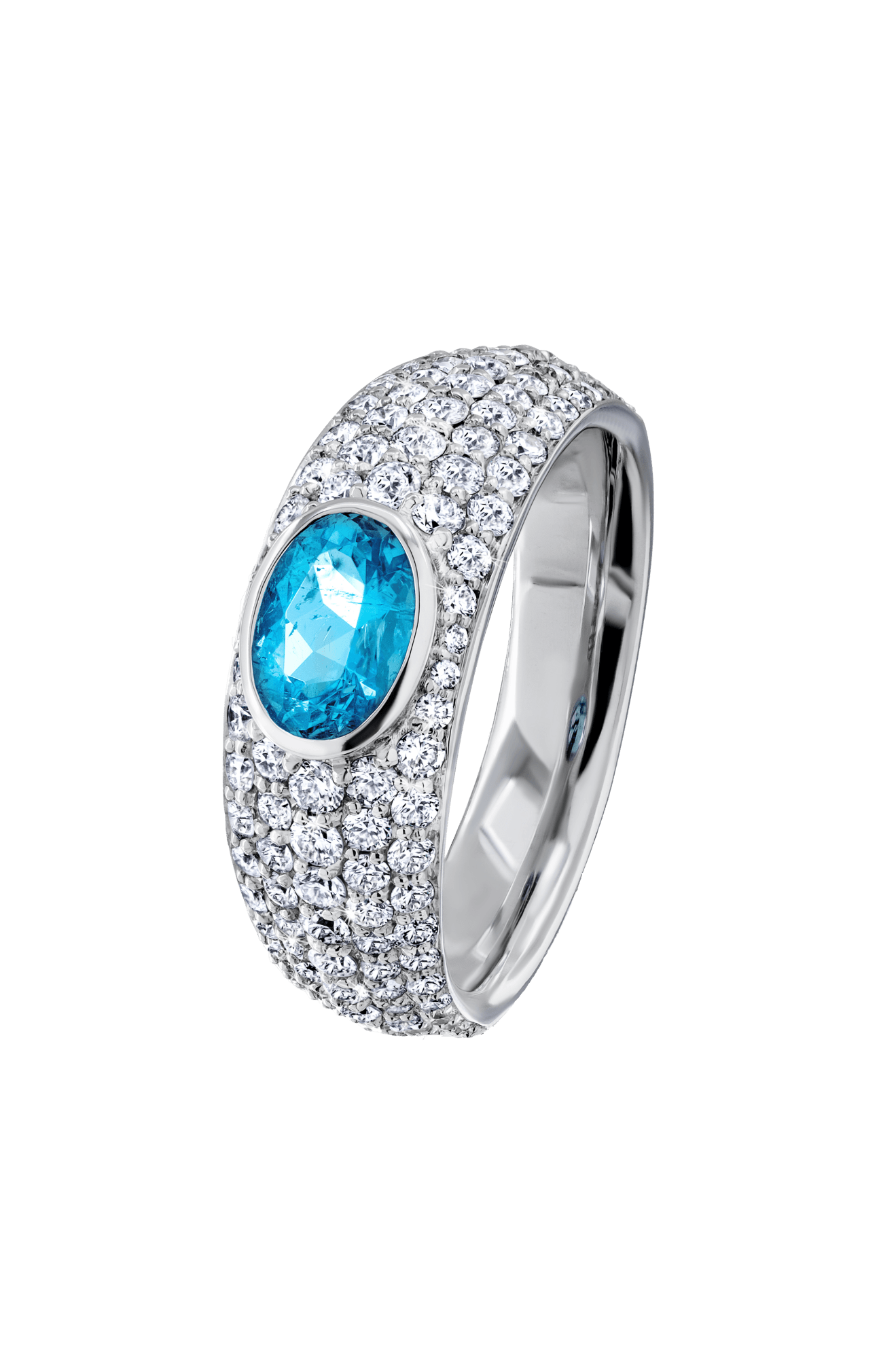
White gold and platinum bring out the cool neon blue of a Paraíba tourmaline most clearly, because they reflect no warmth into the stone. Rose gold warms the picture and flatters greenish stones. Platinum is denser, hardly wears and needs no rhodium plating. Besides the metal, the construction above all protects the stone: bezel setting or prong setting.
At a glance
- Clearest blue
- White gold or platinum
- Warmest look
- Rose gold, colored by copper in the alloy
- 18k (750) gold
- 75 percent fine gold, 25 percent other metals
- Platinum
- Usually around 95 percent pure, hallmark Pt950
- White gold
- Usually rhodium-plated, the rhodium wears off over time
- Best edge protection
- Bezel, partial bezel or V-shaped prongs
Metal color changes the stone's color
A transparent stone does not show only its own color. Light enters, is reflected and picks up something of its surroundings along the way, including the metal beneath and beside the stone. GIA describes this effect in diamonds: yellow gold prongs can give a colorless stone a yellowish tone, while a white setting makes it appear more colorless. In a Paraíba tourmaline, the same mechanism acts on a glowing blue or green.

GIA therefore pairs cool colored stones such as blue sapphire, tanzanite and blue spinel with white gold, and warm colored stones with yellow and rose gold. With its range from violetish blue through greenish blue to green, the Paraíba tourmaline belongs mostly to the cool stones. A white metal supports this coolness, a warm metal breaks it. Both can be intended. What matters is the tone the individual stone brings.
White gold or rose gold
According to the World Gold Council, white gold is made by alloying gold with white metals such as palladium or silver and is usually rhodium-plated to obtain a harder, brighter surface. Beside a Paraíba tourmaline it looks neutral to cool. The blue appears pure, and neon blue remains neon blue. For stones with a distinct blue component, white gold is therefore the obvious choice, especially when colorless diamonds accompany the stone.
Rose gold results from copper in the alloy, according to GIA from copper and silver. It casts a warm, rosy shimmer and takes some of the coolness from the Paraíba blue. With stones that lean toward green, this can look very beautiful, because green and rose form a soft contrast. With a pure, cool neon blue, on the other hand, rose gold can shift the tone slightly. A combination is possible: prongs in white gold, shank in rose gold.
| Metal | Effect on Paraíba | Care and behavior |
|---|---|---|
| 18k (750) white gold | Cool, clear, the blue looks pure | Rhodium wears off, renew occasionally |
| 18k (750) rose gold | Warm, soft, flatters green tones | Less care, polish occasionally |
| Platinum 950 | Cool, naturally white, without plating | Hardly wears, develops a patina |
| 18k (750) yellow gold | Strong contrast, warms considerably | Little care |
Information on alloys and care according to GIA and the World Gold Council. The effect depends on the tone of the individual stone.
Platinum or 18k (750) white gold
According to GIA, platinum is denser and stronger than gold and less brittle than gold alloys, so platinum prongs break less often. Its high purity of usually around 95 percent reduces the risk of skin reactions. The hallmark Pt950 means 950 parts platinum per 1,000. According to GIA, platinum loses hardly any material even over decades and keeps its shape. Over time it develops a patina, which some appreciate and others have polished away.
According to the World Gold Council, 18k (750) gold contains 75 percent fine gold and 25 percent other metals. White gold in this alloy resists corrosion and impact, but according to GIA its prongs should be checked regularly. The rhodium layer wears off over time, revealing a warmer, slightly yellowish tone. For a Paraíba ring worn every day, there is therefore much to be said for platinum 950. For earrings and pendants the difference is smaller.
Prong, bezel and halo
Besides the metal, the construction is decisive. Prongs are small metal claws that hold the stone. According to GIA, they let the most light into the stone and show the most of it. A bezel is a metal rim that encloses the stone completely or partially. According to GIA, it protects the edges very well and lets in somewhat less light. For a tourmaline with a hardness of 7 to 7.5 and fair toughness, this protection is worth a great deal in a ring.

A bezel colors the stone more strongly than prongs, because more metal is visible. A white gold bezel around a Paraíba tourmaline therefore looks cooler than four fine prongs, and a rose gold bezel noticeably warmer. A halo of small diamonds, in turn, can make the center stone look larger, according to GIA. The guide Solitaire or diamond entourage covers how a solitaire and a halo look on a Paraíba ring.
Good to know
According to GIA, tourmaline does not tolerate high heat. High temperatures can change its color, and sudden temperature changes can cause fractures. When soldering a set Paraíba ring, the stone must therefore be protected or removed from the setting beforehand.
How the setting is chosen
- Determine the stone's hueDoes the stone lean more toward blue or toward green? This decides whether a cool or a warm metal supports it.
- Choose the type of jewelryA ring needs more protection than earrings or a pendant. This determines whether a prong or a bezel setting is used.
- Compare metals on the stonePlace the stone on white gold, rose gold and platinum and compare them in daylight.
- Plan accompanying stonesColorless diamonds usually call for white prongs, even when the shank is warm.
- Review in the 3D designAssess proportion, height and visible metal before production.
Typical mistakes in the setting
- Choosing the metal out of habit without testing it on the stone.
- Placing a cool neon blue stone in a wide rose gold bezel that warms it more than intended.
- Forgetting the rhodium plating on white gold: it needs to be renewed occasionally.
- Mounting an everyday ring on high, open prongs.
- Handing the ring in for soldering without pointing out the heat sensitivity of tourmaline.
Another mistake is confusing metal color with treatment. If a stone looks greener in a setting than loose, this is due to the light and the metal, not to a change in the stone. According to SSEF, Paraíba tourmalines are frequently heated, and a report notes whether there are indications of this. That information concerns the stone. The setting only changes how it appears, not what it is.
Paraíba settings at Vikar Ahmed
For Paraíba tourmaline, Vikar Ahmed prefers platinum or 18 karat white gold. He sees 18 karat yellow gold as a warm contrast in which the stone often looks greener. He likes an open prong setting with a halo of small white diamonds, and for everyday wear a bezel that protects the edges. Stones are set under the microscope in the in-house atelier in Idar-Oberstein. Before production, a 3D CAD design shows how much metal is visible around the stone and how prongs or a bezel look.
Alongside 18k (750) gold in white, rose, and yellow, the house works with platinum 950 and, on request, 14k (585) gold. Metal and alloy are decided together in the consultation. Anyone who wishes for a piece in a particular metal should mention it in the first conversation. The guide The path to Paraíba jewelry describes the way from the first appointment to the finished piece.
Frequently asked questions
Which setting brings out the neon blue of a Paraíba tourmaline better, white gold or rose gold?
White gold. It reflects no warmth into the stone, so a neon blue appears pure and cool. Rose gold warms the stone and shifts a cool blue slightly. For stones with a green component, on the other hand, rose gold can look very harmonious.
Is Paraíba jewelry in platinum worth it compared with 18k (750) white gold?
For rings, often yes. Platinum is denser and hardly wears, its prongs break less often and it needs no rhodium plating. White gold has to be rhodium-plated again from time to time. For earrings and pendants, which are subject to little stress, the difference is smaller. Visually, both look cool.
White gold or rose gold, which metal brings out the blue of a Paraíba tourmaline better?
White gold for a clear blue, rose gold for a softer, warmer look. How great the difference is depends on the stone's hue and on the amount of visible metal. A bezel colors more strongly than fine prongs. A direct comparison on the stone is the most reliable way to decide.
Which goldsmith makes Paraíba rings in platinum?
Vikar Ahmed makes Paraíba jewelry in its in-house atelier in Idar-Oberstein and prefers platinum 950 or 18 karat white gold for the stone. In general, for platinum the workshop needs experience with the metal and must protect the heat-sensitive tourmaline during work.
Does a rose gold ring permanently color the Paraíba tourmaline?
No. The metal only changes how the stone appears while it is set. Light is reflected inside the stone and picks up some of the metal's tone. The stone itself remains unchanged and shows its own color again once loose.
Which setting best protects a Paraíba tourmaline in a ring?
A bezel or partial bezel setting. It encloses the sensitive edges and keeps knocks away. For less durable stones, GIA also recommends V-shaped prongs at points and corners. Open, high prongs show more of the stone but protect it the least.
Private consultation
Which metal carries your stone is best seen when it rests in turn on white gold, rose gold and platinum. Vikar Ahmed advises by appointment in the house's showroom in Idar-Oberstein, and virtually on request. Request an appointment for a private consultation.
Further reading
- Paraíba ring: solitaire or diamond entourage
- Paraíba tourmaline in an engagement ring
- Wearing Paraíba jewelry with confidence
- Glossary: Prong setting
- Gemstone: Paraíba tourmaline
Sources
- GIA 4Cs: Engagement Ring Setting Metals, accessed 2026-11-17
- GIA 4Cs: White, Yellow and Rose Gold Engagement Rings, accessed 2026-11-17
- GIA 4Cs: How to Pick the Right White Metal, accessed 2026-11-17
- GIA 4Cs: Best Ring Material for Everyday Wear, accessed 2026-11-17
- GIA 4Cs: Complete Guide to Engagement Ring Settings, accessed 2026-11-17
- GIA 4Cs: More than the Mohs Scale, Gem Durability, accessed 2026-11-17
- GIA: Tourmaline Care and Cleaning, accessed 2026-11-17
- World Gold Council: About gold jewellery, accessed 2026-11-17
- SSEF: Paraíba Tourmaline, accessed 2026-11-17
- Vikar Ahmed: Paraíba, accessed 2026-11-16

A personal conversation starts here.
At the showroom in Idar-Oberstein or by video. Vikar Ahmed discusses your ideas, stones and designs with you and answers your questions calmly and in confidence.


Thank you for your request.
Your request will be handled with the utmost attention and discretion. Vikar Ahmed will get back to you.
Your details
Request
–
Occasion
–
Consultation
–
Contact
–
In the meantime
Insights: What is a Paraíba tourmaline? · Engagement ring to your own design: how does it work?
Confidential and without obligation
Back to the pagePrivate consultation
A personal conversation starts here.
- Time for your questions, wishes and ideas
- In the showroom in Idar-Oberstein or by video
- Confidential, discreet and without obligation
Vikar Ahmed · Hauptstraße 111 · 55743 Idar-Oberstein, Germany