

How a Piece of Jewelry with Paraíba Tourmaline Is Made
A one-of-a-kind piece with Paraíba tourmaline is created in several stages, and at each one a decision is made. What is clarified in which order, and how you recognize good work.
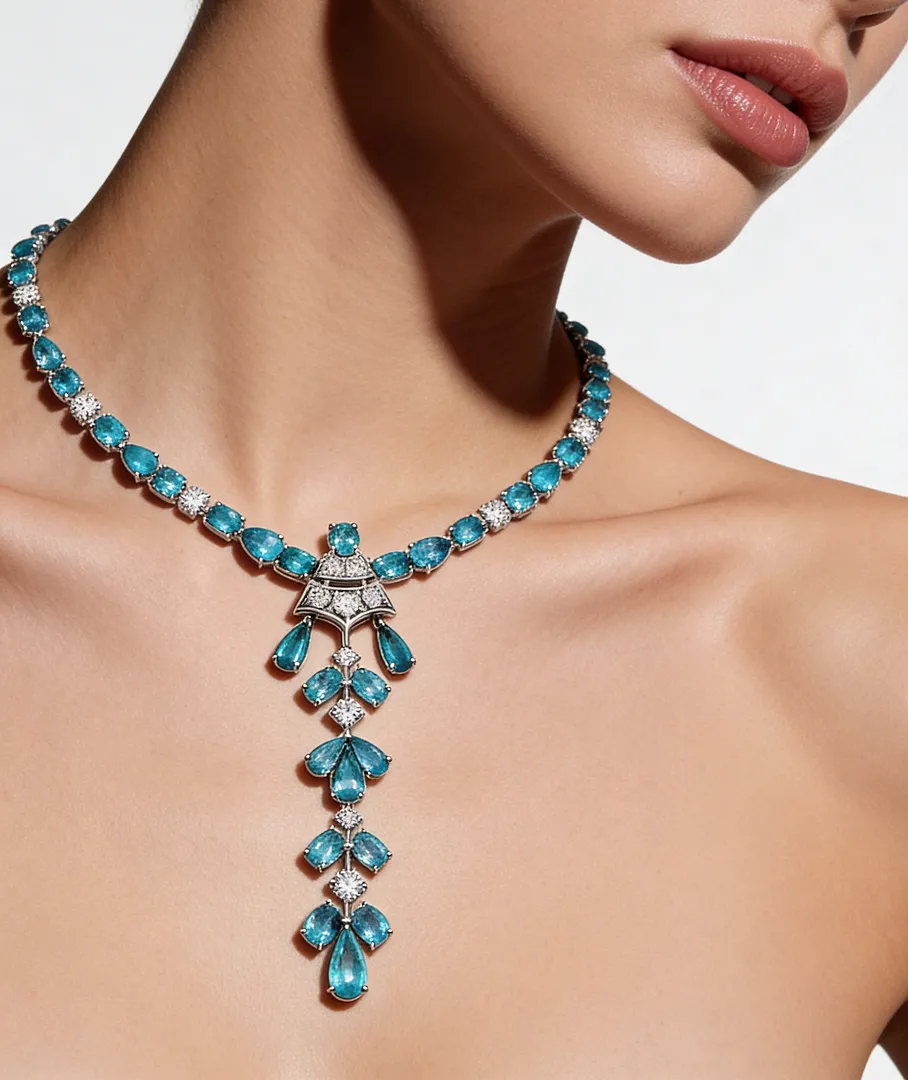
A piece of jewelry with Paraíba tourmaline is created in four stages: a conversation about wishes and occasion, clarification of the stone including its report, design with three-dimensional visualization and production in the workshop. The stone comes first, because Paraíba tourmalines are usually cut individually. The setting is planned around it, not the other way around.
At a glance
- Stages
- Conversation, stone and report, design and visualization, production
- Starting point
- The stone, because according to GIA Paraíba tourmalines are almost always cut individually
- Key document
- Laboratory report with identification, treatment and, on request, origin
- Treatment
- According to the LMHC, Paraíba tourmalines are frequently heated
- Sensitive to
- Great heat and rapid temperature changes, important in the workshop
- Preview
- Three-dimensional visualization before production
The path in four stages
A one-of-a-kind piece with Paraíba tourmaline follows a fixed order. First comes the conversation about occasion, style and wearing habits. Then comes the stone: which one it should be, what its report states and how it can be worked. Only then does the design begin. There is a reason for this order. With Paraíba tourmaline, the stone determines the form, size and setting of the piece more strongly than with stones of standard dimensions.

- ConversationOccasion, type of jewelry, style, wearing habits and time frame are clarified, in the showroom or virtually.
- Stone and reportThe stone's color, size, cut and laboratory report are discussed, including treatment and origin.
- DesignSketches translate the wish into a form that suits the stone.
- VisualizationA three-dimensional rendering shows the piece before production, and changes are still simple at this point.
- ProductionGoldsmiths make the piece, set the stone and polish by hand.
The first conversation: what you should bring
The first conversation serves to clarify, not to decide. It is about what the piece should achieve: a ring for every day, a pendant for special occasions, a bracelet that shows color in motion. The more precisely you describe how you wear jewelry, the better the type of jewelry can be matched to the stone. The appointment at Vikar Ahmed is arranged in advance, in person in Idar-Oberstein or virtually.
- The occasion and, if there is one, a fixed date for the handover.
- Photos of jewelry you like and of jewelry you wear daily.
- Notes on your profession, sports and daily life that matter for durability.
- An existing stone with its report, if it is to be worked.
- Preferences for the metal, such as white gold, rose gold or platinum.
The stone comes before the design
According to GIA, Paraíba tourmalines are almost always cut individually because of the high value of the rough. Their dimensions follow the crystal, not a standard. A setting can therefore only be planned precisely once the stone is settled. GIA also emphasizes that with Paraíba, color is the decisive factor, not size. The conversation about the stone is therefore first about hue and saturation, and then about weight.
The stone comes with a report from an independent laboratory. According to the shared standard of the major laboratories, set by the Laboratory Manual Harmonisation Committee, LMHC for short, a tourmaline is only called Paraíba if its color is due mainly to copper and manganese. The report also notes indications of treatments. Well-known independent laboratories include GIA and SSEF; ask for the laboratory and report number. The guide to the identification report explains what such a report contains in detail.
What the report says about treatment
According to the LMHC, Paraíba tourmalines are frequently heated. In some cases this cannot currently be detected. The SSEF laboratory in Basel then states that the color may have been improved by heating, but that this cannot be determined, and that the color is considered stable. SSEF notes fillings of fissures with oil or resin and grades their amount as minor, moderate or significant.

For the design, this is more than a formality. A filling can change under heat, pressure or chemicals, GIA writes. Anyone who knows whether a stone is filled can align the setting and later care accordingly. GIA also points out that every treatment must be disclosed. The glossary entry Treatment gives an overview of the terms.
| Statement in the report | What it means for the piece |
|---|---|
| Paraíba as a variety | The color is due mainly to copper and manganese (LMHC) |
| Heating undeterminable | Color may have been improved by heating but is considered stable (SSEF) |
| Filling minor, moderate or significant | Adapt setting and care; fillings react to heat and pressure |
Typical statements in a Paraíba tourmaline report and what they mean for design and care.
Design and visualization
In the design, wish and stone become a form. At Vikar Ahmed, in-house designers develop independent concepts into which personal wishes flow. The path leads from sketches to a three-dimensional visualization with CAD, computer-aided design. The piece can thus be seen as a whole before production. Proportions, the height of the setting and the relationship between stone and metal can still be changed at this stage without effort.
With Paraíba tourmaline, it is worth paying attention to three things in the visualization: how much metal protects the edges of the stone, how much light falls into the stone from behind and whether accompanying stones support the color or outshine it. Diamonds as a frame bring sparkle, but take away the effect of the blue if their area is too large. More on the tool itself under 3D design.
The setting is built around the stone
Tourmaline has a Mohs hardness of 7 to 7.5, and according to GIA its toughness is considered fair. It is therefore wearable, but sensitive at edges and corners. A bezel setting encloses the stone with a metal rim and, according to GIA, protects the edges very well. Prongs show more of the stone but need to be checked at intervals. The guide to the setting of the Paraíba tourmaline goes deeper into which setting suits which piece.
In the workshop, a second property comes into play. According to GIA, great heat can change the color of a tourmaline, and a rapid temperature change can cause fractures. Work with an open flame, such as soldering, should therefore be completed before the stone is set. At Vikar Ahmed, goldsmiths from Idar-Oberstein with decades of experience set the stones and polish by hand.
Typical mistakes on the way to the piece
- Fixing the design before the stone is settled: individually cut stones rarely fit a ready-made form.
- Choosing by the word neon: it is a trade term, not a laboratory term.
- Reading the report only at the end: treatment and fillings influence setting and care.
- Choosing the type of jewelry by the stone, not by daily life: a ring bears different loads than a pendant.
- Skipping the visualization: changes are simple there, but laborious on the finished piece.
The second point deserves an explanation. Laboratories such as SSEF describe the color with factual terms such as blue, light blue or greenish blue and do not use expressions such as electric blue or neon blue. The entry Neon quality explains what the trade means by neon. What counts for the choice is how the stone looks in your light and what the report records about it.
Handover and the time afterwards
Before handover, clarify which documents belong to the piece, such as the report on the stone and a description of the materials. At Vikar Ahmed, the treatment of the Paraíba is stated on the certificate, the expert report, and the invoice. As a guide, the house gives about 4 to 6 weeks for more elaborate custom pieces and 1 to 3 months for high jewelry projects. Anyone with a fixed occasion should therefore mention it in the first conversation. For care, GIA recommends warm soapy water for tourmaline rather than ultrasonic or steam cleaning.
Frequently asked questions
How does the making of a piece of jewelry with Paraíba tourmaline begin?
With a conversation about occasion, type of jewelry and wearing habits. Then the stone is clarified, because Paraíba tourmalines are usually cut individually and determine form and setting. Only when the stone and its report are settled does the actual design begin.
Why is the stone chosen before the design with Paraíba tourmaline?
Because its dimensions follow the individual crystal and not a standard. GIA describes that Paraíba tourmalines are almost always cut individually. A setting designed beforehand would have to be adapted afterwards. Starting with the stone means the form is created around its color.
What information should the report on a Paraíba tourmaline contain?
The identification as tourmaline of the Paraíba variety, indications of treatments such as heating or fillings and, if determined, the origin. According to the LMHC standard, the name Paraíba requires that copper and manganese cause the color. Without an origin determination, the report states this explicitly.
What is the purpose of the three-dimensional visualization before production?
It shows the piece as a whole before any metal is worked. Proportions, the height of the setting, the protection of the stone's edges and the effect of accompanying stones can be checked in it. Changes are simple at this stage, but laborious or no longer possible on the finished piece.
Why is heat an issue when working a Paraíba tourmaline?
Because, according to GIA, tourmaline reacts sensitively to great heat and rapid temperature changes. Heat can change the color, and a sudden change in temperature can cause fractures. Soldering is therefore done before setting, and later repairs to the piece must take this into account.
Can I have my own Paraíba tourmaline worked into a piece?
In principle yes, if the stone is suitable for the desired type of jewelry and a laboratory report records its identity and treatment. Vikar Ahmed, however, sets his own stones as a rule. The house takes on a Paraíba you bring only in rare exceptions, after a gemological examination and as part of a new design.
Private consultation
The first step toward a one-of-a-kind piece with Paraíba tourmaline is a conversation. Vikar Ahmed advises by appointment in the house's showroom in Idar-Oberstein or in a virtual appointment. Requests are treated with discretion and reviewed before work begins. Request an appointment for a private consultation.
Further reading
- Guide: Setting the Paraíba tourmaline
- Identification report for Paraíba tourmaline
- How to recognize a genuine Paraíba tourmaline
- Glossary: 3D design
- Bespoke at Vikar Ahmed
Sources
- LMHC Information Sheet #6: Paraiba Tourmaline (Version 8, 2023), accessed 2026-11-17
- SSEF: Paraiba Tourmaline, Report Explanation, accessed 2026-11-17
- GIA: Tourmaline Quality Factors, accessed 2026-11-17
- GIA: Tourmaline Care and Cleaning, accessed 2026-11-17
- GIA: Gem Treatment, accessed 2026-11-17
- GIA 4Cs: Complete Guide to Engagement Ring Settings, accessed 2026-11-17
- Vikar Ahmed: Bespoke, accessed 2026-11-17
- Vikar Ahmed: Paraíba, accessed 2026-11-17
- GIA: Gem Laboratory, accessed 2026-11-17
- SSEF Swiss Gemmological Institute, accessed 2026-11-17
- Vikar Ahmed: Kontakt, accessed 2026-11-17

A personal conversation starts here.
At the showroom in Idar-Oberstein or by video. Vikar Ahmed discusses your ideas, stones and designs with you and answers your questions calmly and in confidence.


Thank you for your request.
Your request will be handled with the utmost attention and discretion. Vikar Ahmed will get back to you.
Your details
Request
–
Occasion
–
Consultation
–
Contact
–
In the meantime
Insights: What is a Paraíba tourmaline? · Engagement ring to your own design: how does it work?
Confidential and without obligation
Back to the pagePrivate consultation
A personal conversation starts here.
- Time for your questions, wishes and ideas
- In the showroom in Idar-Oberstein or by video
- Confidential, discreet and without obligation
Vikar Ahmed · Hauptstraße 111 · 55743 Idar-Oberstein, Germany