

What Is an Identification Report for Paraíba Tourmaline?
With Paraíba tourmaline, a great deal rests on a single word in the laboratory report. Once you know how that word comes about, you read every report differently.

An identification report is a document from a gemological laboratory that confirms what the stone is. For Paraíba tourmaline, it identifies the stone as tourmaline, assigns it to the Paraíba variety or names the trade name in a comment, and lists detectable treatments. Origin is stated only in an extended report.
At a glance
- What it confirms
- Identity of the stone, description and detectable treatments
- Origin
- Only in an extended report, at GIA the Identification & Origin Report
- Name Paraíba (LMHC)
- Copper and manganese bearing, matching color, regardless of the source country
- Name Paraíba (SSEF)
- Only for Brazilian origin, otherwise “Tourmaline” with a note on the trade name
- Heating
- Common, not detectable in tourmaline according to GIA
- Typical details
- Report number, photo, weight, shape, cut, dimensions, color, date of examination
What an identification report confirms
The Gemological Institute of America, GIA for short, describes its Colored Stone Identification Report as a report that identifies and describes a material and lists detectable treatments. It applies to loose and to mounted stones. For Paraíba tourmaline, it answers three questions: Is the stone a natural tourmaline, does it meet the criteria for the Paraíba variety, and which treatments can be detected.
The report is not an appraisal. A statement of value is not among the contents that GIA and the Swiss laboratory SSEF describe for their reports. Nor does it contain a clarity or color grade as for diamonds. It describes the stone as the laboratory found it on the date of examination. Which laboratory reports exist in general and how they differ is explained in the guide The Gemstone Report.
How the report assigns the name Paraíba
The laboratory association LMHC, in which GIA, Gübelin and SSEF are represented among others, defines Paraíba tourmaline as a blue, bluish green to greenish blue, green or yellowish green tourmaline of medium to high saturation whose color is caused mainly by copper and manganese, regardless of the source country. The report then names the stone in the variety Paraíba tourmaline. Alternatively it states tourmaline, and a comment explains that the stone may also be called Paraíba tourmaline in the trade.

SSEF describes a narrower practice for its own reports. If the stone comes from Brazil, the designation is Paraíba tourmaline. If it comes from another country but meets the criteria for color and chemistry, it is called tourmaline, with a note on the trade name. Both views are found in practice. Anyone comparing reports from different laboratories should therefore read the variety, the comment and the origin statement together and not look only for the word Paraíba.
Good to know
According to LMHC, tourmalines with only traces of copper and weak saturation, or with a color outside the defined range, are not called Paraíba tourmaline. The word in the report therefore also says something about the color. What defines the stone is explained in the glossary under Paraíba tourmaline.
The details on the report one by one
The exact layout differs from laboratory to laboratory. SSEF lists a number of details for its reports that appear in similar form on other reports as well. The table shows what they mean and what to look for when reading them. A report is all the more useful the more clearly it can be matched to the stone.
| Detail | What it means | What to look for |
|---|---|---|
| Report number | Unique identifier, after recutting SSEF issues a new one | Verify through the laboratory's online lookup |
| Weight | In carats to three decimal places, for jewelry in grams | Does the weight match the stone presented? |
| Shape, cut, dimensions | Outline, facet style, length by width by depth | Have the dimensions measured on the stone |
| Color | Descriptive term such as blue or greenish blue | No trade terms such as neon blue at SSEF |
| Identification | Tourmaline, Paraíba variety or comment on the trade name | Note on copper and manganese in the comment |
| Treatment | Detectable treatments, fillings with their extent | Read the sentence on undeterminable heating |
| Photo | For illustration, color and size may differ | Never judge the stone by the photo alone |
Details based on SSEF's explanation of its Paraíba reports. Other laboratories arrange them in a similar way.
Identity, origin, treatment: three questions
Identity is the basic question. Origin is a separate, more difficult question. For Paraíba tourmalines, GIA offers an Identification & Origin Report that additionally states the country of origin. According to a 2019 GIA study, standard gemological tests are not sufficient for this. What matters is the measurement of trace elements such as copper, zinc, gallium, strontium, tin and lead by laser ablation. For the great majority of stones the country can be determined reliably this way, for some the result remains open.
SSEF explicitly calls origin determination an expert opinion, based on inclusions, trace elements and spectroscopic data compared with a reference collection. Known source countries are Brazil, Nigeria and Mozambique. Why origin plays such a large role with Paraíba is explained in the guide Origin of Paraíba Tourmaline. What a pure origin report provides is covered in the glossary under Origin report.
The third question is treatment. According to LMHC, Paraíba tourmalines are frequently heated, and this cannot be detected in every case. GIA describes heat treatment of tourmaline in general as permanent and undetectable. In such cases SSEF states, in essence, that it currently cannot be determined whether the stone was heated. SSEF reports fillings of fissures with oil or resin together with their extent. More on this under Treatment.
Which reports belong with a Paraíba ring
For a ring with a Paraíba tourmaline, an identification report on the center stone is the foundation. It confirms that the stone is a natural tourmaline and whether it is designated Paraíba tourmaline. If a specific origin is stated, such as Brazil, an origin report should confirm it. A report produced on the loose stone before setting is often more precise, because the laboratory can measure the stone from all sides.
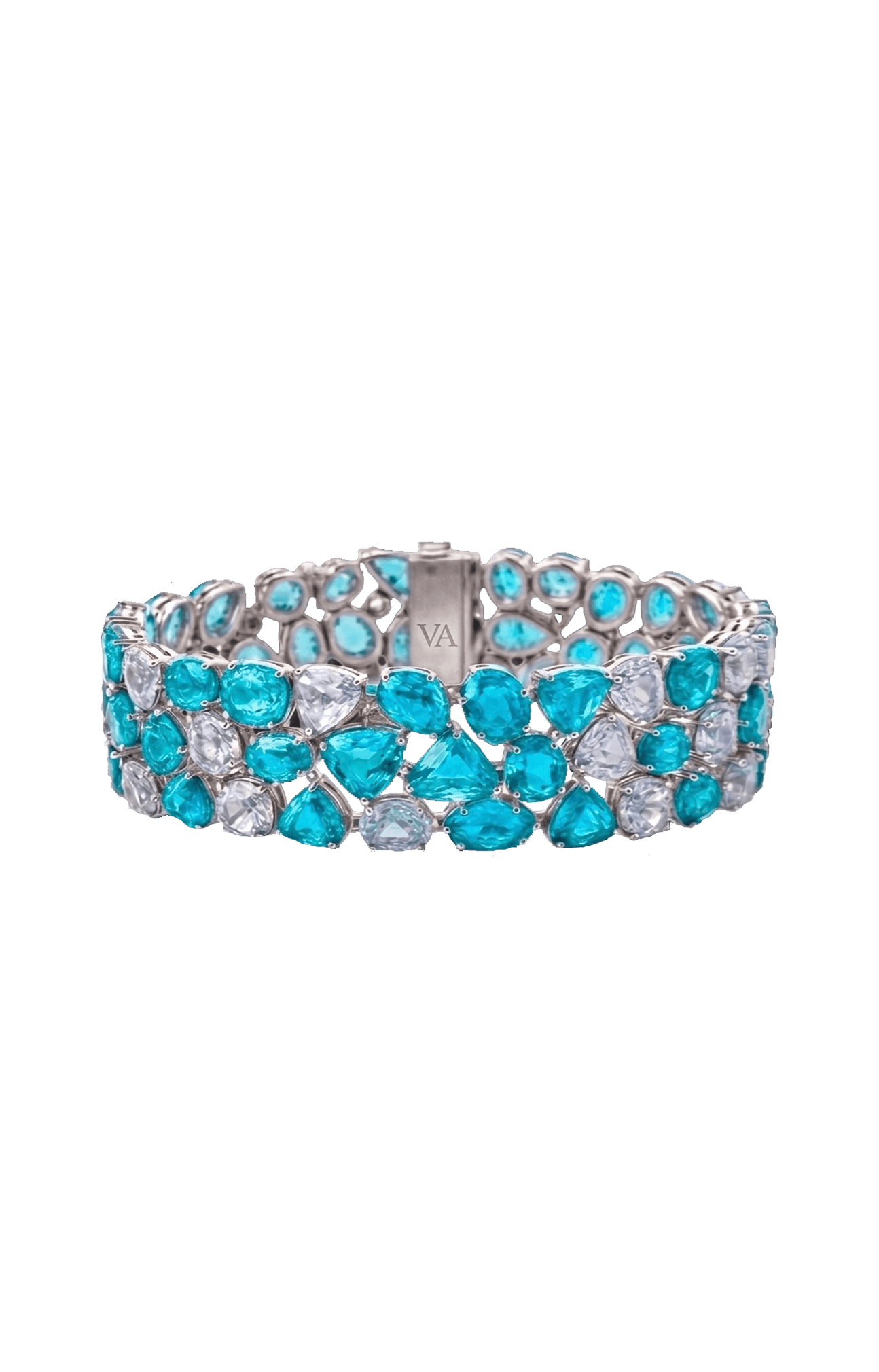
- Identification report on the center stone, with the variety or a comment on the trade name.
- Origin report, if the country of origin is stated or used to support the value.
- Clear statements on treatment, including undeterminable heating.
- Weight and dimensions that can be matched to the set stone.
- For a complete piece of jewelry there are separate documents, Gübelin for example names a Jewellery Passport.
How to check a report
- Verify the report number through the laboratory's online lookup, at SSEF via myssef.ch, at Gübelin via Document Verification.
- Compare weight, shape and dimensions with the stone presented.
- Look at the date of examination: the report describes the stone at that point in time.
- Read the variety and the comment, not just the heading.
- Read the paragraph on treatment in full, including subordinate clauses.
- Note the origin statement or the remark that no origin was determined.
A missing origin statement is not a flaw in the stone. For this case LMHC provides for a remark that the geographic origin was not determined. What matters is only that verbal statements about origin do not go further than the report. How to assess a Paraíba tourmaline beyond the report is shown in the guide How Can You Recognize a Genuine Paraíba Tourmaline?.
Common misunderstandings
- “Paraíba means Brazil”: according to LMHC, the name depends on copper, manganese and color, not on the source country.
- “No treatment note means untreated”: heating is not detectable in tourmaline.
- “Neon is on the report”: SSEF does not use such trade terms on its reports.
- “The report is valid forever”: after recutting, SSEF issues a new number.
- “The photo shows the color”: SSEF points out that color and size may differ.
Behind all five points lies the same idea: a report is precise, but narrow. It states exactly what the laboratory examined, and no more. Read this way, it lets you compare stones fairly and put statements made in conversation into context. How a GIA report is structured and how SSEF and Gübelin differ is explained in the glossary.
Asking about the report: what to clarify
Paraíba tourmaline is at the heart of Vikar Ahmed, and the pieces the house has shown feature Brazilian Paraíba tourmaline. For colored gemstones, the house works with Gübelin, SSEF, GRS, and the DGemG. Every high-quality Paraíba comes with an independent original certificate, from 1 carat with origin determination, for Brazilian stones often below that. On treatment, the finding notes, for example, “heated” or “no indications of heating”. In a consultation, an existing report can be read together, detail by detail.
Frequently asked questions
Which gemstone reports should a Paraíba ring have when I compare it with other rings?
At least one identification report from a recognized laboratory on the center stone, stating identity, variety or trade name, and treatments. If an origin is stated, an origin report belongs with it. For a fair comparison, the reports should come from the same laboratory or at least have been produced under the same rules.
Is an identification report the same as a certificate?
In everyday use, both words are used interchangeably. What is usually meant is a laboratory report that describes and identifies the stone. It guarantees neither a value nor a quality grade. It records what the laboratory found on the date of examination, and it can be verified with the laboratory through the report number.
Does an identification report state the origin?
No, there are separate reports for that. At GIA this is the Identification & Origin Report, which is available for Paraíba tourmalines. Origin is determined through trace elements and cannot be established unambiguously for every stone. SSEF describes it as an expert opinion.
Can a report confirm that a Paraíba tourmaline was not heated?
As a rule, no. According to GIA, heat treatment in tourmaline is not detectable. In such cases SSEF notes that it currently cannot be determined whether the stone was heated. If, on the other hand, a stone shows indications of heating, this is stated in the report.
Does a report also apply to a mounted stone?
Yes. GIA examines colored stones loose or mounted. On a mounted stone, however, not all dimensions can be determined precisely, and SSEF states the weight of jewelry in grams. A report produced on the loose stone before setting is therefore often more informative.
How can I tell that a report is genuine?
By the report number. Laboratories such as SSEF and Gübelin offer an online lookup through which the number and details can be verified. In addition, compare weight, shape and dimensions with the stone presented. If they do not match, the report may belong to a different stone.
Private consultation
A laboratory report is best read with the stone in hand. Vikar Ahmed advises by appointment in the showroom in Idar-Oberstein, virtually on request, It is best to note your questions about the report and the stone in advance. Request an appointment for a private consultation.
Further reading
- The Gemstone Report
- Origin of Paraíba Tourmaline
- Disclosing Treatment in Paraíba
- Glossary: GIA report
- Authenticity and certificates
Sources
- GIA: Colored Stone Reports, accessed 2026-11-17
- GIA FAQ: Gemstone Country of Origin Reports, accessed 2026-11-17
- GIA, Gems & Gemology Winter 2019: Paraíba Tourmaline Geographic Origin Determination, accessed 2026-11-17
- GIA: Tourmaline Care and Cleaning Guide, accessed 2026-11-17
- SSEF: Paraiba Tourmaline, Erläuterung zum Bericht, accessed 2026-11-17
- LMHC Information Sheet 6: Paraiba Tourmaline (Version 8, 2023), accessed 2026-11-17
- Gübelin Gem Lab: Services und Dokumentenprüfung, accessed 2026-11-17
- Vikar Ahmed: Kollektionen, accessed 2026-11-16

A personal conversation starts here.
At the showroom in Idar-Oberstein or by video. Vikar Ahmed discusses your ideas, stones and designs with you and answers your questions calmly and in confidence.





Thank you for your request.
Your request will be handled with the utmost attention and discretion. Vikar Ahmed will get back to you.
Your details
Request
–
Occasion
–
Consultation
–
Contact
–
In the meantime
Insights: What is a Paraíba tourmaline? · Engagement ring to your own design: how does it work?
Confidential and without obligation
Back to the pagePrivate consultation
A personal conversation starts here.
- Time for your questions, wishes and ideas
- In the showroom in Idar-Oberstein or by video
- Confidential, discreet and without obligation
Vikar Ahmed · Hauptstraße 111 · 55743 Idar-Oberstein, Germany