

Origin Reports for Paraíba Tourmaline
Whether a Paraíba tourmaline comes from Brazil, Nigeria, or Mozambique cannot be seen by looking at it. Which report answers this question, and when the effort is worthwhile.
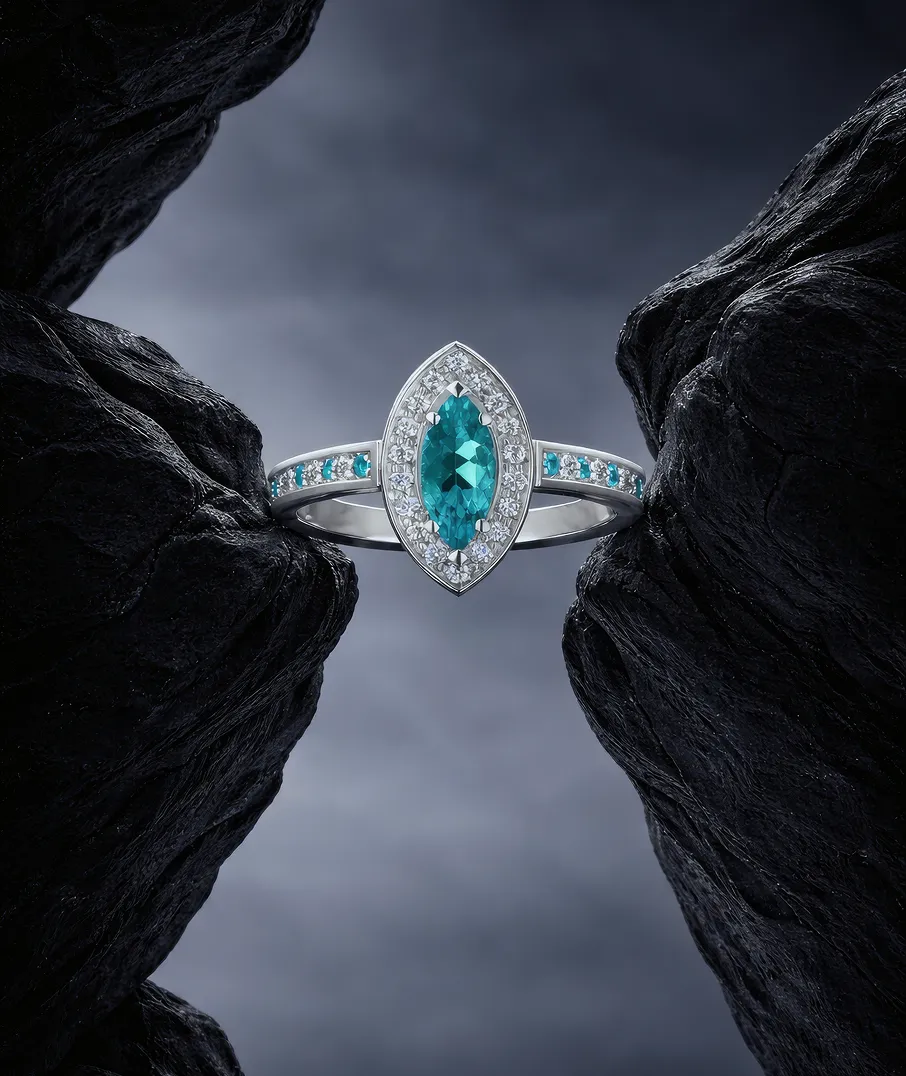
An origin report is worthwhile for a Paraíba tourmaline when origin is part of the stone's value to you, for example in a collector's piece or a center stone. The identification report confirms the species and detectable treatments. Only the origin report also names the country of origin. GIA offers both reports, and origin remains an expert assessment.
At a glance
- Identification report
- Species and detectable treatments, no origin
- Origin report
- Identification plus geographic origin, offered by GIA for natural Paraíba tourmalines
- Known countries of origin
- Brazil, Nigeria, Mozambique
- Method
- Measurement of trace elements such as copper, zinc, and gallium
- Average copper content
- Brazil about 11,400 ppmw, African stones below 2,000 ppmw (GIA)
- Mounted stones
- GIA can also test stones in their setting
- Result
- Expert assessment, may remain inconclusive in individual cases
Two reports answer two questions
The identification report establishes what the stone is. The Gemological Institute of America, GIA for short, describes it as a report that identifies and describes a material and lists detectable treatments. It is available for any cut material, loose or mounted. It contains no statement on the country of origin. For a Paraíba tourmaline, it therefore confirms that the stone is a copper-bearing tourmaline, nothing more.

The origin report adds the geographic origin to this identification. GIA offers it for only a few natural stones, among them emerald, ruby, sapphire, and the Paraíba tourmaline. The frequently asked question "GIA report or origin report" is therefore framed incorrectly. A GIA report can be either. What matters is which type of report was commissioned and whether a country actually appears on the document.
What the name Paraíba means in a report
Paraíba is not proof of origin but first of all a term for the cause of color. Under the definition of the Laboratory Manual Harmonisation Committee, LMHC for short, which GIA cites, the name applies to a blue to green tourmaline whose color is due mainly to copper and manganese, regardless of geographic origin. A stone from Mozambique can therefore be called Paraíba tourmaline just as one from the state of Paraíba can. More on this in the glossary under Paraíba tourmaline.
Laboratories use the name differently. The Swiss laboratory SSEF calls stones of Brazilian origin Paraíba tourmaline in the identification field. Stones of other origin that meet the color and chemistry criteria are called tourmaline there, with a comment that they may also be called Paraíba tourmaline in the trade. Anyone comparing reports from different laboratories should therefore read identification, origin, and comment separately.
Why origin is a separate question for Paraíba
Since the early 2000s, copper-bearing tourmalines have come not only from Brazil but also from Nigeria and Mozambique. A 2006 study in the journal Gems & Gemology noted that stones from the new localities were mixed into parcels from the original Brazilian deposit. Saturated blue to green stones from Africa could not be distinguished from Brazilian ones with standard gemological tests. Without a laboratory, origin therefore remains a claim.
The countries of origin can only be distinguished through trace elements. GIA gives an average copper content of about 11,400 ppmw, parts per million by weight, for Brazilian stones and below 2,000 ppmw for African stones. Further features add to this, such as zinc above 1,000 ppm only in Brazilian samples. Why collectors pay particular attention to Brazilian origin is explained in the guide Brazilian Paraíba tourmaline.
How reliable the origin statement is
Origin is an expert opinion, not a measured value. SSEF explicitly calls the determination an expert opinion, based on inclusions, trace elements, and spectra compared with a reference collection. The CIBJO Gemstone Blue Book requires origin statements to be treated as an assessment and states that a locality says nothing about quality. An origin report therefore answers the question of where, not the question of how beautiful the stone is.

For the Paraíba tourmaline, the determination is comparatively well founded. In a 2019 study, GIA writes that origin can be determined clearly and accurately for the large majority of stones. A small number receive the result "inconclusive". At the same time, GIA points out that an origin report does not lead to a country statement in every case. You should therefore allow for the possibility that the field remains open.
When an origin report is worthwhile
Whether the report is worthwhile depends less on the stone than on its role. The more origin belongs to the value or the history of the piece, the more it should be documented. For accent stones that only carry the color of a design, the effort is rarely proportionate. Keep in mind that a report is passed on with the stone. It therefore helps not only you but anyone who assesses the stone later. The overview sorts typical cases.
| Situation | Appropriate documentation | Why |
|---|---|---|
| Single stone as a collector's piece | Origin report | Origin is part of the value and of later assessment |
| Center stone in a ring or necklace | Origin report | The stone carries the piece and will later be assessed on its own |
| Piece is meant to stay in the family | Origin report | Later generations then have a reliable basis |
| Small accent stones | Usually none or identification | The effort is rarely proportionate to the individual stone |
| Origin does not matter to you | Identification report | Species and treatment are documented, which is sufficient |
Guidance, not a fixed rule. With every report, origin remains the laboratory's assessment.
The right moment in a bespoke piece
The best time for the report is before the stone is set. GIA can also test colored stones in their setting, but it then measures the total weight in grams and only estimates the carat weight. Unmounting and resetting stones is not part of its service. If the report is already available for the loose stone, weight and dimensions are exact, and the design can build on them.
- Clarify the stone's roleCollector's piece, center stone, or accent stone: this determines whether an origin report is needed.
- Report before settingHave the loose stone tested, or have an existing report handed over together with its number.
- Match report and stoneCompare weight, dimensions, and shape in the report with the stone before the design begins.
- Keep the original with the jewelryHand over the report with the finished piece and store it safely in a separate place.
Common mistakes with proof of origin
- Taking the name Paraíba for a statement of origin.
- Being shown an identification report and assuming it proves Brazil.
- Confusing an origin in the title of a piece of jewelry with a laboratory finding.
- Reading an open origin field as a flaw of the stone rather than an honest result.
- Commissioning the report only after setting and living with an estimated weight.
One mistake is made especially often: the origin appears in the description of the piece, but there is no document for it. Under CIBJO rules, place names may only refer to the locality where the stone was found. Whether this is the case is shown only by a report on the individual stone. What an identification report contains in detail is explained in the guide Identification report for Paraíba tourmaline.
Origin at Vikar Ahmed
Paraíba tourmaline is the heart of the house. Vikar Ahmed creates Paraíba high jewelry as one-of-a-kind pieces in 18 karat gold, platinum, and with diamonds, with Brazilian Paraíba tourmaline among the stones in the pieces shown. An origin statement is reliable only as a laboratory's assessment. For high-quality Paraíbas from 1 carat, a report with origin determination is standard at the house, and for Brazilian stones often well below that, issued by Gübelin, SSEF, GRS, or the DGemG. You can find more background on the stone on the Paraíba page.
Frequently asked questions
Is an origin report worthwhile for a Paraíba tourmaline I want to keep as a collector's piece?
Yes, in most cases. In a collector's piece, origin is part of the history and the later assessment of the stone. Without a report, it remains a statement by the seller. Do expect, however, that the laboratory phrases origin as an assessment and in rare cases leaves it open.
For a Paraíba tourmaline, which says more: a GIA report or an origin report?
The question depends on the type of report, not on the laboratory. GIA issues both identification reports and reports with origin. The report that also names a country of origin says more. Check on the document itself whether a geographic origin is entered.
Origin report or identification report: which is more useful for a Paraíba tourmaline in a bespoke piece?
For a center stone that carries the piece, the origin report. It contains everything the identification report offers, plus the country of origin. For small accent stones, identification or the goldsmith's written statement is usually sufficient. The report is best obtained while the stone is still loose.
For a bespoke piece of jewelry with Paraíba tourmaline, which counts more: a GIA report or an origin report?
What will count later is the documentation that belongs to the individual stone and whose weight and dimensions match the piece. Whether the issuer is GIA or another recognized laboratory matters less than whether identity, treatment, and origin appear on the same document.
Is a Paraíba necklace with an origin report worth more than one without documentation?
For the main stone of a necklace, usually yes. African and Brazilian stones cannot be distinguished with standard tests, only laboratory analysis separates them. Without documentation, every statement of origin rests on trust. For the many small stones of a necklace, however, a report per stone is hardly customary.
Can a laboratory determine the origin of a Paraíba tourmaline that is already set?
At GIA, yes. The analysis for identification and origin reports is also possible on mounted colored stones. The weight is then only estimated, however, because the laboratory does not unmount the stone. For exact weight and dimensions, the loose stone is the better basis.
Private consultation
Whether an origin report makes sense for your stone depends on its role in the design. Vikar Ahmed offers consultations by appointment in the showroom in Idar-Oberstein, and virtually on request. Your inquiry is handled with the utmost care and discretion. Request a private consultation.
Further reading
- Glossary: Origin report
- Brazilian Paraíba tourmaline
- Gemstone report: what a laboratory report provides
- Gemstone: Paraíba tourmaline
- Paraíba as a collector's piece
Sources
- GIA, Gems & Gemology Winter 2019: Paraíba Tourmaline Geographic Origin Determination, accessed 2026-11-17
- GIA, Gems & Gemology Spring 2006: Paraíba-Type Copper-Bearing Tourmaline from Brazil, Nigeria, and Mozambique, accessed 2026-11-17
- GIA: Colored Stone Reports, accessed 2026-11-17
- GIA FAQ: Country of Origin Report, accessed 2026-11-17
- GIA FAQ: Mounted Colored Stone Analysis, accessed 2026-11-17
- SSEF: Paraiba Tourmaline, accessed 2026-11-17
- CIBJO: The Gemstone Book (Blue Book), Ausgabe 2026, accessed 2026-11-17
- Vikar Ahmed: Paraíba, accessed 2026-11-16

A personal conversation starts here.
At the showroom in Idar-Oberstein or by video. Vikar Ahmed discusses your ideas, stones and designs with you and answers your questions calmly and in confidence.


Thank you for your request.
Your request will be handled with the utmost attention and discretion. Vikar Ahmed will get back to you.
Your details
Request
–
Occasion
–
Consultation
–
Contact
–
In the meantime
Insights: What is a Paraíba tourmaline? · Engagement ring to your own design: how does it work?
Confidential and without obligation
Back to the pagePrivate consultation
A personal conversation starts here.
- Time for your questions, wishes and ideas
- In the showroom in Idar-Oberstein or by video
- Confidential, discreet and without obligation
Vikar Ahmed · Hauptstraße 111 · 55743 Idar-Oberstein, Germany