

The First Paraíba Collector's Piece
For many, a collection begins with the first Paraíba piece. This page shows which form suits a beginning and what keeps a piece collectible over the years.
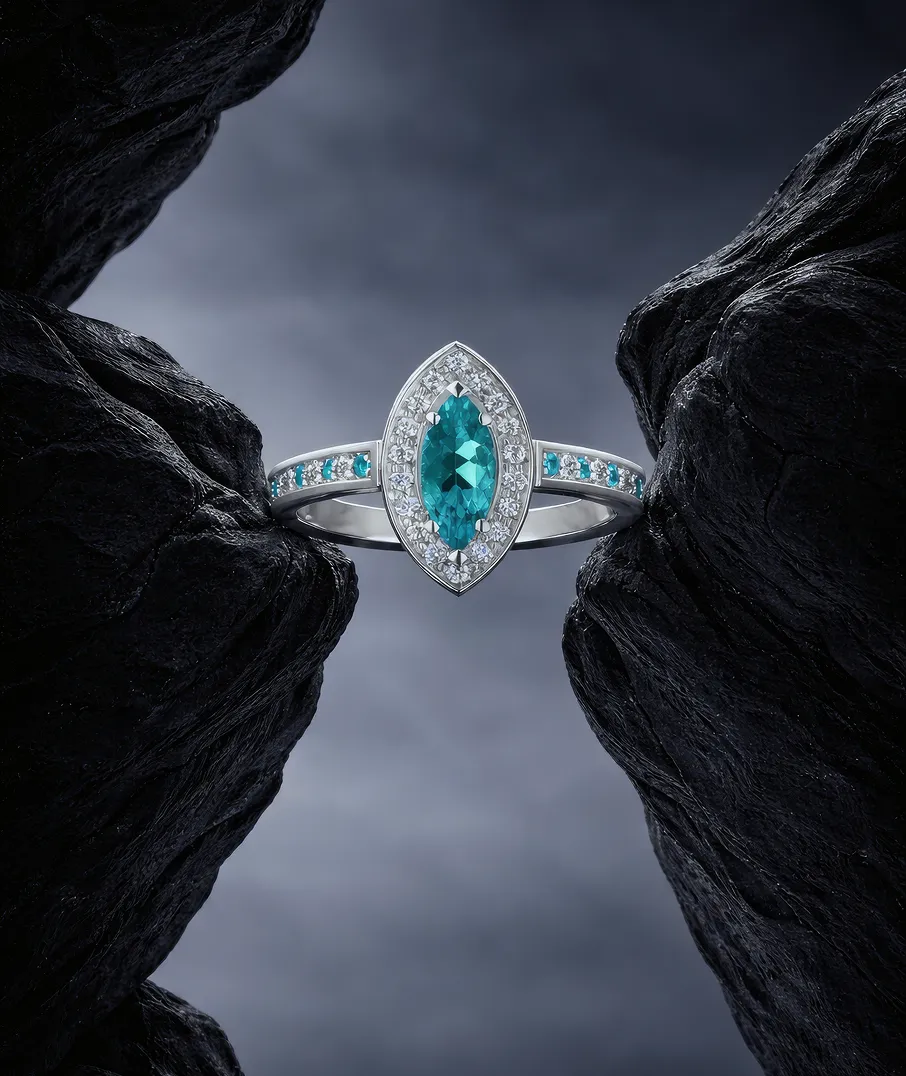
As a first collector's piece, a Paraíba pendant is often the more relaxed choice: at the neck the stone is exposed to fewer knocks, and the color stands freely at the center. A ring is more present but needs more protection. What makes a piece collectible is above all the stone itself, its documents and good condition, not the form.
At a glance
- What determines rank
- For Paraíba above all the color, not the size (GIA)
- Rarity
- Paraíba tourmalines over one carat are rare according to GIA
- Documents
- Identification report, an origin report where origin is stated
- Ring
- Under the most stress, needs a protective setting
- Pendant
- Exposed to fewer knocks, color freely visible
- Care
- Warm soapy water, no ultrasonic or steam cleaner (GIA)
What makes a piece a collector's piece
A collector's piece depends first on the stone. According to GIA, color is the decisive factor for Paraíba tourmaline, not size. A stone with a saturated, vivid blue or green whose color is caused mainly by copper and manganese shows what this variety is known for. Then there is rarity: according to GIA, Paraíba tourmalines over one carat are seen only rarely. Anyone choosing a first piece should therefore look at the color first.
Besides the stone, three things count. First, the documents that confirm identity, treatment and, where applicable, origin. Second, the craftsmanship that protects the stone and shows its color. Third, the condition over the years. A collectible piece is not a safe investment, but a well-documented, well-preserved stone in a suitable setting. What determines the value of colored gemstones is explained in the guide Colored Gemstones as an Investment.
Pendant and ring compared
Pendant and ring place different demands on the stone. The table compares both forms by the same criteria. It shows why the choice is less a question of value than a question of everyday life. It is based on GIA's information on the hardness and toughness of tourmaline and on the properties of different settings.

| Criterion | Paraíba pendant | Paraíba ring |
|---|---|---|
| Stress | Low, protected at the neck | High, knocks on edges and corners |
| View of the stone | Clearly visible to others, hardly to yourself | Constantly in view for yourself as well |
| Setting | More open, light can reach the stone well | Must protect edges, for example with a bezel |
| Size of the stone | Even a larger, flatter stone looks calm | Height and size must suit the hand |
| Care and work | Work on the piece rarely needed | Resizing only with protection from heat |
Based on GIA's information on the hardness, toughness and care of tourmaline and on setting types.
Why the pendant is often the calmer beginning
Tourmaline has a Mohs hardness of 7 to 7.5, and GIA rates its toughness only as fair. On the finger, a stone meets door handles, table edges and bags every day. At the neck it is hardly exposed to such knocks. For a first piece that you want to wear often and keep for a long time, the pendant is therefore the more relaxed choice. The color of the stone can show freely without the setting having to provide much protection.
A further advantage lies in the later collection. A pendant can easily be complemented with earrings or another stone in a similar tone. Anyone planning this way should document the color of the first stone precisely, for example with photos in daylight and the report. What matters in a pendant in detail is described in the guide What Defines a Paraíba Pendant.
When the ring is the better choice
The ring is the piece you see most often yourself. Anyone who wants to look at their Paraíba tourmaline every day will find it the more personal form. It does, however, require a setting that protects edges and corners. GIA describes that a bezel setting protects the edges of a stone very well, while prongs leave more of the stone exposed. For a tourmaline in a ring, there is much to be said for a solution that combines both.
How the ring is treated also matters. During rough work and sports, a Paraíba ring is better taken off. Any later work on the ring must take into account that, according to GIA, heat can damage tourmaline and sudden temperature changes can cause fractures. Which ring styles exist and how they protect the stone is explained in the guide The Paraíba Tourmaline Ring.
The documents belong with the piece
A collector's piece without documents loses significance. The foundation is an identification report from a recognized laboratory that identifies the stone as tourmaline, names the Paraíba variety or the trade name and lists treatments. If an origin is stated, an origin report belongs with it. GIA offers one for Paraíba tourmalines but cannot determine a country of origin in every case. What such a report contains is explained in the guide What Is an Identification Report for Paraíba Tourmaline?.

- The original laboratory report, with the report number for online verification with the laboratory.
- Design drawings and visualizations, if the piece was made to order.
- Photos of the stone in daylight, before and after setting.
- Details of metal, weight and further stones in the piece.
- Notes on care and later work.
Preserving the condition over the years
A well-preserved stone is part of the collector's value. GIA recommends cleaning tourmaline with warm soapy water and avoiding ultrasonic and steam cleaners. Strong heat can alter the color, and sudden temperature changes can cause fractures. Vikar Ahmed also advises keeping a Paraíba piece out of the sauna and taking it off for sports and housework. Store a Paraíba piece separately from other jewelry, because a diamond is considerably harder and can scratch the surface of the tourmaline. A soft pouch or a separate compartment is sufficient.
Good to know
If a stone is later recut, the laboratory SSEF issues a new report number. A report always describes the stone at the time of examination. With a collector's piece, it is therefore worth having the stone reworked only for good reason.
Common mistakes with a first collector's piece
- Choosing by carat rather than by color.
- Choosing a piece without a laboratory report or with an unclear designation.
- Accepting a verbally stated origin without an origin report.
- Wearing a ring with unprotected edges every day.
- Not keeping documents and photos together with the piece.
Most of these mistakes arise from haste. A first collector's piece may take time. Look at several stones, compare color and clarity under different light and read the reports in full. How color and clarity are weighed against each other is shown in the comparison Color or Clarity in Paraíba Tourmaline?.
From the first piece to a collection
A collection grows best with a plan. Anyone who begins with a pendant can later add earrings with a pair of stones in the same tone. Anyone who begins with a ring will find in a pendant a piece for special occasions. At Vikar Ahmed, Paraíba pieces are created as one-of-a-kind pieces in 18k gold, platinum and with diamonds, from the design through the three-dimensional visualization to production in the in-house atelier in Idar-Oberstein. Every high-quality Paraíba comes with an independent original certificate there, from 1 carat with origin determination.
For every addition, the first piece is the reference. According to GIA, tourmaline shows different colors depending on the viewing direction, and a stone can look different in daylight than in artificial light. New stones should therefore be assessed directly next to the existing piece and under several light sources, not from photos. How a pair of two stones can be matched is described in the guide Paraíba Earrings That Remain Timeless.
Frequently asked questions
Paraíba pendant or Paraíba ring, which is more worthwhile as a first collector's piece?
For value, what counts above all is the stone, not the form. As a first piece, the pendant is often the more sensible choice, because the tourmaline is better protected at the neck and stays in good condition longer. The ring is worthwhile if you want to see the stone every day and choose a protective setting.
Is a Paraíba tourmaline an investment?
Not in the sense of a predictable investment. Paraíba tourmaline is rare and sought after for its color, but its value depends on the individual stone, its documents and its condition. Choosing a piece for the pleasure of its color and documenting it well creates the best conditions for a piece that is valued for a long time.
Which documents should a Paraíba collector's piece have?
At least one identification report from a recognized laboratory on the main stone. If the origin is stated, an origin report belongs with it. Also useful are photos of the stone before setting, for made-to-order pieces the designs, and details of the metal and further stones.
How do I store Paraíba jewelry properly?
Separately from other jewelry, in a soft pouch or its own compartment, so that harder stones such as diamonds do not scratch the tourmaline. According to GIA, it is best cleaned with warm soapy water. You should avoid ultrasonic cleaning, steam, strong heat and sudden temperature changes.
Is a small Paraíba tourmaline suitable as a first collector's piece?
Yes. According to GIA, Paraíba tourmalines over one carat are rare, so smaller stones are the norm. With Paraíba, color matters more than size. A small stone with a rich, even blue is often more convincing as a beginning than a large, pale stone.
How do I find stones that match my first Paraíba piece?
By placing new stones directly next to the existing piece and comparing them in daylight as well as in artificial light. Tourmaline looks different depending on the viewing direction, so it is worth looking from several angles. Photos and color descriptions in the report help with a preselection but do not replace a direct comparison.
Private consultation
Which form suits your first piece is best clarified in conversation and with the stone in front of you. Vikar Ahmed advises by appointment in the showroom in Idar-Oberstein, virtually on request, and accompanies your project with discretion. Request an appointment for a private consultation.
Further reading
- What defines a Paraíba pendant
- The Paraíba tourmaline ring
- Paraíba bracelet or pendant?
- Glossary: Origin report
- Gemstone: Paraíba tourmaline
Sources
- GIA: Tourmaline Quality Factors, accessed 2026-11-17
- GIA: Tourmaline Care and Cleaning Guide, accessed 2026-11-17
- GIA: Colored Stone Reports, accessed 2026-11-17
- GIA FAQ: Gemstone Country of Origin Reports, accessed 2026-11-17
- GIA 4Cs: Complete Guide to Engagement Ring Settings, accessed 2026-11-17
- SSEF: Paraiba Tourmaline, Erläuterung zum Bericht, accessed 2026-11-17
- LMHC Information Sheet 6: Paraiba Tourmaline (Version 8, 2023), accessed 2026-11-17
- Vikar Ahmed: Paraíba, accessed 2026-11-16
- Vikar Ahmed: Bespoke, Designprozess, accessed 2026-11-16

A personal conversation starts here.
At the showroom in Idar-Oberstein or by video. Vikar Ahmed discusses your ideas, stones and designs with you and answers your questions calmly and in confidence.


Thank you for your request.
Your request will be handled with the utmost attention and discretion. Vikar Ahmed will get back to you.
Your details
Request
–
Occasion
–
Consultation
–
Contact
–
In the meantime
Insights: What is a Paraíba tourmaline? · Engagement ring to your own design: how does it work?
Confidential and without obligation
Back to the pagePrivate consultation
A personal conversation starts here.
- Time for your questions, wishes and ideas
- In the showroom in Idar-Oberstein or by video
- Confidential, discreet and without obligation
Vikar Ahmed · Hauptstraße 111 · 55743 Idar-Oberstein, Germany