

Paraíba Bracelet or Pendant?
A bracelet spreads the color across many stones, a pendant concentrates it in one. How the two forms differ in effect, in the demands placed on the stones and in durability.

Neither form is better in itself. A bracelet of many small Paraíba tourmalines shows the color as a band and requires stones that match precisely in tone. A pendant with one large stone lives from that stone's color alone and is better protected in everyday wear. Because large Paraíba tourmalines are rare, the single stone is usually the more demanding choice.
At a glance
- Bracelet
- Many stones, color as a continuous band, color matching is decisive
- Pendant
- One stone, color as the focal point, the quality of the single stone is decisive
- Size
- According to GIA, Paraíba tourmalines over one carat are rare
- Mohs hardness
- 7 to 7.5, toughness fair according to GIA
- Stress
- Considerably higher on the wrist than at the neck
- Report
- For a pendant usually one for the stone, for a bracelet more involved
Color as a band or as a focal point
The difference begins with the effect. In a bracelet, many small stones line up into a line of blue or green that moves with the wrist. The eye perceives the color as a surface, and the individual stone recedes. In a pendant, one stone sits alone, close to the face, and draws the gaze. Here every nuance of that one stone counts, from saturation to clarity.

With the Paraíba tourmaline, this decision weighs more heavily than with other colored stones. Its color arises mainly from copper and manganese and looks intense even in small stones. The Gemological Institute of America, GIA for short, explicitly calls color the most important factor for Paraíba, not size. A bracelet can therefore show as much glow as a large stone, only distributed.
Both forms by the same criteria
| Criterion | Bracelet with many stones | Pendant with one stone |
|---|---|---|
| Effect | Color as a line, moving on the wrist | Color as a focal point close to the face |
| Demands on the stones | The same hue across all stones | High quality of a single stone |
| Stone size | Small stones, easier to find | Large stones, rarely over one carat according to GIA |
| Stress in everyday wear | High: knocks against table edges and door frames | Low: hangs protected against the body |
| Setting | Bezel or channel protects many edges | Bezel or prongs, freely designed |
| Documentation | Several stones, report more involved | Usually one report for the main stone |
Comparison of jewelry with Paraíba tourmaline. The assessment of an individual piece depends on the stones, setting and craftsmanship.
The table shows two different kinds of demand. With the bracelet, the difficulty lies in quantity: many stones that together must form a calm picture, and many edges that need protection. With the pendant, it lies in rarity: one stone that is large enough and whose color carries the surface. Which kind of demand suits you better often decides more than the question of value.
Why large Paraíba tourmalines are rare
According to GIA, Paraíba tourmalines over one carat are seen only rarely. Because of the high value of the rough, they are almost always cut individually, that is, according to the individual crystal rather than to standard dimensions. The cutter tries to retain as much weight and color as possible. For a pendant with a large stone, this means: the setting is created around a particular stone, not the other way around.
A bracelet, by contrast, needs many smaller stones. Individually they are easier to find, but they must match one another. Anyone looking for a large stone is therefore looking for an exception. Anyone planning a bracelet is looking for a family of stones. Both take time, but for different reasons. A separate guide covers how color and size can be weighed against each other with Paraíba.
What a bracelet with many stones requires
A bracelet only looks calm when all stones appear in the same tone. With tourmaline this is demanding. According to GIA, many tourmalines show a different color depending on the viewing direction, a property called pleochroism. The cutter therefore deliberately orients the table to the crystal axis. Stones from different crystals can nevertheless look different in the same bracelet. Selection takes place stone by stone, side by side and under different light.
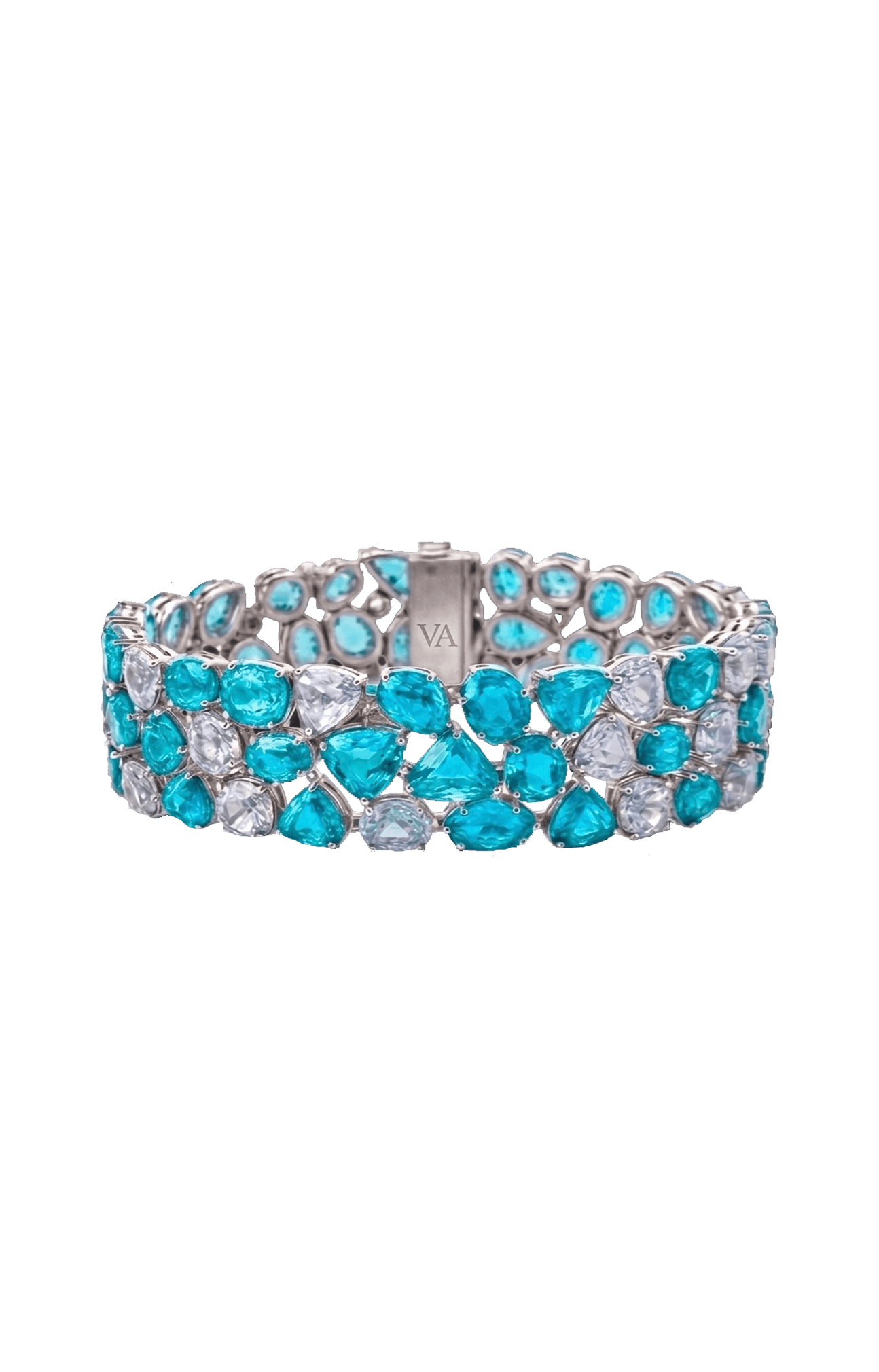
- Check the hue and saturation of all stones side by side, not individually.
- Choose protective settings: a bezel or channel covers the edges of the stones.
- Look for a clasp with a safety catch, which GIA recommends for bracelets.
- Choose the size so that about one finger fits between wrist and bracelet.
- Have the settings checked at intervals, because many small stones need more care.
On the wrist, a simple rule applies to the setting: the more metal surrounds the edge of a stone, the better it withstands knocks. GIA names the bezel setting, in which a metal rim encloses the stone, and the channel setting, in which the stones sit between two metal strips, as particularly protective. Prongs show more of the stone but catch more easily on fabric. More on this in the guide to the setting of the Paraíba tourmaline.
What a pendant with one stone requires
In a pendant, a single stone carries the entire piece. Saturation, brightness and clarity are on full view, and small weaknesses are more noticeable than in a row of many stones. In return, the pendant is the more protected place. It hangs against the body and strikes hard edges less often. This leaves more freedom in the setting: fine prongs let more light into the stone, while a bezel frames it calmly.
A single large stone can also be clearly documented. An identification report determines the material and names detectable treatments. For Paraíba tourmalines, GIA also offers a report stating the origin. In a bracelet, every stone would have to be tested individually, which rarely happens with many small stones. The guide Paraíba pendant shows what matters in detail for a pendant.
Durability and care compared
Tourmaline has a Mohs hardness of 7 to 7.5, and GIA rates its toughness as fair. It is therefore very wearable but does not tolerate hard blows well. On the wrist such blows are an everyday occurrence, at the neck they are rare. Heat is a further factor: great heat can change the color, and a rapid temperature change can cause fractures. This mainly affects work in the workshop, such as soldering, when the stone sits in the setting.
For cleaning tourmaline, GIA recommends warm soapy water and advises against ultrasonic and steam cleaners. In a bracelet with many settings, more dirt collects in the gaps, and a soft brush helps. A bracelet should be taken off for sports, gardening and housework. A pendant above all needs a sturdy bail and a chain that suits the weight of the stone.
Which form suits whom
The bracelet suits people who like color in motion and wear jewelry often but handle it consciously. It shows the blue or green of the Paraíba as a continuous line and does without an exceptionally large stone. Anyone who chooses it should allow time for selecting the stones. A comparison with Lagoon tourmalines in a bracelet can be found under Paraíba or Lagoon in a bracelet.
The pendant suits people who want to place a single stone at the center. It is the form for a particularly large or particularly saturated stone and is easy to document. It is also the gentler choice when the jewelry is worn daily. Anyone torn between the two will find a third option in a necklace or a pendant.
Frequently asked questions
What is better for Paraíba jewelry, many small tourmalines in a bracelet or a single large stone in a pendant?
That depends on how you wish to wear the color. The bracelet shows it as a band and requires well-matched stones. The pendant showcases a single stone, which must be large and saturated enough. For daily use, the pendant is the better protected form.
Do small Paraíba tourmalines in a bracelet look less vivid than one large stone?
Not necessarily. The glow of the Paraíba tourmaline depends mainly on its color, which arises from copper and manganese. Small stones can also be highly saturated. In a bracelet, their color adds up to a surface. A large stone, in return, shows more depth in a single point.
Why is it difficult to match many Paraíba tourmalines for a bracelet?
Because tourmalines show different colors depending on the viewing direction, and stones from different crystals deviate slightly in tone. Even small differences in saturation or brightness stand out in a row. The stones are therefore selected side by side under different light before the setting is made.
Which setting best protects Paraíba tourmalines in a bracelet?
Settings that enclose the edges of the stones with metal. GIA names bezel and channel settings as particularly protective against knocks and snagging. Prongs show more of the stone but offer less protection on the wrist and should be checked regularly.
Does every stone in a Paraíba bracelet receive its own report?
As a rule, no. A laboratory report is usually issued for individual, larger stones. With many small stones, a report per stone would be very involved. Vikar Ahmed examines stones without their own report gemologically himself and gives his own guarantee for them. For a pendant with one main stone, by contrast, an identification report is customary, with an origin statement on request.
Is a Paraíba bracelet suitable for daily wear?
With limitations. Tourmaline has a hardness of 7 to 7.5 and fair toughness, and the wrist is also the place exposed to the most knocks. A bracelet with a protective setting and a secured clasp can be worn often but should be taken off for sports and rough work.
Private consultation
Whether your Paraíba tourmaline should take effect as a bracelet or as a pendant is best decided with the stones in view. Vikar Ahmed advises by appointment in the house's showroom in Idar-Oberstein or in a virtual appointment. Every piece is created there as a one-of-a-kind piece. Request a private consultation.
Further reading
- Guide: Paraíba pendant
- Guide: Paraíba bracelet
- Paraíba or Lagoon in a bracelet
- Glossary: Paraíba tourmaline
- Gemstone: Paraíba tourmaline
Sources
- GIA: Tourmaline Quality Factors, accessed 2026-11-17
- GIA: Tourmaline Care and Cleaning, accessed 2026-11-17
- GIA 4Cs: Tennis Bracelet Buying Guide, accessed 2026-11-17
- GIA 4Cs: Complete Guide to Engagement Ring Settings, accessed 2026-11-17
- GIA: Colored Stone Reports, accessed 2026-11-17
- GIA: Tourmaline, Gem Facts, accessed 2026-11-17
- Vikar Ahmed: Paraíba, accessed 2026-11-17
A personal conversation starts here.
At the showroom in Idar-Oberstein or by video. Vikar Ahmed discusses your ideas, stones and designs with you and answers your questions calmly and in confidence.





Thank you for your request.
Your request will be handled with the utmost attention and discretion. Vikar Ahmed will get back to you.
Your details
Request
–
Occasion
–
Consultation
–
Contact
–
In the meantime
Insights: What is a Paraíba tourmaline? · Engagement ring to your own design: how does it work?
Confidential and without obligation
Back to the pagePrivate consultation
A personal conversation starts here.
- Time for your questions, wishes and ideas
- In the showroom in Idar-Oberstein or by video
- Confidential, discreet and without obligation
Vikar Ahmed · Hauptstraße 111 · 55743 Idar-Oberstein, Germany