

A Large Paraíba or Intense Neon Blue?
More carats or more luminosity: in Paraíba tourmaline, this question arises earlier than with almost any other stone, because large specimens are rare.
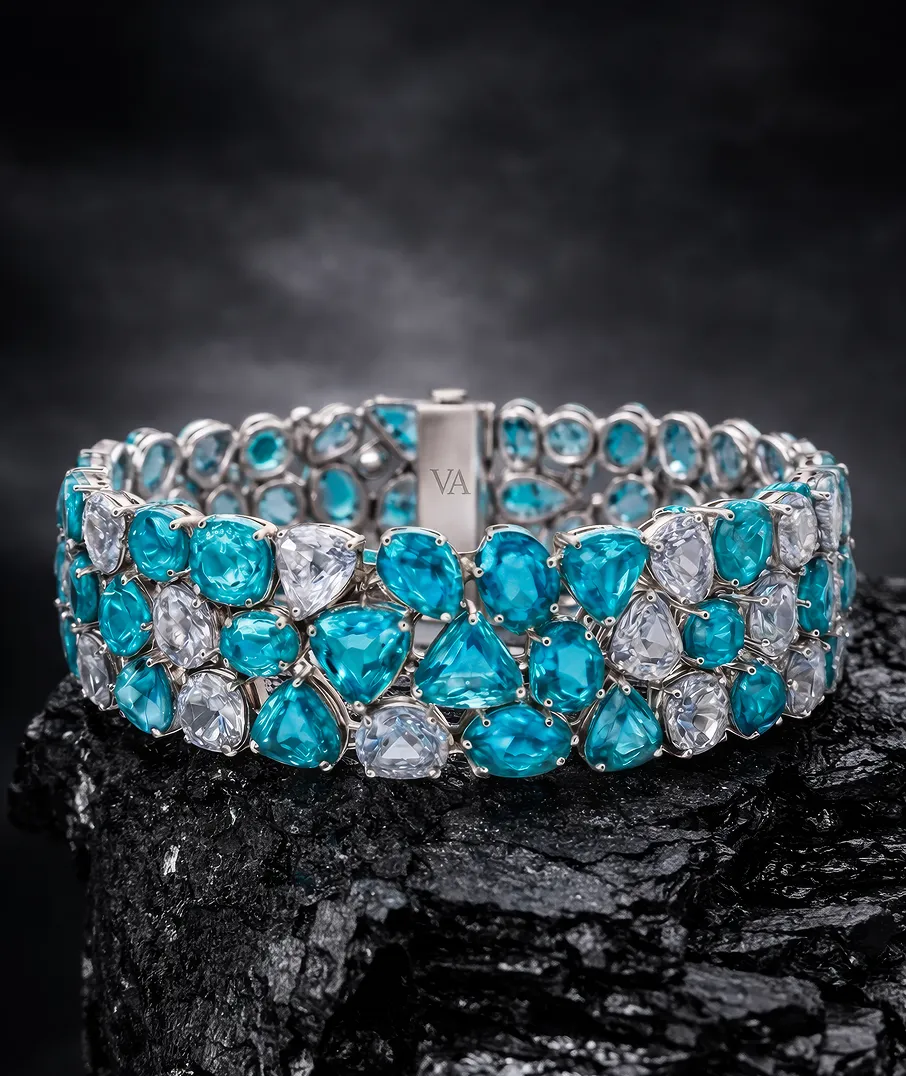
In Paraíba tourmaline, intense color generally carries more weight than additional carat weight. GIA names color, not size, as the decisive factor in Paraíba. A smaller stone in rich blue is therefore usually the stronger choice than a larger, pale stone. Size only tips the balance when the color is comparable.
At a glance
- Decisive factor
- In Paraíba, color, not size (GIA)
- Usual size
- Paraíba tourmalines over one carat are rare according to GIA
- Value per carat
- Rises markedly with size in tourmalines, above all from five carats
- Carat
- A unit of weight: 20 carats equal 4 grams
- Color range according to LMHC
- Blue, bluish green to greenish blue, green, yellowish green at medium to high saturation
- Influence of the cut
- Orientation to the crystal changes color and yield
Color carries more weight in Paraíba
For most gemstones, the rule is: at equal quality, the larger stone is rarer. In Paraíba tourmaline, this rule shifts. The Gemological Institute of America, GIA for short, names color as the decisive factor here, not size. What is meant is the saturation and luminosity of the blue or green, which goes back mainly to copper. A large stone that lacks this glow shows less of what defines Paraíba tourmaline.

The laboratory association LMHC requires medium to high saturation for the designation Paraíba tourmaline. Tourmalines with only traces of copper and weak color do not qualify. A very pale stone therefore gains little from additional weight. It may even appear in the report without the variety designation. What a Paraíba tourmaline is under the laboratories' rules is explained in the glossary.
Large Paraíba tourmalines are rare
According to GIA, Paraíba tourmalines over one carat are seen only rarely. A GIA study of the first locality, São José da Batalha, describes that the material there consisted predominantly of crystal fragments weighing less than one grain, an old unit of weight for gemstones. At the same time, individual stones of over 20 carats were cut there. Large stones therefore exist, but they are the exception.
For tourmalines in general, GIA describes that the value per carat rises markedly in larger stones, especially from about five carats. Anyone comparing two stones should therefore consider not only the total weight but also the size class. A stone just above such a threshold is valued differently from one just below it. Which other factors determine value is explained in the guide Paraíba tourmaline in an engagement ring.
Carat is weight, not size
A carat is a unit of weight. 20 carats equal 4 grams, so one carat equals 0.2 grams. How large a stone looks from above depends on how this weight is distributed across face-up area and depth. A deeply cut stone carries much weight in the pavilion and looks smaller than a shallower stone of the same weight. Comparing by carat alone is therefore easily misleading.

The dimensions are more telling. In its report, the Swiss laboratory SSEF states length, width, and height to two decimal places and the weight to three. Shape plays a role too: for diamonds, GIA describes that an oval shows more visible area than a round stone of the same weight. How the cut brings out the color is explained in the guide Which cut shows the color of Paraíba tourmaline?.
The cutter already weighs size against color
Tourmaline is strongly pleochroic: it shows different colors depending on the direction in the crystal. Many tourmalines absorb more light along the length of the crystal than across it. GIA describes that, with light rough, cutters place the table across the length of the crystal so that the color looks darker. With dark material, they place the table parallel to the length so that it becomes lighter. For Paraíba tourmalines, the GIA study showed the most saturated color when looking along the optic axis.
This decision has a price in weight. According to GIA, cutting parallel to the length of the rough crystal reduces the loss of material. Anyone deepening the color through an orientation across the length often obtains a smaller stone from an elongated crystal. Size and color are therefore set against each other already during cutting. A larger, pale stone may be the result of an orientation that put weight before color.
Size and color compared directly
| Criterion | Larger, paler color | Smaller, intense blue |
|---|---|---|
| Effect in the piece of jewelry | More area, calm color | Less area, strong luminosity |
| Paraíba character | Weaker, open in the borderline zone | Clearly pronounced |
| Visibility of inclusions | Higher, because the color is light | Lower in rich color |
| Rarity | Size over one carat is rare | Strong saturation defines the stone |
| Role of the setting | Carries the stone, little framing needed | A diamond halo can make it look larger |
Comparison of two typical stones. With comparable color, the balance tips in favor of size.
The table shows why the comparison usually favors color: it determines character and designation, while size mainly brings presence. GIA also states that inclusions are far more visible in light, less saturated stones. A large, pale stone therefore requires high clarity to look calm. The comparison Color or clarity in Paraíba tourmaline? goes deeper into weighing color against clarity.
How the setting shifts the balance
A smaller stone need not look small in the piece of jewelry. GIA describes that a halo of small stones around the center stone forms a visual frame that can make it appear larger. A prong setting leaves the stone largely visible; a bezel setting protects its edges very well. In this way, the presence of a strongly colored stone can be increased deliberately. How a diamond halo compares with a solitaire is shown in the guide Solitaire or diamond entourage.
At Vikar Ahmed, Paraíba pieces are created as one-of-a-kind pieces, set in 18k (750) gold, platinum, and with diamonds. The design is visualized three-dimensionally before it is made, so that it can be checked how a stone of a given size looks in the finished piece. The work is carried out in the in-house atelier in Idar-Oberstein. Vikar Ahmed works with Brazilian Paraíbas mostly up to about 1 carat, rarely larger, and with much larger stones from Mozambique and Nigeria.
Which stone suits whom
The smaller stone in intense blue suits everyone looking for the true character of Paraíba tourmaline, for example as the center of a ring or a first collector's piece. The larger stone in a lighter color suits people who value presence and a delicate color, for example in a pendant seen from a distance. It should then be very clean and clearly designated in the report.
- Compare the color of both stones first, then the weight.
- Compare the dimensions instead of the carat figure.
- Look closely at stones near a size threshold such as one or five carats.
- Judge the stone in the planned design, not loose on the table.
Frequently asked questions
Should I choose a larger Paraíba tourmaline with a somewhat paler color or a smaller one in intense neon blue?
In most cases, the smaller stone in intense blue. In Paraíba tourmaline, color determines the character and, according to GIA, also the rank of the stone. A pale stone gains little from more weight and shows inclusions more clearly. Size counts above all when both stones are similar in color.
Recommend Paraíba rings in which intense color matters more than the highest possible carat weight.
This guide does not name individual rings, but it does name the characteristics. Such a ring places a center stone in rich, even color at its heart, even if it is under one carat. A halo of colorless diamonds can give it more presence. The setting should protect the edges of the tourmaline.
How large are Paraíba tourmalines usually?
Usually small. According to GIA, Paraíba tourmalines over one carat are seen only rarely. At the first locality in Brazil, the material consisted predominantly of small crystal fragments, even though individual stones of over 20 carats were cut there.
Does carat weight say anything about the size in the piece of jewelry?
Only to a limited extent. Carat is a weight; one carat equals 0.2 grams. How large a stone looks from above depends on shape and depth of cut. Compare, therefore, the dimensions in the report, that is, length, width, and height, and ideally see the stone in its setting.
Why does the value per carat rise in large tourmalines?
Because large, beautiful stones are considerably rarer than small ones. For tourmalines, GIA describes that the value per carat rises noticeably with size, especially from about five carats. In Paraíba tourmaline, this applies only together with good color, because size alone does not make it valuable.
Private consultation
Whether more carats or more luminosity suits your plans is best seen in the stone and in the design. Vikar Ahmed advises by appointment in the house's showroom in Idar-Oberstein or in a virtual appointment, discreetly and without haste. Request an appointment for a private consultation.
Further reading
- Color or clarity in Paraíba tourmaline?
- Which cut shows the color of Paraíba?
- The ring with Paraíba tourmaline
- Glossary: Neon quality
- Gemstone: Paraíba tourmaline
Sources
- GIA: Tourmaline Quality Factors, accessed 2026-11-17
- GIA, Gems & Gemology: Gem-Quality Cuprian-Elbaite Tourmalines from São José da Batalha, accessed 2026-11-17
- LMHC Information Sheet 6: Paraiba Tourmaline (Version 8, 2023), accessed 2026-11-17
- SSEF: Paraiba Tourmaline, Erläuterung zum Bericht, accessed 2026-11-17
- GIA 4Cs: Oval Cut Diamond Guide, accessed 2026-11-17
- GIA 4Cs: Complete Guide to Engagement Ring Settings, accessed 2026-11-17
- Vikar Ahmed: Paraíba, accessed 2026-11-16
- Vikar Ahmed: Bespoke, Designprozess, accessed 2026-11-16

A personal conversation starts here.
At the showroom in Idar-Oberstein or by video. Vikar Ahmed discusses your ideas, stones and designs with you and answers your questions calmly and in confidence.


Thank you for your request.
Your request will be handled with the utmost attention and discretion. Vikar Ahmed will get back to you.
Your details
Request
–
Occasion
–
Consultation
–
Contact
–
In the meantime
Insights: What is a Paraíba tourmaline? · Engagement ring to your own design: how does it work?
Confidential and without obligation
Back to the pagePrivate consultation
A personal conversation starts here.
- Time for your questions, wishes and ideas
- In the showroom in Idar-Oberstein or by video
- Confidential, discreet and without obligation
Vikar Ahmed · Hauptstraße 111 · 55743 Idar-Oberstein, Germany