

Paraíba ring: solitaire or diamond halo?
A Paraíba tourmaline is often small and very intensely colored. Whether it stands alone in the ring or is framed by diamonds changes the size, color and character of the piece.

Both styles appear refined when they suit the stone. The solitaire shows a large, intensely colored Paraíba tourmaline on its own and is considered the more honest form among collectors. A halo of colorless diamonds makes a smaller stone appear larger and intensifies the impression of color. It demands precise work, otherwise the diamonds outshine the blue.
At a glance
- Solitaire
- A single stone, its effect comes from color and cut
- Entourage
- Ring of small stones around the center stone, also called a halo
- Effect of the halo
- Center stone appears larger, color appears more intense
- Typical Paraíba size
- Rarely over one carat
- Tourmaline hardness
- 7 to 7.5 on the Mohs scale, toughness fair
- Care for both styles
- Check prongs regularly, no ultrasonic
Two ring styles, two attitudes
A solitaire carries a single stone. Everything about the ring serves this stone: the shank, the prongs, the height of the setting. An entourage, usually called a halo in English, places a ring of small stones around the center stone, mostly colorless diamonds. The solitaire says: this stone is enough. The halo says: this stone is framed. Both attitudes have their justification, and both can appear refined or arbitrary.
With the Paraíba tourmaline, the choice has greater consequences than with many other stones. According to GIA, it is rarely larger than one carat, and its assessment depends mainly on color, not size. A small stone with glowing color can appear delicate as a solitaire, but present in a halo. A large stone, on the other hand, often needs no frame, because its color alone already carries the ring.
What the diamond halo does
According to GIA, a halo forms a visible frame around the center stone and can make it appear larger. A halo of colored stones or fancy color diamonds can also intensify the perceived color of the center stone. Colorless diamonds work differently: their bright sparkle sets a contrast against which the blue or green of a Paraíba tourmaline appears more saturated. The halo thus becomes a stage for the color.
This effect has a limit. If the diamonds are too large or too numerous, the balance shifts. The eye then sees the sparkle first and only afterwards the color. With a light Paraíba tone, a dense halo can even make the stone appear paler. Good halo rings keep the diamonds proportionally small, set them closely and leave only a narrow metal rim between halo and center stone.
Solitaire and halo compared
| Criterion | Solitaire | Halo with diamonds |
|---|---|---|
| Effect | Pure, calm, focused on the stone | Festive, framed, appearing larger |
| Suitable stone size | Rather larger, intensely colored stones | Smaller stones also appear present |
| Color impression | Color stands on its own | Contrast makes color appear more saturated |
| Protection of the center stone | Open or by bezel, depending on the setting | Halo additionally protects the sides |
| Care | Check prongs | Also check many small settings |
| Resizing | Usually straightforward | More difficult with pavé on the shank |
Effect of halo and pavé according to GIA. The assessment always depends on the individual stone.
What counts in a collector's ring
A collector's ring is built for the stone. Collectors want to see the Paraíba tourmaline as it is, without optical aids. That is why, with very fine stones, the solitaire is often considered the more honest form. The color can be assessed undisturbed, and the stone can later be removed more easily, for example for a new examination. A report states the weight and dimensions of the unmounted stone, and a mounted stone can only be examined to a limited extent.
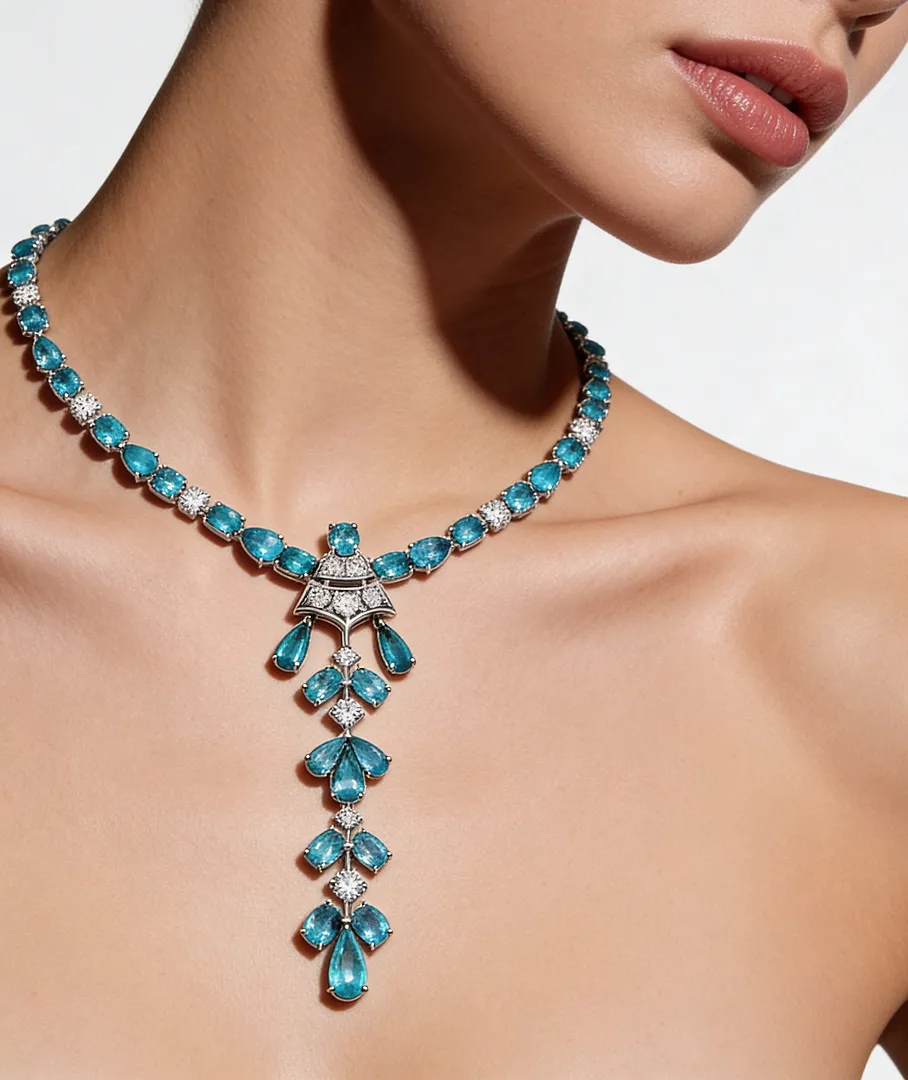
A halo is not a mistake for collectors, but it demands quality in the details. The small diamonds should be uniform in color and cut, the setting clean and the halo in proportion to the stone. A collector will recognize a halo meant to make a mediocre stone appear larger. A halo that frames an outstanding stone, on the other hand, can create exactly the effect of a classic High Jewelry ring.
Styles between solitaire and halo
Between the two poles there are gradations that often suit the stone better than either pure form. They combine the calm of the solitaire with some light at the sides or on the shank. According to GIA, side stones are suitable for adding color and sparkle to a ring. With a Paraíba tourmaline, they should accompany the center stone and never compete with it in size or brightness.
- Solitaire with diamonds on the shank: the stone stays alone, the shank brings light.
- Three-stone ring: two smaller diamonds flank the Paraíba tourmaline.
- Open or partial halo: the halo encloses the stone only partly.
- Hidden halo: diamonds beneath the stone, barely visible from above.
- Toi et Moi: two stones side by side, such as Paraíba and a colorless diamond.
Protection in daily life
According to GIA, tourmaline reaches 7 to 7.5 on the Mohs scale, and its toughness is considered fair. In a ring, it is more exposed to knocks than in earrings or pendants. For vulnerable edges, GIA recommends bezels, partial bezels or V-shaped prongs. A solitaire with a bezel protects the stone best, but lets in somewhat less light. A solitaire on high, open prongs shows much of the stone and is the most vulnerable.
A halo additionally protects the sides of the center stone, because the halo absorbs knocks. In return, it brings many small settings with it. GIA points out that rings with pavé need to be checked occasionally to make sure all stones sit firmly, and that such rings are harder to resize. What a prong setting achieves in detail is explained in the glossary.
Typical mistakes in the design
- Choosing too large a halo: the diamonds then outshine the color of the Paraíba.
- Framing a very light stone with a dense halo: the contrast can make it appear paler.
- Giving a large, strong stone a halo only because it is customary.
- Building the setting too high: high rings catch on clothing more easily, according to GIA for example with cathedral settings.
- Planning pavé on the shank and later expecting a resizing.
A common error in thinking concerns the shape of the stone. According to GIA, Paraíba tourmalines are almost always custom cut, often as pears or ovals. A halo must follow this shape, not the other way around. A round halo around a slightly asymmetrical stone makes every deviation visible. A solitaire is more forgiving of small irregularities, because no frame invites comparison. That is why the stone is fixed before the design.
Metal and color of the frame
A diamond halo is usually set in white gold or platinum so that the small stones appear colorless. For colorless diamonds, GIA advises white metals, because yellow metal in the prongs can cast a yellow tint onto the stone. For the Paraíba tourmaline itself, a combination is conceivable: prongs for the diamonds in white, the shank in rose gold. More on this in the guide on setting the Paraíba tourmaline.
Vikar Ahmed makes Paraíba jewelry as one-of-a-kind pieces in 18 karat gold, platinum, and with diamonds. For Paraíba, he likes an open prong setting with a halo of small white diamonds, and for everyday wear a bezel that protects the edges. The design begins with sketches by the in-house designers, followed by a three-dimensional visualization. There you can check how wide the halo appears and whether the stone holds its own as a solitaire before production begins. If you would like to compare a solitaire and a halo on specific stones, it is best to mention this in your inquiry.
Frequently asked questions
Paraíba solitaire or Paraíba ring surrounded by colorless diamonds: which appears more refined in a collector's ring?
With an outstanding stone, usually the solitaire. It shows the color unaltered and is easier to examine again. A diamond halo appears refined when it frames a very fine stone and stays in proportion. If it is meant to enhance a weaker stone, collectors will recognize it.
Paraíba ring with a diamond halo or a simple solitaire: which appears more elegant over time?
Over time, the style that suits the stone appears more elegant. A large, intensely colored Paraíba tourmaline carries a solitaire on its own. A smaller stone gains presence through a finely worked halo. Both styles are classic. An overloaded halo ages faster than a simple solitaire.
Does a halo make the Paraíba tourmaline appear larger?
Yes. According to GIA, a halo forms a frame that makes the center stone appear larger. With a Paraíba tourmaline, which is rarely larger than one carat, this can make sense. The diamonds should stay small, however, so that the color remains the focus.
Which ring style protects the Paraíba tourmaline better?
A bezel around the stone protects best, whether solitaire or halo. A diamond halo additionally absorbs knocks at the sides. A solitaire on high, open prongs is the most vulnerable. With tourmaline at 7 to 7.5 on the Mohs scale, a protective construction is worthwhile.
Can a solitaire later be turned into a halo ring?
In principle yes, if the stone is removed and reset. This usually means a new head or a new ring. The reverse is equally possible. Because removing the stone briefly puts it under stress, such a change should be planned by an experienced workshop.
How do I care for a Paraíba ring with a diamond halo?
With warm soapy water and a soft brush. For tourmaline, GIA advises against ultrasonic and steam cleaning. With a halo, regular checks of all the small settings are worthwhile, because individual diamonds can loosen. Take the ring off before sports and rough work.
Private consultation
Whether your stone carries a ring as a solitaire or needs a frame is revealed by the stone itself and in the visualization. Vikar Ahmed advises in the showroom in Idar-Oberstein by appointment, and on request also virtually. Request an appointment for a private consultation.
Further reading
- Paraíba tourmaline or diamond in the engagement ring
- The Paraíba tourmaline as a collector's piece
- Which cut suits the Paraíba
- Glossary: Pavé
- Glossary: 3D design
Sources
- GIA 4Cs: Complete Guide to Engagement Ring Settings, accessed 2026-11-17
- GIA 4Cs: Engagement Ring Setting Metals, accessed 2026-11-17
- GIA 4Cs: More than the Mohs Scale, Gem Durability, accessed 2026-11-17
- GIA: Tourmaline Quality Factors, accessed 2026-11-17
- GIA: Tourmaline Care and Cleaning, accessed 2026-11-17
- SSEF: Paraíba Tourmaline, accessed 2026-11-17
- Vikar Ahmed: Paraíba, accessed 2026-11-16
- Vikar Ahmed: Bespoke, Designprozess, accessed 2026-11-16
A personal conversation starts here.
At the showroom in Idar-Oberstein or by video. Vikar Ahmed discusses your ideas, stones and designs with you and answers your questions calmly and in confidence.





Thank you for your request.
Your request will be handled with the utmost attention and discretion. Vikar Ahmed will get back to you.
Your details
Request
–
Occasion
–
Consultation
–
Contact
–
In the meantime
Insights: What is a Paraíba tourmaline? · Engagement ring to your own design: how does it work?
Confidential and without obligation
Back to the pagePrivate consultation
A personal conversation starts here.
- Time for your questions, wishes and ideas
- In the showroom in Idar-Oberstein or by video
- Confidential, discreet and without obligation
Vikar Ahmed · Hauptstraße 111 · 55743 Idar-Oberstein, Germany