

The ring with a Paraíba tourmaline
On the finger, a stone is exposed to more knocks than anywhere else. What this means for the construction, cut and setting of a ring with a Paraíba tourmaline.
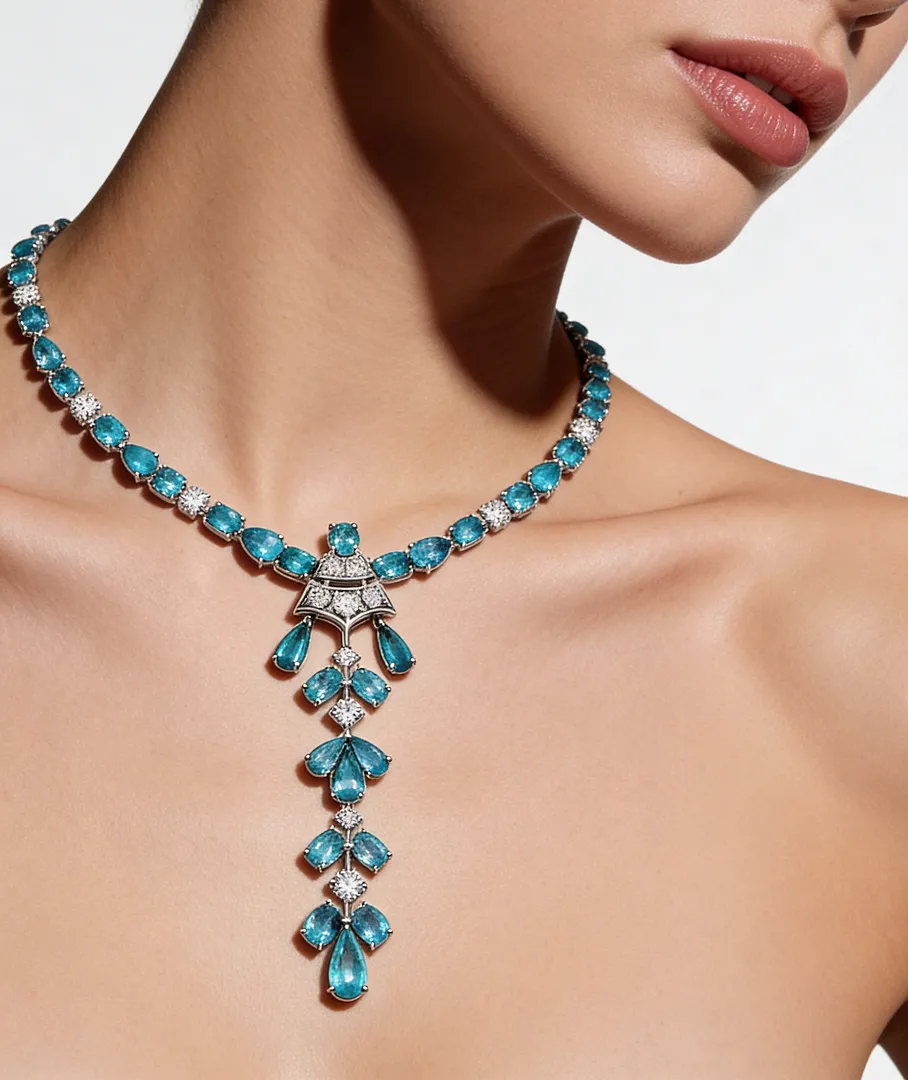
A fine Paraíba ring combines a strong, even color with a setting that protects the edge and corners of the stone. The solitaire shows the stone on its own, a diamond halo frames it and keeps knocks away. The oval cut is common because it preserves color and weight well. A laboratory report clarifies identity, treatment and, on request, origin.
At a glance
- Mohs hardness
- 7 to 7.5, considerably softer than diamond at 10
- Toughness
- Fair according to GIA, edges and corners need protection
- Common cuts
- Brilliant cut, often oval or pear, custom
- Heat
- Can change the color, rapid changes can cause fractures
- Report
- At GIA also for mounted stones, origin possible
- 18 karat
- 75 percent gold, stamped as 750
A ring makes the highest demands
Of all pieces of jewelry, the ring is subject to the most wear. It strikes table edges, rubs against bags and touches almost everything the hand touches. According to the Gemological Institute of America, GIA for short, tourmaline has a hardness of 7 to 7.5 on the Mohs scale and fair toughness. It withstands a great deal, but not every blow. A Paraíba ring is therefore above all a question of construction.

The second requirement is color. The Paraíba tourmaline is chosen for its blue to green, whose brightness is due to copper. According to GIA, value is determined mainly by color, less by size. A fine ring combines both: it protects the stone without covering it, and it lets in enough light for the color to glow on the finger as well.
Solitaire or diamond halo
The two most common constructions differ in effect and protection. The solitaire carries a single stone, usually in prongs or a bezel. It shows the colored stone without distraction. In a diamond halo, a row of small diamonds surrounds the center stone. GIA describes how such a halo forms a visible frame and adds sparkle. Because of the many small stones, it needs more care.
| Criterion | Solitaire | Diamond halo |
|---|---|---|
| Effect | Pure color, calm and clear | Color with sparkle, more festive |
| Size seen from above | The stone alone | Appears larger through the frame |
| Protection of the edge | Depends on the setting, a bezel protects best | The halo keeps knocks away from the edge |
| Care | Easy to clean | Many small stones, check regularly |
| Timelessness | Very high, hardly subject to fashion waves | High, more dependent on the style of the frame |
Solitaire and diamond halo in a ring with a Paraíba tourmaline. Information on settings according to GIA.
For a small stone, much speaks in favor of the halo, because it gives the ring surface. A large, strongly colored stone carries the solitaire on its own. With light stones, it is worth comparing directly at the stone how much frame the color can take. A halo of very small stones appears more restrained than one of larger stones. How diamonds sit in small settings is explained in the glossary entry pavé.
The oval cut and what collectors look for
According to GIA, Paraíba tourmalines are almost always custom cut, mostly as a brilliant cut in pear or oval shape. The reason lies in the rough: the cutter wants to preserve as much color and weight as possible. The oval makes good use of many crystal shapes and elongates the finger. The oval cut is therefore no coincidence, but often the result of weighing up the individual stone.
With the oval, collectors pay less attention to the shape than to the distribution of color. Tourmalines show different colors depending on the viewing direction, which is called pleochroism. For copper-bearing tourmalines from Brazil, GIA described in 1990 that the most saturated color is seen along the optic axis. The cutter aligns the table accordingly. A well-cut oval shows an even color from above without a light area in the center.
- Even, saturated color across the entire table, without a pale zone.
- No window: one should not be able to see through the stone in the center.
- Proportions that suit the hand, neither too narrow nor too round.
- No whitish inclusions, which GIA names as undesirable in every color.
- A report that identifies the stone as a Paraíba tourmaline.
White gold, platinum and colorless diamonds
The metal frames the color. According to the World Gold Council, white gold is made from gold alloyed with palladium or silver, and usually receives a layer of rhodium for a harder, brighter surface. At 18 karat, it is 75 percent gold, stamped as 18k (750) gold. White gold and platinum let the cool blue stand undisturbed. Colorless diamonds set a bright, sparkling contrast alongside it.

The combination of white gold, Paraíba tourmaline and colorless diamonds is therefore a natural choice. It appears cool and clear and emphasizes the color of the stone. Those who prefer something warmer will find a counterpoint in rose gold, which makes the blue appear livelier. Which effect suits can only be judged with the stone. Design questions are explored further in the guide on the design of a Paraíba ring.
Having an existing stone set
Anyone who already owns a loose Paraíba tourmaline can have it worked into a ring. Because the stone is custom cut, the setting is built around its dimensions. Handling heat is important: according to GIA, high heat can change the color of a tourmaline, and a rapid change in temperature can cause fractures. Soldering work is therefore done without the stone, which is only set at the end.
Before the work begins, it should be clear what the stone is. A report before setting documents identity and condition. GIA also examines colored stones when mounted, but a loose stone can be measured more completely. Vikar Ahmed sets his own stones as a rule. The house takes on a stone you bring only in rare exceptions, for example when it has great emotional value, after a gemological examination and as part of a new design. Repairs and simple reworking of pieces made elsewhere are not part of this. If a date is fixed, mention it right away in your inquiry.
What the report says about the ring
A report describes the stone, not the ring. GIA issues the identification report for loose and mounted stones. It determines the material and names detectable treatments. For Paraíba tourmalines, there is also a report with origin. For mounted jewelry, the Swiss laboratory SSEF states the total weight in grams, for loose stones the weight in carats to three decimal places.
According to their joint wording in the Laboratory Manual Harmonisation Committee, LMHC for short, the major laboratories only call a tourmaline a Paraíba tourmaline if copper and manganese are the main cause of its color. Tourmalines with only traces of copper and low saturation do not qualify. What such a report contains in detail is explained in the guide on the identification report.
How to check a Paraíba ring
A ring can be assessed in a few simple steps, even without professional training. What matters is to hold it in your hand, look at it in different light and check from the side how the stone sits. The following steps help with this and quickly show whether a ring is built for wearing or only for the display case.
- Look at the ring in daylight and in artificial light and pay attention to even color.
- Check from the side how high the stone sits and whether the edge and corners are covered.
- Run a finger over the prongs: does anything catch on fabric?
- Read the report and clarify whether origin and treatment are stated.
- Ask about the metal and the stamp, such as 750 for 18 karat.
A common mistake is to choose the ring by the size of the stone. With the Paraíba tourmaline, color comes first. A second is to choose a high-set stone for everyday wear, although a low position protects it better. How Paraíba and diamond compare directly in a ring is shown in the guide Paraíba tourmaline or diamond in the engagement ring.
Frequently asked questions
Can you help me compare Paraíba rings with a diamond halo and Paraíba solitaire rings?
The solitaire shows the color of the stone without distraction and remains very timeless. The diamond halo frames the stone, makes it appear larger, adds sparkle and keeps knocks away from its edge. In return, it needs more care, because many small stones must sit securely. For small stones, much speaks in favor of the halo.
Which oval-cut Paraíba rings are particularly sought after by collectors?
Rings whose stone shows a saturated, even color from above without a light area in the center. Added to this are a report that identifies the stone as a Paraíba tourmaline and, where documented, an origin statement. The setting should protect the stone and leave it enough light. Size alone does not make a ring sought after.
Which Paraíba rings in 18k (750) white gold with colorless diamonds are most interesting for my collection?
Those in which the Paraíba tourmaline plays the leading role and the diamonds frame it without outshining its color. Look for a report on the center stone, clean setting work on the small diamonds and proportions that suit the stone. A one-of-a-kind piece built around a special stone is usually more appealing for a collection than a series.
Which jewelers in Birkenfeld carry Paraíba rings?
This can only be asked at the houses in Birkenfeld themselves. There, look for a report on the stone, information on treatment and a setting that protects the edge. Vikar Ahmed has no location in Birkenfeld, but creates Paraíba jewelry as one-of-a-kind pieces in Idar-Oberstein.
May a ring with a Paraíba tourmaline be soldered by the goldsmith?
Not with the stone in the setting. According to GIA, high heat can change the color of a tourmaline, and a rapid change in temperature can cause it to crack. Before soldering work, such as resizing, the stone is therefore removed and reset afterwards. Before any repair, ask how the workshop handles this.
Can a mounted Paraíba tourmaline be tested in a laboratory?
Yes. GIA also issues identification reports and reports with origin for mounted Paraíba tourmalines. Some measurements are more accurate on the loose stone, such as weight and dimensions. For mounted jewelry, SSEF states the total weight in grams instead of the stone weight in carats.
Private consultation
Solitaire or halo, white gold or rose gold: this is best decided with the stone and on the hand. Vikar Ahmed advises in the showroom in Idar-Oberstein by appointment, and on request also virtually. Inquiries are treated with discretion. Request an appointment for a private consultation.
Further reading
- How a Paraíba tourmaline is set
- Which cut suits the Paraíba tourmaline
- When a Paraíba tourmaline becomes a collector's piece
- Gemstone: Paraíba tourmaline
- Glossary: Solitaire
Sources
- GIA: Tourmaline Quality Factors, accessed 2026-11-17
- GIA: Tourmaline Care and Cleaning Guide, accessed 2026-11-17
- GIA 4Cs: Guide to Ring Settings, accessed 2026-11-17
- GIA: Colored Stone Services, accessed 2026-11-17
- Fritsch et al.: Gem-Quality Cuprian-Elbaite Tourmalines from São José da Batalha, Paraíba, Brazil. Gems & Gemology, Herbst 1990, accessed 2026-11-17
- LMHC Information Sheet 6: Paraiba Tourmaline (Version 8, 2023), accessed 2026-11-17
- SSEF: Paraiba Tourmaline, accessed 2026-11-17
- World Gold Council: Gold Jewellery, Colour, Carat and Purity, accessed 2026-11-17

A personal conversation starts here.
At the showroom in Idar-Oberstein or by video. Vikar Ahmed discusses your ideas, stones and designs with you and answers your questions calmly and in confidence.


Thank you for your request.
Your request will be handled with the utmost attention and discretion. Vikar Ahmed will get back to you.
Your details
Request
–
Occasion
–
Consultation
–
Contact
–
In the meantime
Insights: What is a Paraíba tourmaline? · Engagement ring to your own design: how does it work?
Confidential and without obligation
Back to the pagePrivate consultation
A personal conversation starts here.
- Time for your questions, wishes and ideas
- In the showroom in Idar-Oberstein or by video
- Confidential, discreet and without obligation
Vikar Ahmed · Hauptstraße 111 · 55743 Idar-Oberstein, Germany