

Paraíba or Lagoon Tourmaline in a Bracelet?
On the wrist, a stone is moved, knocked and seen from many angles. This comparison shows what that means for Paraíba and Lagoon tourmalines.
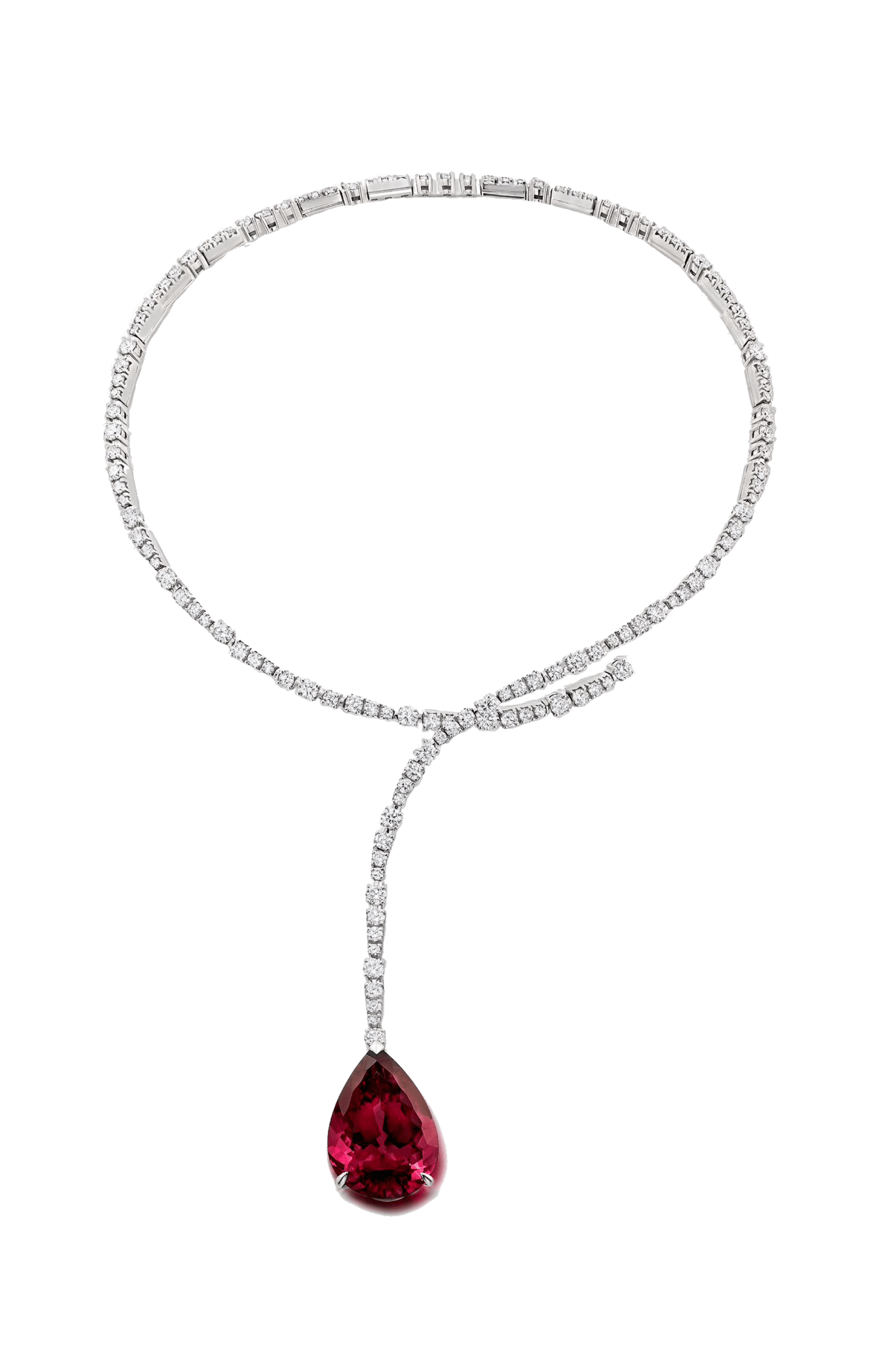
A Paraíba tourmaline appears more intense in a bracelet, because copper and manganese give it a vivid blue to green. A Lagoon tourmaline appears lighter and calmer. Neither is inherently more refined. What matters is color, consistency across all stones and a setting that protects the edges, because tourmaline only has a hardness of 7 to 7.5.
At a glance
- Paraíba tourmaline
- Blue to green, color mainly due to copper and manganese
- Lagoon tourmaline
- Trade name for a light blue-green, not a laboratory term
- Hardness of both stones
- 7 to 7.5 on the Mohs scale, fair toughness
- Typical Paraíba size
- Rarely above one carat, color counts more than size
- Protection in a bracelet
- Bezels or half bezels protect the edges
- Cleaning
- Warm soapy water, no ultrasonic, no steam
Two blues, two effects
Paraíba tourmaline stands out through saturation. The Swiss laboratory SSEF defines it as a blue, blue-green, green-blue or green tourmaline of medium to high saturation whose color is due mainly to copper and manganese. In a bracelet, this appears as color that carries even at a distance. When the wrist turns, the stones light up, even when they are small.
Lagoon tourmaline stands for a lighter, watery blue-green. The name comes from the trade and describes a color impression. In a bracelet it appears quieter, fresher and closer to aquamarine than to neon. This is not a shortcoming but a different attitude: a Lagoon bracelet accompanies, a Paraíba bracelet sets an accent. The question of the more refined stone is therefore above all a question of the desired effect.
What laboratories distinguish
For a laboratory, the hue alone is not decisive, but the cause of the color. A Paraíba tourmaline in the sense of laboratory guidelines requires copper and manganese. A light blue-green tourmaline without detectable copper remains a tourmaline. Blue tourmalines without copper are often called indicolite in the trade. Otherwise, according to GIA, blue and green in tourmaline are caused by iron and possibly titanium.

In reports, SSEF describes color with factual terms, not with trade names. A word such as “Lagoon” therefore does not appear in any report as a variety designation. If a copper-bearing stone comes from Brazil, SSEF calls it Paraíba tourmaline. Stones of other origin that meet the color and chemistry are called tourmaline there, with the note that the trade may call them Paraíba tourmaline. How such reports are structured is explained in the guide on the identification report.
Good to know
SSEF reports on two stones submitted as a pair that matched in shape, size and color. One contained copper and was a Paraíba tourmaline, the other contained iron and was an indicolite. Looking the same does not mean being the same.
Both stones by the same criteria
| Criterion | Paraíba tourmaline | Lagoon tourmaline |
|---|---|---|
| Color | Vivid blue to green, high saturation | Light blue-green, calm |
| Cause of color | Copper and manganese, detectable in the laboratory | Without copper, no Paraíba in the laboratory sense |
| Term in the report | Paraíba tourmaline or tourmaline with a note | Tourmaline, the trade name does not appear in the report |
| Typical stone size | Rarely above one carat | Depends on the individual stone |
| Hardness | 7 to 7.5 | 7 to 7.5 |
| Effect in a bracelet | Accent, carries at a distance | Understated, for everyday wear |
Information on definition and report according to SSEF, on hardness and size according to GIA. Lagoon is a trade name without a fixed laboratory boundary.
What a bracelet demands of the stone
A bracelet sits where the hand knocks against table edges, door frames and bags. For less tough stones, GIA recommends earrings and necklaces instead, because these come into contact with hard surfaces less often, and advises restraint in everyday wear with rings and bracelets. According to GIA, tourmaline has a hardness of 7 to 7.5 and a toughness considered fair. This is wearable for a bracelet but requires a well-considered setting.
For protection of sensitive edges, the GIA guides recommend bezels, half bezels or V-prongs. A bezel is a closed metal rim around the stone. It keeps impacts away from the edges and lets somewhat less light into the stone than open prongs. For a bracelet that is worn often, this trade-off usually makes sense. A bangle with a few well-protected stones is more robust than a fine link bracelet with openly set stones.
Stones that match each other
A bracelet with many stones stands or falls with consistency. With Paraíba tourmaline this is difficult, because according to GIA the stones are rarely larger than one carat and are usually cut individually. Each stone brings its own color. Tourmalines are also strongly pleochroic: they show different colors depending on the viewing direction in the crystal. Through the orientation, the cutter determines which color shows through the table.

For a row, this means that stones are selected by their face-up color, not by weight. In light Lagoon tones, differences in lightness are noticed more quickly, in Paraíba blue, differences in saturation. According to GIA, inclusions are considerably more visible in light, less saturated stones. A Lagoon bracelet therefore tends to require cleaner stones, a Paraíba bracelet above all a uniform vividness.
Treatment and documents
According to SSEF, Paraíba tourmalines are often heated to improve their color. GIA writes that heating cannot always be detected. A report therefore notes indications of heating, no indications, or that the question cannot be resolved. Other tourmalines can also be heated or irradiated. According to GIA, color changes caused by irradiation can fade under heat or strong light, which matters for a bracelet worn in sunlight.
For a bracelet with many small stones, there is rarely a report for each stone. A report for the principal stones or a report on the finished piece makes sense. What such a document states about treatments should be clarified before production. Under CIBJO rules, a treatment must be disclosed, so ask for the details for your bracelet in writing. Independent laboratories such as GIA or SSEF issue reports on tourmalines. Note the laboratory and the report number.
What suits whom
- Paraíba tourmaline: for anyone who sees color as the main point and wears a bracelet as an accent.
- Lagoon tourmaline: for a calm bracelet that goes with many colors and occasions.
- For everyday wear: a few stones in bezels, a bangle instead of a fine link bracelet.
- For collectors: a Paraíba stone with a report as the centerpiece, complemented by colorless diamonds.
- For those who like both tones: a gradient from light Lagoon to intense Paraíba, matched stone by stone.
Vikar Ahmed calls Paraíba tourmaline the heart of the house. In the pieces shown, the Maison works with Lagoon tourmalines alongside Paraíba tourmalines, as well as 18k (750) white and rose gold. For Lagoon tourmaline, what matters most to Vikar Ahmed is the radiance of the color and a precise cut, and he expects an almost eye-clean clarity. A bracelet is created there as a one-of-a-kind piece in three steps: design, three-dimensional visualization, and realization in the in-house atelier. If you would like to see Paraíba and Lagoon tourmaline side by side at the appointment, it is best to say so when you inquire.
Frequently asked questions
Which stone looks more refined in a bracelet, Paraíba tourmaline or Lagoon tourmaline?
Neither is inherently more refined. Paraíba tourmaline appears more intense and striking, because copper makes its color glow. Lagoon tourmaline appears lighter and more understated. A bracelet looks refined when the stones match each other in color and lightness and the setting is cleanly crafted.
Which bracelets with Paraíba or Lagoon tourmalines are worth comparing?
It is worth comparing bangle and link bracelet, bezel and prong setting, and a single center stone with a row of matching stones. These constructions determine more than the type of stone how robust the bracelet is and how the color appears. On the wrist, the difference is visible at once.
Is a Lagoon tourmaline an inexpensive Paraíba tourmaline?
No. Lagoon is a trade name for a light blue-green color. Whether a tourmaline counts as Paraíba tourmaline is decided solely by the laboratory detection of copper and manganese. A Lagoon tone can arise without copper. The stone is then a tourmaline in its own right, not a substitute.
Is tourmaline hard enough for a bracelet?
Yes, with limitations. Tourmaline reaches 7 to 7.5 on the Mohs scale and is considered to have fair toughness. That is sufficient for a bracelet if bezels or half bezels protect the edges. The bracelet should be taken off for rough work and sports.
How do I clean a bracelet with tourmalines?
With warm soapy water and a soft brush. GIA advises against ultrasonic and steam cleaners for tourmaline. Sudden temperature changes can cause fractures. After cleaning, dry the bracelet well and check whether prongs and clasp are secure.
How can I tell whether all the stones in a Paraíba bracelet really are Paraíba?
Only through laboratory analysis. Similar-looking blue tourmalines can owe their color to iron instead of copper. SSEF examined a pair of stones in which only one contained copper. With bracelets of many stones, usually only some are examined, and this should be clearly documented.
Private consultation
Whether Paraíba or Lagoon is best seen when both colors lie on your own wrist. Vikar Ahmed advises in the showroom in Idar-Oberstein by appointment, or virtually if you prefer. Your inquiry is treated discreetly. Request an appointment for a private consultation.
Further reading
- Lagoon tourmaline and Paraíba compared directly
- Bangle with Paraíba or diamond
- Paraíba bracelet or pendant
- Gemstone: Lagoon tourmaline
- Glossary: Bangle
Sources
- SSEF: Paraíba Tourmaline, Definition und Berichte, accessed 2026-11-17
- SSEF: A perfect match? Paraíba tourmaline and indicolite tourmaline, accessed 2026-11-17
- GIA: Tourmaline Description, accessed 2026-11-17
- GIA: Tourmaline Quality Factors, accessed 2026-11-17
- GIA: Tourmaline Care and Cleaning, accessed 2026-11-17
- GIA 4Cs: More than the Mohs Scale, Gem Durability, accessed 2026-11-17
- GIA Gems & Gemology: Paraíba Tourmaline Geographic Origin Determination, accessed 2026-11-17
- Vikar Ahmed: Paraíba, accessed 2026-11-16
- CIBJO: Introduction to the Blue Books, accessed 2026-11-17
- GIA: Gem Laboratory, accessed 2026-11-17

A personal conversation starts here.
At the showroom in Idar-Oberstein or by video. Vikar Ahmed discusses your ideas, stones and designs with you and answers your questions calmly and in confidence.


Thank you for your request.
Your request will be handled with the utmost attention and discretion. Vikar Ahmed will get back to you.
Your details
Request
–
Occasion
–
Consultation
–
Contact
–
In the meantime
Insights: What is a Paraíba tourmaline? · Engagement ring to your own design: how does it work?
Confidential and without obligation
Back to the pagePrivate consultation
A personal conversation starts here.
- Time for your questions, wishes and ideas
- In the showroom in Idar-Oberstein or by video
- Confidential, discreet and without obligation
Vikar Ahmed · Hauptstraße 111 · 55743 Idar-Oberstein, Germany