

Lagoon Tourmaline or Paraíba Tourmaline?
Both are tourmalines in blue to green, and yet a clear line separates them. A comparison by color, rarity, and documentation, with collectors in mind.
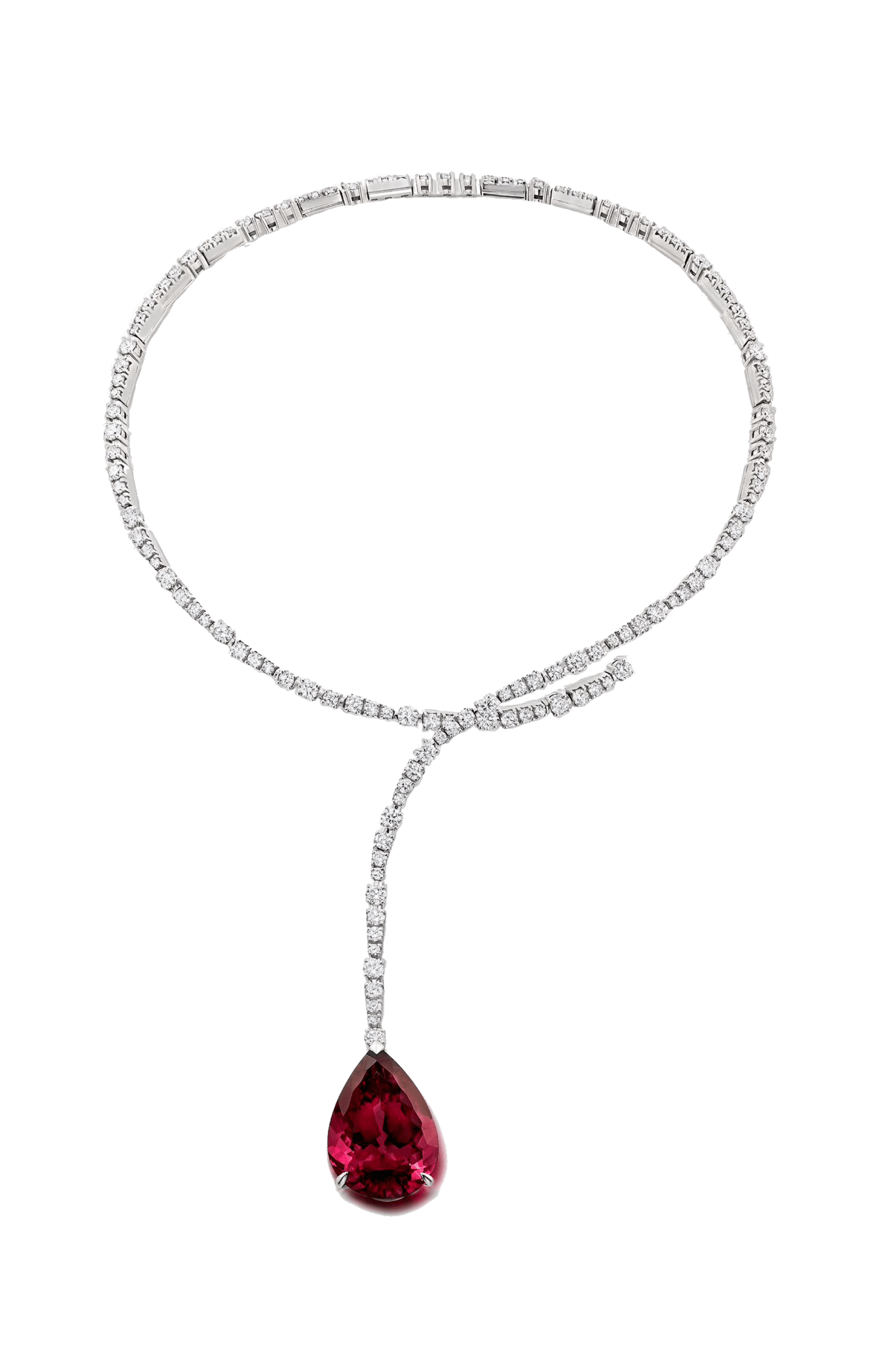
Lagoon and Paraíba tourmaline differ in the cause of their color. In Paraíba, the saturated blue to green is produced mainly by copper and manganese, which makes it rare and gives it its luminosity. Lagoon is a trade name for bluish green tourmalines without this condition. Their color is clearer and calmer, and the name alone says nothing about rarity.
At a glance
- In common
- Both are tourmalines, Mohs hardness 7 to 7.5
- Paraíba
- Color mainly from copper and manganese, defined by the LMHC
- Lagoon
- Trade name for a bluish green, not a laboratory designation
- Rarity
- Paraíba over one carat rare according to GIA
- Origin report
- Possible at GIA for Paraíba, not for other tourmalines
- Borderline case
- A Lagoon with copper and manganese as the cause of color counts as Paraíba
The cause of color draws the line
The difference between the two stones is not a hue but a cause. Under the standard of the Laboratory Manual Harmonisation Committee, LMHC for short, a tourmaline is called Paraíba if its color is caused mainly by copper and manganese and lies within a defined range from blue to yellowish green with medium to high saturation. Lagoon, by contrast, is a trade name for a particular bluish green. It is not a laboratory designation.

An asymmetry follows from this. A Paraíba is determined by measurement, a Lagoon by description. A bluish green tourmaline that meets the LMHC criteria is a Paraíba, even if someone calls it Lagoon. A Lagoon without copper as the cause of color remains a tourmaline. Anyone comparing the two stones is therefore comparing a defined term with an open one. Fundamentals in the glossary entry on Lagoon tourmaline.
Both stones by the same criteria
| Criterion | Lagoon tourmaline | Paraíba tourmaline |
|---|---|---|
| Name | Trade name for a color | Variety, defined by the LMHC |
| Cause of color | Usually iron, possibly titanium | Mainly copper and manganese |
| Color effect | Clear, calm bluish green | Saturated, glowing, blue to green |
| Rarity | Depends on the stone; the name says nothing | Copper as a coloring agent only in this tourmaline |
| Designation in the report | Tourmaline | Paraiba tourmaline or tourmaline with comment |
| Origin report at GIA | Not offered | Offered |
| Hardness and care | 7 to 7.5, soapy water | 7 to 7.5, soapy water |
Information according to LMHC, GIA, and SSEF. The individual stone and its report are authoritative.
Color compared
According to GIA, blue and green in ordinary tourmalines are usually produced by traces of iron and possibly titanium. These colors can be very clear and beautiful, but they look different from the copper color of Paraíba. GIA calls Paraíba tourmaline unusual because copper occurs as a coloring agent in no other tourmaline. The result is a saturation the trade often calls neon, which laboratories describe only in factual terms.
Not every trace of copper is enough. Under the LMHC, tourmalines with only small amounts of copper and weak color do not count as Paraíba. This creates a transition zone: bluish green stones with some copper but too little saturation. What the trade calls such stones is not uniformly regulated. For the comparison, this means that a particularly luminous Lagoon deserves a look at the report, and so does a particularly pale Paraíba. More on the effect of color in the guide color or clarity in Paraíba.
Rarity: what is documented and what is not
For Paraíba tourmaline, rarity is well described. It was discovered in the late 1980s in the Brazilian state of Paraíba; deposits in Nigeria and Mozambique were added later. According to GIA, stones over one carat are seen only rarely, and because of its value the rough is almost always cut individually. According to GIA measurements, Brazilian stones contain on average considerably more copper than African ones.

For Lagoon tourmaline, there are no comparable figures, because the name is not tied to locality or chemistry. A Lagoon can come from various deposits, and its rarity depends on the individual stone: on color, clarity, and size. In general terms, one can only say that it lacks the property that makes Paraíba so rare. Anyone speaking of rarity in a Lagoon should justify it by the stone, not by the name.
What the report states
For Paraíba tourmaline, the major laboratories follow the joint wording of the LMHC. SSEF designates stones from Brazil as Paraiba tourmaline. Stones of other origin that meet all criteria it calls tourmaline, noting that the trade may call them Paraíba. For Lagoon tourmaline, the report simply states tourmaline, supplemented by a factual color description and detected treatments. SSEF does not use trade names such as Lagoon or neon.
There is a further difference regarding origin. GIA offers reports with an origin statement only for certain stones, including Paraíba tourmaline, but not for other tourmalines. Origin is determined from trace elements, and not every stone can be assigned unambiguously. How such a report is structured is shown in the guide How to recognize a genuine Paraíba tourmaline.
For a collection: what a stone should bring
For collectors, traceability counts alongside beauty. A Paraíba tourmaline brings a clear basis for this: a defined variety, a possible origin statement, and a documented treatment. Whether a stone comes from Brazil is proven only by a report with an origin statement, not by the name. As a collector's piece, a Lagoon tourmaline is above all a question of color, because the name and the report record less about it.
- A report from an independent laboratory for every significant stone.
- For Paraíba, read the comments on copper, manganese, and origin.
- Record statements on heating and fillings, because they affect value.
- Compare weight and dimensions with the report.
- View stones side by side under the same light before they become part of the collection.
Which stone suits whom
Paraíba tourmaline suits people who are looking for exactly this luminosity and value a defined, documentable variety. It is the choice for a collection built on rarity and origin. Lagoon tourmaline suits people who love its clear bluish green for the color itself and choose a stone by its appearance. In jewelry, it looks calmer. How it works in a ring is covered in the guide ring with Lagoon tourmaline.
Frequently asked questions
How do Lagoon tourmalines differ from Paraíba tourmalines in color and rarity?
Paraíba owes its saturated blue to green mainly to copper and manganese, which does not occur in other tourmalines. Lagoon refers to a clear bluish green, usually caused by iron. Paraíba is therefore the rarer stone. With Lagoon, rarity depends on the individual stone, not on the name.
Paraíba tourmaline from Brazil or Lagoon tourmaline: which stone is the better addition to my collection?
For a collection focused on rarity and documentation, Brazilian Paraíba is the obvious addition. Its variety is defined, and GIA offers an origin statement for it. A Lagoon adds to a collection above all through its color. Both should be documented with a report from an independent laboratory.
I own a loose Paraíba tourmaline and would like to have it made into a pendant. Which ateliers in or around Trier specialize in such colored gemstones?
Look for a house that sets Paraíba tourmalines regularly, reads the report of your stone, and plans the setting around it. Vikar Ahmed has no location in Trier but advises in Idar-Oberstein, where Paraíba is at the heart of the Maison. However, the house sets clients' own stones only in rare exceptions, after gemological testing and as part of a new design. More under Jeweler for clients from Trier.
Are there jewelers in Morbach where I can compare loose Paraíba and Lagoon tourmalines directly side by side?
A side-by-side comparison makes sense, because both colors only show properly then, ideally in daylight and artificial light. Vikar Ahmed has no location in Morbach and advises in the house's showroom in Idar-Oberstein by appointment. Information for clients from the area under Jeweler for clients from Morbach.
Can a Lagoon tourmaline appear in the report as a Paraíba tourmaline?
Yes, if it meets the criteria. If its color is caused mainly by copper and manganese and is sufficiently saturated, it counts as Paraíba under the LMHC standard. The trade name plays no role for the laboratory. Stones with only traces of copper and weak color remain tourmaline.
Are Lagoon and Paraíba tourmalines equally delicate?
Yes, essentially. Both are tourmalines with a hardness of 7 to 7.5 and fair toughness. They do not tolerate great heat or rapid changes in temperature and should be cleaned with warm soapy water rather than ultrasonic or steam.
Private consultation
If you are weighing Lagoon against Paraíba tourmaline, you should view both colors in a calm setting. Vikar Ahmed advises in the house's showroom in Idar-Oberstein by appointment or virtually. If you would like to see both stone types at the appointment, it is best to say so in your request. Request a private consultation.
Further reading
- Glossary: Lagoon tourmaline
- Gemstone: Lagoon tourmaline
- Paraíba or Lagoon in a bracelet
- Paraíba tourmaline as a collector's piece
- Glossary: Origin report
Sources
- LMHC Information Sheet #6: Paraiba Tourmaline (Version 8, 2023), accessed 2026-11-17
- SSEF: Paraiba Tourmaline, Report Explanation, accessed 2026-11-17
- GIA: Tourmaline, Gem Facts, accessed 2026-11-17
- GIA: Tourmaline Quality Factors, accessed 2026-11-17
- GIA: Tourmaline Care and Cleaning, accessed 2026-11-17
- GIA: Colored Stone Reports, accessed 2026-11-17
- GIA Gems & Gemology: Paraíba Tourmaline Geographic Origin Determination (Winter 2019), accessed 2026-11-17
- Vikar Ahmed: Paraíba, accessed 2026-11-17

A personal conversation starts here.
At the showroom in Idar-Oberstein or by video. Vikar Ahmed discusses your ideas, stones and designs with you and answers your questions calmly and in confidence.


Thank you for your request.
Your request will be handled with the utmost attention and discretion. Vikar Ahmed will get back to you.
Your details
Request
–
Occasion
–
Consultation
–
Contact
–
In the meantime
Insights: What is a Paraíba tourmaline? · Engagement ring to your own design: how does it work?
Confidential and without obligation
Back to the pagePrivate consultation
A personal conversation starts here.
- Time for your questions, wishes and ideas
- In the showroom in Idar-Oberstein or by video
- Confidential, discreet and without obligation
Vikar Ahmed · Hauptstraße 111 · 55743 Idar-Oberstein, Germany