

How to Recognize a Genuine Paraíba Tourmaline
Not every vivid blue tourmaline is a Paraíba. The line is drawn by chemistry, and only a laboratory can draw it. What is tested and how to read the report.
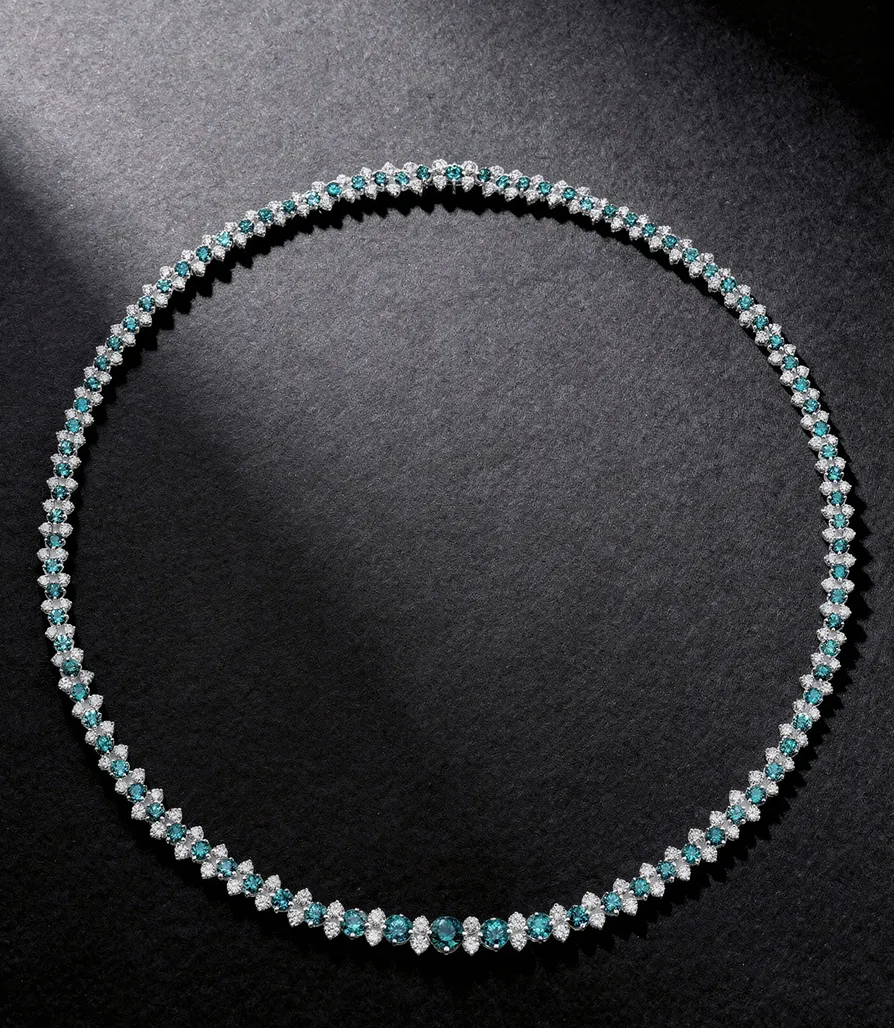
A genuine Paraíba tourmaline is recognized by its laboratory report, not by its hue. Under the standard of the major laboratories, a tourmaline is called Paraíba only if it is blue to green, shows sufficient saturation, and owes its color mainly to copper and manganese. Origin plays no role in the name; it is a separate statement.
At a glance
- Decisive
- Color mainly caused by copper and manganese, whatever the country of origin
- Color range
- Blue, bluish green to greenish blue, green, or yellowish green
- Not Paraíba
- Tourmalines with only traces of copper or low saturation
- Standard
- LMHC Information Sheet 6, issued jointly by GIA, SSEF, Gübelin, and others
- Origin
- A separate statement, determined in the laboratory from trace elements
- Treatment
- Frequently heated, not always detectable
Genuine means: the right cause of color
Paraíba is not a mineral of its own but a variety of tourmaline. What belongs to it has been defined jointly by the major laboratories. The Laboratory Manual Harmonisation Committee, LMHC for short, includes GIA, SSEF, Gübelin, and the German laboratory DSEF, among others. Under their standard, a Paraíba tourmaline is a blue, bluish green to greenish blue, green, or yellowish green tourmaline of medium to high saturation whose color is caused mainly by copper and manganese.

Two exclusions matter just as much. Tourmalines with only traces of copper and weak color do not count as Paraíba, nor do stones outside the stated color range. Iron-rich copper-bearing tourmalines in which a particular feature of the absorption spectrum dominates are excluded as well. Genuine, then, is not every stone that contains copper, but one whose color within a defined range is produced by copper and manganese.
What the eye can and cannot do
A trained eye recognizes whether a stone glows with unusual saturation. It cannot tell why. According to GIA, ordinary blue and green tourmalines usually owe their color to traces of iron and possibly titanium. Such stones can be very attractive in blue or bluish green and resemble a Paraíba. Without analysis, the cause of color cannot be determined, and therefore neither can the name.
Trade terms do not help here. Neon, Electric Blue, or Lagoon describe color impressions. SSEF deliberately does not use such expressions in its reports and describes color in factual terms such as blue, light blue, or greenish blue. A stone offered as neon is therefore not automatically a Paraíba. What lies behind the term is explained in the glossary entry neon quality.
What the laboratory measures
A laboratory first determines the material. According to GIA, tourmaline has a refractive index of 1.624 to 1.644 and a specific gravity of about 3.06, which separates it from other blue stones. Chemistry follows: copper and manganese are detected, and their effect on color is assessed through light absorption. For iron-rich stones, the LMHC standard names a spectral criterion: a stone is excluded when an absorption at 700 nanometers is stronger than the copper-related absorption at 900 nanometers.
For origin, the laboratory goes further. In its journal Gems & Gemology, GIA describes that origin determination for Paraíba tourmaline rests overwhelmingly on the measurement of trace elements by laser ablation. No single element is sufficient; only the combination of several, such as copper, zinc, gallium, strontium, tin, and lead, separates the localities. If a stone falls between the known ranges, the result is undeterminable.
How the report is worded
Under the LMHC standard, the report states under variety something like "Paraiba tourmaline", with the note that this is a variety containing copper and manganese. Alternatively, it states only "tourmaline", and a comment explains that this copper- and manganese-bearing stone may also be called Paraíba tourmaline in the trade. If the origin has not been determined, the report must say so explicitly.

SSEF in Basel handles it as follows: stones from Brazil are designated Paraiba tourmaline. Stones of other origin that meet the color and chemical criteria are called tourmaline in the report, with a comment that the trade may call them Paraíba. Both versions confirm the same cause of color. Anyone placing two reports side by side should therefore read not only the variety line but also the comments. What an identification report contains beyond this is explained in a separate guide.
| Statement in the report | What it means |
|---|---|
| Variety Paraiba tourmaline | Copper and manganese confirmed as the cause of color |
| Tourmaline with comment on Paraíba | Cause of color confirmed, name permitted in the trade |
| Tourmaline without comment | No evidence of the cause of color as Paraíba |
| Origin not determined | No judgment on the country of origin, not negative |
| Note on heating | Treatment detected or cannot be ruled out |
Wording according to LMHC Information Sheet 6 and SSEF. Individual laboratories differ in phrasing.
Origin is a second question
The name Paraíba comes from the Brazilian state in which the stone was first found in the late 1980s. In the early 21st century, finds in Nigeria and Mozambique followed. Under the LMHC standard, these stones are also called Paraíba if the cause of color is right. A Paraíba from Mozambique is therefore not a false Paraíba. It is a Paraíba of a different origin, which appears in the report as a separate line.
GIA's measurement data show why origin matters to many collectors. Brazilian samples contained on average around 11,400 ppm copper, African samples less than 2,000 ppm. Lighter stones can contain less copper. Origin can only be determined in the laboratory, not from the hue. The role it plays in value is covered in the guide to Brazilian Paraíba tourmaline, the fundamentals in the glossary entry origin report.
Treatment is part of authenticity
A genuine Paraíba tourmaline can be treated. The LMHC notes that Paraíba tourmalines are frequently heated and that in some cases this cannot currently be detected. GIA describes the effect of heating in tourmaline as stable and undetectable. SSEF discloses fillings of fissures with oil or resin and grades their amount. This does not affect the authenticity of the stone, but it does affect value and care. Vikar Ahmed states the treatment of every Paraíba in writing on the certificate, the expert report, and the invoice.
How to check, step by step
- Ask for a report from an independent laboratory that works to the LMHC standard.
- Read the variety line and the comments: does it say Paraíba, or is there a note on copper and manganese?
- Check that the report number matches the stone: weight and dimensions must agree.
- Assess the origin statement separately: not determined is not a flaw, only the absence of a statement.
- Read the section on treatments, above all on heating and fillings.
- Verify the report online with the laboratory; SSEF offers this via myssef.ch.
For the third point, the precision of the reports helps. SSEF states the weight in carats to three decimal places and the dimensions to two. A recut stone receives a new number when it is examined again. If the weight of the stone differs from the report, the report does not belong to this stone or the stone has been altered. For mounted jewelry, SSEF states the total weight in grams; the comparison then works only through the dimensions.
Frequently asked questions
Genuine Paraíba tourmaline or an ordinary blue tourmaline: is the price difference really worth it?
That depends on what you are looking for. Paraíba tourmaline owes its luminosity to copper and manganese, while an ordinary blue tourmaline usually owes its color to iron. If you want exactly this luminosity and rarity, you will find it only in a Paraíba. If you are looking for a beautiful blue without that requirement, another tourmaline will serve you well.
Can a Paraíba tourmaline be recognized with the naked eye?
No, not reliably. The eye sees the saturation but not its cause. Tourmalines colored by iron can look similar in blue or bluish green. Whether copper and manganese cause the color is shown only by laboratory analysis, which is recorded in the report.
Is a Paraíba tourmaline from Mozambique a genuine Paraíba?
Yes, if its color is caused mainly by copper and manganese. The standard of the major laboratories applies expressly regardless of the country of origin. Origin appears in the report as a separate statement. Some laboratories call non-Brazilian stones tourmaline in the report and explain in a comment that the name Paraíba is permitted.
What does it mean if the report only says tourmaline?
That depends on the comment. If it states that the copper- and manganese-bearing stone may be called Paraíba tourmaline in the trade, the cause of color is confirmed. If there is no such note, the laboratory has not established the Paraíba criteria. In that case, it is a different tourmaline.
Does heating make a Paraíba tourmaline not genuine?
No. Heating changes the color, not the identity of the stone. According to the LMHC, Paraíba tourmalines are frequently heated, which cannot be detected in every case. Authenticity and treatment are two separate questions. Both should be answered in the report, because they affect value in different ways.
How can I tell that a report belongs to my stone?
By comparing weight and dimensions. Laboratories such as SSEF state the weight to three decimal places and the dimensions to two. If they match the stone and the report number can be verified online with the laboratory, the report and the stone belong together.
Private consultation
Whether a stone meets the criteria of a Paraíba tourmaline is stated in the report. What the report means for your piece of jewelry is clarified in conversation. Vikar Ahmed advises in the house's showroom in Idar-Oberstein by appointment or virtually. Ask for the laboratory and the report number, and verify the report online where the laboratory offers this. Request a private consultation.
Further reading
- Glossary: Paraíba tourmaline
- Glossary: SSEF and Gübelin
- Identification report for Paraíba tourmaline
- Lagoon tourmaline or Paraíba
- Authenticity and certificates
Sources
- LMHC Information Sheet #6: Paraiba Tourmaline (Version 8, 2023), accessed 2026-11-17
- SSEF: Paraiba Tourmaline, Report Explanation, accessed 2026-11-17
- GIA Gems & Gemology: Paraíba Tourmaline Geographic Origin Determination (Winter 2019), accessed 2026-11-17
- GIA: Tourmaline, Gem Facts, accessed 2026-11-17
- GIA: Tourmaline Quality Factors, accessed 2026-11-17
- GIA: Tourmaline Care and Cleaning, accessed 2026-11-17

A personal conversation starts here.
At the showroom in Idar-Oberstein or by video. Vikar Ahmed discusses your ideas, stones and designs with you and answers your questions calmly and in confidence.


Thank you for your request.
Your request will be handled with the utmost attention and discretion. Vikar Ahmed will get back to you.
Your details
Request
–
Occasion
–
Consultation
–
Contact
–
In the meantime
Insights: What is a Paraíba tourmaline? · Engagement ring to your own design: how does it work?
Confidential and without obligation
Back to the pagePrivate consultation
A personal conversation starts here.
- Time for your questions, wishes and ideas
- In the showroom in Idar-Oberstein or by video
- Confidential, discreet and without obligation
Vikar Ahmed · Hauptstraße 111 · 55743 Idar-Oberstein, Germany