

Brazilian Paraíba Tourmaline
The name Paraíba comes from Brazil, but the stones no longer do exclusively. What distinguishes the Brazilian deposits and how their origin can be proven.
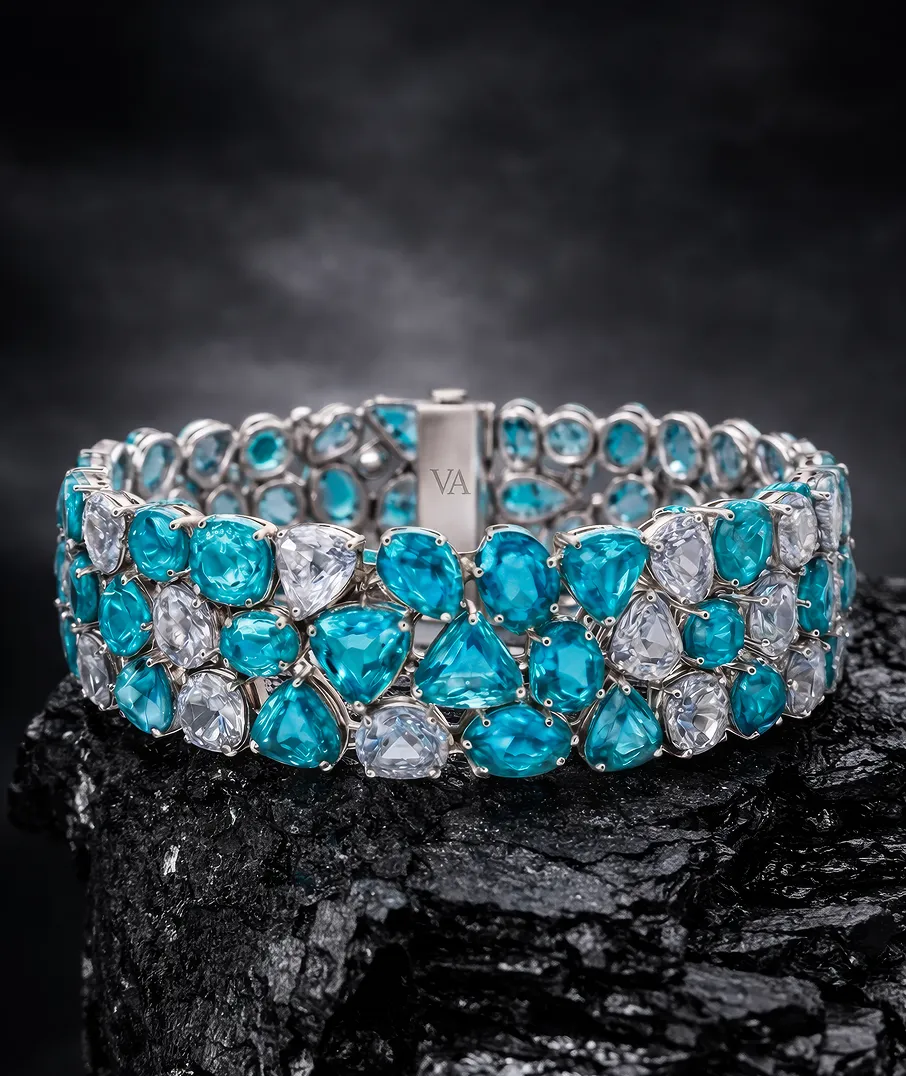
Brazilian Paraíba tourmalines come from the state of Paraíba, where the stone was discovered in 1987, and from two mines in Rio Grande do Norte. On average, they contain considerably more copper than stones from Nigeria and Mozambique and were mined only in small quantities. Collectors therefore value them especially. Their origin can only be proven in a laboratory.
At a glance
- First discovery
- Mina da Batalha near São José da Batalha, state of Paraíba, 1987
- Further mines
- Mulungu and Alto dos Quintos in Rio Grande do Norte, since the 1990s
- Deposit
- Primary in pegmatite, in Africa by contrast secondary in alluvial deposits
- Average copper content
- About 11,400 ppmw, African stones below 2,000 ppmw (GIA)
- Other countries of origin
- Nigeria since 2001, Mozambique since the mid-2000s
- Proof
- Only through laboratory analysis of trace elements
Where Paraíba tourmaline was first found
The first gem-quality copper-bearing tourmaline came from the Mina da Batalha near the village of São José da Batalha in the state of Paraíba in northeastern Brazil. According to a study in the journal Gems & Gemology of the Gemological Institute of America, GIA for short, it was discovered in 1987 and appeared in the trade shortly afterward. Originally, the name Paraíba was reserved solely for the bluish to green material from this mine.

What distinguished the stone from other blue tourmalines was its cause of color. Blue tourmaline is not rare in itself, and its color is usually due to iron. According to GIA, the intense blue of Paraíba tourmaline, by contrast, is produced mainly by copper. Since the late 1980s, the area around Paraíba has therefore been regarded as a source of particularly vivid tourmaline colors. Basic knowledge about the stone is available in the glossary under Paraíba tourmaline.
The three Brazilian localities
Brazilian Paraíba tourmaline does not come only from Paraíba. In the 1990s, similar, mostly less saturated blue material from two mines in the neighboring state of Rio Grande do Norte reached the trade. Both lie near the town of Parelhas. Although they are not in Paraíba, their material is usually also called Paraíba in the trade. The three localities yield very different stones.
| Locality | Location | Typical material |
|---|---|---|
| Mina da Batalha | Near São José da Batalha, Paraíba | Blue-green and green, a small portion in neon blue |
| Mulungu | About 5 km north of Parelhas, Rio Grande do Norte | Much light blue of good quality, little blue-green |
| Alto dos Quintos | About 10 km south of Parelhas, Rio Grande do Norte | Small light blue stones, occasionally several carats |
After Abduriyim et al., Gems & Gemology, Spring 2006. The information describes production up to 2005.
Small quantities, mostly small stones
Production in Brazil was low from the start. For the Mina da Batalha, the 2006 study gives an estimate of at least 600 grams of rough material per year, around 10,000 pieces, most of them fragments under 5 carats. In the best years, from 1989 to 1991, production of the finest blue to green material was 10,000 to 15,000 grams. After that, it declined considerably.
The mines in Rio Grande do Norte also yield mainly small stones. For Mulungu, the study estimates at most 1,000 grams of rough material per year, with the pieces mostly under one carat. Alto dos Quintos is known above all for very small light blue stones. A Brazilian Paraíba tourmaline of several carats in strong color is therefore an exception. This rarity is one reason why collectors pay attention to Brazilian origin.
How Brazilian stones differ from African ones
Since 2001, the trade has known copper-bearing tourmalines from Nigeria, and since the mid-2000s also from Mozambique. The stones come from other types of deposits. According to GIA, the Brazilian mines lie predominantly in pegmatites, that is, in the original rock, whereas the African ones lie in alluvial deposits, to which weathering and water carried the crystals. Large stones are also known from Mozambique, and the 2006 study shows a drop of over 40 carats.

Chemically, the stones differ above all in copper. GIA gives an average of about 11,400 ppmw for Brazilian material and below 2,000 ppmw for African material. Added to this are trace elements such as zinc, gallium, strontium, and lead, whose ratios differ by country of origin. With the naked eye or with a gemologist's standard tests, however, saturated stones from Africa and Brazil cannot be separated.
Good to know
More copper does not automatically mean the more beautiful color. Brazil also has light stones with little copper, and African stones can be highly saturated. The average describes the deposits, not the individual stone.
Why collectors pay attention to Brazil
For collectors, Brazilian origin combines three things: the origin of the name, the small production, and the early years in which the stone became known. How strongly the market weights origin is shown by the discussion among laboratories. In 2006, the Swiss laboratory GRS explicitly justified its reporting practice in part with the aim of protecting collectors' earlier acquisitions and preventing African stones from being regarded as Brazilian.
At the same time, the industry's rules set a clear limit. The Gemstone Blue Book of the world jewelry confederation CIBJO states that a locality does not express a quality grade. A Brazilian stone with pale color and many inclusions is not better than a vivid stone from Mozambique. Origin explains a premium for rarity and history. Color, clarity, and cut remain the basis of every assessment.
How to establish Brazilian origin
Brazilian origin can only be proven by a report that names a country of origin. GIA offers such reports for natural Paraíba tourmalines. In the identification field, SSEF calls only Brazilian stones Paraíba tourmaline. If a description states Brazil but there is no report for it, this is a statement by the seller. Which type of report you need is explained in the guide Origin report for Paraíba tourmaline.
- The report names Brazil as the origin, not just the name Paraíba.
- Weight, dimensions, and shape in the report match the stone.
- The report states the finding on treatment, for Paraíba tourmaline above all on heating.
- Origin is understood as the laboratory's assessment, not as a guarantee.
- The report stays with the stone and is passed on with the jewelry.
Common misconceptions
The most common misconception is that the name alone reveals the origin. According to the laboratories' definition, Paraíba refers to the cause of color, not the country of origin. Equally widespread is the assumption that Brazilian stones all come from the state of Paraíba. Two of the three mines lie in Rio Grande do Norte. And finally, origin is often equated with quality, even though the CIBJO rules exclude exactly that.
Treatment is also easily overlooked. Like African stones, Brazilian stones are frequently heated to remove violet components of the color, and according to GIA this heating is not always detectable. Origin says nothing about this. What belongs to disclosure is covered in the guide Treatment of Paraíba tourmaline. For the history of the first mine, there is the guide Batalha Paraíba.
Brazilian Paraíba at Vikar Ahmed
The Paraíba tourmaline is at the heart of the Maison. The Vikar Ahmed website describes its discovery in the late 1980s in the Brazilian state of Paraíba and its luminosity owing to its natural copper content. Original Brazilian Paraíbas are the house's specialty, mostly up to about 1 carat and rarely larger. A Brazilian origin is only reliable as a laboratory's assessment in a report. At Vikar Ahmed, Brazilian Paraíbas often come with a report including origin determination well below 1 carat.
Frequently asked questions
For my collection, is the premium for a Paraíba tourmaline of Brazilian origin worthwhile compared with other strongly colored tourmalines?
If rarity and history matter for your collection and a laboratory report supports the origin, yes. Brazilian stones were mined only in small quantities, mostly under a few carats. Without a report, the premium is not justified. And a strongly colored stone of another origin can be more beautiful, because origin is not a quality grade.
What do collectors value more: Brazilian Paraíba tourmalines or stones from other localities?
Many collectors weight Brazilian origin more heavily, because the stone was first found there and production was small. Some laboratories have explicitly aligned their reporting practice accordingly. For the assessment of the individual stone, however, color, clarity, and size remain decisive, including for stones from Nigeria or Mozambique.
Do all Brazilian Paraíba tourmalines come from the state of Paraíba?
No. Besides the Mina da Batalha in Paraíba, there are two mines in the neighboring state of Rio Grande do Norte, Mulungu and Alto dos Quintos. Their material is also called Paraíba in the trade. It is usually a lighter blue and smaller than the best stones from Batalha.
Can a Brazilian Paraíba tourmaline be recognized with the naked eye?
No. According to a GIA study, saturated blue to green stones from Nigeria and Mozambique cannot be distinguished from Brazilian ones with standard gemological tests. Only the measurement of trace elements in a laboratory separates the countries of origin. Without a report, origin remains a statement.
When was Paraíba tourmaline discovered in Brazil?
According to a study in the GIA journal, in 1987, in the Mina da Batalha in the state of Paraíba. It reached the trade shortly afterward. The best production years were between 1989 and 1991. Comparable material from Nigeria has only been known since 2001.
Do Brazilian Paraíba tourmalines always contain more copper?
On average yes, in the individual case not necessarily. GIA gives an average copper content of about 11,400 ppmw for Brazilian stones and below 2,000 ppmw for African ones. Light stones, however, can contain less copper. Origin is therefore determined by the overall picture of several trace elements.
Private consultation
Whether a Brazilian Paraíba tourmaline is the right choice for your piece or your collection is decided at the stone and by its report. Vikar Ahmed offers consultations by appointment in the showroom in Idar-Oberstein, and virtually on request. Request a private consultation.
Further reading
- Glossary: Origin report
- Origin report for Paraíba tourmaline
- Paraíba as a collector's piece
- Gemstone Knowledge: Paraíba tourmaline
- Paraíba tourmaline at Vikar Ahmed
Sources
- GIA, Gems & Gemology Spring 2006: Paraíba-Type Copper-Bearing Tourmaline from Brazil, Nigeria, and Mozambique (Volltext PDF), accessed 2026-11-17
- GIA, Gems & Gemology Winter 2019: Paraíba Tourmaline Geographic Origin Determination, accessed 2026-11-17
- GIA: Tourmaline History and Lore, accessed 2026-11-17
- GIA: Colored Stone Reports, accessed 2026-11-17
- SSEF: Paraiba Tourmaline, accessed 2026-11-17
- CIBJO: The Gemstone Book (Blue Book), Ausgabe 2026, accessed 2026-11-17
- GRS: Paraiba-tourmaline research completed, reporting policy of GRS (2006), accessed 2026-11-17
- Vikar Ahmed: Paraíba, accessed 2026-11-16

A personal conversation starts here.
At the showroom in Idar-Oberstein or by video. Vikar Ahmed discusses your ideas, stones and designs with you and answers your questions calmly and in confidence.


Thank you for your request.
Your request will be handled with the utmost attention and discretion. Vikar Ahmed will get back to you.
Your details
Request
–
Occasion
–
Consultation
–
Contact
–
In the meantime
Insights: What is a Paraíba tourmaline? · Engagement ring to your own design: how does it work?
Confidential and without obligation
Back to the pagePrivate consultation
A personal conversation starts here.
- Time for your questions, wishes and ideas
- In the showroom in Idar-Oberstein or by video
- Confidential, discreet and without obligation
Vikar Ahmed · Hauptstraße 111 · 55743 Idar-Oberstein, Germany