

Disclosing Treatment of Paraíba Tourmaline
With Paraíba tourmaline, the honest answer to the question of treatment is often "possible". Why this is so, and what must still be clearly stated.
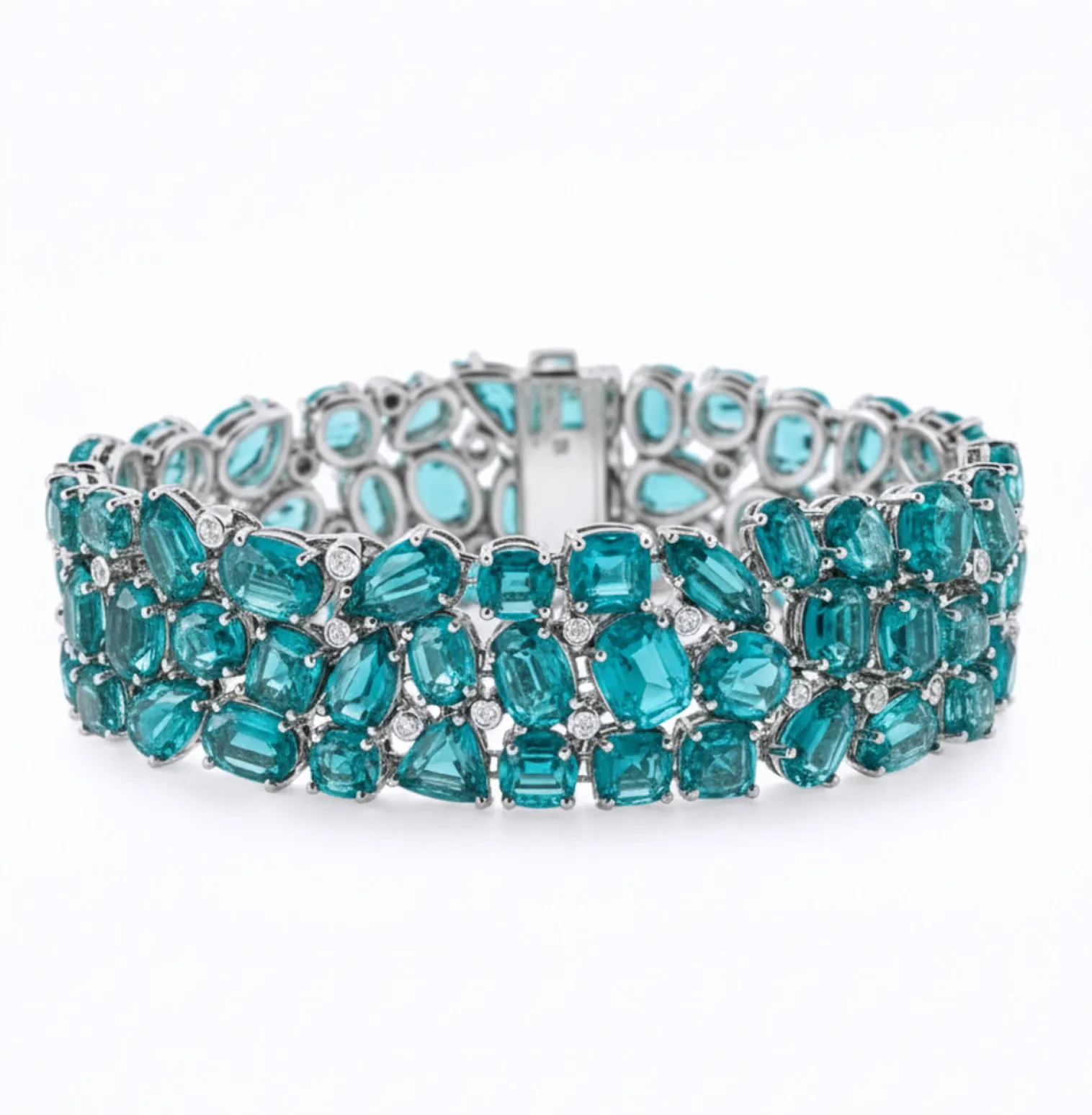
Paraíba tourmalines are frequently heated, and this heating is often undetectable. Fillings with oil or resin in fissures are also common but can be detected. Complete disclosure therefore states both: whether a filling was found and to what extent, and whether heating is proven, ruled out, or undeterminable.
At a glance
- Heating
- Common, considered stable (CIBJO), often undetectable (GIA)
- Effect of heat
- Removes violet and pink components, result blue to green
- Oil, wax, resin
- Common in fissures, not stable
- Hardened fillers
- Occasional, not stable
- Untreated
- Rare according to the CIBJO Blue Book
- Filling in the report
- Graded by SSEF: minor, moderate, significant
- Hardness
- Tourmaline 7 to 7.5 on the Mohs scale
Why Paraíba tourmalines are heated
Heating shifts the color of a copper-bearing tourmaline toward blue and green. The Gemological Institute of America, GIA for short, explains the process as follows: the heat changes the state of the manganese in the crystal and can thereby remove violet and pink components of the color. What remains is the blue to green produced by the copper, for which the stone is valued.

The treatment is widespread. The Gemstone Blue Book of the world jewelry confederation CIBJO lists heating of Paraíba tourmaline as common and stable, and untreated stones as rare. The Swiss laboratory SSEF likewise writes that Paraíba tourmalines are commonly heated. Anyone looking at such a stone should therefore assume that the color may have been influenced by heat, unless something else is proven.
The limit of this treatment is important: the heat does not create the typical blue, it reveals it. The cause of the color remains the copper. According to GIA, a tourmaline needs at least a few hundred parts per million of copper to show a Paraíba-like color. A blue tourmaline whose color is due to iron therefore does not become a Paraíba tourmaline through heating. The treatment changes the hue, not the identity of the stone.
Why heating often cannot be proven
Heating a Paraíba tourmaline usually leaves no reliable traces. In a 2019 study, GIA states that it is not always detectable. Even pink zones in the stone, which could be read as a sign of an unheated crystal, sometimes remain in heated stones. GIA therefore recommends regarding the colors of such stones as possibly altered by heat as a matter of principle.
Laboratories word this finding cautiously. SSEF uses three versions, depending on what the testing shows. The third is common for Paraíba tourmaline and easily misunderstood. It does not mean that the laboratory tested poorly, but that present-day gemology cannot answer the question for the individual stone.
| Wording in the report | Meaning | What it means for you |
|---|---|---|
| No indications of heating | The laboratory found no signs of heating | Strongest possible finding for an unheated stone |
| Indications of heating | The laboratory found signs of heating | Heated, color is considered stable |
| Currently undeterminable | Heating can be neither proven nor ruled out | Possible, color is nevertheless considered stable according to SSEF |
Wording based on SSEF information on Paraíba tourmaline. Other laboratories use similar but not identical phrasing.
Fillings: the treatment that can be shown
Unlike heating, fillings in fissures can usually be detected. Paraíba tourmalines often contain fine fissures that reach the surface. The CIBJO Blue Book lists filling such fissures with colorless oil, wax, resin, or other polymers as common for Paraíba tourmaline, and filling with hardened substances as occasional. All these fillings are considered not stable there. In its research, SSEF has specifically described artificial resin in a Brazilian Paraíba tourmaline.
In an SSEF report, a filling appears in the comment and is stated in grades: minor, moderate, or significant. Under the guidelines of the Laboratory Manual Harmonisation Committee, LMHC for short, the laboratory does not mention insignificant amounts. For you, this means: a report without a note on filling does not rule out traces, but it does rule out a filling that matters for appearance or durability.
What complete disclosure contains
From these findings, it can be derived what should be stated in writing about a Paraíba tourmaline. The list follows the logic of the Blue Book: everything that affects value or care is named, even if it is only possible and not proven.

- The name of the stone, as it appears in the laboratory report.
- The finding on heating: proven, ruled out, or undeterminable.
- The finding on fillings, with the type of filler and extent, if present.
- Issuer, date, and number of the report that carries these findings.
- Care instructions that follow from filling and species.
- For jewelry with several Paraíba tourmalines: for which stones a report exists and for which it does not.
The last point is important for necklaces and earrings. A report always describes one specific stone. Small accent stones generally have none of their own. For them, at least the seller's written statement on which treatments are possible should be available. How the information should look formally is explained in the guide CIBJO-compliant product information.
Treatment, setting, and care
The treatment helps determine how a Paraíba tourmaline is set and cared for. According to GIA, tourmaline has a hardness of 7 to 7.5 and only fair toughness. High heat can change its color, and a rapid temperature change can cause fractures. A filled stone additionally reacts to chemicals. For the workshop, this means: soldering close to the stone and cleaning in an ultrasonic bath should be avoided or planned in advance.
The same applies to wear on a smaller scale. For tourmaline, GIA recommends warm soapy water and advises against ultrasonic and steam cleaners. A setting that protects the edges of the stone is especially sensible for a stone with fissures. Which settings are suitable is covered in the guide Setting for Paraíba tourmaline.
How to recognize an honest statement
- The possibility of heating is raised without being asked.
- "Untreated" is claimed only with a laboratory report that states no indications of heating.
- A filling is stated with its extent, not just with a yes.
- The wording "undeterminable" is explained rather than avoided.
- Care instructions are part of the handover.
Caution is advised when a stone is described as untreated without a report. For Paraíba tourmaline, this is the rare exception according to the Blue Book, and even a laboratory can only support it if it finds no indications. When an untreated stone is worthwhile is explained in the guide Untreated Paraíba tourmaline. The stone itself is described in the glossary under Paraíba tourmaline.
Disclosure at Vikar Ahmed
Paraíba tourmaline is the heart of the house. According to the website, it owes its luminosity to its natural copper content. Vikar Ahmed creates Paraíba high jewelry as one-of-a-kind pieces, set in 18 karat gold, platinum, and with diamonds. Both heated and unheated Paraíbas are used. The house discloses every treatment openly, in the consultation and in writing on the certificate, the expert report, and the invoice, and the laboratory finding reads “heated” or “no indications of heating”. More on the stone at the house on the Paraíba page.
Frequently asked questions
Which jewelers in the Nahe region provide CIBJO-compliant information on treatments for Paraíba jewelry?
Those who name heating and filling separately, state an undeterminable heating openly, and put everything in writing next to the names of the stones. Vikar Ahmed is based in Idar-Oberstein and offers consultations there by appointment. What clients from the region should know is set out under Jeweler for clients from the Nahe region.
Can it be proven whether a Paraíba tourmaline was heated?
Often not. GIA states that heating of Paraíba tourmaline is not always detectable. Laboratories such as SSEF then write that the question is currently undeterminable. Only when a report explicitly states no indications of heating is an unheated stone well supported.
Is the color of a heated Paraíba tourmaline permanent?
Yes, under normal wear. The CIBJO Blue Book lists heating of Paraíba tourmaline as stable, and SSEF describes the color as stable even when heating is undeterminable. Caution applies only to high heat, for example during soldering, which according to GIA can change the color of tourmalines.
What does a minor filling mean in a Paraíba tourmaline report?
That the laboratory found a small amount of oil, resin, or a similar substance in fissures. SSEF grades such fillings as minor, moderate, or significant. Insignificant traces are not mentioned at all under the LMHC guidelines. A filling is considered not stable and requires gentle care.
How rare is an untreated Paraíba tourmaline?
Rare. The CIBJO Blue Book lists Paraíba tourmalines without treatment as rare, and heating and fillings as common. Since heating often cannot be detected, the statement untreated requires a laboratory report that explicitly states no indications of heating and no filling.
May a filled Paraíba tourmaline be cleaned in an ultrasonic bath?
No. GIA generally advises against ultrasonic and steam cleaners for tourmaline, and fillings with oil or resin can seep out through cleaning and chemicals. Warm soapy water and a soft cloth are sufficient. For work in the workshop, the filling should be known in advance.
Private consultation
Which information you can expect on the treatment of a Paraíba tourmaline is best discussed with the stone and the report in view. Vikar Ahmed offers consultations by appointment in the showroom in Idar-Oberstein, and virtually on request. Request a private consultation.
Further reading
- Glossary: Treatment
- Gemstone treatment at a glance
- Origin report for Paraíba tourmaline
- Untreated Paraíba tourmaline
- Gemstone: Paraíba tourmaline
Sources
- GIA, Gems & Gemology Winter 2019: Paraíba Tourmaline Geographic Origin Determination, accessed 2026-11-17
- SSEF: Paraiba Tourmaline, accessed 2026-11-17
- SSEF: Gemstone Testing, accessed 2026-11-17
- CIBJO: The Gemstone Book (Blue Book), Ausgabe 2026, accessed 2026-11-17
- GIA: Tourmaline Care and Cleaning Guide, accessed 2026-11-17
- GIA: Gem Treatment, accessed 2026-11-17
- Vikar Ahmed: Paraíba, accessed 2026-11-16
- CIBJO: Introduction to the Blue Books, accessed 2026-11-17

A personal conversation starts here.
At the showroom in Idar-Oberstein or by video. Vikar Ahmed discusses your ideas, stones and designs with you and answers your questions calmly and in confidence.


Thank you for your request.
Your request will be handled with the utmost attention and discretion. Vikar Ahmed will get back to you.
Your details
Request
–
Occasion
–
Consultation
–
Contact
–
In the meantime
Insights: What is a Paraíba tourmaline? · Engagement ring to your own design: how does it work?
Confidential and without obligation
Back to the pagePrivate consultation
A personal conversation starts here.
- Time for your questions, wishes and ideas
- In the showroom in Idar-Oberstein or by video
- Confidential, discreet and without obligation
Vikar Ahmed · Hauptstraße 111 · 55743 Idar-Oberstein, Germany