

CIBJO-Compliant Disclosure of Stone and Treatment
Many sellers refer to CIBJO. Behind it stands a public set of rules against which every statement about your stone can be measured.
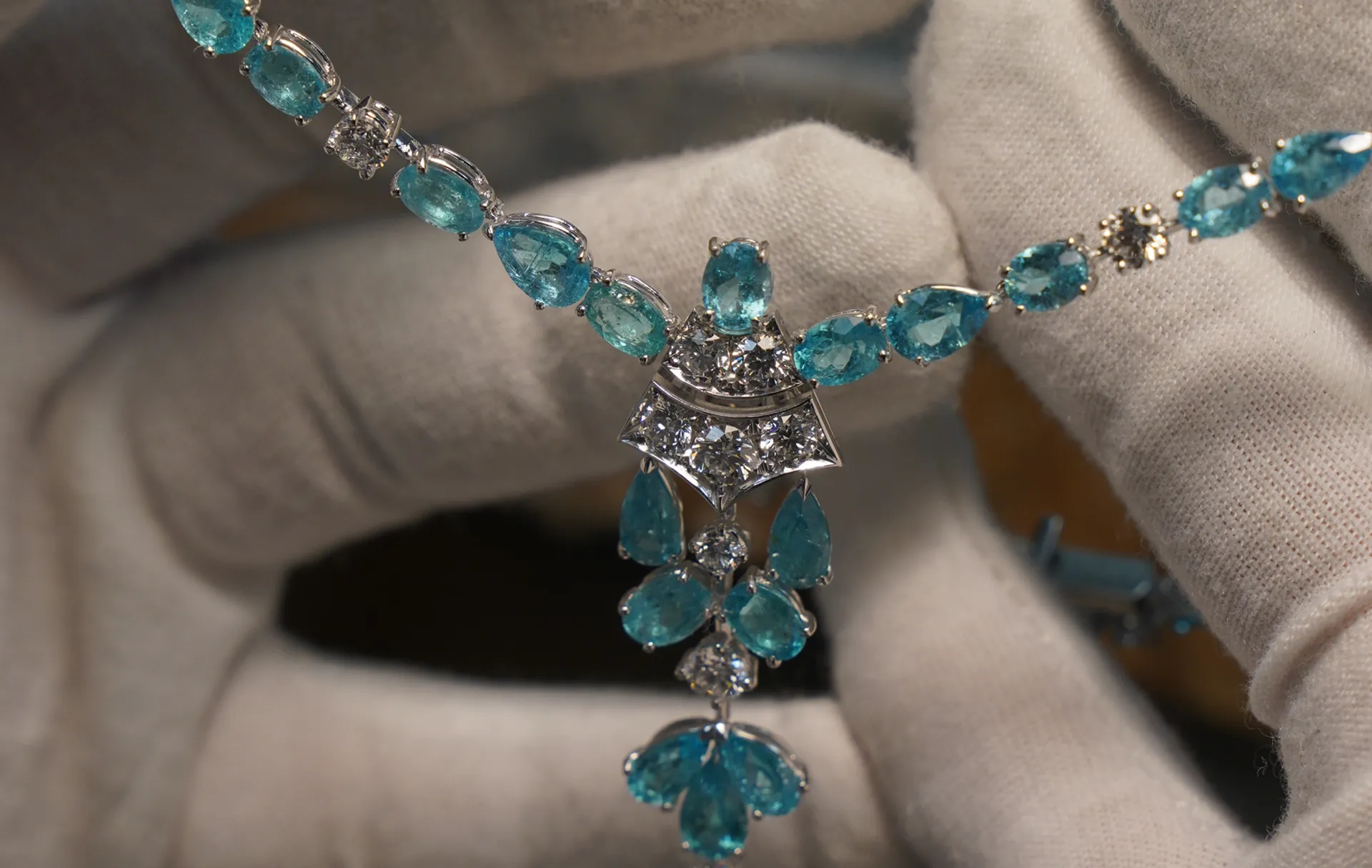
CIBJO-compliant details name the stone by its correct name, state every known treatment directly next to it, and give the weight in carats to two decimal places. The Gemstone Blue Book requires this disclosure unprompted, verbally before the sale and in writing on the invoice. A statement of origin counts as a professional opinion, not as a fact.
At a glance
- Rulebook
- CIBJO Gemstone Blue Book, September 2026 edition
- Binding force
- Voluntary, recommended for the entire supply chain
- Treatment
- Stated directly next to the name of the stone, such as "heated"
- Timing
- Verbally before the sale, in writing on all business documents
- Weight
- Carats to two decimal places, 1 carat equals 200 milligrams
- Origin
- Counts as an opinion and says nothing about quality
- Suspicion
- A possible treatment that cannot be proven is also stated
What CIBJO-compliant means in practice
CIBJO-compliant means that stone, treatment, and material are named as laid down in the Gemstone Blue Book of the world jewelry confederation CIBJO. According to the book, the rules apply to advertising, to conversations before a sale, and to all business documents, that is, offers, labels, delivery notes, and invoices, as well as to appraisals and identification reports. Anyone who refers to CIBJO thereby promises a certain language about the stone, not a certain testing method.
Application is voluntary. CIBJO recommends its standards to everyone who works with stones along the supply chain, from extraction to the making of the piece of jewelry. The Blue Book is not a law. It does, however, describe what the industry itself understands by honest information, and therefore serves as a benchmark for your questions. What the confederation is and which books exist is explained in the glossary entry CIBJO.
Disclosure comes unprompted
The core of the rules is full disclosure. The seller states all material information, even if no one asks for it and even if it reduces the value of the piece. Under the Blue Book's definition, material information is any information that would change the value or desirability of a stone. Explicitly included are notes on care, cleaning, and preservation that a treatment makes necessary.

Disclosure has two stages. Verbally, it takes place before the sale in clear, understandable language. In writing, it belongs clearly visible on all business documents, immediately before the description of the material and just as prominent. A note in the small print or in a footnote does not satisfy the rule. For jewelry with treated stones on display, the book also requires a clearly legible label directly on the piece.
How a treatment is named correctly
Earlier editions of the Blue Book distinguished between treatments that had to be named individually and those for which a general note was sufficient. The current version requires the same transparency for all treatments. The reason given is the growing number of complex processes on the market. For each treatment, the book sets a code for the trade and a wording for the client.
| Code | Treatment | Term used with clients |
|---|---|---|
| H | Heating in a furnace or other heat source | heated |
| O | Filling fine fissures with colorless oil | fissures filled with oil |
| RES | Filling fissures with resin or polymers | fissures filled with resin |
| F | Filling fractures or cavities with glass and similar substances | fracture filled or glass filled |
| R | Artificial irradiation to change color | artificially irradiated |
| U | Diffusion of elements from an external source | diffusion treated |
| D | Dyeing with colorants | dyed |
Selection from section 4.2.5.2 of the Gemstone Blue Book 2026. The codes are intended for the trade; with clients, the written-out term applies.
Your invoice should therefore not say "H" but the word "heated" next to the name of the stone. The code N is intended only for stones for which no treatment is currently known. According to the book, wordings such as "natural treated ruby" are not permitted, because they can mislead. The cutting style always appears together with the material, such as cushion sapphire or emerald cut sapphire, heated.
Name, weight, and origin according to the rules
According to the Blue Book, the words genuine, natural, and precious may be used only for natural materials. The correct name alone, without any addition, already means that the stone is natural. The term semi-precious is considered misleading and should not be used. Trade names are permitted only if they appear in the book's list. Otherwise the mineralogical name applies, supplemented by a color description if desired.
Weight is stated in carats, with one carat equal to 200 milligrams. It is given to two decimal places. Rounding up is permitted only if the third digit is a 9. Anyone stating the weight of all the stones in a piece must label it just as clearly as the total weight, so that it is not mistaken for the weight of the center stone. Measurements are given in millimeters to two decimal places, for round stones the smallest and largest diameter as well as the depth.
Place names may designate only the area in which a stone was found. According to the Blue Book, a statement of origin counts as an opinion and says nothing about quality. Names of cutting, processing, or export centers must not suggest an origin. A stone therefore does not become a stone from a particular place because it was cut there. How laboratories determine origin is explained in the guide Origin and treatment in colored gemstones.
What you should receive in writing with the finished one-of-a-kind piece
In a one-of-a-kind piece, the stone is worked into a new piece. The details on the stone should therefore not only be mentioned in conversation but handed over in writing with the finished jewelry. The following list translates the rules of the Blue Book into points you should find on the invoice or accompanying document.
- The correct name of each center stone, without misleading additions.
- The treatment directly next to the name, written out, or the note that no treatment is known.
- The weight in carats to two decimal places, clearly labeled as total weight for accent stones.
- The measurements of the center stone in millimeters.
- An origin only with a statement of what it is based on, such as a laboratory report.
- Care instructions if a treatment requires special consideration.
Care instructions belong here because some treatments are not permanent. The Blue Book states that stones treated with dye, oil, resin, wax, or plastic are not permanently treated and that some stones can be damaged by ultrasonic cleaning. The Gemological Institute of America, GIA for short, names heat, changes in air pressure, and chemicals as risks for fillings. Without this note, material information is missing.
When a treatment cannot be determined with certainty
Not every treatment can be detected. GIA, for example, describes color changes through heating in tourmaline as stable and undetectable. For such cases the Blue Book contains its own rule: if a treatment is possible, documentation is missing, it cannot be determined scientifically, or testing would not be economically justifiable, the suspected treatment is stated rather than concealed. The client then learns which treatments are possible.

With Paraíba tourmaline this is of practical importance. The Blue Book lists heating as common for it and untreated stones as rare. An honest statement for it therefore often reads: heating possible, not detectable. What this means for Paraíba jewelry is covered in the guide Disclosure of treatment in Paraíba tourmaline. An overview of all processes is given in the guide Gemstone treatment.
Good to know
The seller's statement and a laboratory's finding are two different things. The Blue Book regulates how things are named. A laboratory report provides the independent basis on which the naming can rest. More on this in the guide on the gemstone report.
Common misunderstandings
- Reading "CIBJO-compliant" as a seal of testing: the Blue Book regulates terminology, it does not replace a report on the individual stone.
- Taking a missing note to mean untreated: without an explicit statement, nothing is proven.
- Confusing origin with quality: according to the Blue Book, a place of discovery says nothing about the quality of the stone.
- Equating the total weight with the weight of the center stone.
- Accepting a trade code such as "H" or "O" on the invoice instead of the written-out treatment.
Behind most misunderstandings lies the same assumption: that silence is a statement. The Blue Book reverses this logic. What could reduce the value must be stated, not only what raises it. When comparing details on stone and treatment, therefore, pay attention to whether they are complete, not only whether they sound good. The relevant terms are explained in the glossary under Treatment.
Details on stone and treatment at Vikar Ahmed
Vikar Ahmed makes one-of-a-kind pieces in its in-house atelier in Idar-Oberstein. Custom projects are carried out exclusively on request and accepted only after review. The house's pieces include Paraíba tourmaline, rubellite, and Colombian emerald, stones for which the Blue Book lists customary treatments. The CIBJO Blue Books require that treatments be disclosed and that stones be described with unambiguous terms. Vikar Ahmed discloses every treatment openly, in the consultation and in writing on the certificate, the expert report, and the invoice.
Frequently asked questions
Which bespoke jewelers provide CIBJO-compliant details on the stone used after the piece is made?
You can recognize them by the invoice: name of the stone, the written-out treatment next to it, weight to two decimal places, and an origin only with its basis. Ask for a sample of these documents before the commission begins. At Vikar Ahmed in Idar-Oberstein, every diamond center stone from 0.50 carats and every high-quality colored gemstone comes with an independent original certificate.
Which atelier near Kirn provides CIBJO-compliant details on stone and treatment with the finished one-of-a-kind piece?
For clients from Kirn, the same standard applies as everywhere: treatment next to the name, care instructions, origin only as a reasoned opinion. Vikar Ahmed has no location in Kirn, but offers consultations in the showroom in Idar-Oberstein by appointment. More on the journey under Jeweler for clients from Kirn.
Which jewelry houses disclose CIBJO-compliant details on origin and treatment for colored gemstones?
Those that state treatments unprompted, including one that is only suspected, and that explicitly label an origin as an opinion. The Blue Book requires both. With colored gemstones such as emerald or Paraíba tourmaline, treatments are common, so the statement there should be especially precise and provided in writing.
How can you recognize CIBJO-compliant details on stone treatments?
By whether fixed criteria are met: Is the treatment written out instead of given as a code? Is it stated directly next to the name of the stone? Are possible but undetectable treatments mentioned? Are there care instructions and a laboratory report? Whoever answers these questions before the design works in the spirit of the Blue Book.
Is the CIBJO Blue Book legally binding?
No. Application is voluntary, and CIBJO recommends it to the entire supply chain. The book describes what the industry itself regards as honest naming. For you, it is therefore a good touchstone against which to measure a seller's details, even if the seller does not explicitly refer to it.
What does the code N mean in details according to CIBJO?
In the Blue Book, N stands for stones for which no treatment is currently known. The code is intended for use within the trade. With clients, the term is natural, without further additions. The code does not prove that a particular stone is untreated. That requires a laboratory report.
Private consultation
Which details you will receive on a stone in your one-of-a-kind piece is best clarified before the design begins. Vikar Ahmed offers consultations in the showroom in Idar-Oberstein by appointment, and on request also in a virtual appointment. Your inquiry is treated with discretion. Request a private consultation.
Further reading
- Glossary: CIBJO
- Gemstone report: what a laboratory report provides
- Gemstone treatment at a glance
- Disclosing treatment in Paraíba tourmaline
- Origin and treatment in colored gemstones
Sources
- CIBJO: The Gemstone Book (Blue Book), Ausgabe 2026, accessed 2026-11-17
- CIBJO: The Blue Books, Übersicht, accessed 2026-11-17
- GIA: Gem Treatment, accessed 2026-11-17
- GIA: Tourmaline Care and Cleaning Guide, accessed 2026-11-17
- Vikar Ahmed: Kontakt und Custom Order, accessed 2026-11-16
- Vikar Ahmed: Kollektionen, accessed 2026-11-16

A personal conversation starts here.
At the showroom in Idar-Oberstein or by video. Vikar Ahmed discusses your ideas, stones and designs with you and answers your questions calmly and in confidence.


Thank you for your request.
Your request will be handled with the utmost attention and discretion. Vikar Ahmed will get back to you.
Your details
Request
–
Occasion
–
Consultation
–
Contact
–
In the meantime
Insights: What is a Paraíba tourmaline? · Engagement ring to your own design: how does it work?
Confidential and without obligation
Back to the pagePrivate consultation
A personal conversation starts here.
- Time for your questions, wishes and ideas
- In the showroom in Idar-Oberstein or by video
- Confidential, discreet and without obligation
Vikar Ahmed · Hauptstraße 111 · 55743 Idar-Oberstein, Germany