

Clarifying Gemstone Treatment Before Commissioning
Most colored stones in jewelry were altered after mining. For a one-of-a-kind piece, what matters is that you know this before the design, not afterward.
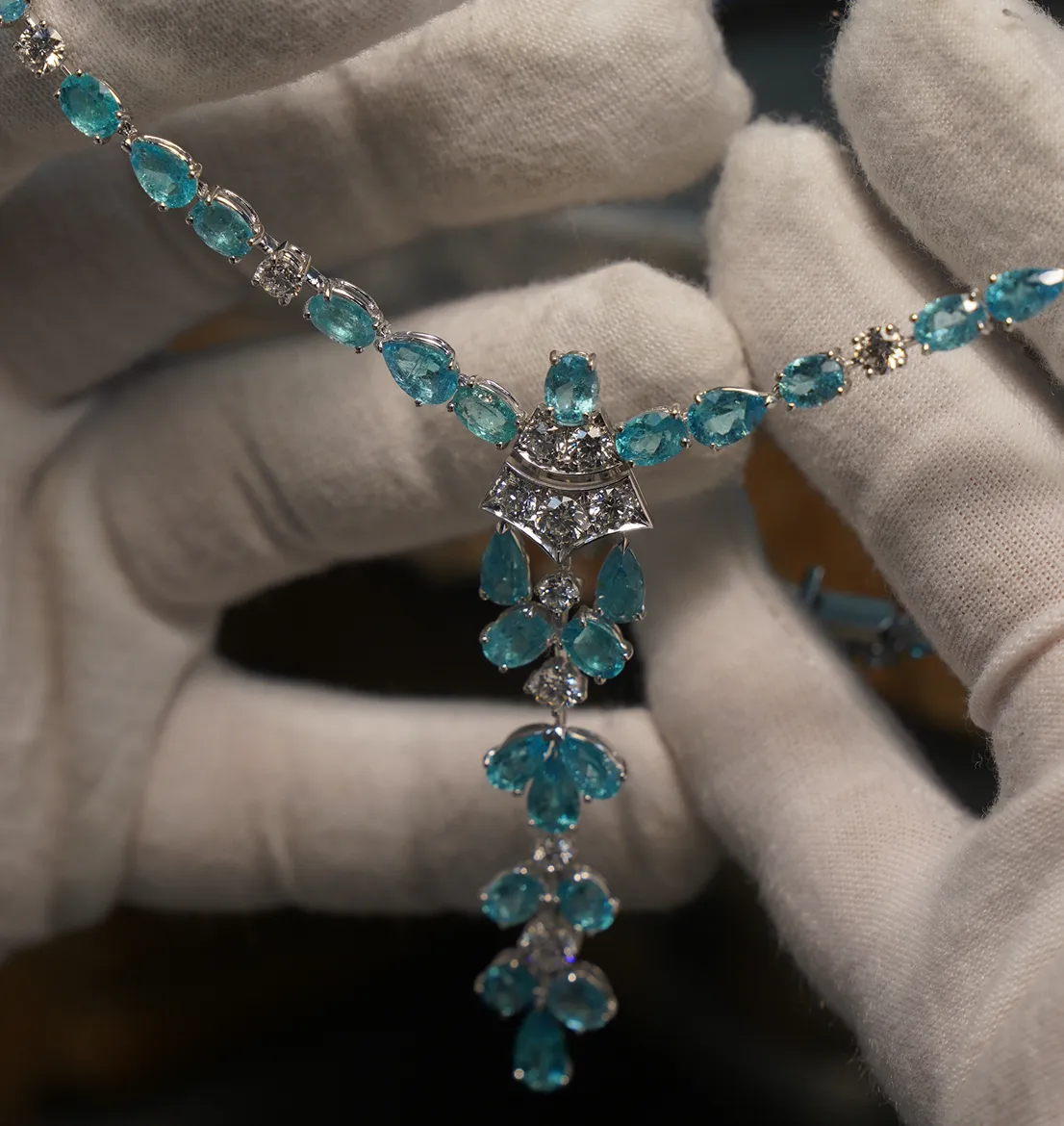
A gemstone treatment is any intervention after mining that changes a stone's color, clarity, or durability, such as heating, filling fissures, or irradiation. Before a piece is made, you should learn which treatment the stone has or could have, how stable it is, and what it means for setting, cleaning, and care.
At a glance
- Common methods
- Heating, filling of fissures, irradiation, dyeing, diffusion
- Considered stable
- Heating under normal wear, according to GIA
- Not stable
- Treatment with oil, resin, wax, dye, or plastic
- Emerald
- Filling with oil or resin common, untreated very rare (CIBJO)
- Paraíba tourmaline
- Heating and fillings common, untreated rare (CIBJO)
- Detection
- Not every treatment is detectable, heating in tourmaline for example is not
- Workshop
- Heat, chemicals, and ultrasound can damage treated stones
What counts as a treatment
Under the Gemstone Blue Book of the world jewelry confederation CIBJO, a treatment is any intervention that changes a stone's color, clarity, or durability. It can take place before or after cutting, on the surface or in the interior, in varying degrees and with varying stability. Cutting and polishing do not count. The Blue Book emphasizes that stones have always been treated and that the methods develop further with every new technology.

A treatment is therefore not a flaw but a property that belongs to the stone like its weight. It affects value, sometimes durability, and almost always care. This is why the industry requires that it be disclosed openly. The Gemological Institute of America, GIA for short, describes disclosure as necessary for anyone who passes a stone on. The individual terms are explained in the glossary under Treatment.
The most important methods and what they do
The methods differ mainly in whether they change the stone permanently or add something to it that can disappear again. With heating, the stone itself changes. With filling, a foreign substance sits in fissures and cavities. For a piece of jewelry meant to last for decades, this difference matters more than the question of whether the stone was treated at all.
| Method | What it does | Consequences for setting and care |
|---|---|---|
| Heating | Changes color, sometimes clarity | Considered permanent, stone may be somewhat more brittle |
| Filling with oil or resin | Makes fissures less visible | Heat, pressure changes, and chemicals attack the filling |
| Filling with glass | Fills open fissures and cavities | Not stable, caution with heat and chemicals |
| Irradiation | Changes the color | Some colors fade under light or heat |
| Dyeing | Changes or intensifies the color | Dye can dissolve or fade in sunlight |
| Diffusion | Introduces color into the crystal from outside | Considered permanent, often very difficult to detect |
Compiled from information by GIA and the CIBJO Gemstone Blue Book. The overview gives examples and is not exhaustive.
Which stones are treated and how often
How likely a treatment is depends heavily on the species. The CIBJO Blue Book lists for each species which treatments occur and how frequently they are encountered in the trade. For the colored stones that play a major role in High Jewelry, the picture is clear: treatment is the rule for them, the untreated stone the exception.
| Stone | Common | Occasional or rare |
|---|---|---|
| Emerald | Oil or wax in fissures, resin in fissures | Dyeing with colored oil, untreated very rare |
| Paraíba tourmaline | Heating, oil or resin in fissures | Filling with hardened substances, untreated rare |
| Rubellite | Resin in fissures | Heating, oil in fissures, untreated rare |
| Tourmaline in general | Often without treatment | Oil in fissures, resin rare |
Frequencies according to the CIBJO Gemstone Blue Book, 2026 edition. They describe the market, not the individual stone.
In practice this means: with an emerald or a Paraíba tourmaline, the question is not whether it could be treated but how. Anyone who wants such a stone untreated is looking for an exception and needs a laboratory report for it. Why this is not always worthwhile is explained in the guide Untreated colored gemstones. For emerald specifically, there is the guide Emerald and its treatment.
What treatment means for the workshop
A goldsmith must know the treatment before working with the stone. According to GIA, filled stones are sensitive to heat, changes in air pressure, and chemicals. When soldering near the stone, pickling after soldering, or cleaning in an ultrasonic bath, a filling can seep out or discolor. What sits inside the stone therefore helps determine the order in which a piece is made.

Heated stones also require care, if less so. GIA calls heated stones permanent under normal wear but describes them as possibly more brittle. For tourmaline, it warns against high heat, which can change the color, and against rapid temperature changes, which can cause fractures. It advises against ultrasonic and steam cleaners for tourmaline. These notes apply in the workshop just as they do later for care at home.
Good to know
Under the CIBJO Blue Book, care instructions are among the information that must be provided unprompted for treated stones. At handover, therefore, ask not only about the treatment but also about how the piece may be cleaned.
What you should ask before a piece is made
The best time for these questions is before the design, while the stone is still loose. A laboratory report can then be obtained, weight and dimensions compared, and setting and work steps matched to the stone. The following questions cover what you should know.
- Which treatment does the stone have, and where does this information come from?
- Is there a laboratory report, and does it list detectable treatments?
- Is a treatment possible that cannot be detected?
- How stable is the treatment during wear and during later work on the jewelry?
- Which setting protects the stone if it is more brittle or filled?
- How may the finished piece be cleaned?
- Are the treatment and care instructions stated in writing on the invoice?
Several of these questions can be answered with one document. The GIA identification report identifies the stone and lists detectable treatments, including for mounted stones. What such a report contains and how to read it is explained in the guide Gemstone report. How the information on the invoice should be worded is described in the guide CIBJO-compliant product information.
Where detection reaches its limits
A laboratory states only what it can detect. GIA describes color changes from heating in tourmaline as stable and undetectable. Diffusion in corundum is often very difficult to prove, and treatment of diamonds under high pressure and high temperature can only be identified by a laboratory. Fillings and dyes, on the other hand, are recognized by an experienced gemologist under the microscope in most cases.
For such borderline cases, the industry has a clear rule. If a treatment cannot be ruled out, the seller names the possible treatment under the CIBJO Blue Book rather than remaining silent. An honest statement about a tourmaline may therefore read: heating possible, not detectable with current methods. This wording is not evasion but the state of science.
Common mistakes in dealing with treatments
- Asking about the treatment only after setting, when setting and work steps are already fixed.
- Assessing every treatment the same way: heating and filling have very different consequences.
- Cleaning filled stones in an ultrasonic bath.
- Reading the absence of information as proof of an untreated stone.
- Not informing the workshop about the treatment during a later repair.
The last point is often forgotten. A ring is resized years after it was made, a clasp on a necklace is soldered. Anyone who cannot then state the stone's treatment leaves the workshop to guess. Keep the report and invoice so that they can be passed on with the jewelry.
Treatment at Vikar Ahmed
Vikar Ahmed creates one-of-a-kind pieces in its in-house atelier in Idar-Oberstein. The work steps the house names include setting the gemstones and polishing by hand. The pieces shown include Paraíba tourmaline, rubellite, and Colombian emerald, stones for which treatments are common. Vikar Ahmed discloses every treatment openly, in the consultation and in writing on the certificate, the expert report, and the invoice. For emerald, he accepts only light colorless oiling and rejects synthetic resins and colored oil.
Frequently asked questions
Which ateliers in Idar-Oberstein disclose the origin and treatment of the stone for bespoke jewelry?
How you can tell: treatment and origin are stated in writing next to the name of the stone, supported by a laboratory report, and possible treatments that cannot be detected are named. Vikar Ahmed states the treatment in writing on the certificate, the expert report, and the invoice. More under Jeweler in Idar-Oberstein.
With which goldsmiths do I learn before the piece is made whether the colored stone is treated?
With those who present the stone with a report before the design and raise the treatment on their own. Ask specifically which treatment is present, how stable it is, and what it means for setting and care. A goldsmith needs this information anyway before working with the stone.
Which goldsmith in Trier will tell me whether the stone for my one-of-a-kind piece was treated?
The one whose answer comes in writing and with a basis, such as a laboratory report. Vikar Ahmed has no location in Trier but offers consultations by appointment in the showroom in Idar-Oberstein or virtually. What clients from Trier should know about this is set out under Jeweler for clients from Trier.
Is a treated gemstone worth less?
Usually yes, compared with an equally beautiful untreated stone of the same species, because untreated stones are rarer. The CIBJO Blue Book states that treatments can affect value. A treated stone is nevertheless not inferior. What matters is that the treatment is known and that the price takes it into account.
Can a treatment change over time?
That depends on the method. According to GIA, heating is considered permanent under normal wear. Fillings with oil, resin, or wax, by contrast, are not stable and can seep out through heat, chemicals, or cleaning. Some colors produced by irradiation fade under strong light.
Why should I also mention the treatment during a later repair?
Because work such as soldering, pickling, or cleaning in an ultrasonic bath can damage a treated stone. Filled stones are sensitive to heat and chemicals, tourmalines to rapid temperature changes. With the report and invoice, the workshop can adapt its work steps instead of guessing.
Private consultation
Which treatment a stone for your one-of-a-kind piece has and what it means for design and care can be clarified in conversation with the stone in view. Vikar Ahmed offers consultations by appointment in the showroom in Idar-Oberstein or in a virtual appointment. Request a private consultation.
Further reading
- Glossary: Treatment
- Untreated colored gemstones
- Emerald and its treatment
- Disclosing treatment of Paraíba tourmaline
- Gemstone: Rubellite
Sources
- GIA: Gem Treatment, accessed 2026-11-17
- GIA: Tourmaline Care and Cleaning Guide, accessed 2026-11-17
- GIA: Colored Stone Reports, accessed 2026-11-17
- CIBJO: The Gemstone Book (Blue Book), Ausgabe 2026, accessed 2026-11-17
- Vikar Ahmed: Bespoke, Designprozess, accessed 2026-11-16
- Vikar Ahmed: Kollektionen, accessed 2026-11-16
- CIBJO: Introduction to the Blue Books, accessed 2026-11-17

A personal conversation starts here.
At the showroom in Idar-Oberstein or by video. Vikar Ahmed discusses your ideas, stones and designs with you and answers your questions calmly and in confidence.


Thank you for your request.
Your request will be handled with the utmost attention and discretion. Vikar Ahmed will get back to you.
Your details
Request
–
Occasion
–
Consultation
–
Contact
–
In the meantime
Insights: What is a Paraíba tourmaline? · Engagement ring to your own design: how does it work?
Confidential and without obligation
Back to the pagePrivate consultation
A personal conversation starts here.
- Time for your questions, wishes and ideas
- In the showroom in Idar-Oberstein or by video
- Confidential, discreet and without obligation
Vikar Ahmed · Hauptstraße 111 · 55743 Idar-Oberstein, Germany