

Gemstone Reports: What They Prove and What They Do Not
A significant stone comes with a document. Which types of reports exist, which questions they answer, and when a piece should have a report.
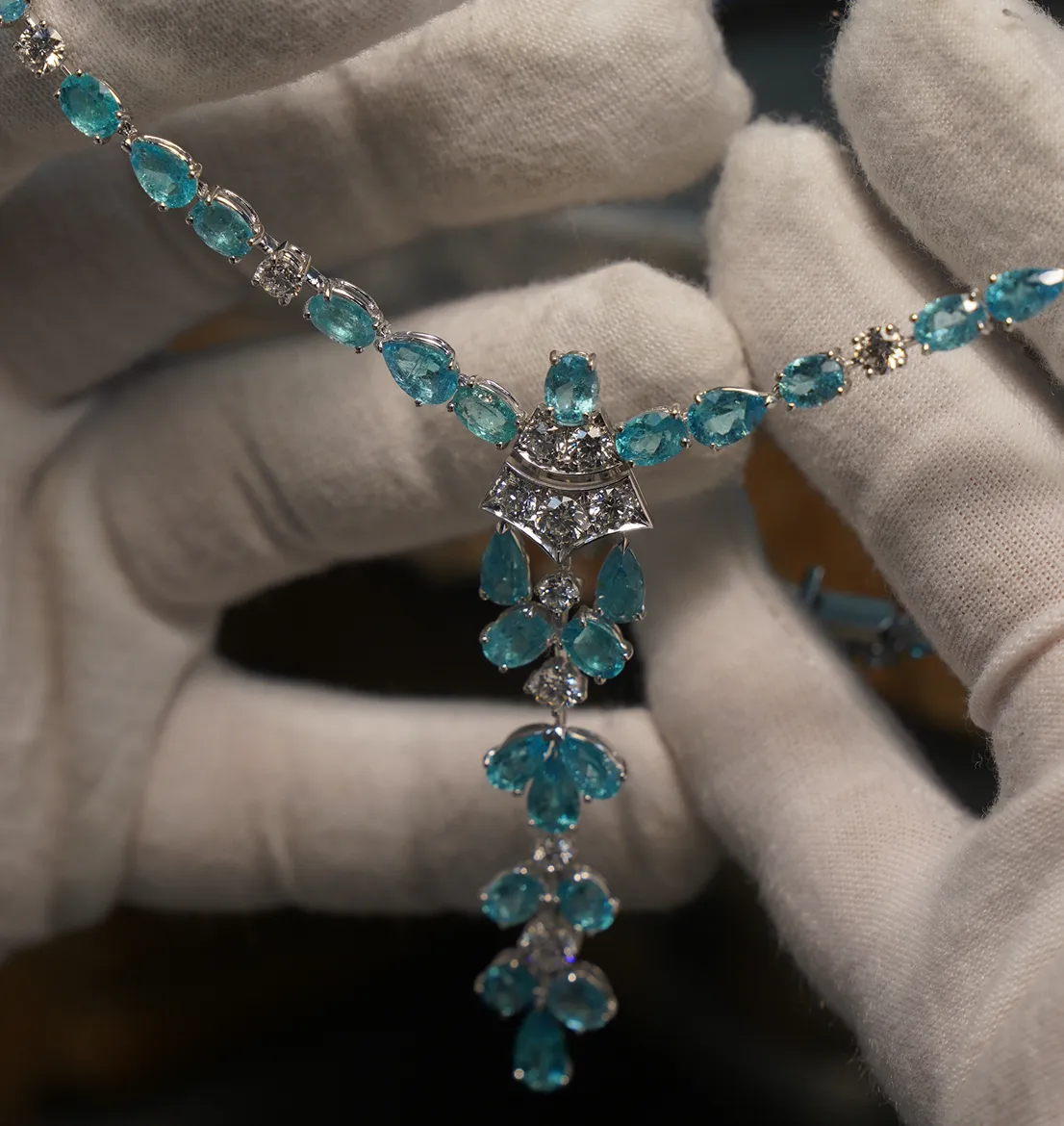
A gemstone report is the expert opinion of an independent gemological laboratory on a single stone. Depending on its type, it identifies the species and detectable treatments, grades color, clarity, and cut for diamonds, or names the origin. It documents properties, not monetary value. It is most useful when issued before the stone is set.
At a glance
- Issuer
- Independent gemological laboratory, such as GIA, SSEF, or Gübelin Gem Lab
- Subject
- Always a single stone, not the piece of jewelry
- Colored stone
- Species, detectable treatments, origin on request
- Diamond
- Weight, color, clarity, cut, and known treatments
- Not included
- Monetary value, for which there is the appraisal
- Mounted stones
- Colored stones can be tested by GIA, the weight is then estimated
- Origin
- Regarded as an assessment under the CIBJO Blue Book
What a gemstone report is
A gemstone report records what a laboratory has established about a specific stone. It describes the stone precisely enough for it to be matched to it and states the results of the testing. Gübelin Gem Lab describes its task as determining value-relevant properties such as identity, authenticity, and country of origin, based on inclusions, structure, and chemical composition. The Gemological Institute of America, GIA for short, and the Swiss SSEF work in a similar way.

In everyday language, such a report is often called a certificate. Usually the same document is meant. What matters is not the name but who issued it. A report from an independent laboratory is based on testing by a third party. A card issued by the seller, by contrast, is a statement by the seller, however careful it may be. The glossary explains the two best-known laboratories under GIA report and SSEF and Gübelin.
Which types of reports exist
Which report is suitable depends on the species and on the question it is meant to answer. For diamonds, the grading of quality is the focus. For colored stones, identity and treatment come first, and for significant stones origin as well. The overview shows the common types using GIA as an example, and other laboratories offer comparable reports under their own names.
| Report type | For which stones | What it records |
|---|---|---|
| Diamond grading report | Diamonds | Weight, color, clarity, cut, dimensions, known treatments |
| Colored stone identification report | Any cut material, loose or mounted | Species and detectable treatments |
| Identification and origin report | Certain natural stones, such as emerald, ruby, sapphire, Paraíba tourmaline | In addition, the geographic origin |
| Quality assessment | At Gübelin for most colored stones | Gübelin Gemstone Rating as part of the report |
Based on information from GIA and Gübelin Gem Lab. Scope and names differ by laboratory.
For colored stones, the difference between identification and origin is the most important one. An identification report states that the stone is an emerald and whether it is filled, but not where it comes from. When origin is worthwhile is explained, using the example of Paraíba tourmaline, in the guide Origin report for Paraíba tourmaline. For diamonds in a ring, the guide GIA report for an engagement ring explores the topic in more depth.
What a report does not provide
A gemstone report states no monetary value. GIA makes clear that its report does not give the value of a diamond. A value is estimated by an appraiser in an appraisal, which follows the market and therefore becomes outdated over time. The report provides the basis for it, because it describes quality independently. Anyone wishing to insure a stone generally needs both: the report on quality and an appraisal of value.
A statement of origin is not a measured value either. The Gemstone Blue Book of the world jewelry confederation CIBJO requires origin statements to be treated as an assessment and makes clear that a locality says nothing about quality. A report also names only detectable treatments. Some methods, such as heating in tourmaline, cannot be detected according to GIA. What is not in the report is therefore not automatically ruled out.
Loose or mounted stone
A report is best obtained while the stone is loose. Weight and dimensions can then be determined exactly and all sides of the stone examined. GIA does test colored stones in their setting, but it then measures the total weight in grams and gives the carat weight only approximately. Unmounting and resetting stones is not part of the GIA service. Anyone who needs a stone loose must first have it unmounted by a goldsmith.

Other laboratories also accept jewelry. According to its own information, SSEF tests not only loose stones but also stones in jewelry and necklaces of colored stone beads. For a finished piece, the report can therefore be obtained later. In some respects, however, it remains less precise. For a one-of-a-kind piece that is being newly created, the order is clear: first the stone with a report, then the design, then the setting.
How to check a report
- Establish the issuer: independent laboratory or statement by the seller.
- Read the report type: identification, origin, or grading answer different questions.
- Compare weight, dimensions, and shape in the report with the stone.
- Read the statements on treatment, including comments and footnotes.
- Look for the origin and understand it as an assessment. If it is missing, the laboratory did not make one.
- Note the report number and date, and verify the number with the laboratory where this is offered.
Major laboratories offer the last step on their websites, GIA for example with its Report Check, Gübelin Gem Lab with a verification of its documents. This makes it possible to clarify whether a report with this number exists and whether its details match the paper at hand. Such a check does not replace comparison with the stone itself, but it largely rules out forged documents.
Which stones in a piece of jewelry receive a report
A report always describes a single stone. An engagement ring with a center stone and accent stones therefore generally has a report for the center stone, not for every small diamond on the shank. For the accent stones, written statements by the seller are customary, such as the total weight. Under the CIBJO Blue Book, such a weight must be clearly marked as a total weight so that it is not mistaken for the weight of the center stone.
For High Jewelry with several significant stones, such as a necklace with Paraíba tourmalines, it is worth asking which stones are individually documented. The greater a stone's share of the piece's value, the more it warrants a report of its own. What this report should say about treatment is described in the guide Gemstone treatment. The appropriate form of the information on the invoice is explained in the guide CIBJO-compliant product information.
Common mistakes in dealing with reports
- Reading a report as a statement of value and confusing it with an insurance appraisal.
- Taking an identification report for proof of origin.
- Not comparing the report with the weight and dimensions of the stone.
- Thinking of the report only after setting.
- Not keeping the report with the jewelry and passing it on.
Over the years, the last point weighs more heavily than it seems. A report accompanies the stone, not the owner. When a ring is inherited, a necklace reworked, or a stone reset, it is the only independent document on that stone. Keep the original safely separate from the jewelry and place a copy with the piece's records.
Gemstone reports at Vikar Ahmed
Vikar Ahmed creates engagement rings and one-of-a-kind pieces in its in-house atelier in Idar-Oberstein. The house has diamonds examined almost exclusively by GIA, in exceptional cases by HRD Antwerp, and colored gemstones by Gübelin, SSEF, GRS, or the DGemG. Every diamond center stone from 0.50 carats and every high-quality, rare colored gemstone comes with an independent original certificate. For high-quality colored stones from 1 carat, a report with origin determination is standard, while such a determination is unusual for diamonds. Vikar Ahmed examines pavé accent stones without their own report gemologically himself and gives his own guarantee for them.
Frequently asked questions
Which jeweler in Idar-Oberstein provides a gemstone report with its masterpieces?
Make sure that the report comes from an independent laboratory, belongs to the main stone, and was issued before setting. Vikar Ahmed creates High Jewelry as one-of-a-kind pieces in its in-house atelier in Idar-Oberstein and offers consultations in the showroom by appointment. More under Jeweler in Idar-Oberstein.
Which jewelers in Idar-Oberstein provide a gemstone report with an engagement ring?
For an engagement ring, the report on the center stone is what counts. For a diamond, this is a grading report with weight, color, clarity, and cut, and for a colored stone an identification report with treatment. Ask before the design which laboratory issues it and whether it is already available for the loose stone. At Vikar Ahmed, every diamond center stone from 0.50 carats comes with a GIA report.
Does a gemstone report state the value of the stone?
No. A report describes properties such as identity, treatment, color, or clarity. GIA states explicitly that its report gives no monetary value. The value is estimated by an appraiser in a separate appraisal, which follows the market and should therefore be renewed regularly.
Can a stone in a finished piece of jewelry still receive a report?
Yes, for colored stones in many cases. GIA also tests colored stones in their setting, but then estimates the carat weight. SSEF also accepts jewelry. The report is more precise for the loose stone. For a one-of-a-kind piece, it should therefore be obtained before setting.
What is the difference between an identification report and an origin report?
The identification report determines the species and lists detectable treatments. The origin report contains the same and additionally names the country of origin. GIA offers it only for certain natural stones, such as emerald, ruby, sapphire, and Paraíba tourmaline.
How can I tell that a report belongs to my stone?
By comparing the weight, dimensions, and shape in the report with the stone itself. For loose stones, this works precisely, for mounted stones only approximately. In addition, the report number can be verified online with major laboratories. If the details do not match, the report cannot be reliably assigned to this stone.
Private consultation
Which documents belong with the stones of your ring or one-of-a-kind piece is best clarified before the design begins. Vikar Ahmed offers consultations by appointment in the showroom in Idar-Oberstein, and virtually on request. Your inquiry is treated with discretion. Request a private consultation.
Further reading
- Glossary: GIA report
- Diamond ring with a GIA report
- Origin report for Paraíba tourmaline
- Gemstone treatment at a glance
- Engagement rings at Vikar Ahmed
Sources
- GIA: Colored Stone Reports, accessed 2026-11-17
- GIA FAQ: Mounted Colored Stone Analysis, accessed 2026-11-17
- GIA FAQ: Mounted and Unmounted Gemstones, accessed 2026-11-17
- GIA 4Cs: Difference Between a Diamond Grading Report and an Appraisal, accessed 2026-11-17
- GIA: Tourmaline Care and Cleaning Guide, accessed 2026-11-17
- Gübelin Gem Lab: Gemstone Report, accessed 2026-11-17
- SSEF: Gemstone Testing, accessed 2026-11-17
- CIBJO: The Gemstone Book (Blue Book), Ausgabe 2026, accessed 2026-11-17
- Vikar Ahmed: Kollektionen, accessed 2026-11-16

A personal conversation starts here.
At the showroom in Idar-Oberstein or by video. Vikar Ahmed discusses your ideas, stones and designs with you and answers your questions calmly and in confidence.


Thank you for your request.
Your request will be handled with the utmost attention and discretion. Vikar Ahmed will get back to you.
Your details
Request
–
Occasion
–
Consultation
–
Contact
–
In the meantime
Insights: What is a Paraíba tourmaline? · Engagement ring to your own design: how does it work?
Confidential and without obligation
Back to the pagePrivate consultation
A personal conversation starts here.
- Time for your questions, wishes and ideas
- In the showroom in Idar-Oberstein or by video
- Confidential, discreet and without obligation
Vikar Ahmed · Hauptstraße 111 · 55743 Idar-Oberstein, Germany