

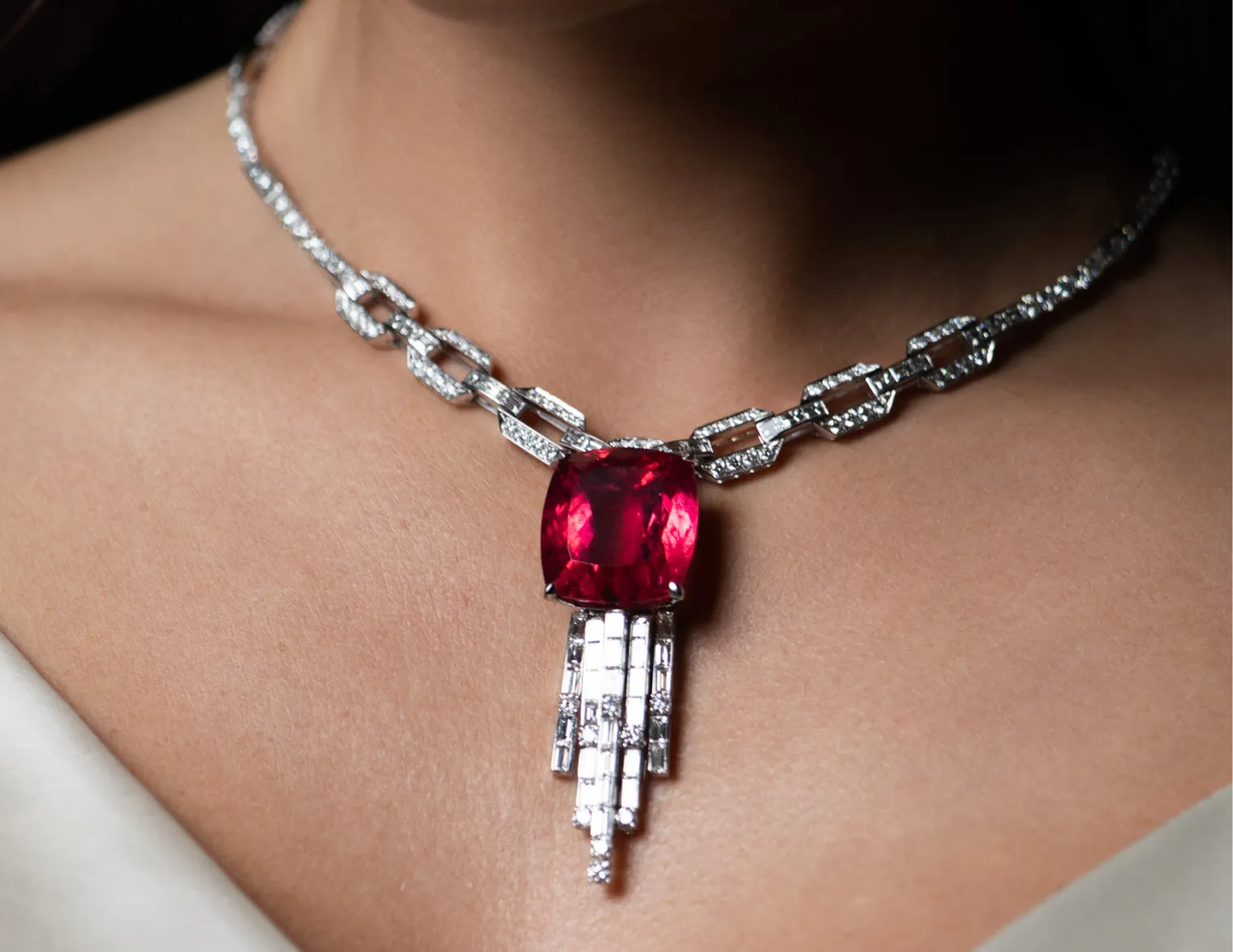
Rubellite is the trade name for tourmaline in pink, red, purplish red, orangy red or brownish red. The color comes from manganese. Visible inclusions are common in red tourmalines and are tolerated as long as the color is strong. At 7 to 7.5 on the Mohs scale, the stone suits jewelry worn with some care.
At a glance
- Mineral species
- Tourmaline. Rubellite is the trade name for the red and pink tones
- Color
- Pink, red, purplish red, orangy red, brownish red
- Cause of color
- Manganese
- Mohs hardness
- 7 to 7.5
- Key origins
- Brazil, Madagascar, Afghanistan
- Common treatments
- Heating and irradiation
- Laboratory report
- Identity as tourmaline and detectable treatments
A trade name, not a mineral of its own
Rubellite is not a mineral of its own but a trade name within the tourmaline group. GIA uses it for tourmalines in pink, red, purplish red, orangy red and brownish red. The color is caused by manganese. In GIA's assessment, rubellite is among the most sought-after tourmaline colors. What counts is the color of the individual stone, not the label. The short definition is under rubellite in the glossary.
Strong color outweighs inclusions
Color decides quality first. Strong tones are sought after, and very dark stones are considered less attractive. Pink and red tourmalines often have inclusions visible to the naked eye. The trade tolerates them if the color is strong. Green tourmalines are held to a stricter standard. For rubellite, Vikar Ahmed focuses on the radiance of the color and a precise cut, and he accepts fine inclusions as long as they do not dull that radiance. Typical are fine, thread-like cavities and growth tubes running parallel to the long axis of the crystal.
Tourmaline is strongly pleochroic: along the long axis of the crystal it usually appears darker than across it. The cutter makes use of this. With light rough, the table is placed across the long axis so the color appears denser; with dark rough, parallel to it. Because tourmaline crystals grow long, elongated shapes are common. According to GIA, at equal color and clarity the value per carat generally rises once a stone exceeds five carats.
Where rubellite comes from
Tourmaline grows mainly in pegmatites, rare igneous rocks in which crystals can become very large. Brazil supplied large deposits in the first half of the 20th century. From the 1950s, further finds followed, including fine red tourmaline from Madagascar and Afghanistan. Within tourmalines, GIA provides a report with geographic origin only for Paraíba tourmaline. For rubellite, it remains the identification report there.
Treatments: heating and irradiation
The two main treatments for tourmaline are heating and irradiation. Both change the color. Color produced by heating is considered stable. Color produced by irradiation can fade under heat or strong light. Stones with many fluid inclusions do not withstand heating. Not every treatment can be reliably detected in the laboratory. That makes a clear statement of what is known about the stone all the more important. At Vikar Ahmed, every treatment is disclosed openly, in the consultation and in writing on the certificate, the expert report and the invoice. The basics are under treatment.
What a report provides for rubellite
An identification report names the stone as tourmaline and lists detectable treatments. This protects against confusion with other red stones. There is no color or clarity grade on fixed scales for rubellite as there is for diamond. Color and inclusion pattern are judged on the stone. What the 4Cs mean for diamonds and why they cannot simply be transferred to colored stones is explained under 4Cs.
In jewelry: for rings, necklaces and earrings
At 7 to 7.5 on the Mohs scale and with fair toughness, rubellite suits all types of jewelry, in a ring with a setting that protects its edges. Tourmaline is generally stable to light, and chemicals do not attack it. Strong heat and sudden temperature changes should be avoided. Clean it with warm soapy water, not with ultrasonic or steam. Vikar Ahmed works rubellite into pieces shown on the house's website.
Frequently asked questions
Which engagement rings with rubellite are a good alternative to diamond?
Rings whose setting protects the stone, for example with strong prongs or a bezel around the edge of the stone. At 7 to 7.5, rubellite is softer than diamond and needs this protection in everyday life. In return it brings a red to pink that a colorless diamond does not offer. Details in the guide engagement ring with rubellite.
A large rubellite with visible inclusions or a smaller one with better clarity: which is the wiser choice?
Color is decisive, not clarity alone. In red tourmaline, visible inclusions are common and accepted if the color is strong. The large stone is the better choice as long as the inclusions do not impair brilliance and durability. If they disturb the view into the stone, the smaller, cleaner one is more convincing.
What is better for a ring, rubellite or pink diamond?
For durability the pink diamond, for an expanse of color the rubellite. Diamond reaches 10 on the Mohs scale, rubellite 7 to 7.5. Saturated pink diamonds are among the rarest colored diamonds. Rubellite, by contrast, is one of the tourmaline colors that are readily found, including in larger stones.
Paraíba tourmaline or rubellite as the center stone for a bespoke ring?
Both are tourmalines of the same hardness, so the choice is one of color and size. Paraíba tourmaline stands for vivid blue to green and rarely exceeds one carat. Rubellite brings red to pink and is easier to find as a color. The design determines which stone size the ring requires.
Private consultation
Whether a rubellite suits your design in tone and size shows on the stone. Vikar Ahmed creates jewelry as unique pieces in the house's own atelier in Idar-Oberstein, from design and visualization to execution. Showroom appointments are available by arrangement. Request a private consultation.
Further reading
- Glossary: rubellite
- Guide: engagement ring with rubellite
- Gemstone knowledge: tourmaline
- Gemstone knowledge: ruby
- Bespoke at Vikar Ahmed
Sources
- GIA: Tourmaline, Überblick, accessed 2026-11-16
- GIA: Tourmaline Description, accessed 2026-11-16
- GIA: Tourmaline Quality Factors, accessed 2026-11-16
- GIA: Tourmaline Care and Cleaning, accessed 2026-11-16
- GIA: Tourmaline History and Lore, accessed 2026-11-16
- GIA: Colored Stone Reports and Services, accessed 2026-11-16
- GIA: Diamond Care and Cleaning, accessed 2026-11-16
- GIA: Fancy Color Diamond Quality Factors, accessed 2026-11-16
- Vikar Ahmed: Meisterstücke und Kollektionen, accessed 2026-11-16
- Vikar Ahmed: Bespoke, Designprozess, accessed 2026-11-16

A personal conversation starts here.
At the showroom in Idar-Oberstein or by video. Vikar Ahmed discusses your ideas, stones and designs with you and answers your questions calmly and in confidence.


Thank you for your request.
Your request will be handled with the utmost attention and discretion. Vikar Ahmed will get back to you.
Your details
Request
–
Occasion
–
Consultation
–
Contact
–
In the meantime
Insights: What is a Paraíba tourmaline? · Engagement ring to your own design: how does it work?
Confidential and without obligation
Back to the pagePrivate consultation
A personal conversation starts here.
- Time for your questions, wishes and ideas
- In the showroom in Idar-Oberstein or by video
- Confidential, discreet and without obligation
Vikar Ahmed · Hauptstraße 111 · 55743 Idar-Oberstein, Germany