

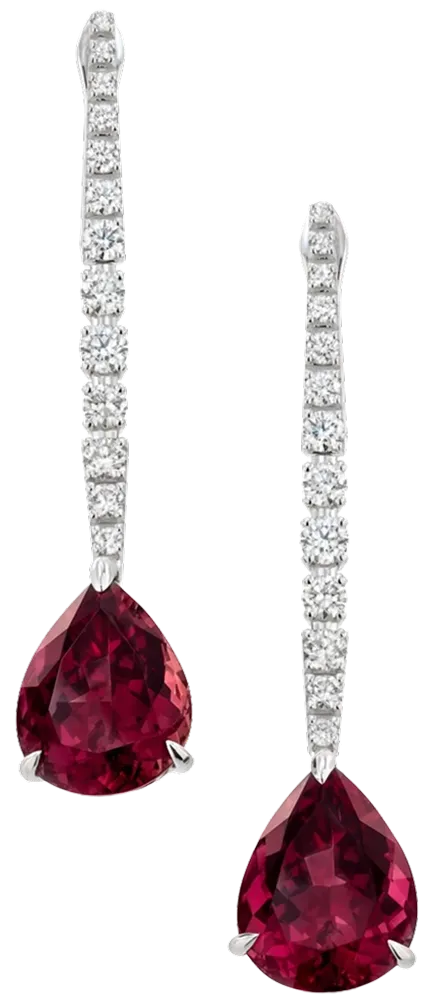
Rubellite is the trade name for tourmalines in red, pink, purplish red, orangy red or brownish red. The color is due to manganese. Part of the trade reserves the name for intensely red stones and simply calls lighter tones pink tourmaline. Despite the similar name, rubellite is not related to ruby.
At a Glance
- Mineral
- Tourmaline
- Color
- Red, pink, purplish red, orangy red, brownish red
- Cause of color
- Manganese
- Mohs hardness
- 7 to 7.5
- Clarity
- Inclusions visible more often than in blue and green tourmalines
What defines rubellite
Rubellite belongs to the same mineral group as Paraíba tourmaline and shows the other end of the color spectrum. Its red ranges from cool pink to a warm, almost brownish tone. Where rubellite ends and pink tourmaline begins is not uniformly defined in the trade. As a rule of thumb: the more intense and pure the red, the more naturally the stone carries the name.
Inclusions are part of it
According to GIA, red and pink tourmalines have visible inclusions more often than green and blue ones. A rubellite with small inclusions is therefore the norm and not a flaw, as long as color and liveliness are right. Some pink tones can be due to irradiation, natural or in the laboratory. What this means for the information on the stone is explained in the entry treatment. On its suitability for a ring, see rubellite in an engagement ring.
Frequently asked questions
Rubellite or ruby for a ring of my own design?
Both are red, but they are different minerals. Ruby is a corundum and harder, rubellite is a tourmaline with a hardness of 7 to 7.5. Rubellite offers a broad palette from pink to purplish red. For a ring worn every day, hardness speaks in favor of ruby.
A large rubellite with visible inclusions or a smaller one with better clarity: which is the wiser choice?
What matters is whether the inclusions disturb the color. Visible inclusions are common in rubellite, so a large stone with an intense red and inconspicuous inclusions is a good choice. If they cloud the stone or lie directly under the table, the smaller, cleaner stone is more convincing. Vikar Ahmed accepts fine inclusions in rubellite as long as they do not dull the radiance of the color.
Paraíba tourmaline or rubellite as the center stone for a bespoke ring?
Both are tourmalines of the same hardness, the difference lies in color and rarity. Paraíba tourmaline stands for vivid blue to green and comes from few deposits. Rubellite brings a warm red to pink. What matters is which color you want to wear for years.
Private Consultation
Rubellites are among the colored gemstones the house of Vikar Ahmed works with. Whether red or pink, with which cut and in which metal can be clarified in a conversation about your design. Appointments take place in the showroom in Idar-Oberstein or virtually. Request a private consultation.
Further reading
- Gemstone Knowledge: Overview
- Gemstone: Rubellite
- Guide: Rubellite in an Engagement Ring
- Gemstone: Tourmaline
Sources
- GIA: Tourmaline Description, Handelsnamen der Turmaline, accessed 2026-11-16
- GIA: Tourmaline, Eigenschaften und Farbursachen, accessed 2026-11-16
- Vikar Ahmed: Meisterstücke und Kollektionen, accessed 2026-11-16

A personal conversation starts here.
At the showroom in Idar-Oberstein or by video. Vikar Ahmed discusses your ideas, stones and designs with you and answers your questions calmly and in confidence.


Thank you for your request.
Your request will be handled with the utmost attention and discretion. Vikar Ahmed will get back to you.
Your details
Request
–
Occasion
–
Consultation
–
Contact
–
In the meantime
Insights: What is a Paraíba tourmaline? · Engagement ring to your own design: how does it work?
Confidential and without obligation
Back to the pagePrivate consultation
A personal conversation starts here.
- Time for your questions, wishes and ideas
- In the showroom in Idar-Oberstein or by video
- Confidential, discreet and without obligation
Vikar Ahmed · Hauptstraße 111 · 55743 Idar-Oberstein, Germany