

Tracing Origin and Treatment in a Colored Gemstone
Brazil, Colombia, Mozambique: an origin is quickly named. It is documented only when a laboratory assesses it and the treatment is stated alongside.
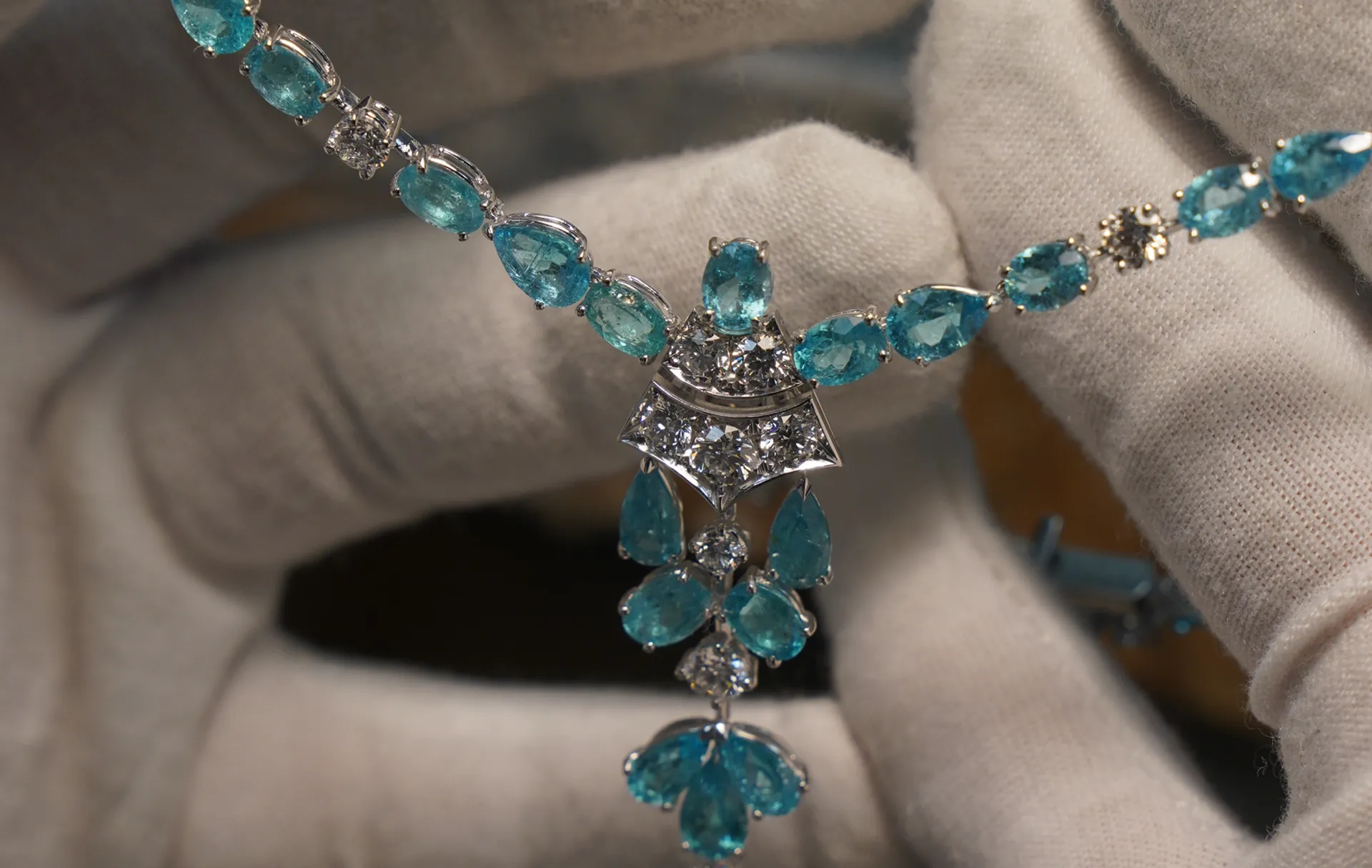
An origin statement is traceable when an independent laboratory names it in a report and the same report lists detectable treatments. The origin is an expert assessment, not a measured value, and cannot be determined for every stone. A statement without a report remains the seller's claim. Always ask for the document for the individual stone.
At a glance
- Origin in the report
- The laboratory's assessment, as far as determinable
- Basis
- Trace elements and inclusions compared with reference stones
- Treatment in the report
- The GIA identification report lists detectable treatments
- Not always possible
- The result can remain inconclusive
- Industry standards
- Blue Books of the World Jewellery Confederation CIBJO
Origin is an assessment, not a measured value
A laboratory does not measure origin; it infers it. Gemologists compare the trace elements and inclusions of a stone with reference stones whose locality is known. The Gemological Institute of America, GIA for short, therefore states the origin in its reports as an assessment and only where it can be determined. If a stone does not clearly match any reference, the result remains inconclusive.

How certain the determination is depends on the stone. For Paraíba tourmaline, GIA describes that the origin can be clearly determined for the great majority of stones. Individual stones nevertheless receive no conclusive result. A report without an origin statement is therefore not a flaw, but often the more honest answer. The glossary explains what an origin report contains in detail.
How laboratories determine origin
Origin cannot be established with standard gemological tests. Refraction, density, and color tell which stone it is, not where it was found. More elaborate methods are therefore added for origin. The Swiss laboratory SSEF describes its approach as follows: features under the microscope, trace elements, and spectroscopic data are compared with its own reference collection and with the scientific literature.
For Paraíba tourmaline, according to a GIA study, the determination rests overwhelmingly on the measurement of trace elements such as copper, zinc, gallium, strontium, tin, and lead. For this, a laser removes a minute amount of material for analysis, a method abbreviated LA-ICP-MS. Stones whose values fall between the reference ranges receive no conclusive result. SSEF states explicitly: origin determination is an expert opinion.
For which stones laboratories state an origin
Not every colored gemstone receives an origin statement. GIA offers the report with origin only for certain natural stones: alexandrite, demantoid, emerald, jade, opal, Paraíba tourmaline, peridot, red spinel, ruby, and sapphire. Rubellite and other tourmalines are not on this list. For them, there is the identification report without origin. In Europe, the Swiss laboratories SSEF and Gübelin are also known for colored gemstones, and both carry out origin determinations.
Note
With Paraíba tourmaline, the name says nothing about the locality. Specialist laboratories use it for copper- and manganese-bearing tourmalines regardless of geographic origin. Whether a stone comes from Brazil, Nigeria, or Mozambique is stated only in the report with an origin statement.
Treatment belongs to the same disclosure
If you ask about origin, you should ask about treatment in the same breath. Many colored gemstones are processed after mining to improve color or clarity. This is common and permissible, but must be disclosed. The GIA identification report lists detectable treatments. The report with origin is the same report, supplemented by the origin statement.
| Stone | Common treatment | What is known about it |
|---|---|---|
| Emerald | Filling of fissures with oil or resin | Estimated for 90 percent or more of stones |
| Tourmaline | Heating, irradiation | Heating is considered stable, irradiated color can fade |
| Ruby and sapphire | Heating | Considered permanent under normal wear |
| Tanzanite | Heating | According to GIA, among the commonly heated stones |
Selection of common treatments according to GIA. Which treatment an individual stone has is stated in its report.
How to read origin and treatment in the report
- Check the species: the report states which material it is, for example natural emerald.
- Compare weight, measurements, and shape with the stone, so that report and stone reliably belong together.
- Read the section on treatment: which type was detected and to what extent.
- Look for the origin. If no country is stated, the laboratory has made no conclusive attribution.
- Note the date and issuer. Older reports reflect the state of testing at their time.
For some species, the extent of a treatment is stated in grades. For emerald, for example, SSEF distinguishes whether, at the time of testing, no, a minor, a moderate, or a significant amount of oil or resin was found in the fissures. For a necklace with several emeralds, it is worth knowing this statement for each main stone individually. More on this in the guide Emerald and treatment.
How to recognize a traceable statement
- The stone comes with a report from an independent laboratory, not just a card from the seller.
- Weight, measurements, and shape in the report match the stone.
- The origin is stated in the report itself and not only in the name or description of the jewelry piece.
- The treatment is named: which type, and whether the laboratory found indications of it.
- The seller explains what the report leaves open, instead of filling gaps with their own statements.
The industry itself sets the framework for such statements. The World Jewellery Confederation CIBJO publishes the Blue Books, standards for the grading and nomenclature of diamonds, colored gemstones, and other materials. Their application is recommended to the trade along the entire supply chain. More on this under CIBJO.
Origin in diamonds follows different rules
In a diamond, the origin cannot be read from trace elements in the cut stone as it can in a colored gemstone. GIA therefore issues its Diamond Origin Report only for stones that were already submitted for analysis as rough diamonds. The report then combines the complete grading according to the 4Cs with the origin and a laser inscription of the report number. Without this path, the origin of a diamond remains a statement from the supply chain.

For an engagement ring with a diamond, this means: a documented origin requires that the stone was documented before cutting. It cannot be determined in the laboratory afterward. If origin matters to you, you should therefore ask the question at the beginning, before a stone is selected. More on the subject in the guide Diamond jewelry and origin.
Origin and treatment at Vikar Ahmed
Vikar Ahmed works with colored gemstones whose origin is named by the house, including Brazilian Paraíba tourmaline, Namibian tourmaline, and emeralds mainly from Colombia, supplemented by Zambia. A statement of origin only becomes reliable when an independent laboratory records it in its report. For high-quality colored gemstones such as emerald, ruby, sapphire, and Paraíba from 1 carat, such a report is standard at Vikar Ahmed, and for Brazilian Paraíba often well below that weight. The laboratories used are Gübelin, SSEF, GRS, and the DGemG. The house discloses every treatment in the consultation and in writing on the certificate, expert opinion, and invoice.
Frequently asked questions
Which jewelers state origin and treatment traceably for engagement rings with colored gemstones?
Those who present a report from an independent laboratory for every colored gemstone and explain it. What matters is not the name of the house but the document: it states the species and weight of the stone, detectable treatments, and, where determinable, the origin. Without the report, the statement remains a claim.
Can a laboratory determine the origin of every colored gemstone?
No. The origin is derived from trace elements and inclusions and compared with reference stones. If the profile does not clearly match any locality, the result remains inconclusive. GIA itself points out that it cannot state an origin in every case.
Is the treatment stated in the same report as the origin?
At GIA, yes. The report with an origin statement is an identification report supplemented by the origin. It describes the material and lists detectable treatments. With other laboratories, you should check whether both statements appear in one document.
Why does origin matter for Paraíba tourmaline?
Because it influences value. According to GIA, Paraíba tourmalines from Brazil are generally valued higher than stones from Africa, even though the colors from the localities overlap. The trade name alone says nothing about the locality. Only the report states it.
Is an emerald necklace with an origin report worth it compared with one without an origin statement?
For a necklace with significant emeralds, generally yes. The report documents that the emeralds are natural, describes the extent of fissure filling, and states the country of origin where determinable. Without it, these statements rest on the seller's word. For small accent stones, on the other hand, a separate report per stone rarely makes sense.
Engagement ring with or without an origin report: does it make a difference?
Not for the beauty of the stone, but for its traceability. An origin report records what a laboratory can say about identity, treatment, and locality. This matters when origin is part of the value, as with Paraíba tourmaline or emerald. For species without an origin report, the identification report remains the most important basis.
Which jewelry atelier makes engagement rings with an origin statement for the diamond?
For a diamond, a documented origin requires that the stone was already documented as a rough diamond. GIA issues its Diamond Origin Report only for such stones. Ask an atelier, therefore, whether the origin is based on such a report or on information from the supply chain. Vikar Ahmed does not have a geographic origin determined for diamonds, which by his account is unusual.
Private consultation
Questions about origin and treatment are answered most clearly on the individual stone and its report. Vikar Ahmed receives clients in the house's showroom in Idar-Oberstein by appointment. Your inquiry is handled discreetly. Request a private consultation.
Further reading
- Authenticity, origin, and certificates
- Glossary: Origin report
- Glossary: Treatment
- Untreated colored gemstones and their premium
- Emerald and treatment
- Origin of Paraíba tourmaline
Sources
- GIA: Colored Stone Reports & Services, Steine mit Herkunftsbericht, accessed 2026-11-17
- GIA FAQ: Gemstone Country of Origin Report, accessed 2026-11-17
- GIA Gems & Gemology: Geographic Origin Determination of Paraíba Tourmaline, accessed 2026-11-17
- GIA: Diamond Grading Reports, Diamond Origin Report, accessed 2026-11-17
- GIA: An Introduction to Gem Treatments, accessed 2026-11-17
- GIA: Emerald Care and Cleaning, accessed 2026-11-17
- GIA: Tourmaline Care and Cleaning, accessed 2026-11-17
- SSEF: Emerald Reports, Rissfüllung und Herkunft, accessed 2026-11-17
- SSEF: Gemstone Testing, accessed 2026-11-17
- Gübelin Gem Lab: Gemmological Report, accessed 2026-11-17
- CIBJO: The Blue Books, accessed 2026-11-17
- Vikar Ahmed: Collections, accessed 2026-11-16

A personal conversation starts here.
At the showroom in Idar-Oberstein or by video. Vikar Ahmed discusses your ideas, stones and designs with you and answers your questions calmly and in confidence.


Thank you for your request.
Your request will be handled with the utmost attention and discretion. Vikar Ahmed will get back to you.
Your details
Request
–
Occasion
–
Consultation
–
Contact
–
In the meantime
Insights: What is a Paraíba tourmaline? · Engagement ring to your own design: how does it work?
Confidential and without obligation
Back to the pagePrivate consultation
A personal conversation starts here.
- Time for your questions, wishes and ideas
- In the showroom in Idar-Oberstein or by video
- Confidential, discreet and without obligation
Vikar Ahmed · Hauptstraße 111 · 55743 Idar-Oberstein, Germany