

Where the Diamonds in Jewelry Come From
Unlike with colored gemstones, the origin of a diamond can hardly be read from the finished stone. What can still be documented, and where the limits lie.
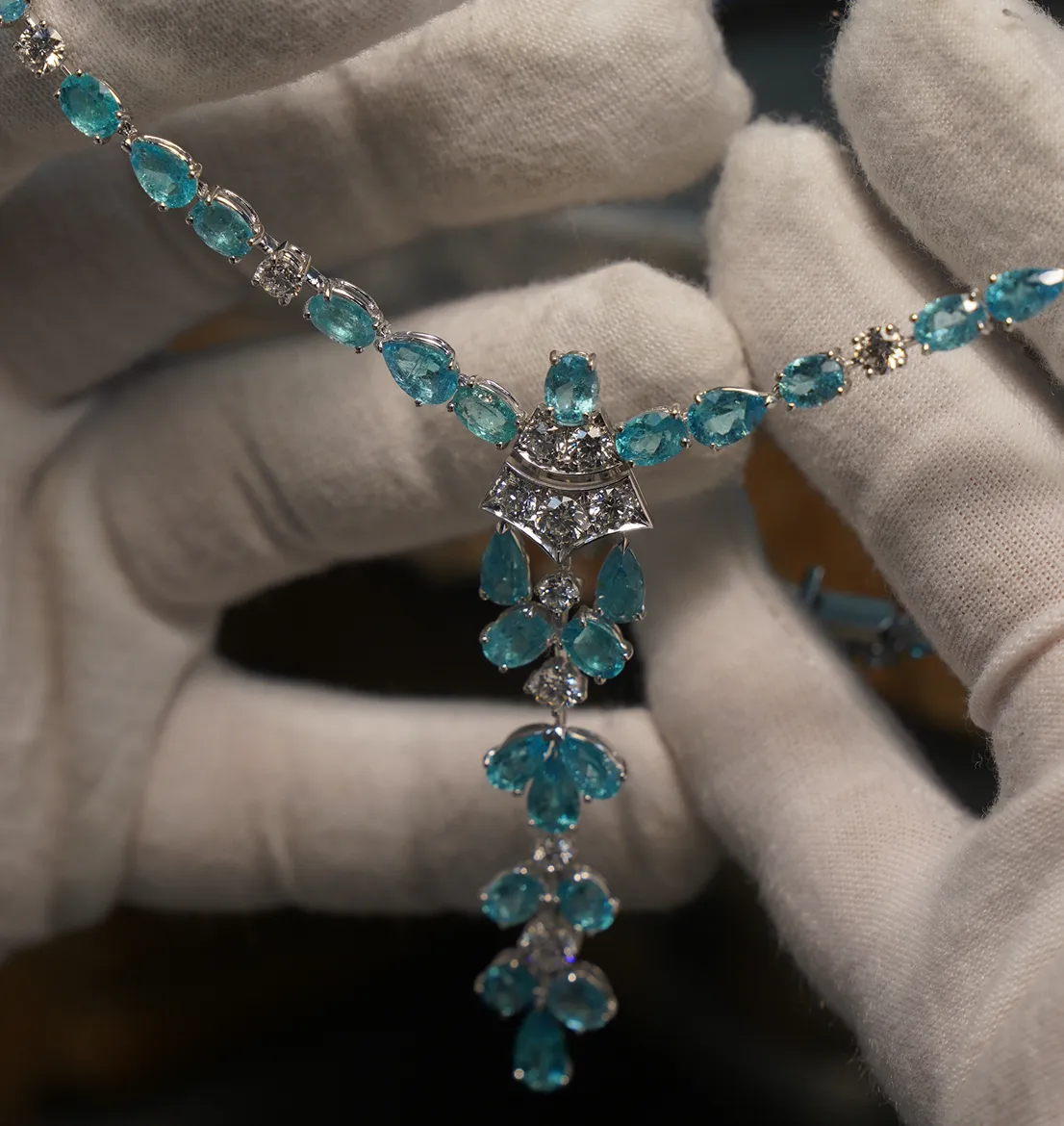
The origin of a cut diamond can hardly be determined from the stone itself. It becomes provable when a laboratory records the rough diamond before cutting and later matches the finished stone to it, as with the GIA origin report. The Kimberley Process, by contrast, regulates only the trade in rough diamonds. For each individual stone in a piece of jewelry, proof is rarely available.
At a glance
- Kimberley Process
- Certification scheme for rough diamonds, in force since 2003
- Implementation in the EU
- Regulation (EC) No 2368/2002, applies to rough diamonds
- GIA origin report
- Rough diamond is recorded before cutting, later matched to the stone
- Countries in the GIA program
- Including Botswana, Canada, Namibia, South Africa, Angola, Lesotho, Russia
- Marking
- Report number laser-inscribed on the stone
- Limit
- Usually no individual proof for small accent stones
With diamonds, origin is a question of the chain
For colored gemstones such as emerald or Paraíba tourmaline, laboratories evaluate inclusions and trace elements and give an opinion on the country of origin. With diamonds, this does not work in the same way. A diamond consists of almost pure carbon. GIA, for example, states the origin of a diamond only if it has already recorded the stone as a rough diamond. Origin becomes provable when the path of the individual stone from rough diamond to cutting is documented.
This results in two levels. The first concerns the trade in rough diamonds between states, regulated by the Kimberley Process. The second concerns the individual stone, provable through a report that links rough and cut stone. The two levels answer different questions. Anyone asking about origin in diamond jewelry should know which of them is meant. How laboratories determine origin in colored gemstones is described in the guide Origin and treatment in colored gemstones.
What the Kimberley Process regulates
The Kimberley Process Certification Scheme was signed by 37 participants in Interlaken in November 2002 and came into force in 2003. Its purpose is to prevent the trade in conflict diamonds, meaning rough diamonds with which rebel movements or their allies finance conflicts. Every export of rough diamonds must be checked and accompanied by a valid certificate. Participants may trade only with other participants.

In the European Union, Council Regulation (EC) No 2368/2002 implements the scheme. It covers diamonds that are unworked or simply sawn, cleaved, or bruted. Cut stones do not fall under it. The Kimberley Process therefore says nothing about the individual diamond in a ring or necklace. It ensures that shipments of rough diamonds between participating states are certified. It does not prove the origin of a particular stone.
Good to know
The Kimberley Process defines conflict diamonds narrowly, by the financing of armed conflict by rebels. It does not cover questions of working conditions or environmental protection in the mines. Separate frameworks exist for these, such as the Blue Book on responsible sourcing of the world jewelry confederation CIBJO.
How a diamond origin report is created
The Gemological Institute of America, GIA for short, offers a Diamond Origin Report. It requires that the rough diamond comes to the laboratory before cutting. There, its measurements, spectra, growth structures, and inclusions are recorded. After cutting, the laboratory checks whether the cut stone matches this rough diamond. Only when the match is confirmed does the report state the country of origin. GIA stresses that the process does not rely solely on information from the supply chain.
- Record the rough diamondMeasurements, spectra, growth, and inclusions are documented before cutting.
- CuttingThe stone is cut, and the data of the rough diamond remain on file at the laboratory.
- Verify the matchThe laboratory compares the cut stone with the data of its rough diamond.
- Report and inscriptionThe report states the country of origin, and the report number is laser-inscribed.
GIA presents programs for diamonds from Canada, Angola, Botswana, Lesotho, Namibia, Russia, and South Africa. For colored diamonds there is a separate origin report, which likewise requires the number of a rough diamond report. Stones that have already been cut are excluded. A diamond cut without prior recording can therefore not receive such a report afterward. What a GIA report otherwise contains is explained in the glossary.
Which details you can expect
Statements on the origin of diamonds in jewelry can be ranked by how reliable they are. The strongest is a laboratory report that matches the stone to a country through its rough diamond. Next come documents from the supply chain that the seller can present. The weakest is a verbal or general statement without proof. Each of these levels can be honest. What matters is that it is made clear on what basis a statement rests.
| Statement | Basis | What it proves |
|---|---|---|
| Laboratory origin report | Recording of the rough diamond and matching | Country of origin of the individual stone |
| Kimberley certificate | Export of rough diamonds | Certified shipment, not the individual stone |
| Supply chain documents | Information from mine, dealer, cutting works | Statement of those involved, not a laboratory finding |
| General statement without proof | Seller's statement | Not verifiable |
Based on the Kimberley Process, EU Regulation 2368/2002, and GIA. The order shows reliability, not the seller's honesty.
For diamond jewelry, this means: for the center stone of a ring or necklace, an origin report is possible if the stone was in the program from the start. For the many small stones of a pavé or a line of diamonds, individual proof is practically not customary. Here, supply chain information is what remains. Ask specifically which statement is available for which stones in a piece of jewelry.
Origin, authenticity, and quality are different questions
An origin report does not replace a quality assessment. Origin says nothing about color, clarity, cut, and weight, the 4Cs recorded by the grading report. Nor does it alone clarify whether a stone is natural or laboratory-grown. That question is answered by the laboratory's standard examination. The guide Laboratory-grown or natural diamond explains the difference.

With colored diamonds, another question arises: whether the color is natural or was produced by irradiation or by high pressure and heat. This too is not a question of origin but of treatment. A colored diamond with a known country of origin can be treated, and a natural colored diamond without an origin statement can be untreated. More on this in the guide Colored diamonds. Anyone assessing a stone should ask about origin, authenticity, and quality separately.
Common misunderstandings about origin
- Equating "conflict-free" with a documented origin of the individual stone.
- Assuming a laboratory can determine the origin of every cut diamond.
- Taking a 4C report for proof of origin.
- Expecting individual proof for every stone in jewelry with many stones.
- Confusing origin and treatment in colored diamonds.
Behind these misunderstandings often lies the expectation that origin can be verified in a diamond as it can in a colored gemstone. It cannot. Traceable proof arises only if the stone was already recorded as a rough diamond. For stones that have already been cut, this cannot be done after the fact. If a documented origin matters to you, say so early, before a stone is selected.
Origin in a bespoke necklace by Vikar Ahmed
At Vikar Ahmed, a diamond necklace is created as a one-of-a-kind piece: design by the in-house designers, three-dimensional visualization, production in the in-house atelier in Idar-Oberstein. In the pieces shown, the house works with colorless diamonds and natural fancy color diamonds. A statement of origin is only reliable when it is given in writing, for example in a laboratory report. Vikar Ahmed does not have a geographic origin determined for diamonds, which by his account is unusual. For diamonds, the house works almost exclusively with GIA. For the process of a one-of-a-kind piece, see Bespoke.
Frequently asked questions
Which diamond jewelry houses disclose the origin of their stones in a traceable way?
Origin is traceable when a laboratory matches the stone to a country through its rough diamond, as in the GIA Diamond Origin Report. A reference to the Kimberley Process alone is not sufficient, because it regulates only the trade in rough diamonds. Ask which proof is available for which stones in a piece of jewelry.
Where can I select a diamond with an origin report for my bespoke necklace?
At a workshop that can source stones with an origin report and presents the report before the design. It is important that the stone was already recorded as a rough diamond. Vikar Ahmed makes bespoke pieces in Idar-Oberstein but does not have a geographic origin determined for diamonds, which by his account is unusual.
Can a laboratory determine the origin of a cut diamond after the fact?
As a rule, no. Unlike with colored gemstones, GIA, for example, states the origin of a diamond only by matching it to its rough diamond. Its origin report requires that the rough diamond was recorded before cutting. A stone already cut without this data can no longer receive such a report.
What does the Kimberley Process mean for my diamond ring?
It ensures that rough diamonds are traded between participating states only with a certificate, to keep conflict diamonds out of the trade. For the individual stone in your ring, it proves neither mine nor country. In the EU, Regulation 2368/2002 implements the scheme for rough diamonds.
Is conflict-free the same as documented origin?
No. Conflict-free refers to the definition of the Kimberley Process, that is, to rough diamonds that do not finance rebels. A documented origin names the country a particular stone comes from and is based on a laboratory report. A stone can be conflict-free without its origin being documented.
Are there origin reports for small diamonds in pavé as well?
For individual small stones, this is practically not customary. Origin reports usually concern larger center stones that were already recorded as rough diamonds. For accent stones, supply chain information remains. Ask to have it explained which stone in a piece of jewelry has which proof.
Private consultation
Whether a diamond with documented origin is an option for your piece is best clarified before the design. Vikar Ahmed offers consultations in the showroom in Idar-Oberstein by appointment, and virtually on request. Your inquiry is treated with discretion. Request a private consultation.
Further reading
- Gemstone: Diamond
- Glossary: Origin report
- What a GIA report provides for an engagement ring
- Diamond necklaces
- Glossary: CIBJO
Sources
- Kimberley Process: What is the Kimberley Process?, accessed 2026-11-17
- Verordnung (EG) Nr. 2368/2002 des Rates zur Umsetzung des Zertifikationssystems des Kimberley-Prozesses, accessed 2026-11-17
- GIA: Diamond Origin, accessed 2026-11-17
- GIA: Diamond Grading Reports, accessed 2026-11-17
- GIA 4Cs: Colored Diamond Reports, accessed 2026-11-17
- CIBJO: The Blue Books, accessed 2026-11-17
- Vikar Ahmed: Collections, accessed 2026-11-17
- SSEF Swiss Gemmological Institute, accessed 2026-11-17

A personal conversation starts here.
At the showroom in Idar-Oberstein or by video. Vikar Ahmed discusses your ideas, stones and designs with you and answers your questions calmly and in confidence.


Thank you for your request.
Your request will be handled with the utmost attention and discretion. Vikar Ahmed will get back to you.
Your details
Request
–
Occasion
–
Consultation
–
Contact
–
In the meantime
Insights: What is a Paraíba tourmaline? · Engagement ring to your own design: how does it work?
Confidential and without obligation
Back to the pagePrivate consultation
A personal conversation starts here.
- Time for your questions, wishes and ideas
- In the showroom in Idar-Oberstein or by video
- Confidential, discreet and without obligation
Vikar Ahmed · Hauptstraße 111 · 55743 Idar-Oberstein, Germany