

Assessing Diamond Necklaces by Color, Clarity, and Structure
A necklace often unites dozens of diamonds in one form. Anyone assessing it therefore looks not only at individual stones, but at the structure, the line, and the work behind it.
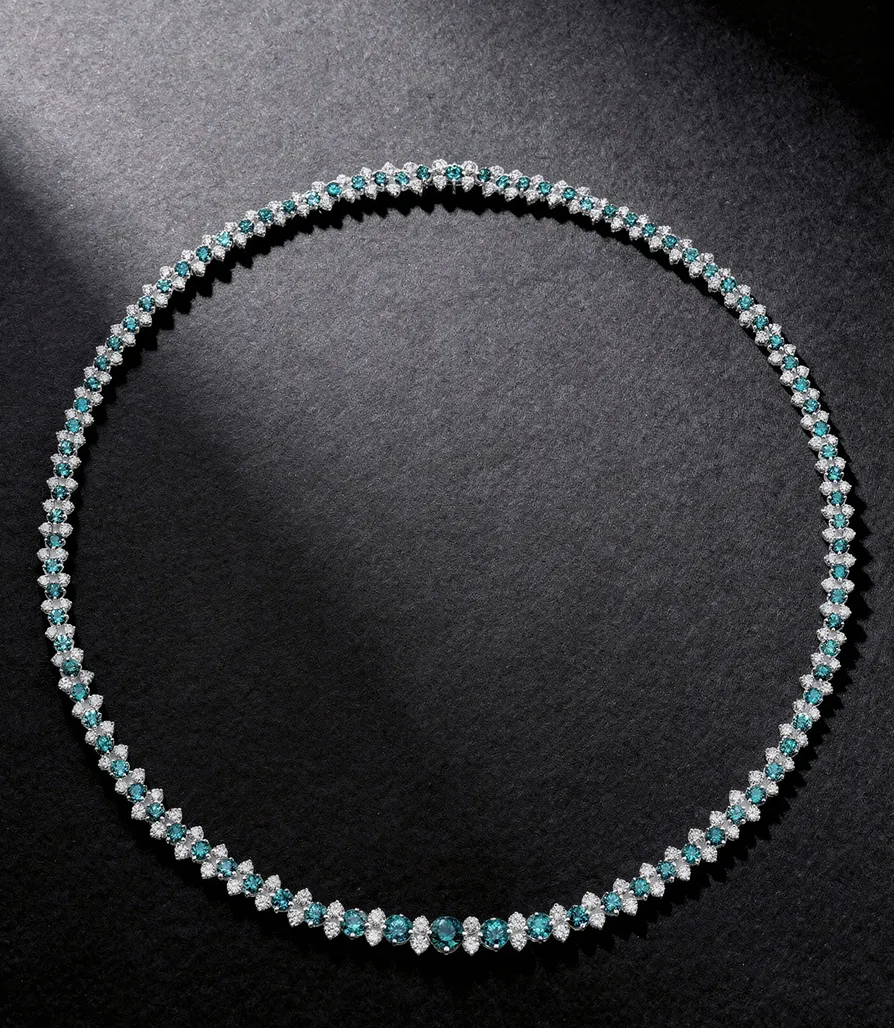
A diamond necklace is assessed on three levels: the main stones with their own laboratory report, the evenness of all other stones in color and clarity, and the execution of setting, links, and clasp. It becomes collectible through rare main stones, an original design, and traceable documentation. The 750 hallmark stands for 75 percent fine gold.
At a glance
- Diamond color scale
- D for colorless to Z for light yellow or light brown, according to GIA
- Clarity scale
- 11 grades from Flawless to I3, graded at tenfold magnification
- 750 hallmark
- 750 thousandths of fine gold, equivalent to 18 karat
- Laboratory report
- Describes quality, states no monetary value
- Emerald in a necklace
- More brittle than corundum, inclusions and clarity enhancement are common
- Collector criteria
- Rarity of the main stones, design, execution, documentation
A necklace has three levels
A necklace is designed as a whole and usually consists of many stones of differing importance. The first level is the main stones, often a center stone or a few larger stones at the front. The second level is the accompanying stones that form the line. The third level is the metal: settings, links, joints, and clasp. Anyone assessing a necklace checks each level on its own and then the interplay.
A classic form is the rivière, French for river: a single row of diamonds that usually grow larger toward the center. There are also necklaces with a dominant center stone, necklaces of several rows, and compositions of set motifs. The more stones involved, the greater the share of setting work in the result. How a necklace can be developed for a particular wearer is described in the guide Necklace made to measure.
Comparing color and clarity in a necklace
GIA describes the color of colorless diamonds on a scale from D to Z. Grading takes place in the laboratory by comparison with stones of known color under controlled light, and many differences are invisible to the untrained eye. The GIA clarity scale comprises eleven grades from Flawless to I3. What counts is what a trained grader can see at tenfold magnification. Both scales apply to the individual stone, not to a piece of jewelry.

In a necklace, therefore, usually only the main stones have their own laboratory report. For the other stones, the maker usually states a range, for example for the color and clarity of the entire quantity of stones. Two necklaces can only be compared if the same details are available: reports for the main stones, the range for the accompanying stones, and total weight separated into main and accompanying stones. If any of these details is missing, the comparison is incomplete.
| Level | What to check | How to recognize it |
|---|---|---|
| Main stones | Color, clarity, cut, weight | Own laboratory report for each stone |
| Accompanying stones | Evenness in color and size | Stated range, viewed under the same light |
| Setting | Seating of each stone, clean prongs | Loupe, no loose stones |
| Links and clasp | Flexibility, safety catch | Drapes without kinks, clasp with lock |
Three levels when comparing diamond necklaces. The total carat weight alone replaces none of these checks.
What makes a necklace collectible
For a collection, what counts is what is rare and traceable. Rarity arises above all from the main stones: high color and clarity grades with high weight, an exceptional cut, or a natural colored diamond. A high total weight made up of many small stones, by contrast, is less rare. The guide High carat weight in a diamond ring explains why weight alone is not a collector's criterion.
- Main stones with a laboratory report whose grades suit the importance of the piece.
- An original design that does more than string stones together.
- Visibly good setting work, on the back as well.
- Complete documentation on stones, metal, and origin of the crafting.
A laboratory report describes quality, not value. GIA stresses that its report is not a certificate, not a guarantee, and states no monetary value. An appraisal is something different: an estimate based on quality and the current market situation. For a collection, both documents make sense. What belongs to a report is explained in the section Authenticity and certificates.
Diamonds alone or with emeralds
A necklace of diamonds alone lives from light and evenness. It can be described comparatively objectively according to the 4Cs and suits almost any wardrobe. A necklace with emeralds sets color against light and is shaped more strongly by the individual colored gemstone. Its assessment is more demanding, because there is no uniform grading for colored gemstones as there is for diamonds. More on this form under Colored gemstone necklace.
Emeralds follow their own rules. According to GIA, bluish green to pure green stones with vivid saturation are the most sought-after. Inclusions, called jardin because of their mossy appearance, are common and accepted even in high-quality stones. Emeralds are more brittle than corundum and often have fissures. The GIA laboratory report classifies a clarity enhancement as minor, moderate, or significant. This detail belongs in the conversation for every emerald.
For a collection, neither variant is inherently more compelling. A pure diamond necklace is easier to compare and document. A necklace with emeralds can be rarer if the emeralds themselves are exceptional, but requires more knowledge about origin and treatment. Anyone weighing both should treat the emeralds as main stones and expect a report for each. An overview is given under Gemstone: Emerald.
What the 750 hallmark means
18k (750) gold contains 750 thousandths of fine gold, that is 75 percent, and is equivalent to 18 karat. According to the World Gold Council, the remaining components are often copper or silver. They determine the color: copper gives rose gold its pink tone, while white gold is made with white metals and is usually rhodium-plated. The glossary explains in more detail under 18k (750) gold what the number means.

In Germany, the German Hallmarking Act (Feingehaltsgesetz) governs this statement. Jewelry may be made in any fineness. If the fineness is stated, it must be stated in thousandths. On jewelry, the hallmark therefore states the thousandths. The mark with company details from § 3 applies to articles such as cutlery and, under § 5, may not appear on jewelry. The supplier is liable for accuracy, and if the hallmark is applied in Germany, so is the owner of that business. For jewelry, the actual content when the entire piece is melted down may be at most ten thousandths below the stated figure.
Typical mistakes when comparing necklaces
- Comparing only the total carat weight without separating main and accompanying stones.
- Viewing necklaces under different light: color differences then become invisible or exaggerated.
- Overlooking the back: it shows how carefully the stones were set.
- Assessing an emerald without information on clarity enhancement.
- Not checking the clasp: without a second safety catch, it carries the entire weight alone.
A common error in thinking concerns length. A necklace that sits too high or too low on the neck loses its effect, no matter how good the stones are. The length should suit the neckline worn most often. For necklaces with a large center stone, weight is added: it should be distributed so that the stone stays at the front and does not turn to the side.
Having a necklace created
Vikar Ahmed crafts jewelry as one-of-a-kind pieces in its in-house atelier in Idar-Oberstein. The path leads through three steps: a design by in-house designers, a three-dimensional CAD rendering, and execution, with gemstone setting and polishing by hand. The pieces shown by the house include colorless diamonds, D Flawless diamonds, and Colombian emeralds, set in 18k (750) white and rose gold. For emeralds, the house accepts only light colorless oiling, no artificial resins and no colored oil.
Whether a necklace should be made of diamonds alone or with colored gemstones can be explored in the design before a single stone is set. With a necklace, it is worth asking which stones come with a report and which laboratory issued it. Well-known independent laboratories include GIA and SSEF. The report number lets you check a report online where the laboratory offers this. Further guidance on large forms at the neck is given in the guide Statement necklace.
Frequently asked questions
Diamond necklace alone or with emeralds: which is more compelling for a collection?
Neither variant is inherently more compelling. A pure diamond necklace can be compared and documented well according to the 4Cs. With emeralds, the piece becomes more colorful and can be rarer if the emeralds are exceptional. Then color, clarity enhancement, and a separate report for each larger emerald count.
Which diamond necklaces are particularly interesting for my High Jewelry collection?
Those with rare main stones and complete documentation. High color and clarity grades with high weight, natural colored diamonds, an original design, and visibly good setting work are of interest. A high total weight made up of many small stones does not on its own make a necklace collectible.
Compare diamond necklaces in Trier by color and clarity.
First compare the reports for the main stones, then the ranges for color and clarity of the accompanying stones, all under the same light. Vikar Ahmed has no location in Trier and offers consultations in Idar-Oberstein or virtually. Notes on the journey under Jeweler for clients from Trier.
Does every diamond in a necklace have its own laboratory report?
As a rule, no. Usually the main stones have their own report. For the many small accompanying stones, the maker usually states a range for color and clarity. What matters is that these details are available in writing and are consistent with the total weight.
What does the 750 hallmark mean on a necklace?
It means 750 thousandths of fine gold, that is 75 percent, equivalent to 18 karat. Under the German Hallmarking Act (Feingehaltsgesetz), the fineness on jewelry is stamped in thousandths, without the official company mark from § 3. The supplier is liable for its accuracy.
Does a laboratory report say anything about the value of a necklace?
No. A report describes the quality of an individual stone and, according to GIA, states no monetary value. The value is estimated in an appraisal based on quality and market conditions. For an entire necklace, design, metal, and workmanship also play a part.
Private consultation
A necklace looks different on the neck than on the table. Whether it should be diamonds alone or with colored gemstones is best clarified in conversation. Vikar Ahmed offers consultations in the showroom in Idar-Oberstein by appointment or in a virtual appointment, with the utmost discretion. Request an appointment for a private consultation.
Further reading
- Necklace made to measure
- Colored gemstone necklace
- Glossary: Necklace
- Glossary: D Flawless
- Gemstone: Emerald
Sources
- GIA: 4Cs Color, accessed 2026-11-17
- GIA: 4Cs Clarity, accessed 2026-11-17
- GIA: Emerald Quality Factors, accessed 2026-11-17
- GIA 4Cs: Grading Report und Appraisal, accessed 2026-11-17
- Gesetz über den Feingehalt der Gold- und Silberwaren (FeinGehG), accessed 2026-11-17
- World Gold Council: About gold jewellery, accessed 2026-11-17
- Vikar Ahmed: Kollektionen, accessed 2026-11-16
- Vikar Ahmed: Bespoke, Designprozess, accessed 2026-11-16
- GIA: Gem Laboratory, accessed 2026-11-17
- SSEF Swiss Gemmological Institute, accessed 2026-11-17

A personal conversation starts here.
At the showroom in Idar-Oberstein or by video. Vikar Ahmed discusses your ideas, stones and designs with you and answers your questions calmly and in confidence.


Thank you for your request.
Your request will be handled with the utmost attention and discretion. Vikar Ahmed will get back to you.
Your details
Request
–
Occasion
–
Consultation
–
Contact
–
In the meantime
Insights: What is a Paraíba tourmaline? · Engagement ring to your own design: how does it work?
Confidential and without obligation
Back to the pagePrivate consultation
A personal conversation starts here.
- Time for your questions, wishes and ideas
- In the showroom in Idar-Oberstein or by video
- Confidential, discreet and without obligation
Vikar Ahmed · Hauptstraße 111 · 55743 Idar-Oberstein, Germany