

Statement Necklace with Emerald or Rubellite?
Green or red, beryl or tourmaline: for a necklace that defines the evening, emerald and rubellite are two very different decisions.
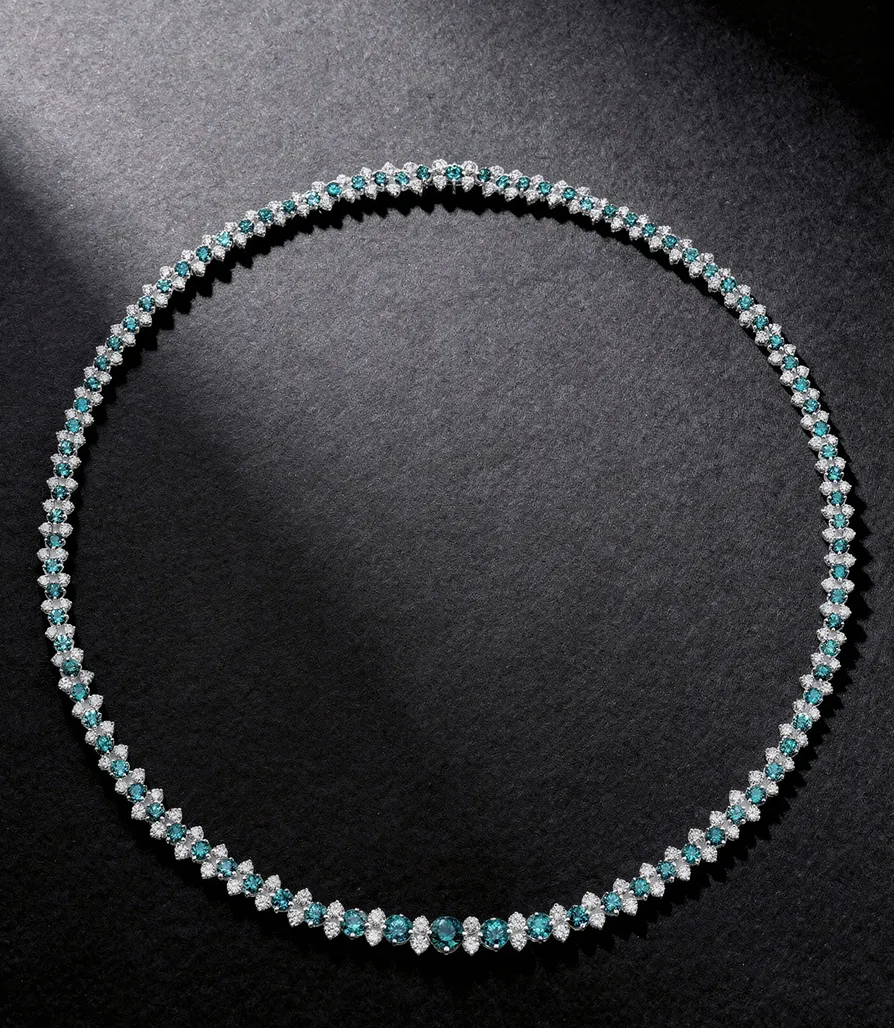
In comparable top quality, emerald is the rarer choice, especially with minimally filled stones and larger sizes. Rubellite is among the readily available tourmaline colors, which makes larger, matched rows easier. Both look timeless when the color is strong, the treatment is disclosed, and the composition of the necklace remains calm.
At a glance
- Emerald
- Green variety of beryl, color from chromium, vanadium, and iron
- Rubellite
- Trade name for pink to red tourmaline, color from manganese
- Mohs hardness
- Emerald 7.5 to 8, tourmaline 7 to 7.5
- Typical emerald treatment
- Filling of fissures with oil or resin, common according to CIBJO
- Typical rubellite treatment
- Irradiation, common according to CIBJO, plus resin fillings
- Rarer in top quality
- Emerald, especially eye-clean and barely filled
Emerald is the rarer choice
Both stones exist in many qualities, and rarity arises only at the top. In emerald, according to the Gemological Institute of America, GIA for short, inclusions are the rule, and eye-clean stones are considered especially valuable because they are so rare. The Swiss laboratory SSEF calls high-quality untreated emeralds without fissures very rare. GIA, by contrast, describes rubellite as one of the most sought-after and at the same time readily available tourmaline colors. A fine rubellite is a beautiful stone, but not one the market has to search for long.
For a statement necklace, the question shifts once more. It often carries several larger stones that must match one another. With emerald, according to GIA the price rises sharply with size, and stones over 20 carats are found only in important pieces. With tourmaline, the price per carat for comparable quality usually rises from about five carats. Assembling a row of large, similarly colored emeralds is therefore considerably more difficult than a row of rubellites of matching appearance.
Two colors, two mineral families
Emerald is a variety of beryl. Its color is caused by chromium, vanadium, and iron. Sought after is a bluish to pure green of strong saturation, evenly distributed and not too dark. If the tone becomes too yellowish or too bluish, according to GIA it is no longer called emerald but another beryl variety. Colombian emeralds are said to have a warmer, more intense green, but the appearance of stones from different sources overlaps.

Rubellite is a tourmaline. GIA understands the trade name to mean pink, red, purplish red, orangy red, or brownish red stones, although some in the trade reserve the name for the strong tones. The color goes back to manganese. Pink and red tourmalines often show inclusions visible to the naked eye. They are accepted as long as the color is strong and the inclusions are not disturbing. With rubellite, therefore, color carries the stone; with emerald, clarity as well.
Treatment, hardness, and care compared
| Criterion | Emerald | Rubellite |
|---|---|---|
| Mineral | Beryl | Tourmaline |
| Mohs hardness | 7.5 to 8, toughness fair to good | 7 to 7.5, toughness fair |
| Untreated according to CIBJO | Very rare | Rare |
| Common treatment | Oil or resin in fissures | Irradiation, resin in fissures |
| Stability according to CIBJO | Fillings not permanent | Irradiation stable, fillings not permanent |
| Cleaning according to GIA | Warm soapy water, no ultrasonic | Warm soapy water, no ultrasonic or steam |
Information according to GIA and the CIBJO Gemstone Blue Book. The information describes what is common in the trade, not every individual stone.
The table shows a point that matters for a necklace over decades. In emerald, fillings with oil or resin are the rule, and according to GIA light and chemicals can change their appearance. In rubellite, the most common treatment is irradiation. The World Jewellery Confederation (CIBJO) classifies it as stable, but GIA points out that color produced by irradiation can fade under heat or bright light. For both stones, the treatment therefore belongs with the necklace in writing.
In the evening: effect with your attire
A statement necklace is rarely seen on its own. It stands against fabric, skin, and light, and all three change its effect. An emerald collier sets a cool, deep accent. Against black, white, and muted tones it looks calm and classic, against strong colors it can quickly look busy. A rubellite collier is warmer and more striking. Against black and midnight blue its red glows, against pink and red it loses contour. The question is therefore less which stone suits evening attire than which attire.
A technical point is added. According to a GIA article, lighter stones that show a window take on the color of the background, in a pendant that of the skin or fabric. In strongly colored stones this is less noticeable. For a collier worn against a deep neckline or a colored dress, richly colored and well-cut stones are therefore doubly important. What separates a collier from a simple pendant is explained in the glossary.
What makes a necklace timeless over decades
A necklace is timeless when its effect comes from the stones and not from a seasonal effect. With emerald and rubellite, this succeeds with few means: a clear line, stones that match in hue and saturation, and a setting that recedes. According to SSEF, emeralds were already mined in ancient Egypt, and their green therefore looks familiar and classic. Rubellite is less fixed in its associations and looks freer. Both can carry over decades if the design remains calm.

What matters in the composition
- One main stone or a clear sequence of stones instead of many equally loud elements.
- Stones that match in hue and saturation under daylight and evening light.
- Settings that protect corners and edges, especially with the brittle emerald.
- A length that suits the necklines you wear most often.
- A clasp with a safety catch that matches the weight of the stones.
Typical mistakes in the choice
- Deciding by rarity alone and overlooking your own color in the process.
- Taking a rubellite for a ruby because of its name. It is not related to ruby.
- Not reading the amount of filling in the report for emeralds.
- Assembling a collier from stones that match only under one type of light.
- Cleaning filled emeralds or rubellites in an ultrasonic bath.
For the care of both stones, GIA recommends warm soapy water and a soft brush. Ultrasonic cleaning can weaken already fissured emeralds, and steam can drive oil or unhardened resin out of the fissures. According to GIA, tourmaline does not tolerate sudden temperature changes well. A statement necklace is worn less often than a ring and is therefore exposed to fewer knocks. It should, however, be stored separately and softly after each wear. How colored stones are combined in a collier is described in the guide Colored gemstone collier.
Emerald and rubellite at Vikar Ahmed
The pieces of Vikar Ahmed shown include both Colombian emeralds and rubellites. A necklace made to your own wishes is created by the house in three steps: design by the in-house designers, three-dimensional visualization, and realization as a one-of-a-kind piece in the in-house atelier in Idar-Oberstein. The visualization makes it possible to check the effect of the stone sequence before production. With emerald, Vikar Ahmed accepts only light colorless oiling, with rubellite fine inclusions as long as they do not dull its brilliance, and the house states every treatment in writing. The path to your own piece is described in the guide Bespoke collier.
Frequently asked questions
Emeralds or rubellites in a statement necklace: which is the rarer choice?
Emerald, when comparing the same top quality. Eye-clean, barely filled emeralds are very rare, and large matched rows even more so. According to GIA, rubellite is among the readily available tourmaline colors. Rarity, however, is only one standard: a strongly red rubellite can be more convincing in a necklace than a mediocre emerald.
Does a rubellite or an emerald collier suit evening attire better?
Both suit it, but with different clothing. An emerald collier looks calm and classic against black, white, and muted tones. A rubellite collier is warmer and glows against black or midnight blue, but loses contour against red and pink. What decides is the attire with which you will wear the collier most often.
I live in Trier and am torn between a necklace with Colombian emeralds and one with rubellite. Which looks more timeless in the long run?
Emerald looks more classic because its green has been familiar in jewelry since antiquity, while rubellite looks freer. Both become timeless through a calm composition and strong color. Vikar Ahmed has no location in Trier and advises in Idar-Oberstein, more under Jeweler for clients from Trier.
Is rubellite related to ruby?
No. Rubellite is a tourmaline, ruby a corundum. The names are similar because of the color, but mineral, hardness, and formation differ. A laboratory report states the species unambiguously and prevents a name from promising more than the stone is.
Which stone is more delicate in a collier, emerald or rubellite?
Both require care, but for different reasons. Emerald is harder, but usually fissured and filled, and heat and ultrasonic cleaning harm it. Rubellite is somewhat softer and of fair toughness, and sudden temperature changes can cause it to fracture. In a necklace, both are less at risk than on the finger.
Which information should accompany an emerald or rubellite necklace?
The species, the treatment of each main stone and, for emeralds, the amount of filling, ideally documented by the report of an independent laboratory. In addition, the fineness of the metal and care instructions. According to CIBJO, the treatment belongs in writing next to the name of the stone.
Private consultation
Whether emerald or rubellite is best seen when you view both colors on yourself and under evening light. Vikar Ahmed advises in the showroom in Idar-Oberstein by appointment, and in a virtual appointment on request. Your inquiry is treated discreetly. Request an appointment for a private consultation.
Further reading
- Rubellite necklace
- Emerald or tourmaline for a one-of-a-kind piece?
- Gemstone: Rubellite
- Rubellite or ruby
- How emeralds are treated
Sources
- GIA: Emerald Quality Factors, accessed 2026-11-17
- GIA: Emerald Care and Cleaning Guide, accessed 2026-11-17
- GIA: Tourmaline Quality Factors, accessed 2026-11-17
- GIA: Tourmaline Description, accessed 2026-11-17
- GIA: Tourmaline Care and Cleaning Guide, accessed 2026-11-17
- GIA, Al Gilbertson: Value Factors, Design, and Cut Quality of Colored Gemstones (The GemGuide 2016), accessed 2026-11-17
- SSEF: Emerald, accessed 2026-11-17
- CIBJO: The Gemstone Blue Book 2026, accessed 2026-11-17
- Vikar Ahmed: Collections, accessed 2026-11-16

A personal conversation starts here.
At the showroom in Idar-Oberstein or by video. Vikar Ahmed discusses your ideas, stones and designs with you and answers your questions calmly and in confidence.


Thank you for your request.
Your request will be handled with the utmost attention and discretion. Vikar Ahmed will get back to you.
Your details
Request
–
Occasion
–
Consultation
–
Contact
–
In the meantime
Insights: What is a Paraíba tourmaline? · Engagement ring to your own design: how does it work?
Confidential and without obligation
Back to the pagePrivate consultation
A personal conversation starts here.
- Time for your questions, wishes and ideas
- In the showroom in Idar-Oberstein or by video
- Confidential, discreet and without obligation
Vikar Ahmed · Hauptstraße 111 · 55743 Idar-Oberstein, Germany