

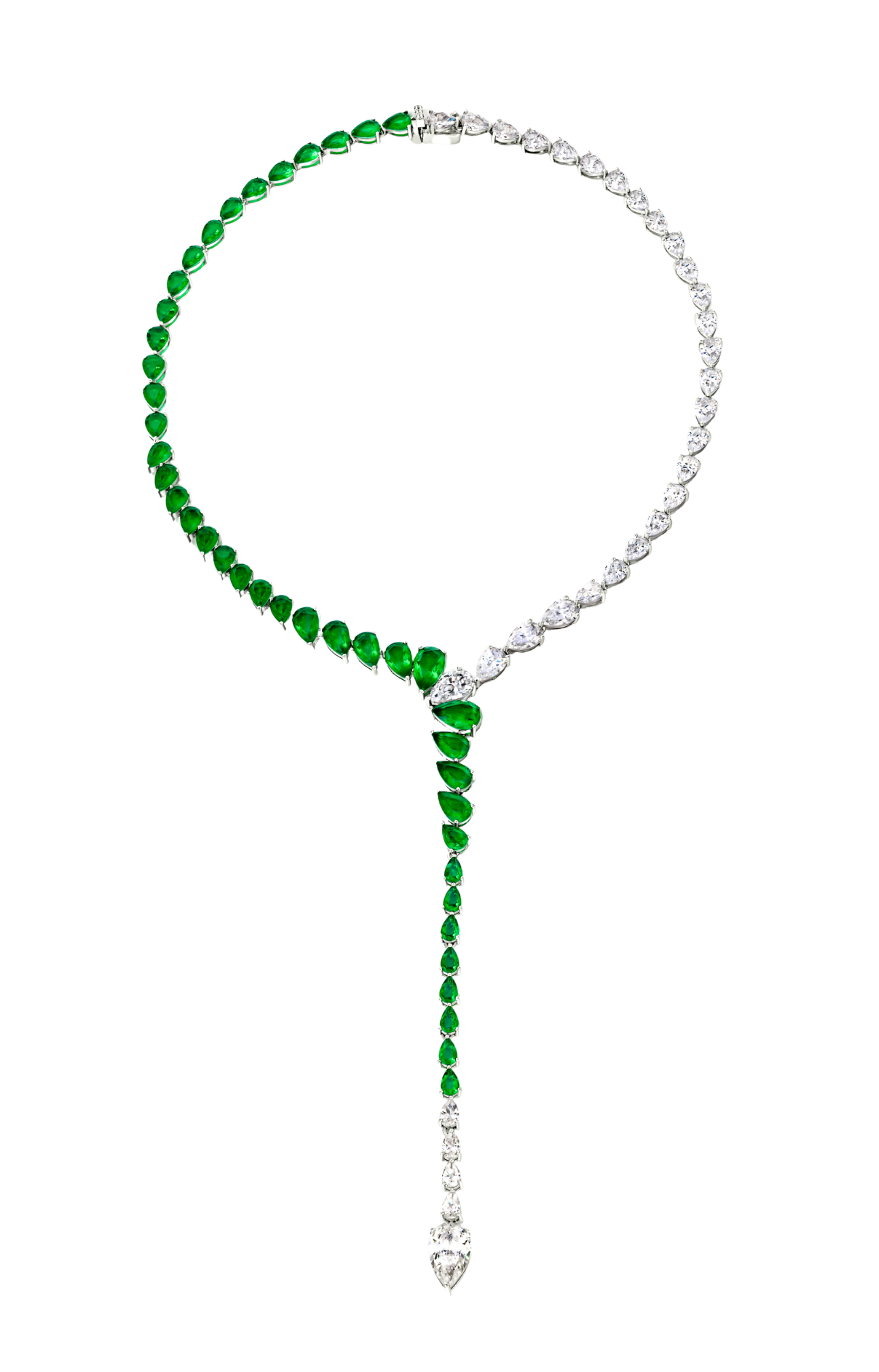
An emerald is worthwhile when the necklace is meant to live from the classic bluish to pure green of beryl and inclusions are accepted as part of the stone. A tourmaline suits when a different color, a very clean stone, or a larger surface is desired. Color, treatment, and the stone's role in the design decide.
At a glance
- Mineral
- Emerald: a variety of beryl. Tourmaline: a group of related mineral species
- Mohs hardness
- Emerald 7.5 to 8, tourmaline 7 to 7.5
- Toughness according to GIA
- Emerald fair to good, tourmaline fair
- Common treatment
- Emerald: filling of fissures. Tourmaline: heating, irradiation
- Colors
- Emerald only green to bluish green, tourmaline in nearly every color
- GIA origin report
- Available for emerald, for tourmaline only for Paraíba tourmaline
Two stones, two mineral families
Emerald is the green to bluish green variety of beryl, the same mineral species to which aquamarine belongs. If a green beryl is too light, gemologists classify it not as emerald but as green beryl. The name emerald is therefore tied to a minimum color. Choosing an emerald means choosing a particular color in a particular mineral species. More about the stone is on the page Emerald.
Tourmaline, by contrast, is not a single mineral. The name stands for a group of closely related mineral species with the same crystal structure, among them elbaite, liddicoatite, dravite, uvite, and schorl. Most tourmalines used in jewelry are elbaites. Green is one color among many in tourmaline. For the design of a necklace, this means: with emerald the color is fixed, with tourmaline the choice begins with the question of which color the piece should carry.
Color: a fixed green or an open palette
In emerald, the colors are caused by chromium, vanadium, and iron. GIA values bluish green to pure green with strong saturation and a tone that is not too dark most highly. The color should be evenly distributed, without color zoning visible to the naked eye. If a stone appears too yellowish or too bluish, it moves toward another beryl variety, and its value decreases.

In tourmaline, traces of iron and possibly titanium produce green and blue, while manganese causes red and pink. The trade uses its own names: rubellite for pink to red, indicolite for blue, chrome tourmaline for intense green. According to GIA, the green of chrome tourmaline comes mainly from vanadium, not from chromium. Dark, olive green tourmalines are common but are considered less attractive and are valued considerably lower.
Good to know
GIA explicitly names chrome tourmaline as a possible alternative to emerald when a saturated green is sought. The stone lacks the name and history of emerald, however, and its green appears different. A side-by-side comparison clarifies more than any description.
Clarity and treatment call for different questions
Almost every emerald has inclusions visible to the naked eye. The trade accepts them even in fine stones and, because of their mossy appearance, calls them jardin, French for garden. According to GIA, eye-clean emeralds are especially valuable because they are so rare. Estimates suggest that 90 percent or more of emeralds have their fissures filled, with oil, wax, natural resin, or synthetic resin.
In tourmaline, the standard depends on the color. Green tourmalines should be free of visible inclusions, while in red and pink, inclusions are more readily accepted if the color is strong. The important treatments are heating and irradiation. According to GIA, a color change by heating is stable and not detectable. Irradiated colors can fade under heat or strong light. The guide Tourmalines and their treatment explains the details.
For the selection, this means: with emerald, you ask about the type and amount of fissure filling. SSEF grades it in its report as none, minor, moderate, or significant, GIA as minor, moderate, or significant. With tourmaline, you ask which treatments are detectable and which cannot be ruled out. What the laboratories can establish is explained under Treatment and in the guide Emerald and treatment.
Durability in a necklace
At 7.5 to 8 on the Mohs scale, emerald is slightly harder than tourmaline at 7 to 7.5. In toughness, meaning resistance to breaking and chipping, the two are close: GIA rates emerald as fair to good and tourmaline as fair. Emerald is more brittle than ruby and sapphire and requires more care in cutting, setting, and wearing. Heat can widen existing fissures.
Tourmaline is generally stable to light and is not attacked by chemicals. In emerald, by contrast, light and chemicals can alter the fillers in the fissures. Heat and sudden temperature changes are a risk for both stones. Both are cleaned with warm soapy water, and GIA does not recommend ultrasonic or steam cleaners. Around the neck, a stone is exposed to knocks less often than on the finger, which benefits both.
Size, cut, and shape in the design
The most common cut for emeralds is the emerald cut. Its beveled corners are less vulnerable and give the prongs a secure place. Because most emeralds have distinct fissures, the cutter plans the stone around these areas. According to GIA, emeralds of 1 to 5 carats are popular as center stones. At equal quality, value rises considerably with size.

Tourmalines grow in elongated crystals. Cutters therefore often fashion long rectangles parallel to the crystal axis to lose little material. The stone is strongly pleochroic: depending on the viewing direction, it shows colors of differing depth, and the orientation of the table determines whether it appears lighter or darker. According to GIA, chrome tourmaline is readily found up to five carats, while emerald is rare above two carats.
| Criterion | Emerald | Tourmaline |
|---|---|---|
| Color | Green to bluish green | Almost every color, including multicolored |
| Inclusions | Usually visible, accepted as jardin | Undesirable in green, more accepted in red |
| Common treatment | Fissure filling with oil or resin | Heating, irradiation |
| Mohs hardness | 7.5 to 8 | 7 to 7.5 |
| Sensitive to | Heat, ultrasonic, steam, chemicals | Heat, temperature changes, ultrasonic, steam |
| Typical cuts | Emerald cut | Long rectangles, also oval and pear |
| GIA origin report | Available | Only for Paraíba tourmaline |
Information according to GIA and SSEF. The effect of an individual stone always depends on color, cut, and setting.
What the report clarifies for each stone
For emeralds, GIA offers a report with geographic origin. SSEF explicitly describes origin determination as an expert opinion, based on inclusions, trace elements, and spectra compared with reference stones. GIA does not assign a clarity grade to emerald as it does for diamond; it only grades the extent of fissure filling. More on this in the guide Colombian emeralds.
For tourmaline, an identification report names the stone and lists the detectable treatments. Within the tourmaline group, GIA confirms an origin only for Paraíba tourmaline, whose color is due to copper. If you are torn between emerald and Paraíba tourmaline, the guide Emerald or Paraíba offers the comparison. Independent laboratories such as GIA and SSEF issue such reports. For colored gemstones, Vikar Ahmed works with Gübelin, SSEF, GRS, and the DGemG.
Which stone suits whom
Emerald suits when the necklace is meant to live from the classic green and you value a stone with a visible inner life. It requires a setting that protects corners and edges, and a wearer who keeps heat, ultrasonic cleaning, and cosmetics away from the stone. Vikar Ahmed works mainly with emeralds from Colombia, supplemented by Zambia, and accepts only light colorless oiling. An origin such as Colombia, however, is a laboratory's assessment and only reliable with a corresponding report.
Tourmaline suits when the necklace is meant to carry a color of its own, such as a strong red, a blue, or a pure green without visible inclusions. It offers more latitude in shape and size, particularly with elongated stones. The pieces by Vikar Ahmed include rubellite, Namibian tourmaline, lagoon tourmaline, and Paraíba tourmaline. How a necklace is created as a one-of-a-kind piece is described in the guide Bespoke necklace.
Frequently asked questions
Is an emerald worth it over a tourmaline if I commission a necklace as a one-of-a-kind piece?
Yes, if the classic emerald green is meant to carry the piece and inclusions are allowed to be part of it. If you are looking for a different color, greater clarity, or a larger surface, a tourmaline is often the better fit. Neither stone is fundamentally the better choice. The color, treatment, and quality of the individual stone decide.
Can a green tourmaline look like an emerald?
A chrome tourmaline can show a similarly saturated green, and GIA even names it as a possible alternative. Mineralogically, it remains a tourmaline and may not be called an emerald. Differences show in the hue, in the inclusions, and most reliably in the laboratory report.
Is an emerald in a necklace more delicate than a tourmaline?
In terms of care, yes. Both stones have fair toughness, but in emerald, light, chemicals, and heat can alter the filling of the fissures. Tourmaline reacts mainly to heat and sudden temperature changes. Ultrasonic and steam cleaning are unsuitable for both.
Why is almost every emerald treated?
Because emeralds, owing to how they form, almost always have fine fissures. These are filled with colorless substances such as oil or resin so that they are less noticeable. This is common practice in the trade and must be disclosed. The laboratory report states the amount of filling, from minor to significant.
Which cut suits emerald and tourmaline in a necklace?
For emerald, the emerald cut is customary because its beveled corners protect the brittle stone. Tourmalines are often cut as long rectangles that follow the crystal shape. Ovals and pears are possible for both and hang calmly on a necklace when the suspension matches the weight of the stone.
Can a laboratory determine the origin of a tourmaline?
At GIA, only for Paraíba tourmaline. For other tourmalines, the report confirms the identity and the detectable treatments, but no locality. For emerald, by contrast, an origin report is common; it is considered a reasoned expert opinion of the laboratory.
Private consultation
Whether emerald or tourmaline suits your necklace is best seen on the stone itself and in the design. Vikar Ahmed advises in the showroom in Idar-Oberstein by appointment or in a virtual appointment. Your inquiry is handled discreetly. Request an appointment for a private consultation.
Further reading
- Gemstone: Emerald
- Gemstone: Tourmaline
- Glossary: Necklace
- Designing a colored gemstone necklace
- Emerald or sapphire
Sources
- GIA: Emerald Description, accessed 2026-11-17
- GIA: Emerald Quality Factors, accessed 2026-11-17
- GIA: Emerald Care and Cleaning, accessed 2026-11-17
- GIA: Tourmaline Description, accessed 2026-11-17
- GIA: Tourmaline Quality Factors, accessed 2026-11-17
- GIA: Tourmaline Care and Cleaning, accessed 2026-11-17
- SSEF: Emerald, accessed 2026-11-17
- GIA: Colored Stone Reports, accessed 2026-11-17

A personal conversation starts here.
At the showroom in Idar-Oberstein or by video. Vikar Ahmed discusses your ideas, stones and designs with you and answers your questions calmly and in confidence.


Thank you for your request.
Your request will be handled with the utmost attention and discretion. Vikar Ahmed will get back to you.
Your details
Request
–
Occasion
–
Consultation
–
Contact
–
In the meantime
Insights: What is a Paraíba tourmaline? · Engagement ring to your own design: how does it work?
Confidential and without obligation
Back to the pagePrivate consultation
A personal conversation starts here.
- Time for your questions, wishes and ideas
- In the showroom in Idar-Oberstein or by video
- Confidential, discreet and without obligation
Vikar Ahmed · Hauptstraße 111 · 55743 Idar-Oberstein, Germany