

Emerald or Paraíba Tourmaline?
One stone with millennia of history, one with a few decades. What this means for a bespoke necklace and for a collection is shown by direct comparison.
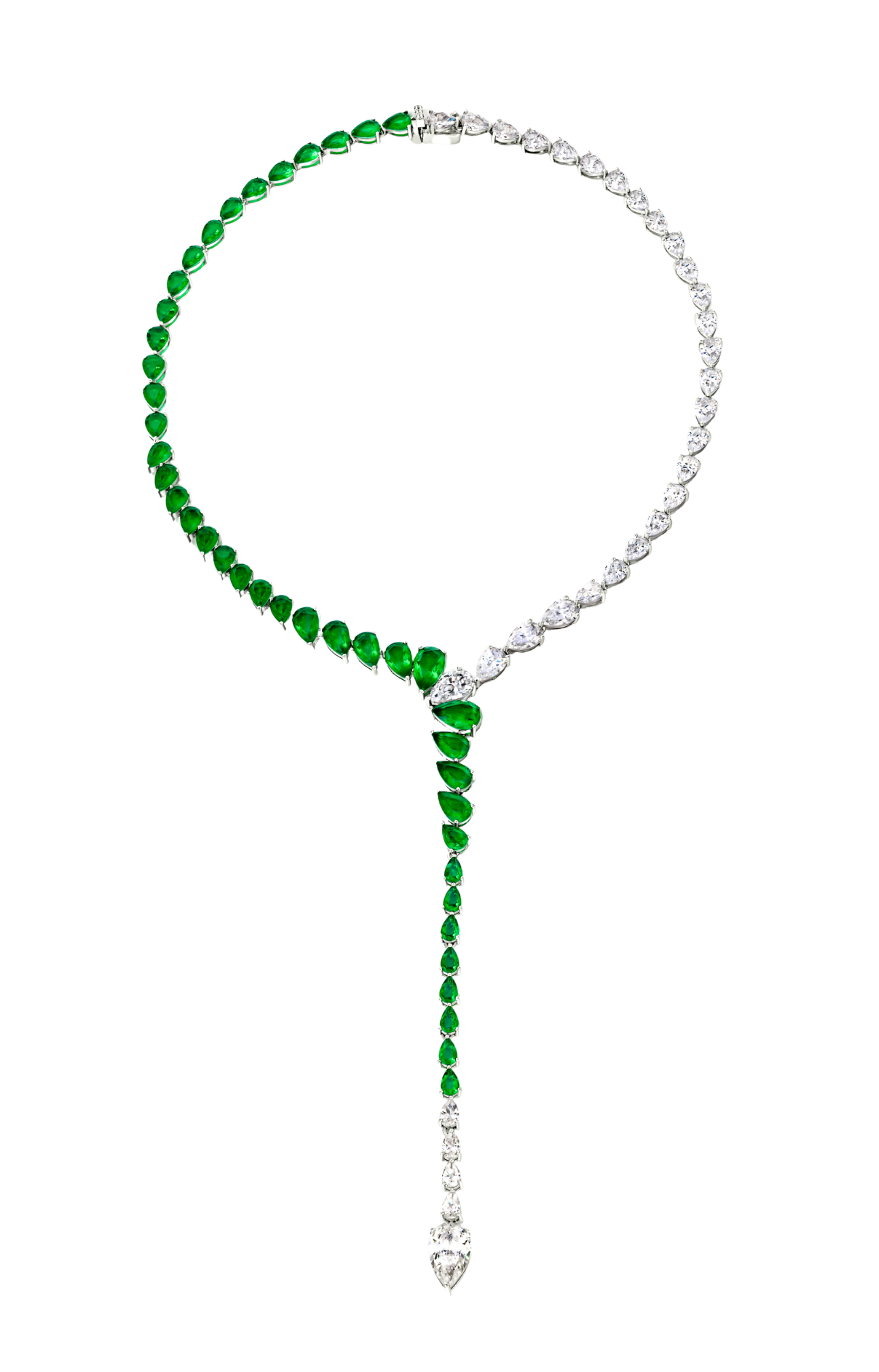
For a necklace that is meant to appear calm over decades, emerald is the classic choice, because its green has been part of the history of jewelry for millennia. Paraíba tourmaline has only been known since the late 1980s, glows more intensely, and is rare above one carat. For a collection, it is the younger, rarer stone, emerald the historically deeper one.
At a glance
- Emerald
- Bluish green to green variety of beryl
- Paraíba tourmaline
- Tourmaline in blue to green, color caused primarily by copper and manganese
- Mohs hardness
- Emerald 7.5 to 8, tourmaline 7 to 7.5
- Known since
- Emerald since antiquity, Paraíba tourmaline since the late 1980s
- Usual treatment
- Emerald usually fissure-filled, Paraíba tourmaline frequently heated
- Origin report
- Available from GIA for emerald and Paraíba tourmaline
Two stones, two kinds of color
According to the Gemological Institute of America, GIA for short, emerald is the bluish green to green variety of beryl. Paraíba tourmaline is a tourmaline in blue, blue-green, or green whose color is based primarily on copper and manganese. In the green range, the two stones can come close to each other. The impression remains different: a fine emerald appears deep and velvety, a fine Paraíba tourmaline seems to glow from within.
For a necklace, this means that emerald sets a calm, rich accent of color that combines equally well with white gold, rose gold, and diamonds. Paraíba tourmaline draws the eye more strongly and appears more modern. For a collection, on the other hand, what counts is less the effect at the neck than the history of the stone, its rarity, and how well both can be documented. The following chapters separate these two questions.
Both stones by the same criteria
| Criterion | Emerald | Paraíba tourmaline |
|---|---|---|
| Mineral | Beryl | Tourmaline |
| Color | Bluish green to pure green | Blue, greenish blue, blue-green, green, also violet |
| Boundary of the name | Green that is too light is called green beryl | Copper and manganese as the cause of color, sufficient saturation |
| Known since | Antiquity, first mines in Egypt | Late 1980s, state of Paraíba in Brazil |
| Size | Price rises sharply with size | Rare over one carat |
| Inclusions | Visible to the naked eye is typical | Color counts more than clarity |
| Usual treatment | Filling of fissures with oil or resin | Heating, not always detectable |
| Hardness and toughness | 7.5 to 8, toughness fair to good | 7 to 7.5, toughness fair |
Information according to GIA, SSEF, and LMHC. Individual stones may deviate from the typical values.
The table shows two different kinds of rarity. With emerald, the combination is rare: vivid green, good transparency, and few visible inclusions in a large stone. According to GIA, eye-clean emeralds are particularly valuable for precisely this reason. With Paraíba tourmaline, the material itself is rare, and large stones even more so. If you choose between the two, you are therefore also deciding which kind of rarity matters more to you.

What makes a necklace appear timeless
Emerald has a long visual language. The Swiss Gemmological Institute SSEF writes that emeralds have been valued for millennia for their saturated green. GIA refers to the first known mines in Egypt and to Cleopatra, who wore emeralds in her royal jewelry. Emeralds from present-day Colombia became part of the spoils of Spanish conquistadors in the 16th century. An emerald necklace connects to this tradition and therefore rarely appears to be a fashion.
Paraíba tourmaline does not have this history. According to GIA, the Paraíba region has been known since the late 1980s as a source of unusually intense tourmaline colors. This does not make a Paraíba necklace short-lived, but it is read differently: as a deliberate, contemporary choice. In the end, a necklace appears timeless above all through its design. Clear proportions, a calm setting, and a center stone that is not overwhelmed by too many accent stones age well with both stones.
Good to know
According to GIA, people in earlier times often mistook tourmalines for other stones because of their color. A Spanish conquistador is said to have mistaken a green tourmaline crystal for an emerald in Brazil in the 16th century. Tourmaline was only recognized as a mineral species of its own in the 19th century.
The center stone in a bespoke necklace
In a necklace, the center stone carries the entire design, and its size determines the proportions. For emerald, the emerald cut is, according to GIA, the most common cut. Its beveled corners protect the most vulnerable points and give the prongs a hold. The elongated shape suits a necklace that falls calmly at the center. At the same quality, the price of an emerald rises sharply with size, according to GIA. A large center stone with strong color is therefore always a deliberate decision.
With Paraíba tourmaline, size is more narrowly limited. According to GIA, stones over one carat are seen only rarely, and color is the decisive value factor, not weight. Because of the high value of the rough material, Paraíba tourmalines are almost always cut individually, usually as brilliant cuts in pear or oval shapes. A Paraíba necklace is therefore often planned around a smaller, glowing stone that diamonds or the shape of the necklace make appear larger. How size and color interact is explained in Paraíba: size or color.
What makes each stone compelling for a collection
With emerald, you collect history and origin. SSEF names historical sources such as ancient Egypt, the Swat Valley in present-day Pakistan, and Austria, as well as present-day sources such as Colombia, Zambia, Brazil, Afghanistan, Ethiopia, and Madagascar. A stone with documented origin and minor fissure filling is a collector's piece with clear criteria. How laboratories determine origin is shown in Colombian emeralds.

With Paraíba tourmaline, you collect a young, scarce variety with an open debate about its name. The Laboratory Manual Harmonisation Committee, LMHC for short, in which GIA, SSEF, and Gübelin are represented among others, calls copper- and manganese-bearing tourmalines of a matching color Paraíba regardless of the country of origin. In its reports, SSEF lists only Brazilian stones as Paraíba tourmaline, and stones from Nigeria or Mozambique as tourmaline with a note on the trade name. For collectors, the origin is therefore part of the stone. More under Paraíba as a collector's piece.
Treatment and report answer different questions
Almost all emeralds have noticeable fissures. According to estimates cited by GIA, 90 percent or more are filled in these fissures, with oil, resins, or polymers. SSEF grades the filling in its report on four levels, from no indications to significant, in each case at the time of testing. According to SSEF and LMHC, Paraíba tourmalines are frequently heated. Whether an individual stone has been heated cannot currently be determined in every case. SSEF describes the color in this case as stable. With emerald, Vikar Ahmed accepts only light colorless oiling and rejects synthetic resins and colored oil.
- Emerald: Does the report state the type and amount of fissure filling, and what is its date?
- Paraíba tourmaline: Does the report confirm copper and manganese as the cause of color?
- Paraíba tourmaline: What is the designation in the report, and which origin is stated?
- Both: Is a report with an origin statement advisable, because the origin helps determine the value?
- Both: Was the report issued by an independent laboratory, and does it match the mounted stone?
GIA offers an identification report, which determines the material and names detectable treatments, and a report with an additional origin statement. Emerald and Paraíba tourmaline are among the few stones for which GIA determines the origin. What the report says about fissure filling is explained in Emerald and treatment, and the route to confirming a Paraíba in How can you recognize a genuine Paraíba tourmaline?.
Wear and care at the neck
At the neck, both stones are better protected than on the finger. Nevertheless, they differ. At 7.5 to 8 on the Mohs scale, emerald is somewhat harder, but according to GIA more brittle than corundum, and its fillers can age through light, chemicals, and heat. Perfume and cosmetics should therefore be dry before the necklace is put on. At 7 to 7.5, tourmaline is softer, but according to GIA it is considered stable to light and is not attacked by chemicals.
Both share a sensitivity to heat. With emerald, it can widen existing fissures; with tourmaline, it can alter the color, and a rapid change in temperature can cause fractures. GIA recommends ultrasonic and steam cleaners for neither of the two stones. With emerald, ultrasonic vibrations can weaken stones that already have fissures, and steam can drive oil or unhardened resin out of the fissures. Warm soapy water and gentle brushing are sufficient.
Which stone suits whom
Emerald suits a necklace that is to be passed down through generations and connects to a long jewelry tradition. It allows larger, elongated center stones and requires a willingness to accept visible inclusions and disclosed fissure filling. For collectors, it is the stone with the deeper history and readily comparable criteria. A first overview is given in Emerald.
Paraíba tourmaline suits a necklace that deliberately appears modern and lives from a color that no other stone shows in the same way. It requires patience in the search and a smaller center stone that is cleverly framed. For collectors, it is the younger, scarcer choice, for which report, designation, and origin are read closely. If you appreciate both, the colored gemstone necklace shows ways to combine the stones.
Frequently asked questions
Emerald or Paraíba tourmaline for a necklace that is meant to appear timeless?
Emerald is considered the more classic choice, because it has been worn in jewelry since antiquity and its green is hardly tied to any one era. A Paraíba necklace can please for just as long, but is read as a contemporary decision. Proportion, setting, and restraint in the design have the greater influence on timelessness.
Which is more compelling for a gemstone collection, an emerald or a Paraíba tourmaline?
That depends on what you collect. Emerald offers a long history, many sources, and clear criteria such as color and degree of filling. Paraíba tourmaline is younger, scarcer, and rare above one carat. With it, the laboratory designation and origin make up a large part of the appeal.
Paraíba tourmaline or emerald as the center stone for a bespoke necklace?
A large, elongated center stone speaks for emerald, usually in an emerald cut, whose corners protect it. A smaller stone with strong luminosity speaks for Paraíba tourmaline, which is often cut as a pear or oval and framed by diamonds. The individual stone is decisive, not the species.
Is a Paraíba tourmaline rarer than an emerald?
As a material, yes. Paraíba tourmalines are a young, limited variety, and stones over one carat are rare, according to GIA. Emeralds come from many deposits worldwide. What is rare with emerald is the combination of vivid color, good transparency, and few visible inclusions in a large stone.
Which of the two stones is more delicate in a necklace?
Both require care, for different reasons. Emerald is harder, but brittle, and its fissure filling can age through heat, light, and chemicals. Tourmaline is softer, but is considered stable to light and chemicals. You should avoid heat, ultrasound, and steam with both.
Can emerald and Paraíba tourmaline be combined in one necklace?
Yes, if one stone takes the lead. Two vivid colors of equal rank compete at the neck. A proven approach is a center stone with accent stones in the other color, or colorless diamonds as a link. Because the two stones are cared for differently, the setting should protect each one individually.
Private consultation
Paraíba tourmaline is the centerpiece of the Maison Vikar Ahmed, and Colombian emeralds are also among the stones worked in its atelier. A bespoke necklace is created in Idar-Oberstein in three steps: design, visualization, realization. The consultation takes place in the house's showroom by appointment or virtually. Anything you would like to see at the appointment, such as emerald and Paraíba side by side, is best mentioned in your request. Request a private consultation.
Further reading
- Guide: Having a bespoke necklace created
- Emerald or tourmaline for a one-of-a-kind piece?
- Gemstone: Paraíba tourmaline
- Glossary: Collier
- Glossary: Origin report
Sources
- GIA: Emerald, Gem Facts, accessed 2026-11-17
- GIA: Emerald Quality Factors, accessed 2026-11-17
- GIA: Emerald Description, accessed 2026-11-17
- GIA: Emerald History and Lore, accessed 2026-11-17
- GIA: Emerald Care and Cleaning, accessed 2026-11-17
- GIA: Tourmaline, Gem Facts, accessed 2026-11-17
- GIA: Tourmaline Quality Factors, accessed 2026-11-17
- GIA: Tourmaline History and Lore, accessed 2026-11-17
- GIA: Tourmaline Care and Cleaning, accessed 2026-11-17
- GIA: Colored Stone Reports, accessed 2026-11-17
- SSEF: Emerald, Report Explanation, accessed 2026-11-17
- SSEF: Paraiba Tourmaline, Report Explanation, accessed 2026-11-17
- LMHC Information Sheet #6: Paraiba Tourmaline (Version 8, 2023), accessed 2026-11-17

A personal conversation starts here.
At the showroom in Idar-Oberstein or by video. Vikar Ahmed discusses your ideas, stones and designs with you and answers your questions calmly and in confidence.


Thank you for your request.
Your request will be handled with the utmost attention and discretion. Vikar Ahmed will get back to you.
Your details
Request
–
Occasion
–
Consultation
–
Contact
–
In the meantime
Insights: What is a Paraíba tourmaline? · Engagement ring to your own design: how does it work?
Confidential and without obligation
Back to the pagePrivate consultation
A personal conversation starts here.
- Time for your questions, wishes and ideas
- In the showroom in Idar-Oberstein or by video
- Confidential, discreet and without obligation
Vikar Ahmed · Hauptstraße 111 · 55743 Idar-Oberstein, Germany