

Colombian Emeralds: Origin, Characteristics, and Proof
Colombia is regarded as the benchmark for emeralds. What lies behind this reputation, and how the origin of an individual stone can actually be documented.
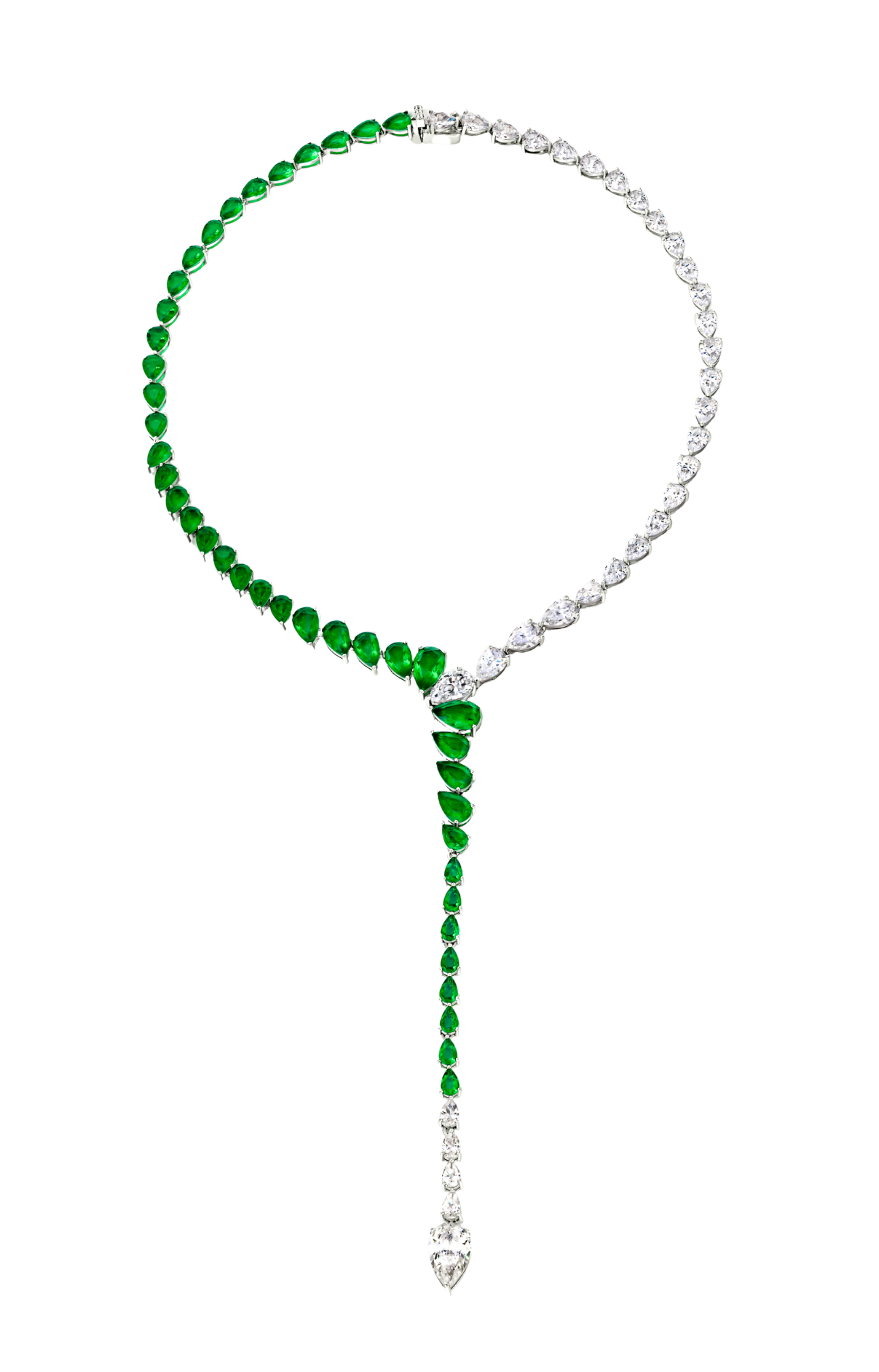
Colombian emeralds form differently from almost all others: in black shales without any involvement of magma, from salt-rich solutions. This produces typical inclusions and a distinct chemical signature. The origin of an individual stone, however, is only documented by a laboratory report that evaluates inclusions, spectra, and trace elements together. It remains an expert opinion.
At a glance
- Deposits
- Eastern Cordillera, western and eastern belt
- Western belt
- Including Muzo, Coscuez, La Pita, Peñas Blancas
- Eastern belt
- Including Chivor, Gachalá, Macanal
- Host rock
- Lower Cretaceous black shales, without magmatic involvement
- Typical inclusion
- Three-phase inclusion: salt crystal, liquid, gas bubble
- Proof of origin
- Laboratory report, opinion based on inclusions, spectra, trace elements
What makes an emerald Colombian
Colombian initially means only that the stone comes from a deposit in Colombia. What is of technical interest is why these deposits are different. In most emerald deposits worldwide, beryllium-bearing pegmatites meet chromium-bearing rocks. In Colombia, this magmatic component is absent. According to a review in GIA's journal Gems & Gemology, the stones grew in veins and cavities of Lower Cretaceous black shales.

The solutions from which they crystallized were highly saline. They formed at depth from groundwater and formation water, dissolved old salt deposits, and rose along tectonic faults. On contact with the shale, they leached beryllium, chromium, and vanadium from the rock. The result was an emerald whose growth conditions are reflected in its inclusions and trace elements. This is exactly where laboratories begin when they determine origin.
Colombia's two emerald belts
The deposits lie in the Eastern Cordillera of the Andes and are divided between two belts. The western belt includes Muzo, Coscuez, La Pita, and Peñas Blancas, among others; the eastern belt includes Chivor, Gachalá, and Macanal. A 2017 report in Gems & Gemology describes the stones from Chivor as slightly bluish, often very clean and light. The same work calls Colombian emeralds the benchmark against which stones of all other origins are measured.
| Characteristic | Western belt | Eastern belt |
|---|---|---|
| Known mines | Muzo, Coscuez, La Pita, Peñas Blancas | Chivor, Gachalá, Macanal |
| Host rock | Lower Cretaceous black shale | Lower Cretaceous black shale |
| Solutions | From dissolved salt deposits along faults | From a salt layer within the shale |
| Described color | No uniform description in the sources | Chivor: slightly bluish, often clean and light |
After Gems & Gemology (Winter 2019 and Fall 2017). The mine alone does not determine the quality of a stone.
For jewelry, the mine is usually secondary. Laboratories state the country in their reports, not the individual mine. And within a single deposit, quality varies widely. A stone from Muzo can be pale, one from a lesser-known mine intense. Anyone who pays attention to the name of a mine should therefore ask whether the information can be documented or is merely handed down.
The reputation has a long history. According to GIA, the Inca used emeralds in jewelry and religious ceremonies for some 500 years before Spanish conquistadors brought stones from the area of present-day Colombia to Europe in the 16th century. The Spanish valued gold and silver more highly and traded the emeralds for precious metal. This is how they reached European and Asian courts.
Three-phase inclusions: an indication, not proof
The best-known characteristic of Colombian emeralds is inclusions with three phases. GIA describes them as tiny cavities containing a halite crystal, liquid, and a gas bubble. For a long time they were considered an indication of Colombia. A 2014 study in Gems & Gemology qualified this rule: emeralds from Afghanistan, China, and Zambia can also contain three-phase inclusions that look very similar to the Colombian ones.
The authors conclude that only the combination of inclusion pattern, absorption spectrum, and trace elements supports an origin. Measurements include the ratio of chromium to vanadium and the contents of iron, lithium, cesium, or gallium. Even then, individual values overlap between Colombia and the Zambian deposit of Musakashi. Only the combination of several characteristics separates them. Origin therefore cannot be determined reliably with a loupe and experience alone.
Good to know
The Swiss laboratory SSEF explicitly describes origin determination as an expert opinion. It is based on comparison with the laboratory's own reference collection and database. A report can therefore also be issued without an origin statement if the data do not allow a reliable attribution.
What an origin report provides
GIA offers origin determination only for selected natural stones, including emerald, ruby, sapphire, and Paraíba tourmaline. The report then contains the identity, the detectable treatments, and in addition the country of origin. What an origin report states in principle is explained in the glossary. For an emerald with a Colombian origin, two points are decisive: who issued the report and whether it states the filling of fissures.
Origin describes where the stone comes from, not how good it is. Color, clarity, cut, weight, and treatment determine the standing of an emerald regardless of country. A stone of Colombian origin with significant filling can be less convincing than a minor-filled stone from another deposit. Origin completes the picture; it does not replace an assessment. How filling is graded in the report is described in the guide to emerald treatment.
- Ask for the report on the individual stone, not on a parcel.
- Check whether origin and treatment appear in the same document.
- Compare the weight and dimensions in the report with the stone.
- Note the date: fillings may have changed since the examination.
- If in doubt, verify the report number with the issuing laboratory.
Treatment and disclosure in Colombia
Colombian emeralds are also filled as a rule. Gems & Gemology reported in 2017 that cedarwood oil is the customary filler in Bogotá and is stated on the certificates of the cutting workshops there. A laboratory in Bogotá in which the Colombian state holds a stake states the material and type of treatment and confirms the Colombian origin. According to the same report, the industry association is committed to full disclosure, including treatments.
For you as the wearer, origin changes nothing about care. A filled Colombian emerald requires the same caution as any filled emerald: no ultrasonic, no steam, no heat during work on the setting. If you wish to pass the piece on, keep the report together with it. Without it, the origin can later only be documented through a new examination.
The Colombian emerald in a necklace
In a necklace, the emerald sits more protected than in a ring. It is knocked less often and is less exposed to soapy water and heat. This makes the necklace an obvious form for stones with moderate filling or for large stones with a visible jardin, as the trade calls the pattern of inclusions. According to GIA, common center stones weigh one to five carats, and in important jewels more than 20 carats.

In the design, cut and setting determine the effect. According to GIA, the emerald cut is the most common cut for emeralds because the beveled corners protect the stone. In a necklace with several emeralds, color matching is added: stones of different origins can differ visibly in their green. More on choosing the cut in the guide to the emerald cut.
Colombian emeralds at Vikar Ahmed
The emeralds Vikar Ahmed works with come mainly from Colombia, supplemented by Zambia. One-of-a-kind pieces are created at the house in three steps: design by the in-house designers, three-dimensional visualization, and production in the in-house atelier in Idar-Oberstein. Colombia as an origin is a laboratory's assessment. For high-quality emeralds from 1 carat, a report with origin determination is standard at the house, and clients always learn whether and how strongly a stone has been oiled. How the process of a one-of-a-kind piece unfolds is described on the page on the bespoke process.
Frequently asked questions
I would like to have a necklace with a Colombian emerald designed as a one-of-a-kind piece. Which jeweler in the Nahe region can do this?
Look for a workshop that works on its own from design to setting and provides a laboratory report on the stone stating origin and treatment. Vikar Ahmed designs and produces one-of-a-kind pieces in Idar-Oberstein on the upper Nahe; there are no other locations in the Nahe region. More under Jeweler in the Nahe region.
Which providers of emerald necklaces state whether the stones have been treated?
The information is reliable when each emerald in the necklace comes with a report from an independent laboratory that states the filling by grade. With several stones, you should ask whether all of them or only the center stone were examined. A general phrase such as "traditionally oiled" does not replace a finding on the individual stone.
Can a Colombian emerald be recognized by its inclusions?
Not reliably. Three-phase inclusions with a salt crystal, liquid, and gas bubble are considered typical but also occur in emeralds from Afghanistan, China, and Zambia. Laboratories therefore base origin on inclusions, spectra, and trace elements together. The result is an expert opinion.
Are Colombian emeralds always better than others?
No. Colombia is regarded as the benchmark, but quality varies within every deposit. Whether a stone convinces is decided by color, clarity, cut, weight, and the amount of filling. A minor-filled emerald of good color from Zambia can be superior to a Colombian stone with significant filling.
Are Colombian emeralds also oiled?
Yes, as a rule. According to a report in Gems & Gemology, cedarwood oil is the customary filler in Bogotá and is stated on the certificates of the cutting workshops. Independent laboratories grade the amount of filling from minor to significant. Untreated stones are rare, including those from Colombia.
Does a laboratory report name the mine an emerald comes from?
As a rule, no. Laboratories state the country of origin, such as Colombia, not the individual mine such as Muzo or Chivor. Information on the mine usually comes from the supply chain and can hardly be verified on the stone itself. It should therefore be read as additional information, not as a finding.
Private consultation
A necklace with a Colombian emerald begins with the stone and its report. Vikar Ahmed advises in the showroom in Idar-Oberstein by appointment, and virtually on request. Custom projects are reviewed on request and only begun after acceptance. Request an appointment for a private consultation.
Further reading
- Gemstone: Emerald
- Glossary: Origin report
- Having emerald jewelry made
- Origin and treatment of colored stones
- Glossary: Necklace
Sources
- Gems & Gemology (Winter 2019): Geology of Corundum and Emerald Gem Deposits, accessed 2026-11-17
- Gems & Gemology (Herbst 2017): Colombian Emerald Industry, Winds of Change, accessed 2026-11-17
- Gems & Gemology (Sommer 2014): Three-Phase Inclusions in Emerald and Their Impact on Origin Determination, accessed 2026-11-17
- GIA: Emerald History and Lore, accessed 2026-11-17
- GIA: Emerald, Gem Encyclopedia, accessed 2026-11-17
- GIA: Emerald Quality Factors, accessed 2026-11-17
- GIA: Colored Stone Reports, accessed 2026-11-17
- SSEF: Emerald, accessed 2026-11-17
- Vikar Ahmed: Collections, accessed 2026-11-17

A personal conversation starts here.
At the showroom in Idar-Oberstein or by video. Vikar Ahmed discusses your ideas, stones and designs with you and answers your questions calmly and in confidence.


Thank you for your request.
Your request will be handled with the utmost attention and discretion. Vikar Ahmed will get back to you.
Your details
Request
–
Occasion
–
Consultation
–
Contact
–
In the meantime
Insights: What is a Paraíba tourmaline? · Engagement ring to your own design: how does it work?
Confidential and without obligation
Back to the pagePrivate consultation
A personal conversation starts here.
- Time for your questions, wishes and ideas
- In the showroom in Idar-Oberstein or by video
- Confidential, discreet and without obligation
Vikar Ahmed · Hauptstraße 111 · 55743 Idar-Oberstein, Germany